Research
AML/KYC Without Mass Surveillance: The Zero-Knowledge Compliance Architecture
May 25, 2026
7 mins read
Current KYC stacks build surveillance databases as a byproduct of compliance. Zero-Knowledge Proofs offer a different architecture: prove identity, transaction validity, and sanctions screening without aggregating raw personal data across every verifier in the network.


TL;DR: AML/KYC compliance does not require placing raw identity data on-chain or duplicating it across every verifier. Zero-Knowledge Proofs enable institutions to prove sanctions screening, transaction threshold compliance, and KYC completion cryptographically - without transmitting underlying personal data. Regulated entities still carry jurisdiction-specific retention and lawful access obligations, but ZKPs reduce unnecessary data exposure at every point in the workflow.
What Does AML/KYC Actually Require - and What Doesn't It Require?
AML/KYC compliance has specific requirements. Understanding exactly what those requirements are - and are not - is the starting point for designing a better compliance architecture.
The Bank Secrecy Act requires financial institutions to act as the first line of AML defense: filing Suspicious Activity Reports, maintaining customer identification programs, and conducting ongoing transaction monitoring. FinCEN receives over four million SARs annually. The value of those reports depends entirely on context - the ability to identify patterns across transactions and trace the movement of funds.
The FATF Travel Rule (Recommendation 16) requires that originator and beneficiary information accompany VASP-to-VASP transfers above threshold amounts. Under FinCEN's implementation (31 CFR 1022.320), money services businesses must retain SAR copies and supporting documentation for five years.
What these requirements do not specify: that raw identity data must be stored on a public blockchain, or that every downstream verifier in a network must independently collect and store the same underlying documents.
Compliance does not require placing raw identity data on-chain or duplicating it across every verifier. That distinction matters because the current industry approach conflates the compliance requirement with a particular, and particularly risky, implementation pattern.
What Is the Surveillance Problem Built Into Current KYC Stacks?
The standard KYC process collects passport scans, proof of address, and increasingly biometric data. Every new protocol, every new platform, every new counterparty relationship triggers the same collection cycle from the same institution.
The result is data that multiplies across platforms. Each new storage point is a new breach surface. Each new storage location is a new regulatory exposure under GDPR, MAS, and the data protection requirements embedded in the GENIUS Act's Bank Secrecy Act obligations.
Nethermind and Deutsche Bank identified this directly in their December 2025 analysis: the current KYC model creates "a set of PII that is a prime target for cyberattacks and a major source of regulatory liability." The institutional compliance program designed to reduce financial crime risk generates a separate category of data security and privacy risk as a byproduct.
This isn't an edge case. It's the structural consequence of a model where every verifier independently collects and stores the same data. The more participants in a network, the more copies of the same sensitive records exist across different storage environments with different security postures.
How Do Zero-Knowledge Proofs Support Privacy-Preserving Compliance Workflows?
Zero-Knowledge Proofs offer a different model. Several specific mechanisms, documented in the TRM Labs and Nethermind/Deutsche Bank analyses, map directly to AML/KYC compliance requirements.
OFAC non-membership proof. An institution can prove cryptographically that a counterparty is not on the OFAC sanctions list without revealing the counterparty's identity to the verifier. The verifier receives a proof that the check was conducted and the result was clean - not the underlying identity data.
Transaction range proofs. A specialized ZKP called a range proof allows an institution to prove that a transaction amount falls below a specified AML reporting threshold without revealing the actual amount. The compliance criterion is satisfied; the transaction detail is not disclosed.
Set membership proofs. Described in TRM Labs' framework as "compliance status attestation," these proofs allow a party to demonstrate that they belong to a permissioned set - accredited investors, verified KYC holders, sanctions-clean counterparties - without revealing which specific identity record places them in that set.
Verifiable credentials. Nethermind and Deutsche Bank describe the Self-Sovereign Identity model: a trusted Issuer (a regulated bank or KYC provider) verifies identity and issues a cryptographic credential to the Holder (an institution or individual). The Holder presents the credential to any Verifier. The Verifier confirms the credential is valid without receiving the underlying identity documents. Deutsche Bank and Privado ID ran a live proof-of-concept of this model in December 2025.
An important nuance on FATF compliance: Zero-Knowledge Proofs can support privacy-preserving Travel Rule workflows, reducing the data exposed during VASP-to-VASP transfers, but regulated entities still carry jurisdiction-specific obligations for identity transmission, data retention (five years under FinCEN rules), and lawful access by law enforcement. ZKPs reduce unnecessary data exposure. They do not replace the compliance program obligations that exist under national law.
What Does a ZK-Native Compliance Architecture Look Like Operationally?
The architecture shifts from "collect and store everywhere" to "verify once, prove anywhere."
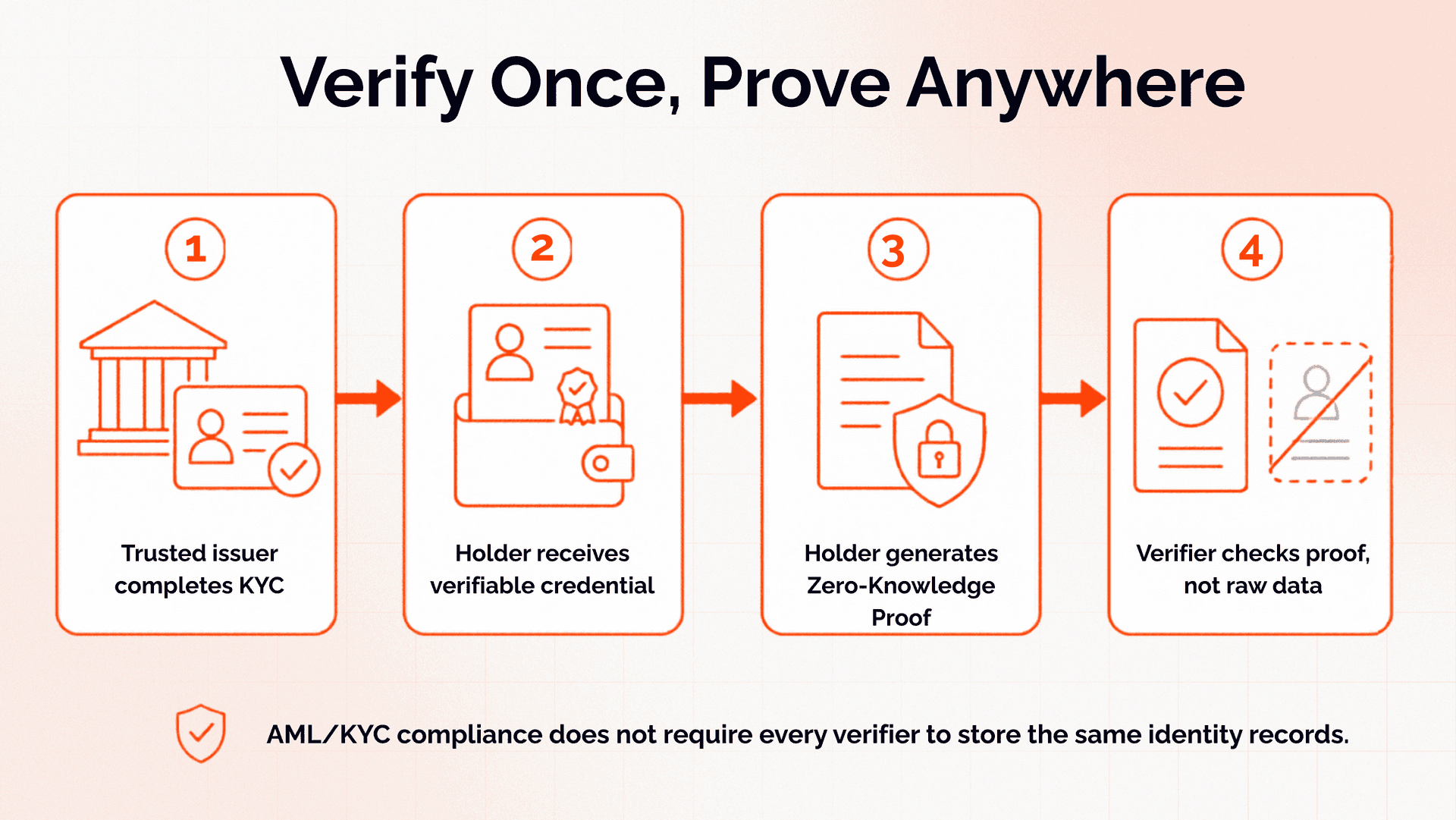 Zero-Knowledge Proofs let AML/KYC workflows move from repeated identity collection to reusable compliance proofs, reducing unnecessary exposure of raw personal data.
KYC is completed once by a trusted, regulated issuer. The issuer generates a verifiable credential. The institution holding the credential can prove its validity to any downstream verifier - a new protocol, a new counterparty, a regulator - without the verifier receiving or storing the underlying documents.
The ZK-KYC market reflects this shift: market estimates (Stratistics MRC) project growth from approximately $83.6 million in 2025 to $903.5 million by 2032, a 40.5% compound annual growth rate. These are market-sizing projections, not confirmed deployment data - but the direction reflects the structural demand created by the compliance cost and liability of the current model.
What's furthest along in 2026: stablecoin reserve compliance using set membership proofs, and accredited investor attestation for tokenized securities platforms. What's still being built: borrower verification in on-chain credit protocols, and cross-border AML workflows that satisfy multiple jurisdictions' Travel Rule implementations simultaneously.
Where Does zkDatabase Fit in This Architecture?
Verifiable credentials prove identity status. zkDatabase proves data state - the underlying compliance records, transaction histories, and eligibility determinations that identity credentials are built on. Compliance state changes are recorded with a Zero-Knowledge Proof at every write. Auditors verify the proofs. The underlying records stay in the institution's custody.
The two layers are complementary. Identity credentials prove who a party is. zkDatabase proves what the data says about their compliance status, without the data itself leaving the system that holds it.
FAQ
What is zero knowledge proof compliance and how does it apply to AML/KYC?
Zero-Knowledge Proof compliance is an approach where institutions generate cryptographic proofs that specific compliance criteria are met - sanctions screening passed, transaction below reporting threshold, KYC verification complete - without transmitting the underlying identity data to the verifier. For AML/KYC, this means a protocol can confirm a counterparty is compliant without receiving or storing their passport scan or personal records. The regulated institution retains the data; the proof travels instead.
Does a Zero-Knowledge Proof approach satisfy FATF Travel Rule requirements?
Zero-Knowledge Proofs can support privacy-preserving workflows for Travel Rule compliance by reducing the personal data transmitted between VASPs. However, regulated entities still carry jurisdiction-specific obligations: originator and beneficiary information must be obtained, retained (five years under FinCEN rules), and made available to law enforcement on lawful request. ZKPs reduce unnecessary data exposure in the transmission layer - they do not replace the underlying compliance program obligations established by national law and FATF guidance.
What is the difference between traditional KYC and ZK-based identity verification?
Traditional KYC requires each verifier to independently collect and store identity documents from the same institution or individual. ZK-based identity verification uses a verifiable credential model: a trusted issuer completes KYC once, issues a cryptographic credential, and the holder proves credential validity to any downstream verifier without re-transmitting the underlying data. This reduces the number of breach-exposed data copies while maintaining the compliance evidence trail regulators require.
Related toResearch