Orochi Essentials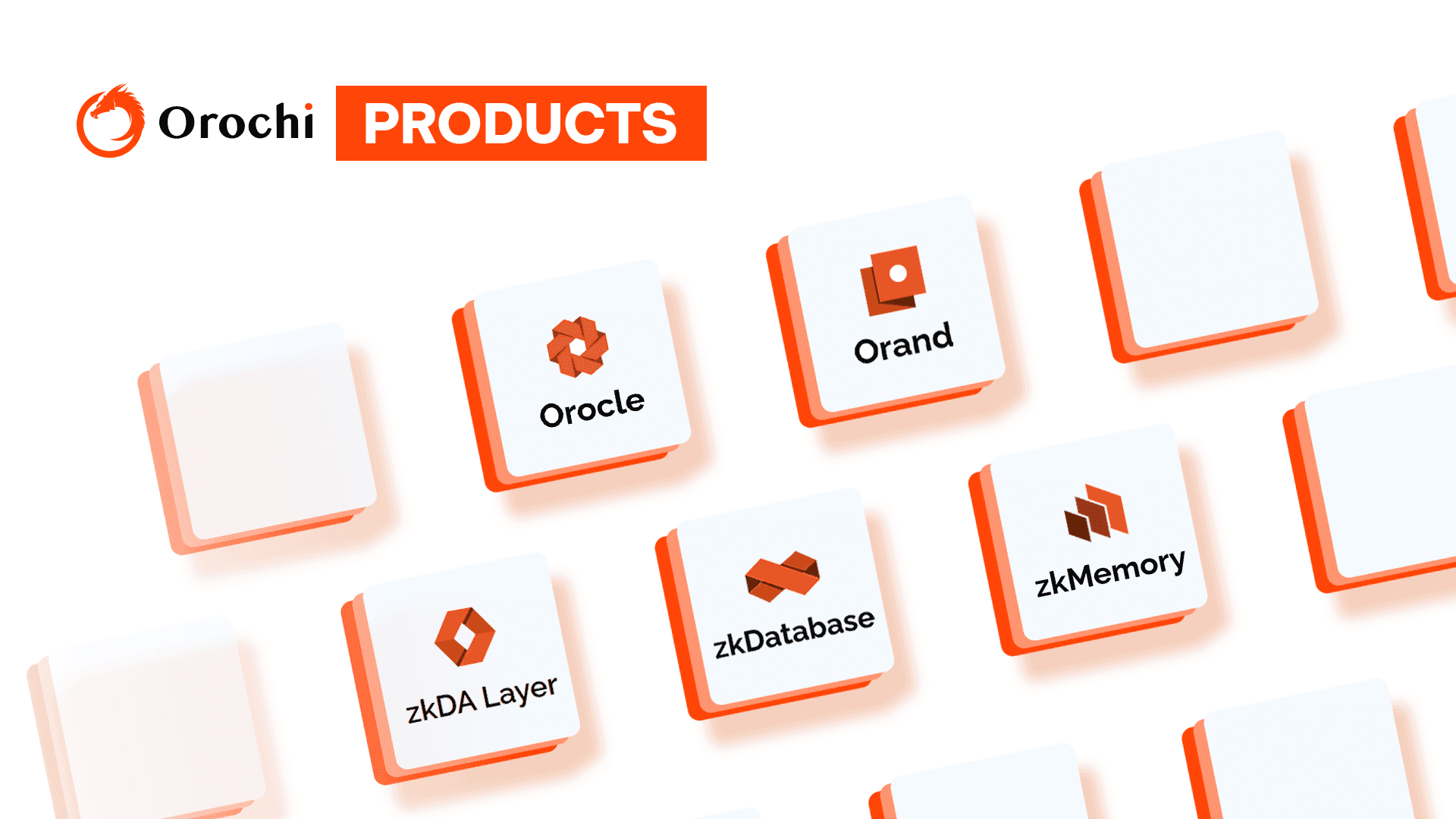
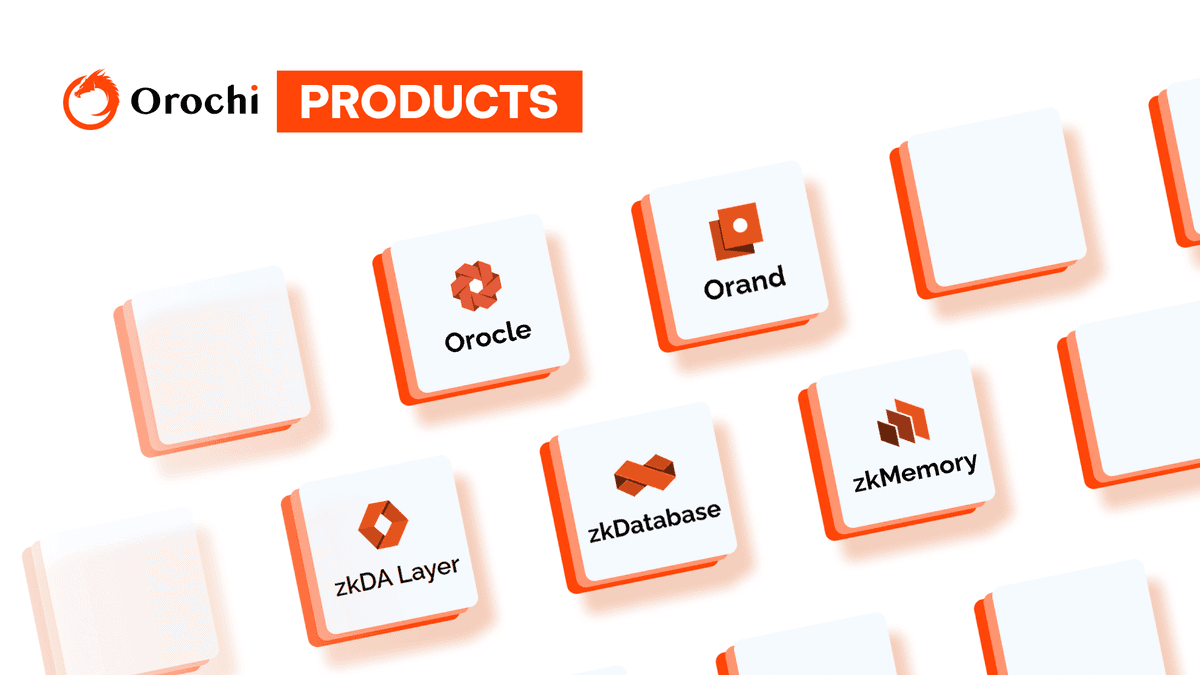
Orochi Products: zkDatabase, Orocle, Orand, zkMemory, and zkDA Layer
July 14, 2026
10 mins read
An overview of Orochi products, including zkDatabase, Orocle, Orand, zkMemory, and the planned zkDA Layer, and how they support Verifiable Data Infrastructure.


TL;DR: Orochi Network is Verifiable Data Infrastructure for applications that need private, provable data. Its flagship product is zkDatabase, while Orocle, Orand, zkMemory, and the planned zkDA Layer are products or modules inside the broader Orochi ecosystem.
Builders evaluating Orochi Network usually arrive with the same problem: publication alone is not proof. For Real-World Assets, stablecoins, capital markets, and on-chain credit, the flagship product zkDatabase turns external data into verifiable inputs that smart contracts and counterparties can check cryptographically.
What should you remember about Orochi Network?
- Orochi Network is Verifiable Data Infrastructure for privacy-preserving data verification.
- zkDatabase is Orochi's flagship product for turning off-chain records into cryptographically verifiable data.
- Orocle, Orand, zkMemory, and the planned zkDA Layer are products or modules in the broader Orochi ecosystem.
- The product story is strongest when framed around Real-World Assets, stablecoins, capital markets, and other systems that need privacy plus audit-grade verification.
- Orochi's value is not "store data on-chain." It is proving how data moved through the pipeline before a contract or counterparty relies on it.
What is Orochi Network?
Orochi Network is Verifiable Data Infrastructure designed to help applications prove the integrity of data across the full path from ingestion to verification. Instead of asking users to trust an operator, an oracle, or a database admin, Orochi's model is to generate cryptographic proof that the data and the computation around it are correct.
That distinction matters most in systems where the economic value lives on-chain but the source data does not. Real-World Asset tokenization, reserve reporting, collateral monitoring, and credit workflows all depend on off-chain records. If those records are late, incomplete, or tampered with, the blockchain layer inherits the error.
For that reason, Orochi is best understood less as a general Web3 ecosystem and more as infrastructure for Verifiable Data workflows. The product stack is built around that idea.
Why does Orochi Network matter for institutional blockchain use cases?
Orochi Network matters because institutional-grade blockchain systems do not fail at token issuance alone. They fail when the off-chain facts behind the token cannot be checked fast enough, privately enough, or consistently enough.
In many tokenized systems today, data is still moved through batch updates, manual reconciliation, or trust-heavy integrations. A smart contract may receive a value, but it usually cannot verify how that value was sourced, transformed, or approved. That leaves a gap between what was reported and what can actually be proven.
Orochi's positioning is built around closing that gap. In Orochi's documentation and GTM materials, the core promise is straightforward: data should become verifiable before it reaches the on-chain application layer, not after a dispute, audit, or incident forces someone to investigate it.
This is also why Orochi's messaging fits best with:
- Real-World Asset tokenization
- Stablecoin reserve and reporting workflows
- Capital markets infrastructure
- On-chain credit and collateral verification
In those categories, privacy and verifiability have to coexist. Public transparency alone is not enough.
What are the core products in the Orochi Network?
Orochi Network has several products and modules in its ecosystem. The easiest way to understand them is by the role each one plays in Orochi's Verifiable Data Infrastructure.
| Product | Primary role | Why it matters |
|---|---|---|
| zkDatabase | Flagship product for proving data queries, updates, and states without exposing underlying records | Gives applications a verifiable database layer |
| zkDA Layer | Planned product for proof-based data availability and storage assurances | Important to frame as not yet launched |
| Orocle | Product for fetching and relaying external data through a provable oracle model | Connects smart contracts to off-chain inputs with stronger integrity guarantees |
| Orand | Product for verifiable randomness using ECVRF-based design | Supports fairness-sensitive logic such as gaming and randomized contract actions |
| zkMemory | Module for zkVM memory proving | Supports teams building verifiable execution environments |
These products are related, but they do not all solve the same problem. zkDatabase is the flagship product today. The others extend Orochi's infrastructure into external inputs, randomness, zkVM tooling, and, once launched, proof-based data availability.
Why is zkDatabase Orochi Network's flagship product?
zkDatabase is Orochi Network's flagship product because it turns the Verifiable Data Infrastructure thesis into a concrete product. It is a NoSQL database architecture designed to generate cryptographic proof for data operations, so a user or smart contract can verify the result without seeing the raw data.
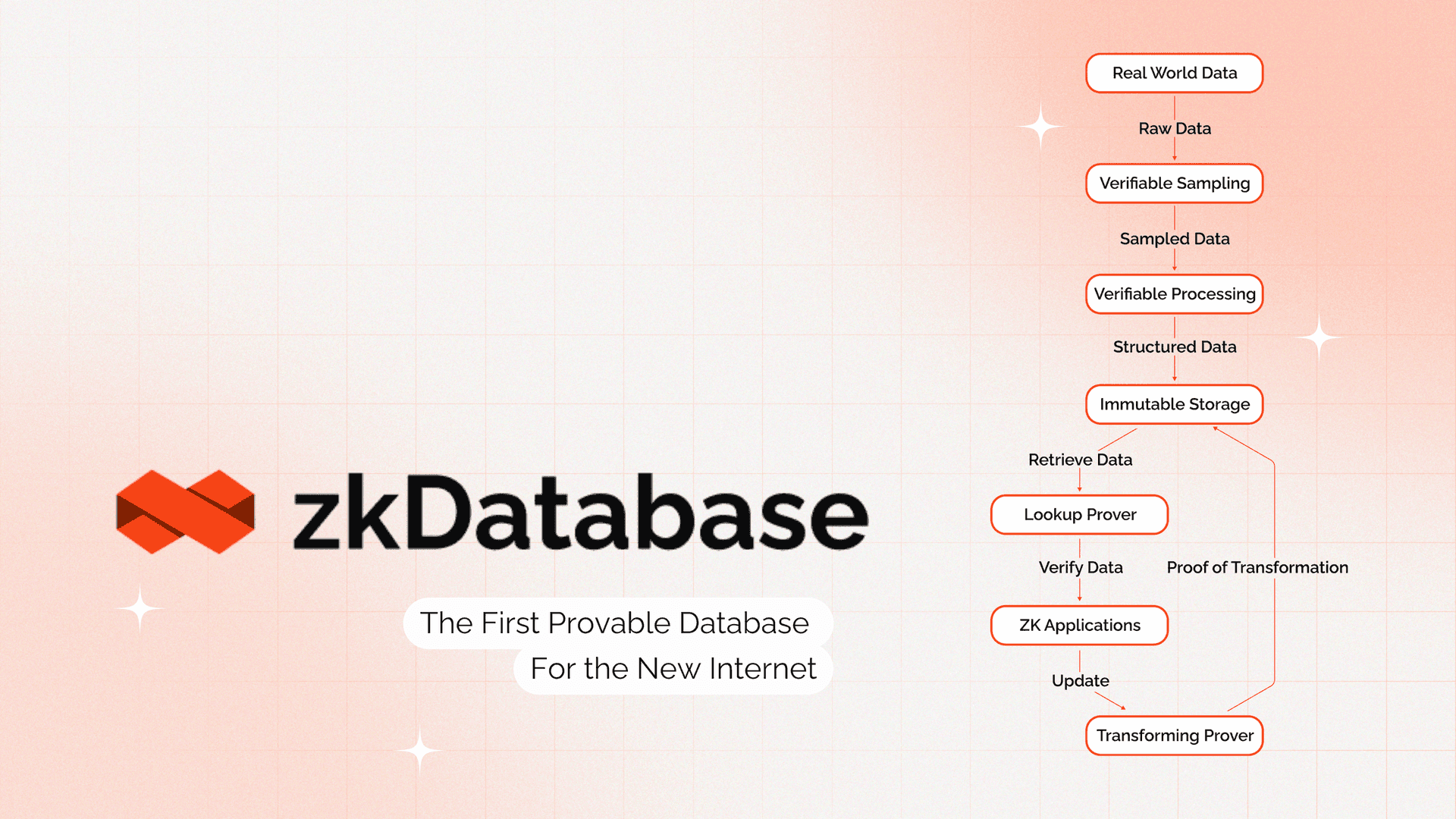
zkDatabase is the product layer for teams that need private data to become provable. It turns records, queries, and transformations into verifiable outputs that can support on-chain and off-chain verification workflows.
According to Orochi's product materials, zkDatabase is built around a Groth16-based proving stack for on-chain verification today, while the broader infrastructure remains proof-system agnostic. In practical terms, that gives Orochi a simple message:
- Keep sensitive records off-chain
- Generate cryptographic proof over the relevant state or query
- Let a smart contract or external verifier check the proof
That architecture is especially relevant for workflows where the verifier does not need the full dataset. They only need proof that a condition is true. Examples include reserve thresholds, collateral state, eligibility rules, or query correctness.
If you want the shorter product definition, this article pairs well with what zkDatabase is and how it works and how zkDatabase proves off-chain data authenticity.
Bottom line: zkDatabase is the product that makes Orochi's "Verifiable Data Infrastructure" category concrete.
What does zkDA Layer do?
zkDA Layer is Orochi's planned proof-based approach to data availability. Because it has not launched yet, it should be described as a product direction rather than a live infrastructure layer.
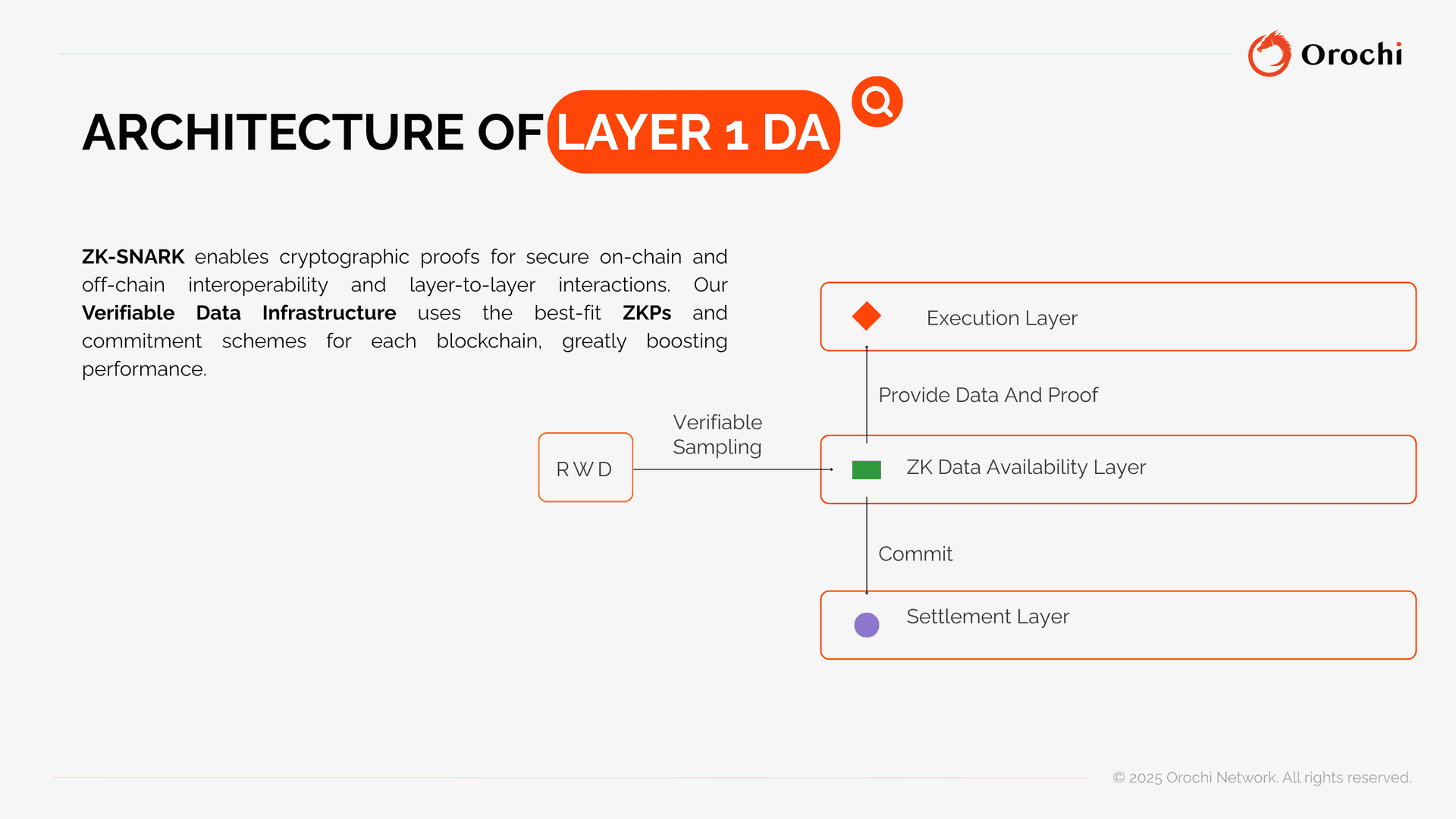
This direction matters because traditional data availability approaches can show that data was posted somewhere, but they do not always give applications a succinct way to prove the state of that data to a smart contract. Orochi's older materials position zkDA Layer around proof composition, verifiable sampling, distributed storage, and a DAG-based consensus design. Until launch, those claims should stay framed as design direction.
For the reader, the important distinction is simple: zkDatabase is the live product story for proving operations over data, while zkDA Layer should be treated as a planned extension for proof-based data availability.
If you want the deeper background, see the Orochi article on zkDA Layer, but keep the launch status clear when using it in new copy.
Bottom line: zkDA Layer should be framed as a planned extension of Orochi's product story, not as a launched product.
What do Orocle and Orand add to the stack?
Orocle and Orand handle two kinds of external inputs that decentralized applications often struggle to trust: data feeds and randomness.
Orocle is Orochi's oracle service for fetching off-chain data for smart contracts. The positioning here is important. Orocle is not just about relaying a value. It is framed as a provable oracle model designed to reduce single points of failure and strengthen trust in how off-chain information reaches on-chain logic.
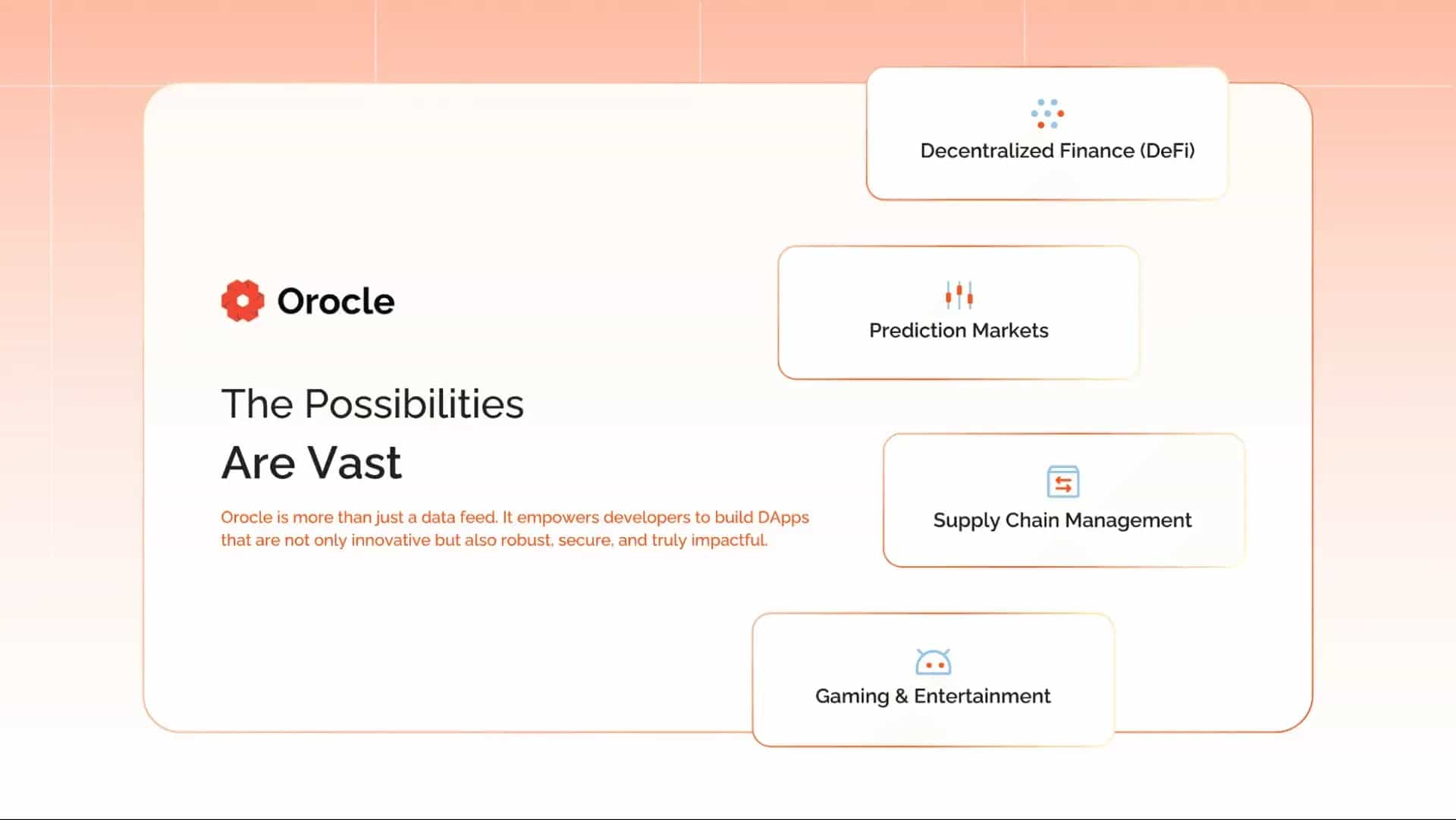
That makes Orocle relevant for use cases such as:
- Price and market data
- Weather or event-driven triggers
- IoT or machine-generated data that smart contracts need to consume
Orand focuses on verifiable randomness. Orochi's documentation describes it as an ECVRF-based service that gives applications a way to request randomness and verify the output independently or through smart contracts.
That matters anywhere fairness depends on unpredictable but checkable outputs, including gaming, lotteries, and some DeFi mechanics.
Bottom line: Orocle handles provable external data, while Orand handles provable randomness.
What is zkMemory and why is it part of the story?
zkMemory is a modular memory prover designed for zkVM-related systems. It is less central to the go-to-market story than zkDatabase, but it still matters because it shows where Orochi's technical work extends beyond application data.
In Orochi's product documentation, zkMemory is described as infrastructure for generating memory consistency proofs. That makes it relevant to teams building verifiable execution systems, custom zkVM stacks, or proof-heavy computation environments where memory correctness is a core requirement.
For a broad blog reader, the simplest way to position zkMemory is this: zkDatabase is about proving data state, while zkMemory is about proving parts of computation that depend on correct memory behavior.
Bottom line: zkMemory expands Orochi's credibility from Verifiable Data into verifiable execution infrastructure.
Where does Orochi Network fit in real-world use cases?
Orochi Network fits best in systems where a public blockchain depends on private, off-chain, or regulated data that still has to be checked with high confidence.
That is why the strongest Orochi use cases in local GTM materials are:
- RWA tokenization infrastructure, where asset state, collateral terms, and ownership data need stronger integrity guarantees
- Stablecoin and tokenized asset workflows, where reserve reporting and operational transparency remain ongoing infrastructure issues
- Audit-grade data integrity, where institutions need proof-backed records rather than static attestations
- Verifiable Data foundations, where the core problem is proving the data pipeline itself
The right framing here is not that Orochi replaces legal, audit, or compliance processes. The safer and more accurate claim is that Orochi provides infrastructure that can support audit, reporting, and verification workflows by making the underlying data state easier to prove.
Bottom line: Orochi is most compelling where privacy, data integrity, and on-chain verification all need to work together.
How should you think about Orochi Network as a whole?
Orochi Network makes the most sense when you view it as Verifiable Data Infrastructure for proving data, not just moving it. zkDatabase is the flagship product today. Orocle, Orand, zkMemory, and the planned zkDA Layer each extend that product ecosystem into adjacent infrastructure layers.
That is the unifying idea behind the stack. A contract, counterparty, or auditor should not have to trust that the data pipeline was handled correctly. They should be able to verify that claim cryptographically.
What is the final takeaway on Orochi Network?
Orochi Network is Verifiable Data Infrastructure built around the idea that off-chain data should be provable before on-chain systems depend on it. zkDatabase is the clearest expression of that model today, while Orocle, Orand, zkMemory, and the planned zkDA Layer extend the Orochi product ecosystem into external inputs, randomness, zkVM infrastructure, and data availability.
For teams building in Real-World Assets, stablecoins, capital markets, or other privacy-sensitive workflows, that is the real value of Orochi. It gives them a way to move from reported data to Verifiable Data without assuming the database, oracle, or operator should be trusted by default.
CTA: Start with the zkDatabase product overview or review how Orochi frames Verifiable Data Infrastructure for RWA.
What questions do readers still ask about Orochi Network?
What is Orochi Network?
Orochi Network is Verifiable Data Infrastructure for applications that need to prove off-chain data without exposing the underlying records. Its product ecosystem focuses on data integrity, privacy, and proof-based verification for blockchain systems that rely on external or sensitive data.
What is zkDatabase in Orochi Network?
zkDatabase is Orochi Network's flagship product for proving database operations and data states cryptographically. It is designed to let applications verify queries, updates, and record integrity without relying on raw data disclosure or blind trust in an operator.
How is Orochi Network different from a normal oracle or database stack?
Orochi Network is different because it is built around proving the data pipeline, not only transporting or storing data. A traditional database stores records, and an oracle relays values. Orochi's positioning is that the system should also prove how the data was sourced, transformed, or checked before another system depends on it.
What are the main use cases for Orochi Network?
The main use cases for Orochi Network are Real-World Asset tokenization, stablecoin reserve and reporting workflows, capital markets infrastructure, and on-chain credit systems. These are the areas where off-chain data integrity, privacy, and on-chain verification need to work together rather than in isolation.
Related toOrochi Essentials