Event Recap
Orochi Network's Field Notes from ETHTaipei 2026
September 16, 2026
4 mins read
Our team spent two days at ETHTaipei 2026. Here is what we heard on privacy and Zero-Knowledge Proofs, and what we think it means for institutions.


Our team just got back from ETHTaipei 2026, held on September 13 and 14 at POPOP Taipei. We came away with a lot of new updates from the Ethereum community, and our founder, Mary Tran, had the chance to share what we have learned on the Asia Community Panel. These are our notes from the two days.
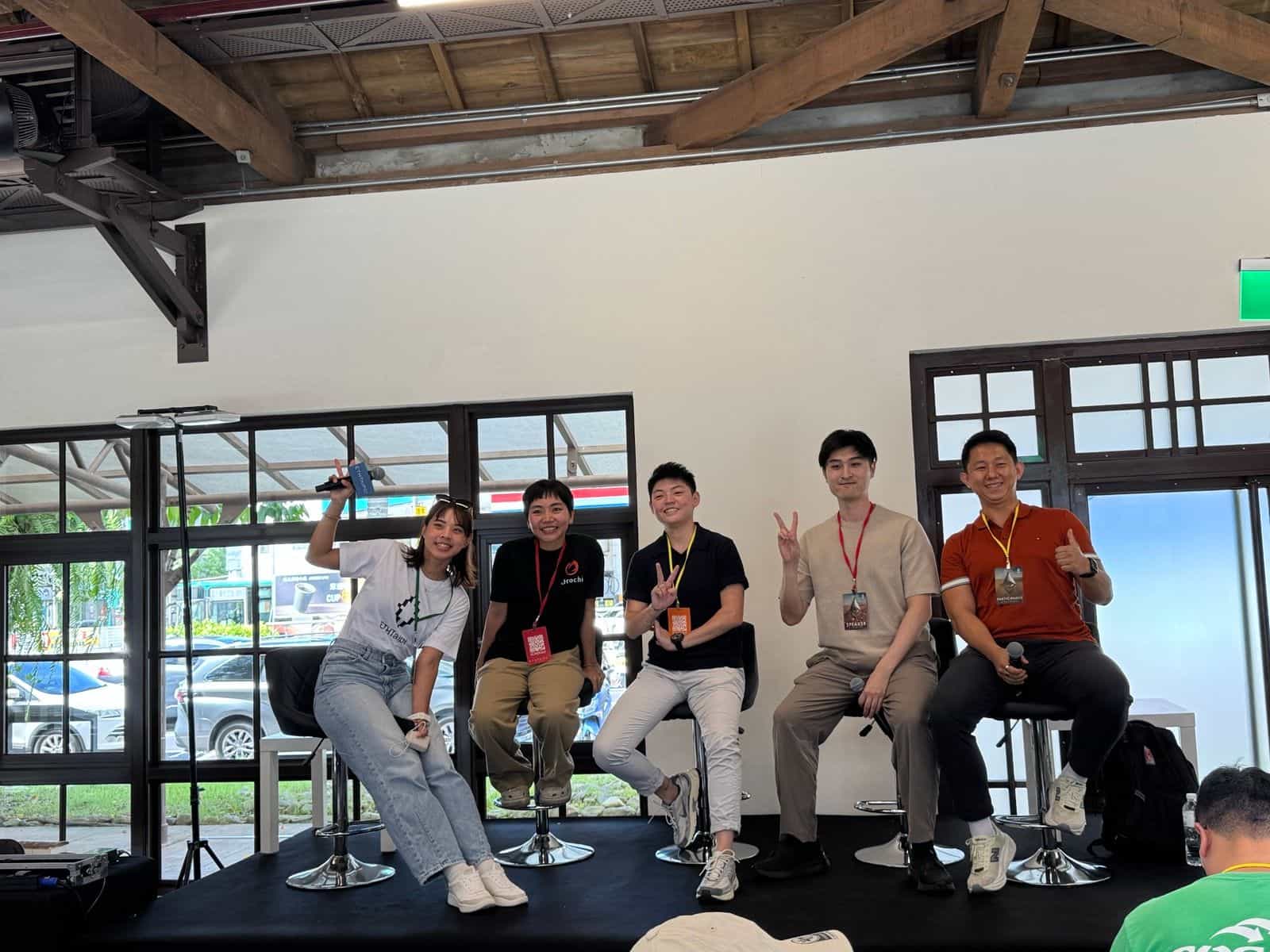 Our founder, Mary Tran, on the Asia Community Panel at ETHTaipei 2026.
Privacy was the headline of the keynote
The talk we came for was Vitalik Buterin's keynote, and privacy sat at the center of it. He framed the goal of the whole space as CROPS: censorship resistance, open source, privacy, and security. His point was that the blockchain is a tool for reaching those goals, so builders should start from the problem and then decide what belongs on-chain.
He then tied privacy to AI. Closed models, data surveillance, and de-anonymization all get worse as AI spreads, and his answer was a stack where local or open-source AI, anonymous networks, Zero-Knowledge Proofs, and trusted hardware work together, with the blockchain handling payments and verification.
Cheaper proofs change what is worth proving
The second part of the keynote, and Vitalik's separate session on EIP-8288, went into how Ethereum plans to scale with Zero-Knowledge Proofs. Transaction proofs would be aggregated recursively until a whole block needs one proof. EIP-8288, still a draft, proposes aggregating proofs and quantum-safe signatures in the mempool to cut their cost. A zkEVM would be phased in over about three years.
For us, the cost of checking a proof is the number that matters. When verification is expensive, teams only prove the few things they have to. When it gets cheap, it starts to make sense to prove much more of the data a system runs on, such as reserve balances, collateral values, or eligibility checks. That is the direction we build zkDatabase for, so it was good to hear it on the Ethereum roadmap.
Vitalik also said the roadmap has grown to around five to ten times its former scope, with AI speeding up development and formal verification keeping it safe. More code written faster means more need to check that it does what it claims, which is another argument for proofs.
Institutions were in the building
ETHTaipei ran its first Institution Day this year. Taiwan Mobile president Jamie Lin laid out a "Crypto Island Taiwan" plan for 2030 in three stages: corporate digital asset reserves, DeFi, and financial infrastructure moving on-chain.
Each of those stages runs on data that institutions cannot publish: reserve holdings, client positions, identity checks. Seeing the builder sessions and the institutional ones side by side, the gap felt clear to us. The builders are working on privacy, the institutions need it, and the two groups are only starting to talk in the same room. Privacy also came up in several other sessions on identity, payments, and selective disclosure, which tells us the builder side is taking the problem seriously.
Orochi Network on the Asia Community Panel
Mary Tran, founder of Orochi Network, joined the "Building Community in Asia and Beyond" session, moderated by Jennifer Hsu, co-founder of XueDAO, with community builders from Japan, Singapore, and Hong Kong. The panel talked about how to keep a Web3 community active between events, and how meetups, reading groups, and hackathons in each market can connect across Asia.
Work With Orochi Network
If you are moving reserves, collateral, or identity data on-chain, you cannot make that data public, but you still need to prove it is correct. This is the problem we work on. zkDatabase generates Zero-Knowledge Proofs for every operation, so smart contracts and counterparties can verify the result while the raw data stays private.
Related toEvent Recap