



Stablecoin
GENIUS Act Stablecoin Rules Make Banks Prove Reserves
July 16, 2026
9 mins read
The OCC's GENIUS Act proposal turns bank-issued stablecoins into an operational proof problem: reserves, redemption, AML controls, and privacy must be verifiable.


TL;DR: GENIUS Act stablecoin rulemaking moves bank-issued stablecoins from policy debate into operating design. OCC-supervised issuers will need reliable evidence for reserves, redemption, risk controls, and AML/sanctions workflows. zkDatabase can support that evidence layer by turning private reserve and compliance data into Verifiable Data checked by smart contracts.
For a bank, the GENIUS Act turns a familiar fact, that reserves are held, into a harder one: reserves must be provable on demand. Issuers now have to evidence reserve adequacy, redemption readiness, and AML controls between reporting dates, not only at them. Orochi Network's zkDatabase lets them prove those claims without publishing the underlying balance sheet.
Key Takeaways:
- GENIUS Act stablecoin implementation turns reserve verification into a recurring operational requirement for banks.
- The OCC proposal covers issuance, reserves, redemption, risk management, and related supervision for OCC-jurisdiction entities.
- Public blockchain transparency does not solve bank confidentiality. It creates a second problem unless disclosure is selective.
- zkDatabase can support stablecoin reserve verification by proving reserve and compliance predicates while keeping raw data off-chain.
- The strategic shift is from "monthly report" to machine-verifiable control evidence.
What does GENIUS Act stablecoin rulemaking change for bank issuers?
GENIUS Act stablecoin rulemaking changes the stablecoin conversation from permission to procedure. Banks are no longer asking whether stablecoin issuance might become regulated; they are preparing for what an OCC-supervised issuance stack must prove.
The OCC's notice of proposed rulemaking implements the GENIUS Act for entities under OCC jurisdiction, including permitted payment stablecoin issuers connected to national banks and federal savings associations. The proposal addresses licensing, permitted activities, reserves, redemption, risk management, and supervisory expectations, with related AML and sanctions obligations expected to remain central to the operating model.
That matters because bank-issued stablecoins are not crypto-native experiments. They sit inside an institution with treasury controls, internal audit, model risk, compliance committees, customer obligations, and regulators who can ask for evidence. A stablecoin issued by a bank affiliate is still a liability-like promise in the eyes of users: one token should redeem for one unit of money.
The OCC projection that OCC-bank-affiliated issuers could account for $50 billion in stablecoin issuance in 2026 should be treated as a planning signal, not as a guaranteed market outcome. If even a fraction of that issuance appears, the evidence burden becomes too large for spreadsheet-driven reserve checks and PDF attestations.
Bottom line: the rulemaking makes reserve proof a banking control problem, not a marketing claim.
Why are reserve reports not enough for bank-issued stablecoins?
Reserve reports are useful, but they are not continuous control evidence. A report can say what was true at a point in time; a bank-issued stablecoin needs assurance that reserve, redemption, and compliance conditions remain true between reporting dates.
Traditional attestation is built around sampling, review, and publication. That workflow works for periodic assurance, but payment stablecoins run on 24/7 rails. Minting, burning, transfers, redemption queues, sanctions screening, liquidity movements, and reserve composition can all change before the next public report exists.
The gap is not that auditors are unnecessary. They remain important. The gap is that issuers need a machine-readable layer beneath the audit process: one that records approved data state changes, proves calculations, and gives regulators or counterparties a way to verify specific conditions without seeing every underlying account.
For a bank, the reserve question is also more complex than "assets exceed liabilities." As unbacked supply from a compromised minting path has shown, reserves can fall out of alignment with supply even when the backing assets were never directly drained. The institution may need to prove:
- reserve assets meet policy requirements;
- circulating supply reconciles across networks;
- redemption requests are processed under defined rules;
- sanctioned addresses are blocked or escalated;
- internal controls were followed for high-risk flows.
zkDatabase maps to this by converting off-chain reserve and compliance data into Verifiable Data. A smart contract or authorized verifier can check a Zero-Knowledge Proof that a condition was satisfied, while the bank keeps custodian identities, account details, and sensitive operational data private.
Where does privacy fit into GENIUS Act stablecoin compliance?
Privacy is not a side feature for bank stablecoins. It is part of the control design because regulated institutions cannot put proprietary treasury, customer, or compliance data on a public ledger.
Public blockchains create a strange tension for banks. They offer shared settlement and public auditability, but they can expose patterns that traditional finance normally keeps confidential: treasury flows, customer behavior, counterparty concentration, operational timing, and liquidity stress. TRM Labs' on-chain privacy research frames this tension clearly: privacy regimes need selective disclosure, not total opacity.
For stablecoin issuers, that means the better model is not "publish everything." It is "prove the right thing to the right party." A regulator may need more visibility than a DeFi protocol. A counterparty may need proof that reserves exceed a threshold, not a list of bank accounts. A user may need confidence that redemption rules are enforced, not internal treasury files.
Zero-Knowledge Proofs are useful here because they let an issuer prove a statement about private data without revealing the data itself. zkDatabase adds the database layer around that proof model: data is ingested, updated, queried, and converted into proofs that can be checked on-chain or by approved systems.
The result is not automatic legal compliance. It is better evidence infrastructure for compliance-adjacent workflows.
What should banks build before issuing payment stablecoins?
Banks should treat stablecoin issuance as a control system with cryptographic evidence, not as a token contract with a compliance wrapper. The operating stack needs to prove data integrity across reserves, liabilities, customers, and transaction controls.
One practical architecture has four layers.
| Layer | Bank question | Proof requirement |
|---|---|---|
| Reserve data | Are backing assets sufficient and eligible? | Proof of reserve threshold and composition rules |
| Supply data | Does token supply reconcile across chains? | Proof of mint, burn, and outstanding supply consistency |
| Compliance data | Are KYC, sanctions, and policy checks enforced? | Membership, non-membership, and rule-validity proofs |
| Audit data | Can evidence be reproduced later? | Timestamped state history and verifiable query results |
This is where zkDatabase is more than a storage component. It gives banks a Verifiable Data Pipeline: state transitions are proven, query results can be proven, and smart contracts can verify outputs without trusting an operator's internal database.
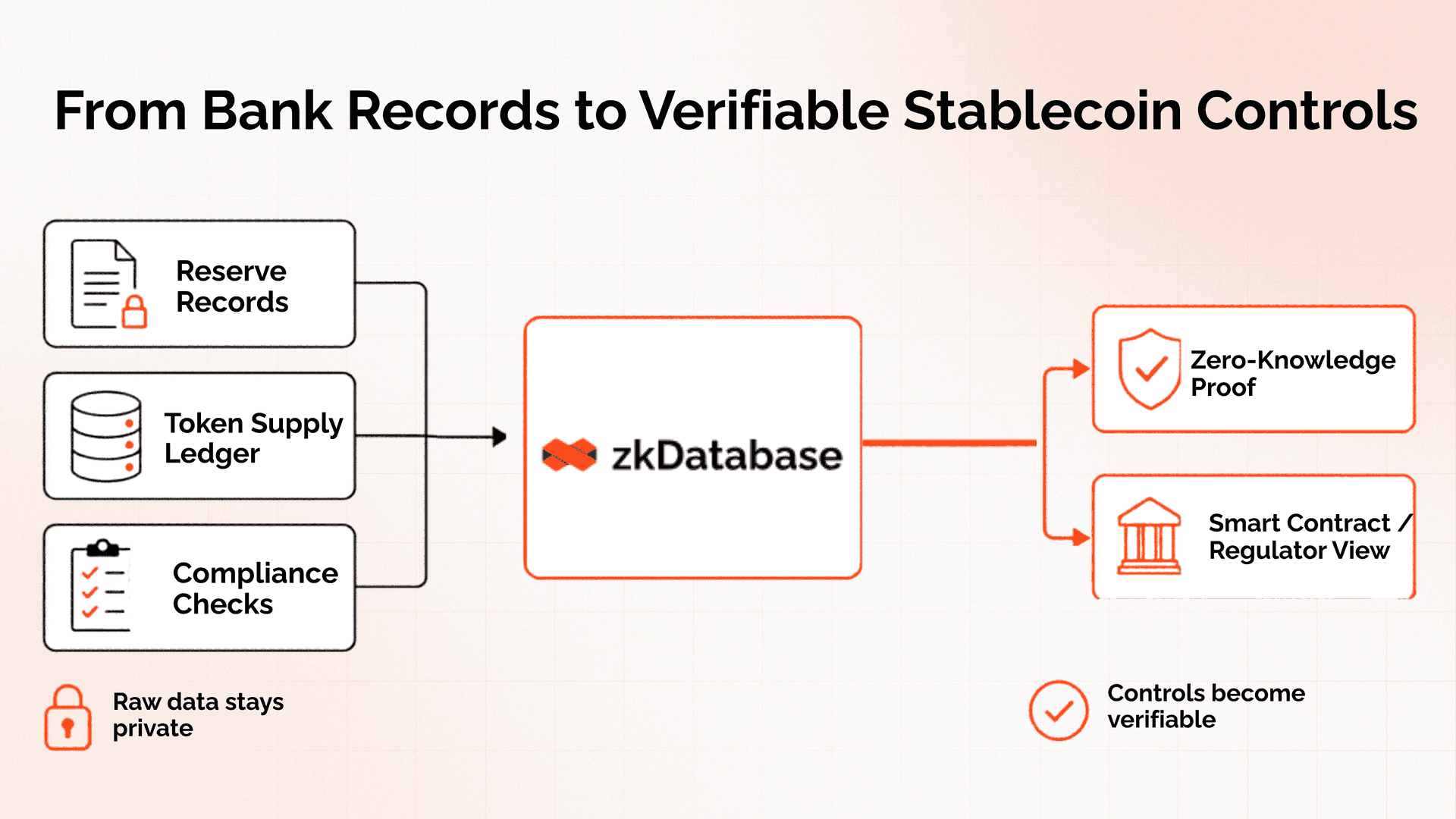 Bank-issued stablecoins need a proof layer between private operating data and public verification. zkDatabase turns reserve, supply, and compliance data into proof-backed control evidence without exposing raw data.
Bank-issued stablecoins need a proof layer between private operating data and public verification. zkDatabase turns reserve, supply, and compliance data into proof-backed control evidence without exposing raw data.That distinction matters for bank governance. A compliance officer does not want a black box. A CTO does not want to hand-write circuits for every reporting workflow. A regulator does not want a dashboard that depends entirely on issuer self-reporting. The proof layer has to sit inside normal institutional systems while still being verifiable outside them.
How can Orochi Network support regulated stablecoin issuance?
Orochi Network supports regulated stablecoin issuance by giving issuers a way to prove reserve and compliance conditions over private off-chain data. zkDatabase turns issuer data into Verifiable Data, then generates Zero-Knowledge Proofs that external systems can verify.
For a bank-issued stablecoin, the practical value is selective assurance:
- prove reserves meet threshold rules without exposing custodian accounts;
- prove circulating supply reconciliation without publishing every internal ledger;
- prove compliance checks were applied without exposing personally identifiable information;
- produce an audit trail that complements external auditor review.
This is the difference between transparency as exposure and transparency as proof. Bank stablecoins do not need to reveal the balance sheet to earn trust. They need a way to show that the controls attached to the balance sheet are working.
Conclusion
GENIUS Act stablecoin implementation makes reserve verification a core infrastructure question for banks. The OCC proposal gives regulated issuers a clearer path, but it also raises the standard for evidence: reserve adequacy, redemption controls, and compliance workflows must be provable at operational speed. zkDatabase gives Orochi Network a credible role in that stack by turning private issuer data into Verifiable Data that can be checked without exposing the data itself.
Book Technical Call -> Discuss how zkDatabase can support reserve verification workflows for bank-issued stablecoins.
Read Stablecoin Proof of Reserves -> Review Zero-Knowledge Proofs for stablecoin reserves.
Related reading: privacy-preserving Proof of Reserves, and off-chain to on-chain data authenticity.
FAQ
What does GENIUS Act stablecoin rulemaking require issuers to prove?
GENIUS Act stablecoin rulemaking pushes issuers toward stronger evidence for reserves, redemption, risk controls, and compliance workflows. The OCC proposal addresses a supervisory framework for OCC-jurisdiction entities, while related AML and sanctions requirements remain central. Issuers should assume that regulators will expect consistent, reproducible evidence rather than informal operational claims.
Can Zero-Knowledge Proofs replace stablecoin audits?
Zero-Knowledge Proofs should complement stablecoin audits, not replace them. Auditors and regulators still evaluate legal structure, controls, custody, and reporting. Cryptographic proofs can improve the evidence layer by proving specific reserve, supply, or compliance predicates more frequently and with less data exposure than raw disclosure.
How does zkDatabase help with stablecoin reserve verification?
zkDatabase helps stablecoin reserve verification by generating proofs over off-chain reserve and supply data. An issuer can prove that reserves meet defined rules or that supply reconciles with approved data, while sensitive inputs remain private. This supports continuous assurance workflows and gives smart contracts a way to verify issuer data.
Is public blockchain transparency enough for bank stablecoins?
Public blockchain transparency is not enough for bank stablecoins because reserves, customer data, and internal controls live off-chain. Token balances may be visible, but the backing assets, redemption queues, and compliance decisions are not. Banks need Verifiable Data Infrastructure that connects private operational data to public verification without exposing the full dataset.
Disclaimer: This article is for informational purposes only and does not provide legal, regulatory, accounting, or financial advice. Stablecoin issuers should consult qualified advisors before designing compliance or issuance systems.
Related toStablecoin


