Research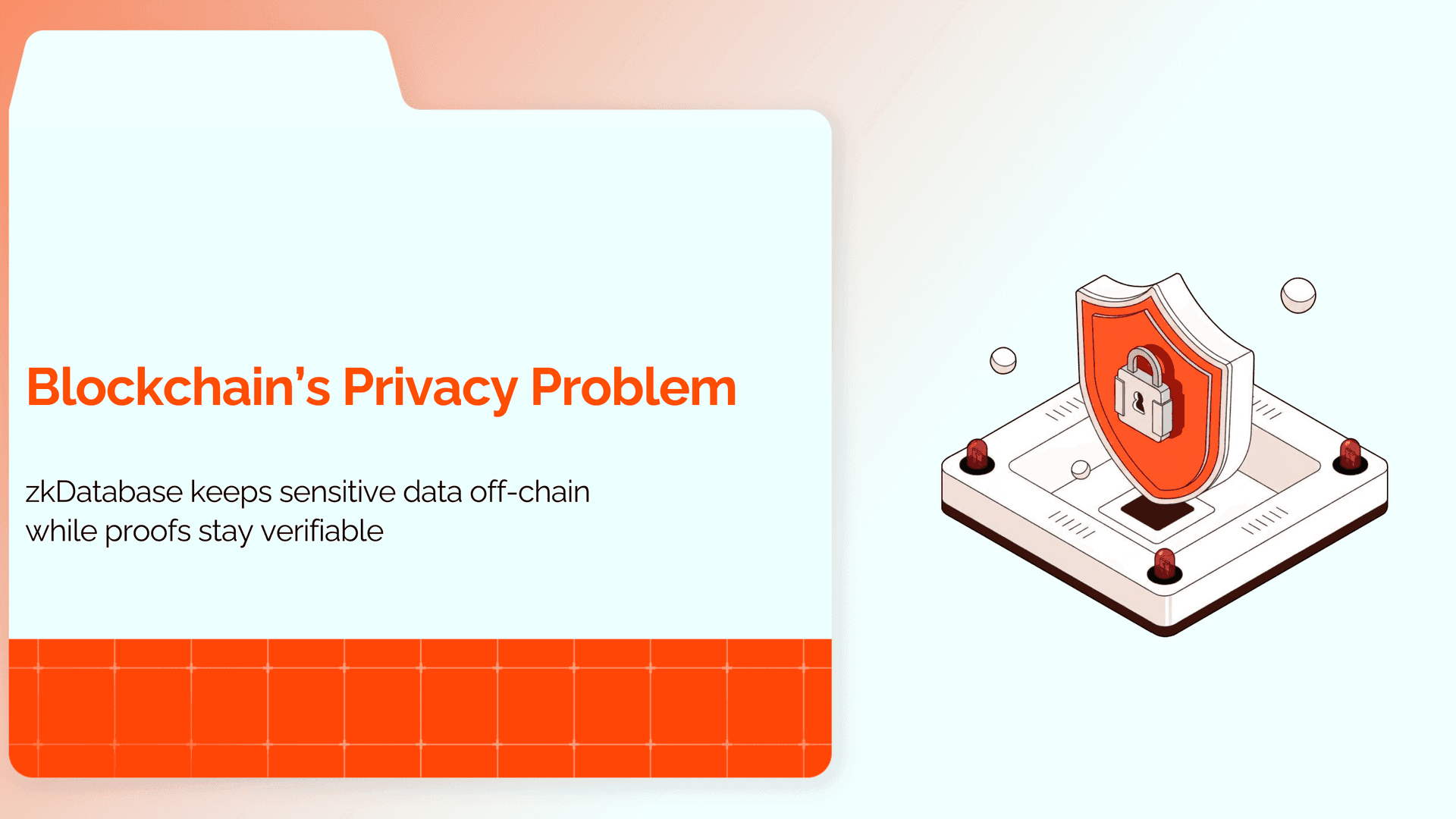
Institutions Don't Have a Blockchain Problem. They Have a Privacy Problem
May 25, 2026
7 mins read
Institutional hesitation around blockchain isn't about technical complexity. It's about transparency by default being structurally incompatible with fiduciary obligation. Zero-Knowledge Proofs are the architecture that resolves this — not by limiting transparency, but by separating proof from disclosure.


TL;DR: Blockchain data privacy is a major blocker for institutional adoption - not technology complexity. Public chains expose client positions, conflict with GDPR's data protection requirements, and create AML/KYC liability. Zero-Knowledge Proofs resolve this by separating what must be proven from what must be disclosed, letting institutions prove compliance without putting sensitive data on-chain.
Why Do Institutions Hesitate on Public Blockchains - and Is It Really About Technology?
Institutional hesitation around public blockchains is not primarily about technical complexity. A major structural blocker is exposure by default: public chains make every transaction readable to every participant, including competitors, regulators, and the public simultaneously.
No fund with fiduciary obligations puts client positions on a transparent ledger. No bank broadcasts its settlement flows to counterparties. No stablecoin issuer publishes exact reserve composition to the market in real time. These aren't preferences. They're legal obligations that public blockchain architecture, in its default form, makes structurally difficult to meet.
TRM Labs, in their 2026 analysis of on-chain privacy and financial compliance, notes that "regulatory requirements like GDPR may actually require transaction confidentiality in certain contexts." The observation matters because it reframes the problem: privacy is not in tension with compliance - in many cases, it is a compliance requirement.
What Are the Three Specific Exposure Problems Institutional Compliance Teams Face?
The exposure problem takes three distinct forms, each with different regulatory and operational consequences.
Client position exposure. On a public blockchain, an institution's trading book, collateral positions, and settlement flows are readable by any party with a block explorer. For asset managers and institutional lenders, this is a competitive liability. For funds operating under fiduciary duties, it raises questions about whether public disclosure of client positions is permissible at all.
GDPR and the immutability conflict. The European Data Protection Board's Guidelines 02/2025 (public consultation closed, not yet final law) recommend that personal data should generally not be processed on-chain where doing so conflicts with data protection principles. GDPR Article 17 grants individuals the right to erasure. Immutable blockchains cannot accommodate this by design. GDPR Article 5(1)(c) requires data minimization - collecting only what is necessary. GDPR Article 25 requires privacy by design, meaning data protection must be built into architecture, not added afterward. Each of these principles creates friction with public chain deployment for any institution handling personal data of EU residents.
AML/KYC data aggregation liability. Storing identity verification data - passport scans, proof of address, biometric records - creates a concentrated breach target. Every institution that re-collects and re-stores this data for a new protocol adds a new surface for cyberattack and a new exposure under data protection law. Nethermind and Deutsche Bank, in their December 2025 analysis of Zero-Knowledge Proofs in blockchain finance, identify this directly: current KYC creates "a set of PII that is a prime target for cyberattacks." The compliance program designed to reduce risk ends up creating new risk of a different kind.
None of these problems are unique to blockchain. Traditional financial infrastructure has its own data management challenges. But blockchain's default transparency amplifies each of them in ways that make institutional deployment decisions harder to justify without a different architectural approach.
Why Doesn't a Private Blockchain Fix This?
Permissioned or private blockchains are often proposed as the solution. They address one layer of the problem - restricting who can read the ledger - but they don't address the underlying compliance architecture problem.
A private chain limits access. It does not produce proof. When a regulator asks whether a reserve requirement was met, whether a KYC check was completed, or whether a collateral threshold was satisfied at a specific point in time, "trust us, we run a private chain" is not a sufficient answer. The regulator needs evidence of compliance - auditable, verifiable evidence - not just access control.
The gap is between auditable compliance and full data disclosure. These are not the same thing. A compliance architecture that requires full disclosure to be auditable is not a viable architecture for institutions. What's needed is the ability to prove facts about data without disclosing the data itself.
 Zero-Knowledge Proofs shift institutional compliance from data disclosure to verifiable proof, allowing sensitive positions, identity records, and reserve details to remain private.
What Do Zero-Knowledge Proofs Actually Change About This Problem?
Zero-Knowledge Proofs shift the compliance architecture from disclosure-based to proof-based. Instead of showing the data to prove a fact, an institution generates a cryptographic proof that the fact is true - and the proof can be verified by any authorized party without the underlying data being revealed.
The practical implications, drawn from TRM Labs' selective disclosure framework and the Nethermind/Deutsche Bank analysis:
A transaction can be proven compliant without revealing the transaction details. A KYC verification can be proven complete without the KYC data leaving the institution that holds it. A reserve ratio can be proven sufficient without the reserve composition being readable by the verifier. A counterparty can be proven absent from a sanctions list without revealing the counterparty's identity.
Nethermind and Deutsche Bank describe this as embedding compliance rules directly into the Zero-Knowledge circuit: "A ZKP for a financial transaction could be constructed to prove not only that the transaction is valid, but also that it adheres to a specific set of compliance rules." The regulator receives the proof. The underlying data stays with the institution.
This is also the architecture the EDPB's guidance points toward. If personal data should not be processed on-chain, the alternative is to process it off-chain and put only the cryptographic proof on-chain. As Nethermind and Deutsche Bank note, "ZKPs could utilize [off-chain] hashes to prove a statement is correct" - a design that is consistent with GDPR data protection principles while still providing the on-chain verifiability that compliance programs require.
Where Does zkDatabase Fit in This Architecture?
zkDatabase is the Verifiable Database powered by Zero-Knowledge Proofs. Data stays off-chain; the proof goes on-chain. Regulators, auditors, and counterparties verify the proof. The underlying data - client positions, reserve composition, identity records - never leaves the institution's custody.
For institutions evaluating blockchain infrastructure, this changes the deployment calculus. The question is no longer "how do we limit who can see the ledger" but "how do we prove compliance without putting sensitive data anywhere it shouldn't be." Those are different problems with different solutions. zkDatabase is built for the second one.
FAQ
What is blockchain data privacy and why does it matter for institutions?
Blockchain data privacy refers to the ability to conduct on-chain operations without exposing sensitive transaction details, client data, or compliance information to unauthorized parties. For institutions, it matters because public blockchain transparency conflicts with fiduciary obligations, GDPR data protection requirements, and AML/KYC data minimization standards. Zero-Knowledge Proofs address this by allowing institutions to prove facts about data - reserve sufficiency, compliance status, transaction validity - without disclosing the underlying data.
How do Zero-Knowledge Proofs help institutions meet data privacy compliance requirements?
Zero-Knowledge Proofs allow institutions to generate cryptographic proofs that specific compliance criteria are met - without putting the data used to generate those proofs on-chain. This means KYC records, reserve composition, and client position data can remain off-chain under institutional control, while on-chain proofs provide regulators and auditors with verifiable evidence of compliance. The approach is consistent with GDPR data minimization principles and the EDPB's guidance that personal data should generally not be processed on public blockchains.
What is the difference between a private blockchain and a Zero-Knowledge Proof approach for institutional compliance?
A private blockchain restricts who can read the ledger - it limits access but does not produce cryptographic proof of compliance. A Zero-Knowledge Proof approach generates verifiable evidence that specific conditions were met, without requiring the verifier to see the underlying data. For institutions, this distinction matters because regulators require evidence of compliance, not just assurance that access was restricted. zkDatabase combines both: data stored off-chain with Zero-Knowledge Proofs generated for every operation, publishable on-chain for any authorized verifier.
Related toResearch