Research
Off-Chain Risks in Tokenization: The Critical Infrastructure Gap Threatening a $36B Market in 2026
March 4, 2026
15 mins read
Off-chain risks in tokenization threaten a $36B market. Learn 5 critical risks, live metrics & how zkDatabase secures your data.


Introduction
The tokenized real-world asset (RWA) market has decisively crossed into institutional territory. As of late 2025, on-chain RWA value exceeded $36 billion , represents growth of over 2,200% since 2020, according to Canton Network's State of RWA Tokenization 2026 report. BlackRock's BUIDL fund alone manages $2.9 billion in tokenized assets. Apollo, Franklin Templeton, and JPMorgan are no longer piloting tokenization , they are running it in production.
Yet beneath this momentum, a structural risk layer remains largely unsolved. The blockchain code works. The smart contracts are executed faithfully. But the information flowing into those contracts , the asset valuations, custody records, legal ownership proofs, and reserve attestations, originates entirely off-chain. And off-chain is where the real attack surface begins.
Off-chain risks in tokenization are the systemic vulnerabilities that sit between blockchain infrastructure and real-world assets: custodians who may fail, oracles that can be manipulated, legal frameworks that may not enforce token holder rights, and operational processes that break down under pressure. Understanding and mitigating these risks is no longer a compliance checkbox , it is the foundational competency that separates institutional-grade tokenization from projects waiting to fail.
This article maps every major off-chain risk category in 2026, with live metrics, active projects tackling each risk, and a framework for evaluating tokenization infrastructure with the rigor it demands.
The Off-Chain Risk Landscape in 2026 - Why It's Getting More Dangerous, Not Less
The RWA market's explosive growth is compounding off-chain risk, not reducing it. More capital on-chain means more custodians, more legal jurisdictions, more oracle dependencies, and more operational complexity. The attack surface is expanding faster than the mitigations being deployed.
Consider the market context: tokenized private credit accounts for over $14 billion of current on-chain RWA value; tokenized
U.S. Treasuries follow at $7.4 billion (up 80% year-over-year). Canton Network , which hosts over $6 trillion in tokenized institutional assets and processes roughly $300 billion in daily volume , named cross-chain fragmentation and off-chain data integrity as its top infrastructure challenges for 2026. Analysts at Standard Chartered project the market reaching $30 trillion by 2034. At that scale, any structural off-chain weakness becomes a systemic financial risk , not just a project-level failure.
The risks below are not theoretical. They are documented, recurring, and growing in severity alongside the market they threaten.
Custodian and Counterparty Failure
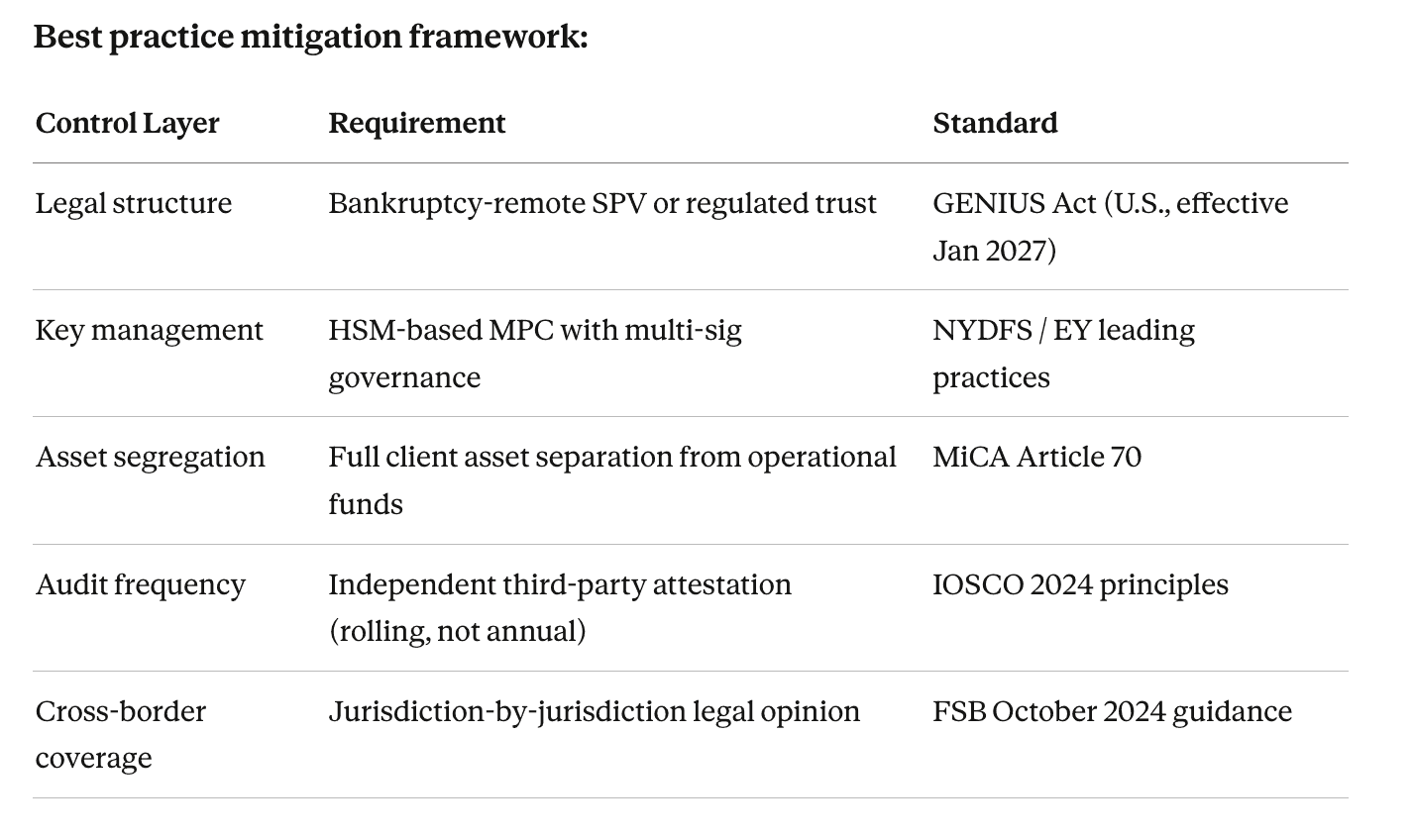
When a real-world asset is tokenized, a regulated entity must physically hold the underlying collateral , the bond certificate, the property deed, the gold bar. That entity is the custodian. And if it fails operationally, legally, or financially, the on-chain token can become an unenforceable claim against nothing.
Custodian risk is not an edge case. It is the primary settlement constraint for every institutional tokenization project operating today. The failure mode is straightforward: the on-chain record persists, but the off-chain legal title , and the asset itself, may be inaccessible, frozen, or absorbed into insolvency proceedings.
How Custodian Risk Manifests in Practice
Key failure scenarios documented in 2024–2026:
- Commingling of assets , custodian mixing client collateral with operational funds, triggering insolvency exposure for token holders
- Private key compromise , the $8.5M Zoth Protocol exploit (H1 2025) was caused directly by a compromised admin key, classified by CertiK as an off-chain operational failure
- Cross-border enforcement gaps , assets held in one jurisdiction with investors in another create a multi-layered enforcement problem no smart contract can resolve
- Inadequate segregation , custodians without mandatory bankruptcy-remote structures can leave token holders as unsecured creditors in default proceedings
Market data on custodian adoption (Q1 2026):
- Fireblocks serves 1,800+ financial institutions including banks, asset managers, and exchanges using MPC-based key management; Fireblocks Trust Company is now a qualified custodian under NYDFS regulation
- Anchorage Digital holds an OCC federal bank charter , the highest regulatory standard for U.S. digital asset custody , making it a preferred custody partner for regulated tokenized fund structures
- Cobo operates with SOC 2 Type II and ISO 27001 certifications, supporting 3,000+ tokens across 80+ networks with a zero-incident custody record since 2017
- BlackRock's BUIDL fund uses Fireblocks' wallet infrastructure via Securitize as transfer agent , a reference architecture now being replicated across the institutional tokenization stack
Oracle Manipulation and Data Integrity Failure
Oracles are the nervous system of tokenized finance. Every asset valuation, NAV update, interest rate feed, and reserve balance that flows into a smart contract originates off-chain and must pass through an oracle to become actionable on-chain. When that pipeline is compromised , through manipulation, latency, or modeling error , the entire pricing and settlement layer of a tokenized asset collapses.
For RWA protocols, oracle risk carries a dimension absent from standard DeFi: most tokenized assets have no continuous liquid market price. A tokenized private credit portfolio or commercial real estate fund does not trade on a 24/7 exchange. The oracle does not merely relay a market price , it effectively creates the authoritative valuation that governs liquidations, redemptions, and collateral ratios. That transforms oracle risk into fundamental model risk.
The Oracle Market in 2026 - Who Is Securing RWA Data

-
Chainlink now secures over $100 billion in value across DeFi markets and commands approximately 69.9% of the total oracle market by value secured (Messari, October 2025). Its SmartData suite delivers Proof of Reserve, NAV, and AUM data specifically for tokenized RWAs. In 2025, Chainlink completed the world's first in-production tokenized fund workflow for UBS, and partnered with J.P. Morgan's Kinexys and Ondo Finance for cross-chain delivery-vs-payment settlement.
-
RedStone achieved sub-millisecond oracle latency (0.5ms–1ms via its Bolt model) and secured partnerships with BlackRock BUIDL, Apollo ACRED, and VanEck VBILL as their primary RWA oracle provider. RedStone became the core oracle for Canton Network's $6 trillion tokenized asset ecosystem and acquired Security Token Market (STM) in January 2026, gaining access to data covering over 800 tokenized RWAs with combined market cap exceeding $60 billion.
Oracle Risk Failure Modes and Mitigations:
Key oracle attack vectors:
- Single-source price feed manipulation or node compromise
- Stale or delayed data causing token value divergence from economic reality
- Flash loan exploits targeting oracle latency windows
- Inconsistent NAV modeling methodologies across data providers
- Lack of auditable provenance for each data update
Mitigation architecture:
- Deploy decentralized oracle networks with multiple independent node operators (minimum 7 nodes for institutional-grade feeds)
- Implement cross-validated feeds , custodian-signed attestations as a secondary verification layer alongside oracle data
- Build circuit breakers in smart contracts that suspend activity when oracle data diverges by more than a defined threshold from the prior period
- Require full methodology disclosure from oracle providers as part of issuer documentation , not just the data output, but how it was derived
Legal Unenforceability and the "Orphan Token" Problem
This is the most underestimated off-chain risk in tokenization , and the one most likely to become a systemic issue as the market scales. A token is a digital representation of a legal claim. Smart contracts cannot enforce property rights in courts. They cannot compel asset transfers in bankruptcy proceedings. They cannot resolve cross-border ownership disputes. Without explicit, jurisdiction-specific legal documentation that maps precisely to each token's on-chain state, token holders may have no enforceable recourse when the underlying system fails.
The result is what practitioners now call the "orphan token" problem: digital tokens representing claims that exist perfectly on-chain but are legally unenforceable in the physical world. As one legal analysis from Global Legal Insights noted, LLC-based RWA structures in 2025 left token holders "often lacking information rights or standing to compel action." The City of Detroit sued RealT-affiliated landlords in 2025 for nuisance violations , demonstrating exactly how off-chain legal fragility can strand on-chain investors.
The Evolving Legal Framework in 2026

New York Governor Hochul signed UCC Article 12 into law on December 5, 2025, establishing digital assets as legally recognized "Controllable Electronic Records" with enforceable security interest and ownership transfer rules under New York State law. This is the most significant U.S. legal development for tokenization in a decade, and it still only applies within one state.
Enforcement Gaps That Persist in 2026
Legal failure modes that remain unresolved:
- Cross-border token distributions where investor jurisdiction and asset jurisdiction use different ownership frameworks
- SPV-based structures where token holders lack explicit insolvency protection (LLC structures remain particularly vulnerable)
- Token transfer mechanics that outpace legal registry updates, creating timing gaps in chain-of-title
- Smart contract upgrades that alter token economics without corresponding updates to off-chain legal documentation Compliance architecture for enforceable tokenization:
- Structure through regulated trust companies (not LLCs), which carry bankruptcy-remote protections by charter
- Obtain UCC Article 12-compliant documentation in each U.S. state of operation
- Execute jurisdiction-by-jurisdiction legal opinions before any cross-border token distribution
- Maintain real-time synchronization between on-chain token state changes and off-chain legal registry updates
Proof-of-Reserves Fraud and Attestation Manipulation
Proof-of-Reserves (PoR) is the mechanism by which token issuers demonstrate that the assets backing their tokens actually exist. It is the primary trust signal for investors who cannot directly audit a custodian's vaults. And because of that centrality to investor confidence, it is also the mechanism most susceptible to sophisticated manipulation at scale.
The core vulnerability is temporal: most PoR implementations rely on point-in-time attestations , a snapshot of reserves at a specific moment. An issuer can deposit assets into an audited wallet before the attestation, receive a clean report, and withdraw them immediately after. CertiK's 2025 RWA security report specifically identified "fraudulent proof-of-reserves attestations" as an emerging high-severity risk category as the market scales past institutional thresholds.
Current PoR Implementations & Their Limitations
How leading protocols implement Proof of Reserves today:
- As of mid-2025, Tether controls ~64% of the stablecoin market ($175B USDT supply) with quarterly attestations , making PoR frequency one of the most debated transparency issues in institutional digital finance
- Canton Network processes $300 billion in daily volume across tokenized assets, all of which require continuous reserve integrity , a scale that point-in-time PoR frameworks cannot adequately address.
Building Manipulation-Resistant Reserve Verification
PoR fraud vectors to guard against:
- Asset cycling: depositing reserves before attestation, withdrawing afterward
- Off-balance sheet encumbrances not disclosed in attestation scope
- Custodian API manipulation feeding false balances to automated PoR systems
- Gaps in attestation methodology where certain asset classes are excluded
Mitigation requirements for institutional-grade PoR:
- Require audits from Big 4 or equivalent regulated accounting firms , not purely technical attestation services
- Implement continuous reserve monitoring with real-time on-chain reporting where technically feasible
- Mandate cryptographic commitments (Merkle tree proofs or ZK-based commitments) that allow any third party to verify reserves independently without relying solely on the issuer's reporting
- Establish audit committee governance with independent oversight authority separate from issuance operations.
Operational Failure and Human Error at Scale
Every layer of the tokenization stack involves human judgment and process execution: legal teams drafting documentation, compliance officers approving transactions, engineers managing key ceremonies, and operations staff reconciling on-chain records with off-chain legal systems. Operational risk is not glamorous. But it is the most frequent source of loss in tokenization , and the most difficult to audit from the outside.
The most significant RWA exploit of H1 2025 was not a cryptographic attack. It was a compromised private key in the Zoth Protocol, resulting in $8.5 million in losses. The smart contracts worked exactly as coded. The operational security framework failed. This pattern , technical infrastructure functioning correctly while human processes collapse around it , is the dominant loss mechanism in tokenized finance.
Operational Risk Metrics and Industry Benchmarks
Fireblocks , which serves 1,800+ financial institutions using its MPC-based custody platform , has documented that "key management lifecycle governance" including generation, storage, transaction signing, and recovery is the highest-risk operational process in institutional digital asset management. EY's Digital Asset Risk Management Leading Practices series (2025) identifies inadequate multi-party key governance as a critical unmitigated risk across a majority of institutional tokenization implementations.
Operational Risk Controls for 2026
Root cause categories:
-
Inadequate private key management (single-point-of-failure key storage)
-
Reconciliation failures between on-chain token records and off-chain accounting systems
-
Undocumented incident response procedures for asset value declines or redemption surges
-
Insufficient staff training bridging legal, compliance, and technical disciplines
-
Governance failures in multi-sig upgrade key management Industry-standard operational controls:
-
HSM-based MPC custody with no single key reconstruction possible at any point in the workflow (Fireblocks, Cobo, Anchorage standard)
-
Automated reconciliation between blockchain token registries and off-chain legal and accounting systems , minimum daily cadence
-
Incident response playbooks pre-approved by legal, compliance, and communications teams, rehearsed annually
-
Least-privilege key governance with segregation of duties between issuance, transfer, and custody operations
-
Cross-functional training programs ensuring legal, compliance, and engineering teams share a common operational vocabulary. zkDatabase by Orochi Network , The Verifiable Off-Chain Data Layer Each of the five risk categories above shares a root cause: the inability to cryptographically verify off-chain data on-chain without trust. Current tokenization infrastructure requires trusting custodians to hold assets correctly, trusting oracles to deliver accurate valuations, and trusting legal entities to honor claims , none of which can be verified at the protocol layer. This is the structural gap that zkDatabase, developed by Orochi Network, is purpose-built to close. zkDatabase is a provable database , a system that stores data off-chain (where it belongs, for performance, privacy, and regulatory compliance) and generates Zero-Knowledge Proofs that verify the accuracy, integrity, and completeness of that data on-chain. It is not a blockchain replacement. It is a cryptographic bridge between real-world data and on-chain smart contract execution , enabling verifiability without trust. What this means in practice:
-
For Proof-of-Reserves: Asset holdings stored in zkDatabase generate on-chain ZK proofs confirming that reserves exist, match declared amounts, and have not been altered , without revealing sensitive financial details. This replaces manipulable point-in-time attestations with continuous, cryptographically verifiable reserve proofs.
-
For Oracle Data Integrity: Rather than trusting a single oracle feed, zkDatabase enables provable data pipelines where every data update carries a ZK proof of its source, validation logic, and integrity , making oracle manipulation detectable before it reaches a smart contract.
-
For Legal Record Anchoring: Off-chain legal documents, ownership records, and custodian attestations can be committed to zkDatabase and verified on-chain, creating an auditable, tamper-evident chain of legal state changes that courts and regulators can independently verify.
-
For Operational Auditability: Every database operation is cryptographically provable , enabling automated reconciliation between off-chain administrative records and on-chain token states without manual audit processes or trusted intermediaries. The significance of this architecture is that it converts trust assumptions into cryptographic proofs. For a market projected to reach $30 trillion by 2034, that conversion is not a feature , it is a prerequisite for institutional confidence at scale.
Explore zkDatabase and Orochi Network's verifiable data infrastructure: What is Orochi Network ?
Conclusion
The tokenized RWA market reached $36 billion in on-chain value entering 2026. Standard Chartered projects it hitting $30 trillion by 2034. Ripple and BCG forecast $18.9 trillion by 2033. Between here and there lies a build-out of infrastructure that does not yet exist at the required scale, security, or verifiability.
Custodian failures, oracle manipulation, legal unenforceability, fraudulent reserve attestations, and operational breakdowns are not hypothetical scenarios. They are documented failures with real capital losses, and they will compound in severity as the market scales. The $14.6M in RWA losses recorded in just the first half of 2025 , more than double the losses of all 2024, is an early signal of a much larger systemic risk that the industry has not yet fully mitigated.
The protocols and institutions that will define institutional-grade tokenization by 2030 are solving the off-chain layer with the same engineering rigor applied to smart contract development.
They are choosing regulated custody providers with bankruptcy-remote legal structures. They are deploying multi-layered oracle architectures with cryptographic data provenance. They are building within MiCA, UCC Article 12, and the GENIUS Act's reserve frameworks. And they are integrating verifiable off-chain storage infrastructure , like Orochi Network's zkDatabase, that converts trust dependencies into cryptographic certainty.
FAQs
Question 1: What are off-chain risks in tokenization?
Off-chain risks in tokenization are structural vulnerabilities that exist outside the blockchain — including custodian failure, oracle data manipulation, legal unenforceability of token holder rights, fraudulent proof-of-reserves attestations, and operational human error. These risks are responsible for over 70% of RWA-related losses in 2025, totaling $14.6M in H1 2025 alone, despite smart contracts functioning correctly.
Question 2: How can tokenization projects mitigate off-chain data integrity risks?
The most robust mitigation combines regulated bankruptcy-remote custody structures, decentralized multi-node oracle networks, UCC Article 12-compliant legal documentation, and cryptographically verifiable off-chain storage. Solutions like zkDatabase by Orochi Network eliminate trust dependencies entirely by generating Zero-Knowledge Proofs that verify off-chain data accuracy on-chain — without exposing sensitive information.
Question 3: Why will off-chain risk management define the next phase of RWA tokenization?
With the RWA market projected to reach $30 trillion by 2034, the scale of capital at risk makes off-chain failures a systemic financial threat — not just a project-level loss. Institutional adoption by BlackRock, Apollo, and JPMorgan depends on infrastructure that is legally enforceable, operationally auditable, and cryptographically verifiable. Off-chain risk management is the final barrier between pilot programs and production-grade tokenized finance.
Related toResearch