Reports
Report Crypto Payment (Part 1): The Infrastructure Stack Powering Real-World Adoption
October 24, 2026
15 mins read
Explore how crypto payments evolved from an experiment into real-world infrastructure, covering market growth, stablecoins, adoption patterns, and the modern payment stack.


Executive Summary & Key Takeaways
The crypto payment landscape has undergone a fundamental transformation between 2020 and 2025. What was once primarily an ideological experiment has evolved into a sophisticated, multi-layered infrastructure connecting blockchain assets to everyday commerce. This report details the current state of crypto payments in 2025, analyzing the market size, key players, business models, and emerging trends shaping how value moves in the digital economy.
Key insights:
- Market maturation: The global crypto payment gateway market reached $2.0 billion in 2025 (up from $1.69 billion in 2024), with payment apps reaching $646.3 million. The market is growing at an 18.9% CAGR, but still represents only a fraction of the $46 trillion in annual crypto transaction volume, primarily driven by stablecoins.
- Two-speed adoption: Developed markets (North America, Europe) lead in value and regulatory frameworks, with adoption driven by investment and premium retail experiences. Emerging markets (Asia-Pacific, Latin America) lead in utility adoption, with crypto solving real problems in cross-border remittances, inflation hedging, and financial inclusion. Asia-Pacific is experiencing the fastest growth globally, with many reports projecting high double-digit CAGR through 2030.
- Stablecoins and fee pressure: While Bitcoin still carries the brand (accepted by over 90% of crypto-accepting merchants), stablecoins now drive roughly three-quarters of actual crypto payment volume thanks to price stability and efficient settlement. As this shift accelerates, intense competition is compressing fees across the stack: gateways typically charge 0.5–1.5% versus 2–3% for cards, card programs compete via token-based rewards rather than headline fee cuts, and moves like Block’s zero-fee Lightning integration for millions of merchants signal direct disruption of the traditional fee model.
- The card bridge: Crypto debit/credit cards have become the primary on-ramp for retail crypto spending in developed markets. These cards don't actually pay merchants in crypto. Instead, they instantly convert crypto holdings to fiat, leveraging existing Visa/Mastercard rails. This provides convenience but maintains dependence on traditional payment infrastructure.
- Regulatory inflection point: 2025 marks the transition from regulatory uncertainty to implementation. MiCA in Europe, evolving frameworks in the US, and proactive regimes in Singapore and Switzerland are creating clearer operating conditions, but also raising compliance costs and de-banking risks.
- UX remains the bottleneck: Despite infrastructure maturity, consumer and merchant adoption is still hampered by onboarding friction, volatility concerns (for non-stablecoins), and psychological barriers around spending appreciating assets. The gap between crypto-native users and mainstream consumers remains significant.
- Economic power concentration: Value capture in the stack is increasingly concentrated among:
- Card networks (Visa/Mastercard) that maintain control of consumer touchpoints
- Banking partners providing fiat rails and regulatory cover
- Stablecoin issuers capturing transaction volume
- Platforms with integrated ecosystems (Crypto.com, Coinbase, Binance)
- Emerging opportunities:
- L2-native payment experiences (particularly on Ethereum L2s and Solana)
- B2B stablecoin settlement for cross-border trade
- Account abstraction enabling seamless wallet experiences
- AI agents managing crypto liquidity and payment routing
- Regulated stablecoins issued by traditional financial institutions
1. The Crypto Payment Stack in 2025
The crypto payment stack has matured significantly since the early "Wild West" days of cryptocurrency. Today's stack represents a sophisticated hybrid of traditional financial infrastructure and blockchain-native components, each serving specific purposes and targeting different user segments. Understanding this layered architecture is essential for anyone building or investing in the space.
Core Components of the Modern Crypto Payment Stack
At its foundation, the 2025 crypto payment stack consists of multiple interconnected layers:
- Settlement Layer (L1/L2 Blockchains)
This is where actual value transfer occurs. Unlike traditional payment systems that rely on centralized databases, blockchain settlement is distributed and transparent:
- Ethereum remains the dominant settlement layer for stablecoin value (hosting over 50% of global supply). However, transaction activity has effectively decoupled: high-frequency USDC and USDT transfers have migrated to low-cost networks, primarily Ethereum L2s (Base, Arbitrum) and Tron, which now process the vast majority of daily volume to reduce costs and increase speed.
- Solana: Growing rapidly for merchant payments due to low fees (<$0.001) and high throughput (65,000 TPS)
- Specialized payment chains: Ripple (XRP Ledger) for cross-border corridors, Stellar for remittances, and newer players like Monad focusing exclusively on payment throughput
- Asset Layer (Stablecoins and Tokens)
This layer consists of the digital currencies being transacted – moving on the settlement rails described above. In 2025, the assets flowing through the crypto payment stack have evolved beyond just volatile cryptocurrencies:
- USD-denominated stablecoins: These are the workhorses of crypto payments. Leading stablecoins like USDC (Circle), USDT (Tether), BUSD/PAX (Binance/Paxos), DAI (MakerDAO), and newer entrants like PYUSD (PayPal’s USD stablecoin) collectively process tens of trillions in volume annually. In addition to USD, we see regional and local stablecoins gaining traction – for example, JPYC (Japanese yen stablecoin), NZDS (New Zealand dollar stablecoin), IDRXC or IDRC (Indonesian rupiah stablecoin) are growing in their respective markets, enabling digital transactions in local currency units.
- Major cryptocurrencies (BTC, ETH): Despite volatility, cryptocurrencies like Bitcoin and Ether are still used directly in some payments, especially where the user base is crypto-savvy or for online services that originally adopted them (e.g. VPN subscriptions, IT services, some retail where “Pay with Bitcoin” has been long available).
- Platform-specific tokens: Some payment ecosystems or crypto commerce platforms have their own tokens that give users benefits (e.g. Crypto.com’s CRO, Binance’s BNB used for fee discounts or rewards).
- Central Bank Digital Currencies (CBDCs): By 2025, a few CBDC projects have launched pilot or production implementations (such as China’s e-CNY, which is expanding in domestic use, and smaller jurisdictions like The Bahamas’ Sand Dollar). While most CBDCs are still in trial stages or limited rollout, the crypto payment industry is watching closely.
- Other tokenized assets: A growing category is the use of tokenized real-world assets in payments. For example, gold-backed stablecoins (like PAX Gold, Tether Gold) see use in countries with distrust in fiat but cultural affinity for gold – they serve as a stable store of value and sometimes as a payment asset for large purchases.
- Protocol tokens: Still relevant for fee payment and governance in specific ecosystems
In practice, the asset layer is dominated by USD stablecoins for transactions, with BTC/ETH and other tokens playing secondary roles.
- Application & Interface Layer
This top layer is what users and merchants directly interact with – the wallets, payment apps, merchant gateways, and point-of-sale integrations that make crypto payments user-friendly. By 2025, this layer has seen enormous innovation to abstract the blockchain complexity and integrate with existing commerce workflows:
- Consumer wallets: These range from non-custodial mobile wallets (e.g. MetaMask, Phantom, Rainbow) to custodial “super-apps” like Coinbase Wallet or Binance Pay that link to exchanges. Many wallets have moved to a smart-wallet model with features like social recovery, biometric security, and the ability for the wallet to execute complex tasks (via account abstraction ERC-4337) – dramatically improving ease of use.
- Merchant payment gateways: These are the crypto equivalents of PayPal or Stripe, providing tools for merchants to accept crypto and either hold it or convert to fiat. Leading providers in 2025 include BitPay, CoinGate, Binance Pay, Coinbase Commerce, and Stripe’s crypto integration.
- Institutional custody: Fireblocks, Copper, and Anchorage providing insured, enterprise-grade solutions with payment APIs
- On/Off-Ramp services: These are services that connect the crypto economy with fiat banking – essentially the “exchanges/brokers” integrated into apps that let users buy crypto with local currency or cash out to a bank. Companies like MoonPay, Ramp Network, Transak, Coinbase, Kraken, Circle etc. provide API-based ramp services that other wallets and apps embed.
- Crypto-first “Neobanks” and fintechs: A distinct category at the app layer are fintech platforms that blur the line between banking and crypto. These are services like Revolut, Cash App, Juno, Strike, and Circle’ s forthcoming consumer app that allow users to hold both fiat and crypto, spend via cards, and pay both crypto and traditional endpoints from one interface.
- Point-of-Sale (POS) systems and hardware: By 2025, mainstream POS manufacturers (Verifone, Ingenico) and vendors of retail software have begun including crypto payment options.
- APIs and “payment as a service” layers: A lot of the Application layer is now available via APIs, allowing any platform to embed crypto payments. Companies provide wallet-as-a-service APIs, custody APIs, and payment APIs (for example, Coinbase’s and Circle’s APIs allow automated sending/receiving of stablecoins, with Circle having merchant settlement services in USDC.
4. Middleware & Service Layer:
Not often discussed by end-users but crucial to the stack are various middleware services that connect and enhance the above layers:
- Liquidity providers and exchanges: Handle frequent asset and fiat conversions with competitive rates and low slippage. In 2025, many payment companies route orders through major CEXs (Coinbase, Kraken, Binance) or DEXs (Uniswap, Curve) and, in some cases, maintain their own liquidity pools or OTC channels for large merchant settlements.
- Oracles and rate feeds: To settle a payment, one often needs a reliable price (e.g. how many USDC equals a certain amount of EUR, or what’s the BTC to USD rate for a point-of-sale conversion). Oracle networks like Chainlink provide reliable exchange rates on-chain, which many smart contract payment systems use.
- Identity, compliance, and verifiable data services: These include blockchain analytics companies (Chainalysis, TRM Labs, Elliptic) that monitor transactions and flag suspicious activity. They also include KYC providers for user onboarding and identity verification APIs. Additionally, new decentralized identity standards (DID, verifiable credentials) are emerging, which in the future might allow a wallet to prove it’s KYC-verified without exposing all details.
- Security and fraud mitigation services: Beyond compliance, services that provide insurance (covering hacks or errors), smart contract audits, and fraud scoring for transactions play a role. By 2025, we also see multi-sig and MPC (multi-party computation) custodial solutions offered as services, so that even non-technical businesses can secure funds with advanced techniques.
- Off-chain messaging and scheduling: For more complex payments (like subscriptions, payroll, or batched settlements), services that schedule transactions or facilitate off-chain agreement before on-chain execution are important.
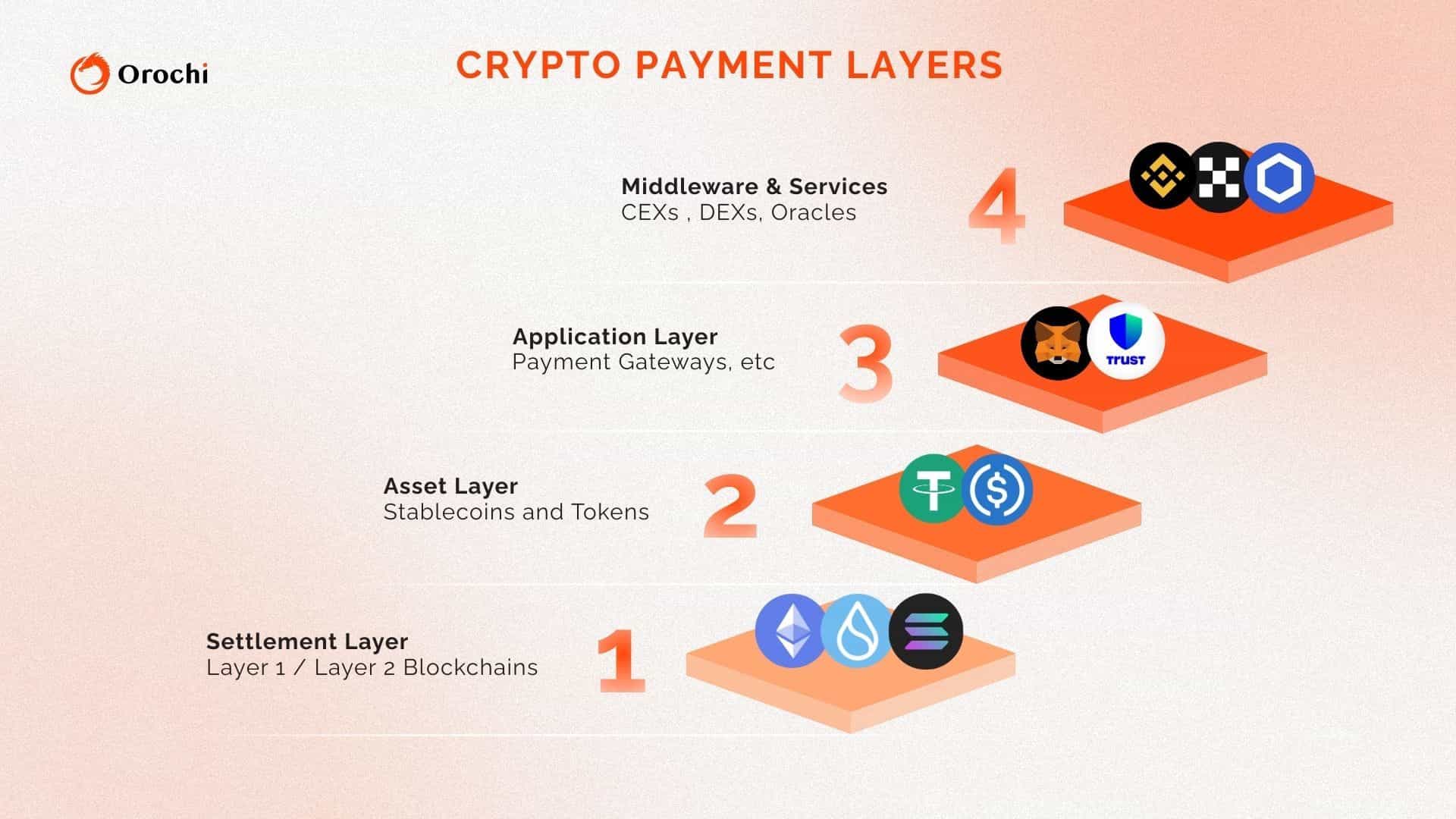 Underneath all of these layers sits an often-ignored data layer: the systems that track balances, positions, transaction histories, risk metrics, and compliance states across chains and off-chain services. Historically, this has been handled by traditional databases and internal reconciliation scripts. In a world of regulators demanding real-time transparency, AI agents orchestrating flows, and cross-jurisdiction operations, this data layer itself is becoming a verifiable infrastructure layer – one that can prove, not just store, the state of the payment stack.
Crypto Payment Archetypes: Market Positioning and Differentiation
The market has consolidated around distinct archetypes, each with specific strengths and limitations:
Table 1: Crypto Payment Provider Archetypes (2025)
| Dimension | Crypto Card Programs | Payment Gateways | On/Off Ramps | Crypto-first Neobank |
|---|---|---|---|---|
| Primary Users | Retail crypto holders in developed markets | Online merchants, service providers | New entrants to crypto, casual users | Crypto-native businesses, DAOs, Web3 teams |
| Core Function | Offer branded Visa/Mastercard cards linked to crypto wallets. Allow users to spend crypto at any merchant, converting to fiat at point of sale. | Enable merchants to accept crypto payments (online and in-store) and optionally convert to fiat. Provide checkout APIs, invoices, POS apps. | Provide conversion between fiat and crypto (buy/sell) typically within other apps or directly to consumers. Essential for entering/exiting crypto economy. | Offer bank-like accounts that hold crypto or stablecoins natively, with features like interest, payments, and often an attached debit card. Mix of crypto and traditional services. |
| Settlement Currency | Primarily fiat (USD, EUR) | Merchant's choice (crypto or fiat) | Crypto for on-ramp, fiat for off-ramp | Primarily stablecoins with fiat options |
| Geographic Focus | North America, Europe, APAC | Global with regional compliance variations | Region-specific based on banking access | US, EU, Singapore, UAE |
| Primary Risks | De-banking, card network policy changes | Volatility during settlement, fraud | Regulatory action, banking relationships | Regulatory scrutiny, reserve transparency |
| Leading Players | Crypto.com, Coinbase, AviciMoney | |||
| BitPay, Block, Coinbase Commerce | MoonPay, Transak, Ramp Network | M^0, AviciMoney, Juno, Circle |
The crypto payments market is growing fast on both the infra and consumer sides.
- B2B crypto payment gateways: $1.69B in 2024 → $2.0B in 2025 → $4.0B by 2029 (18.9% CAGR), with some estimates putting the broader crypto payments stack at $5.5B in 2025.
- B2C crypto payment apps: $556.9M in 2024 → $646.3M in 2025 → $2.4B by 2033 (17.8% CAGR).
- Both grow at almost the same rate, but these figures reflect the revenue/market value of providers, not the underlying flow: crypto’s total market cap passed $4T in 2025, and stablecoins process ~$46T/year, at a scale comparable to Visa.
Global Adoption Patterns: The Three-Tier Model
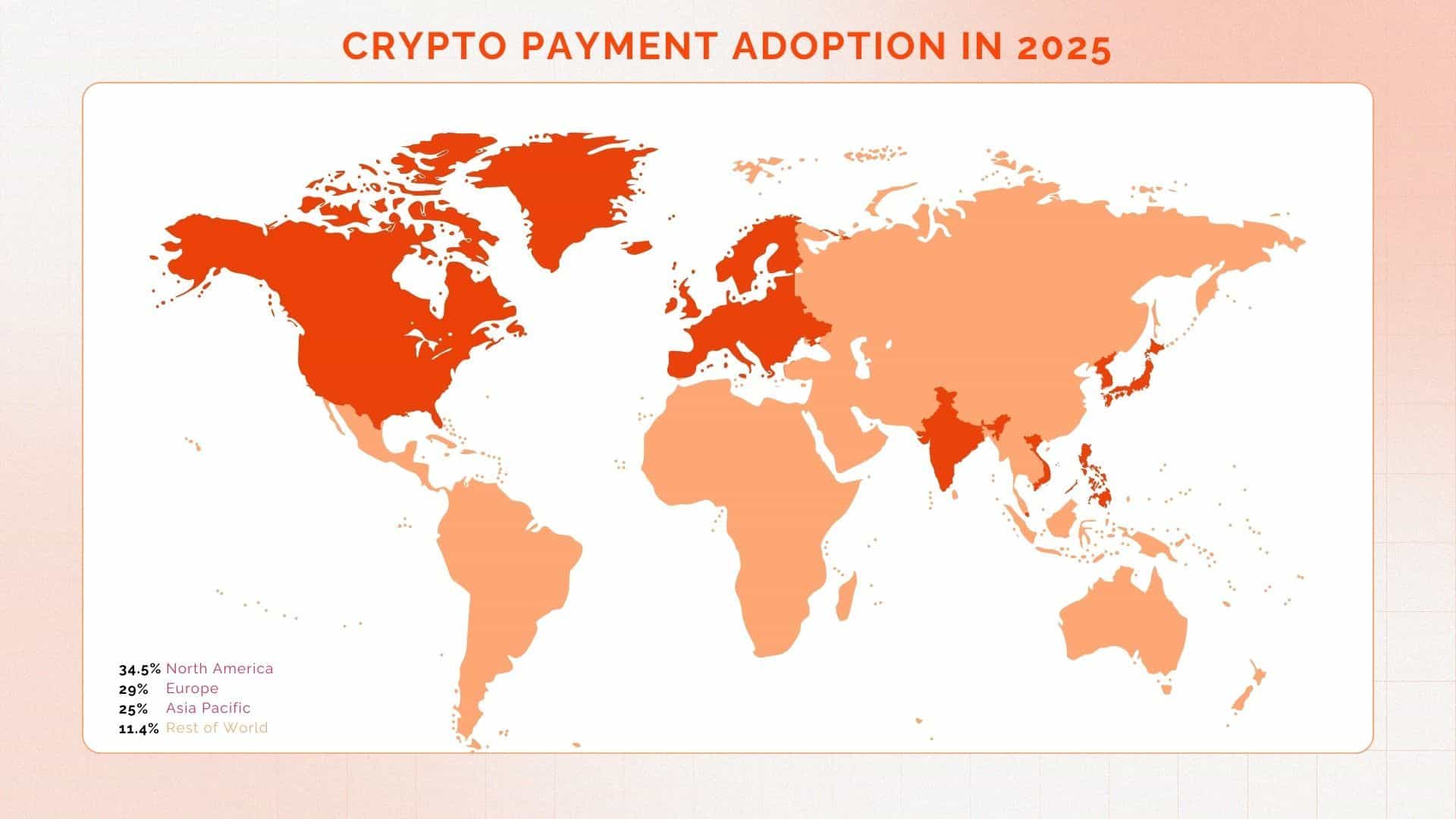 Crypto payment adoption in 2025 cannot be understood as a monolith – it varies widely across different regions and economies. Our analysis reveals a three-tier model of global adoption, which transcends simple “developed vs developing” labels. The tiers are defined by a combination of market maturity, use-case drivers, and regulatory stance:
- Tier 1: Developed Market Adoption (Investment-Driven) – This tier includes North America, Western Europe, parts of East Asia (e.g. Japan, South Korea) and Oceania. Together, these regions control the bulk of the commercial crypto payments market, with North America and Europe alone accounting for roughly two-thirds of global crypto payment gateway and app revenue, depending on the study. Adoption here is led by investment and value-capture motives: users and institutions primarily treat crypto as an asset class or trading instrument, with everyday payments still a relatively small share of overall activity.
- Tier 2: Emerging Market Adoption (Utility-Driven) – This tier includes large parts of Asia-Pacific (e.g. Southeast Asia, India), Latin America, Africa, and the Middle East. Here, crypto payment adoption is problem-driven: it solves real issues in the local economy. These regions have smaller per-capita transaction values but higher engagement rates among certain demographics. Notably, India, Pakistan, Vietnam, Brazil, Nigeria all rank in the top 10 of Chainalysis’s 2025 Global Crypto Adoption Index, despite their lower income levels – indicating broad-based usage. Latin America is similar: amid inflation, countries like Argentina have over 60% of their crypto transaction volume in stablecoins, and approximately 18-20% of the Argentine population actively use crypto (out of ~46 million population) to cope with currency instability.
- Tier 3: Frontier & Necessity Adoption (Financial Inclusion) – This refers to smaller economies, or those with extreme economic conditions, where crypto adoption is nascent but potentially extremely impactful. Examples might include countries in Africa (like Zimbabwe, where local currency issues have led some to use crypto informally), or sanctioned economies where access to global finance is limited (e.g. individuals in Iran or Cuba using crypto for necessities).
Table 2a: Regional Crypto Payment Adoption Patterns (2025)
| Region | Market Share (2024) | Growth Rate | Primary Driver | Leading Countries | Regulatory Maturity |
|---|---|---|---|---|---|
| North America | ~34.6% | 18-20% CAGR | Investment & Value Capture | United States, Canada | Medium-High (fragmented) |
| Europe | 29% | 20-22% CAGR | Regulatory Clarity & Integration | UK, Germany, Switzerland | High (MiCA framework) |
| Asia-Pacific | 25% | 34.7% CAGR through 2030 | Utility & Grassroots Adoption | Japan, India, Singapore, South Korea, Vietnam, Philippines | Medium (country-specific) |
| Rest of World | 11.4% | 40%+ CAGR | Necessity & Financial Inclusion | Nigeria, Turkey, South Africa, UAE | Low (MEA average; UAE high clarity, others evolving or unclear) |
The Two-Speed Adoption Reality
Data from the 2025 Chainalysis Global Adoption Index reveals a critical insight: the apparent contradiction between North America's market leadership and developing nations like India, Vietnam, and Nigeria ranking in the Top 6 for actual usage. This isn't contradictory, this reflects two distinct adoption patterns:
- Value Adoption (Developed Markets): In North America and Europe, crypto payment adoption is primarily driven by investment behavior and speculative activity. Users in these markets treat crypto as an asset class first, payment method second. This creates high-value transactions but lower frequency of use.
- Utility Adoption (Emerging Markets): In Asia-Pacific, Latin America, and Africa, crypto payments solve real problems: cross-border remittances, inflation hedging, and accessing global commerce without traditional banking infrastructure. These markets show lower transaction values but significantly higher frequency and penetration rates relative to population.
This dual-track adoption pattern explains why North America leads in market value while emerging markets lead in practical usage metrics. It informs strategy: a crypto payment startup targeting the US or EU must integrate with investment platforms and prioritize compliance (to tap into the bigger value flows), whereas one in LATAM or Africa must prioritize mobile UX, cash conversion, and education to capture broad user adoption.\
By 2026, crypto payment cards will bifurcate along the same adoption lines: in developed markets, they will converge with regulated fintech and investment platforms to capture high-value, compliance-heavy spending, while in emerging markets they will scale rapidly as everyday financial tools, driven by mobile-first design, stablecoin rails, and seamless cash conversion, turning utility adoption into mass-market dominance
What’s Next: Part 2 - Inside the Crypto Payment Infrastructure Stack
In Part 2, we’ll go deeper into how crypto payments actually work behind the scenes.
We’ll break down the payment stack layer by layer, from blockchains and stablecoins to wallets, payment gateways, on/off-ramps, and middleware services, to show how value moves, where fees are captured, and which parts of the stack still depend on traditional financial infrastructure.
Related toReports