Research
Overview Real World Assets from Orochi Network Aspect
December 24, 2025
8 mins read
Orochi will dive into an overview of RWAs within the Orochi ecosystem, explore the concept of zkDatabase for RWA, define how RWAs operate on-chain in this network, and highlight a case study showcasing Orochi’s real-world impact.


Exposure of Real-World Assets (RWAs) such as commodities, real estate, art, and bonds, on a blockchain, allows for the transfer and trading of these tokens like any other blockchain asset. However, the focus shouldn't be on what standard the tokens will be, and rather how the RWA systems still rely on off-chain records and systems which can't be verified through cryptography, meaning that infrastructure is the true limiting factor. The RWA system as a whole is tokenized systems that still rely on traditional systems. This aritcle will be exploring the definition of RWA and suggest know how Orochi Network, especially zkDatabase can provide the infrastructure for RWA and tokenization.
What is RWA, and How is RWA represented on the Blockchain?
While Real World Assets are traditional or physical assets, what is meant by tokenzed simply means that for a particular asset or a collection of assets, the ownership rights have been converted into a digital token, thus allowing for fractionalized ownership, global access, and better liquidity.
To avoid any misunderstandings, we'll need to come to a clear understanding on the 3 main components of tokenization:
-
The underlying asset: a physical or tangible asset (a house) or a financial asset (a bond).
-
The off-chain records: these act as the lifecylce of the asset and are the supporting documents such as property deeds, financial agreements, and transactional histories.
-
The on-chain records: represented by the token or the blockchain and in the form of an NFT, which represents the ownership rights to the asset and can be traded in for other assets through smart contracts and other off-chain legal agreements.
The critical factor to make clear is that representation is NOT the same as legal ownership. Digital representation is a form of rights which can be placed in a legal system, but are in their own sense, make un-enforcable.
The appeal is straightforward and practical:
- It targets long-standing constraints in finance such as illiquidity, increased transaction costs, and limited access.
- It expands Web3 beyond crypto-native assets, allowing traditional assets to be represented as tokens and NFTs with parallel usability to existing crypto assets, while opening the door to new market sectors tailored specifically for tokenized real-world assets.
- It raises the bar for infrastructure: as RWAs scale, the market quickly runs into questions of privacy, data integrity, and the ability to validate claims in a trustless context. A quiet but important market insight from the article is that the “hard part” is not launching tokens—it’s sustaining a healthy market around them. The post explicitly calls out the developer challenge of fostering an active market for tokenized assets, similar to what OpenSea achieved for NFTs.
What Steps Are Involved in the RWA Tokenization Process?
This is the explains the entire process beginning with the RWA tokenization process to the complete integration of tokenization, validation, and interoperability.
Here, in the same order, is the flow of the process described in the previous paragraph, one step at a time.
Step 1: Tokenizing the Asset
Real-World Assets can either be physical (houses) or financial (bonds), and they can be converted into digital tokens. On Orochi, through the use of smart contracts, the tokenization process (issuance of tokens) is managed while also ensuring that the tokens remain linked to the assets that they represent.
Step 2: Verifiable Data Pipeline
Orochi’s proprietary asset infrastructure applies a transformation technique that converts raw asset data into provable asset data using cryptographic proofs. Components such as sampling, storage, and retrieval are shielded with ZKPs, enabling trustless interaction from smart contracts with this data.
Step 3: On-Chain Verification
Using ZK-data-Rollups, Orochi consolidates extensive datasets into succinct proofs verified on-chain. This will allow us to maintain RWAs cost effective as we increase volume of transactions.
Step 4: Interoperability
With the help of tailored commitment schemes and ZKPs Orochi has the ability to work with several blockchains, and as such any RWAs tokenized on the Orochi system will be able to access other ecosystems and substantially increase their utility.

What Are the Biggest Infrastructure Challenges Facing RWA Today?
RWA systems tend to break in the same few places once they move from pilot to production:
- Scalability pressures: Traditional blockchain databases struggle as transaction volumes grow, leading to congestion and high fees.
- Privacy requirements: Depending on how verified RWAs are, sensitive RWA data, such as property deeds, financial contracts, and other forms of documentation, may have to remain private and non-disclosed to the public.
- Cross-ecosystem usage: Operating from various decentralised ecosystems RWA have more use cases to deploy from, creating a greater demand for continual interoperability and route validation.
From these issues, one predominant operational need surfaces. There should be a system that can verify on-chain ownership, purpose and parameters of a transaction, and all data remain encrypted with a high level of confidentiality, while still being scalable to other use cases.
Why Is Verifiable Data Infrastructure Critical for RWA Systems?
Orochi Network is the world’s first system to provide Verifiable Data Infrastructure based on Zero-Knowledge Proofs (ZKPs) tailored for high performance, blockchain infrastructures, especially to provide for interoperability, confidentiality, and protect transactions. The main purpose of the system is to support decentralized applications, and other specialized applications for AI Systems, and machine learning in real time to create a Highly scalable pipeline of verified data.
This for RWAs is highly important. As the life cycle of the asset is highly dependent and more verified the more rapidly the data in the system changes, and more on and on. The trust level of the system is based on the accuracy of the real time report. Trust values will not scale in an institution.
The post also highlights ZK-data-Rollups as a key scalability component: compressing large datasets into succinct proofs for efficient on-chain processing, making tokenized assets more reliable and accessible across decentralized ecosystems.
How Does zkDatabase Act as Infrastructure for RWA?
Zero-knowledge proofs (ZKPs) are identified as cryptographic methods to verify to one party that a certain assertion is true about the other party without having to provide the data necessary to verify the assertion. For example, using ZKP method for ownership and transfer of an asset, it would be possible to verify ownership of an asset without disclosing the information contained within that asset.
As such, ZKP technology offers a privacy-preserving, scalable workflow that facilitates the use of tokenized assets and aligns with many of the previous challenges.
- Off-chain confidentiality: sensitive RWA data like property deeds or financial contracts remains confidential.
- Scalable verification: Orochi addresses database scalability issues with native ZK-data-rollups, bundling large datasets into succinct proofs that can be efficiently verified on-chain.
- Audit-relevant verification outcomes: the system is described in terms of verifying ownership and transaction history on-chain without disclosing personal details.
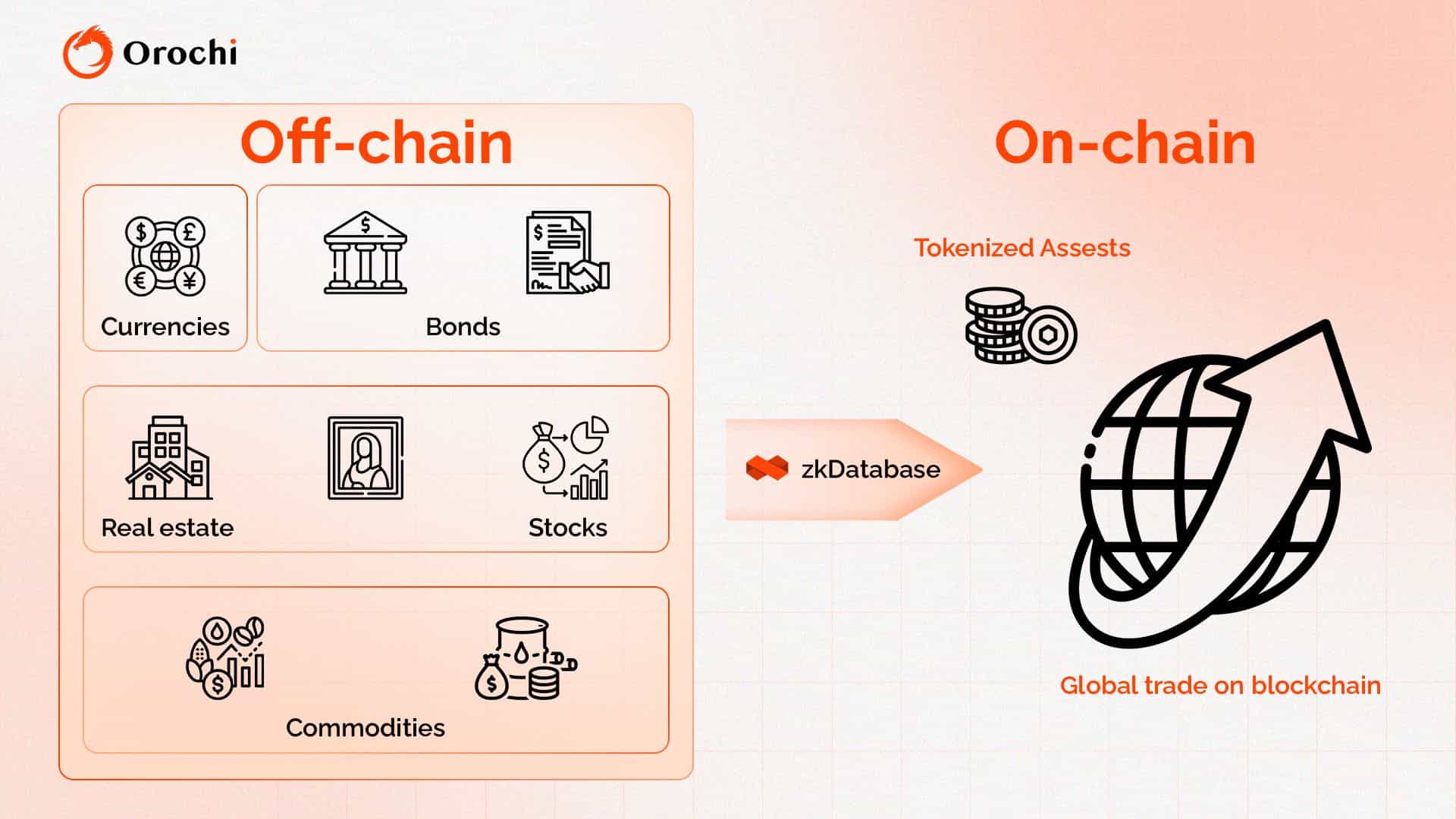
For example, a tokenized real estate platform where ownership and transaction history can be verified without exposing buyer/seller personal details, positioning privacy and transparency as compatible, rather than mutually exclusive.
Which RWA Use Cases Benefit Most From Verifiable Infrastructure?
- Trading: fungible tokenized RWAs can be traded on decentralized exchanges (DEXs) like Uniswap; if RWAs are NFTs, they can be traded on specialized NFT marketplaces.
- Collateralization and Lending: RWAs can be used as collateral to obtain loans in stablecoins (noted as still underdeveloped in DeFi).
- Yield Generation: tokenized RWAs can generate income, e.g., a real estate asset transformed into an NFT can be fractionalized, managed through a DAO, or used as collateral for a crypto loan.
- Cross-border and multi-ecosystem utility: interoperability enables tokenized RWAs to interact across multiple blockchains, strengthening their usefulness beyond a single ecosystem.
Conclusion
RWA tokenization is more than a packaging exercise. It is a shift in how markets think about ownership, liquidity, and access, by connecting tangible assets and decentralized systems.
But as the category matures, the decisive factor becomes infrastructure: scalability, privacy, and provable integrity across the full asset lifecycle.
From the Orochi Network perspective, the path forward is to treat RWA as a Verifiable Data problem, where Zero-Knowledge Proofs and a verifiable data pipeline enable trustless verification without forcing sensitive data into public disclosure. In that model, zkDatabase is presented as the solution for RWA data integrity at scale.
FAQs
1) What are Real-World Assets (RWA)?
RWAs are physical or traditional financial assets tokenized and brought onto a blockchain, such as real estate, commodities, art, or bonds, converting ownership rights into digital tokens.
2) Why does RWA tokenization require Zero-Knowledge Proofs (ZKPs)?
Because ZKPs allow verification of ownership, transaction details, and data integrity on-chain without exposing sensitive underlying data.
3) How does Orochi define RWA on-chain in its ecosystem?
Through an integrated approach combining Asset Tokenization, a Verifiable Data Pipeline that converts raw asset data into provable asset data, On-Chain Verification via ZK-data-rollups, and Interoperability using bespoke commitment schemes and ZKPs.
Related toResearch