Research
Tokenized Bonds Just Got a Policy Push in Hong Kong
July 14, 2026
9 mins read
Hong Kong's HKMA convened a 21-member Tokenised Bond Expert Group on 5 June 2026 to move tokenized bonds from government pilots to private-issuer scale. Scaling surfaces a verification gap that verifiable data infrastructure using Zero-Knowledge Proofs is built to close.


TL;DR: On 5 June 2026, the Hong Kong Monetary Authority convened a 21-member Tokenised Bond Expert Group to drive adoption of tokenized bonds. Moving from government pilots to private-issuer scale surfaces a verification gap across ownership data, lifecycle events, settlement finality, and regulator audit trails. Verifiable data infrastructure using Zero-Knowledge Proofs is built to close that gap without exposing sensitive data.
Tokenized bonds are fixed-income instruments issued and tracked on distributed ledgers instead of legacy registries. Hong Kong just made them a policy priority: on 5 June 2026 the HKMA convened a Tokenised Bond Expert Group to push from pilots toward scaled, private-sector issuance. That shift raises a direct question about how bond data gets proven, and it is where verifiable data infrastructure matters.
Key Takeaways
- Tokenized bonds moved from experiment to policy priority when the HKMA convened a 21-member Tokenised Bond Expert Group on 5 June 2026.
- The group held its first discussions in May 2026, focused on Hong Kong's legal and regulatory regime for issuance and transactions.
- Scaling beyond government pilots exposes four verification gaps: ownership records, lifecycle events, settlement finality, and regulator-accessible audit trails.
- The member mix, spanning global banks, market infrastructure provider CMU OmniClear, digital asset firms, and associations such as ICMA and ASIFMA, signals intent to link distributed ledgers with traditional market plumbing.
- Verifiable data infrastructure using Zero-Knowledge Proofs is designed to give regulators provable assurance while keeping underlying records private.
What did Hong Kong's Tokenised Bond Expert Group actually change for tokenized bonds?
The Expert Group turns tokenized bonds from a series of one-off government issuances into a coordinated market-building exercise. Announcing it on 5 June 2026, the HKMA said the body was convened to "drive further adoption and scalability of tokenised bonds," and that the first round of discussions in May 2026 examined how Hong Kong's current legal and regulatory regime applies to issuance and transactions. The wording is deliberate: adoption and scalability, not another pilot.
Who are the members and why does the mix matter?
The group brings together 21 institutions across four roles. Global and regional banks include HSBC, Standard Chartered, Bank of China (Hong Kong), UBS, J.P. Morgan Securities (Asia Pacific), Crédit Agricole CIB, and others. Law firms include A&O Shearman, Clifford Chance, Linklaters, Ashurst, and King & Wood. Market infrastructure is represented by CMU OmniClear, digital asset firms by Ant Digital Technologies and HashKey Group, and the buy and sell side by ICMA and ASIFMA. That composition is the tell: issuers, settlement plumbing, and standards bodies in one room means the agenda is interoperability, not another isolated pilot.
What is the group's mandate?
The mandate is to collectively explore policy measures, market practices, and innovations, and to feed views into the HKMA and FSTB review of legal and regulatory enhancements. The work starts with the legal regime for issuance and transactions. The HKMA has been explicit that specific recommendations and outcomes will be announced separately, so the right reading today is direction, not a finished rulebook.
Bottom line: The Expert Group is a signal that Hong Kong wants tokenized bonds to be main-market ready, and the unresolved questions are mostly about proof and legal certainty.
Why are tokenized bonds moving from government pilots to private-issuer scale?
Because the pilots already proved the mechanics, and the next stage is volume. Hong Kong has run a deliberate sequence: the 2021 BIS-HKMA proof of concept, then three landmark HKSAR Government issuances, a 2023 green bond, a 2024 multi-currency deal, and a 2025 issuance that integrated tokenized money rails. Layered on top are the Digital Bond Grant Scheme and infrastructure such as EvergreenHub.
What did the pilots prove, and what breaks at scale?
The pilots proved that a government issuer can originate, settle, and service a bond on a distributed ledger. Private-issuer scale is a different problem. When many issuers run high-frequency issuance on shared or interoperable infrastructure, the market needs standardized custody, clear legal title transfer on-ledger, and a way for every counterparty and regulator to trust the same record without taking each issuer's word for it. Government balance-sheet credibility does not transfer to a private corporate issuer, so the assurance has to come from the data itself.
Which legal and regulatory gaps must the Expert Group close?
The group's starting agenda points at the places where current practice leaves trust unproven. Tokenizing a bond does not automatically make its lifecycle verifiable. The hard gaps sit in four areas where what an issuer claims and what it can prove still diverge.
| Verification gap | What issuers claim | How it is proven today | Where it breaks at scale |
|---|---|---|---|
| Ownership records | The holder of record is correct | Internal registry plus periodic reconciliation | Off-ledger registries and on-ledger tokens drift; no shared proof |
| Lifecycle events | Coupons and redemptions were applied correctly | Issuer and agent attestation, after the fact | High-volume servicing makes manual attestation slow and opaque |
| Settlement finality | The trade is final and irreversible | Legal opinion plus infrastructure assurance | Legal title transfer on a ledger is not yet settled across regimes |
| Regulator audit trail | Records are complete and accurate | Reports compiled and submitted on request | Regulators get snapshots, not continuous verifiable state |
Where does proof break first?
Proof breaks first at the seam between off-ledger legal records and on-ledger tokens, and at lifecycle servicing. A bond that pays coupons and amortizes generates a stream of state changes, and at institutional volume the market cannot rely on after-the-fact attestation to confirm each one. This is the difference between publishing data and proving it.
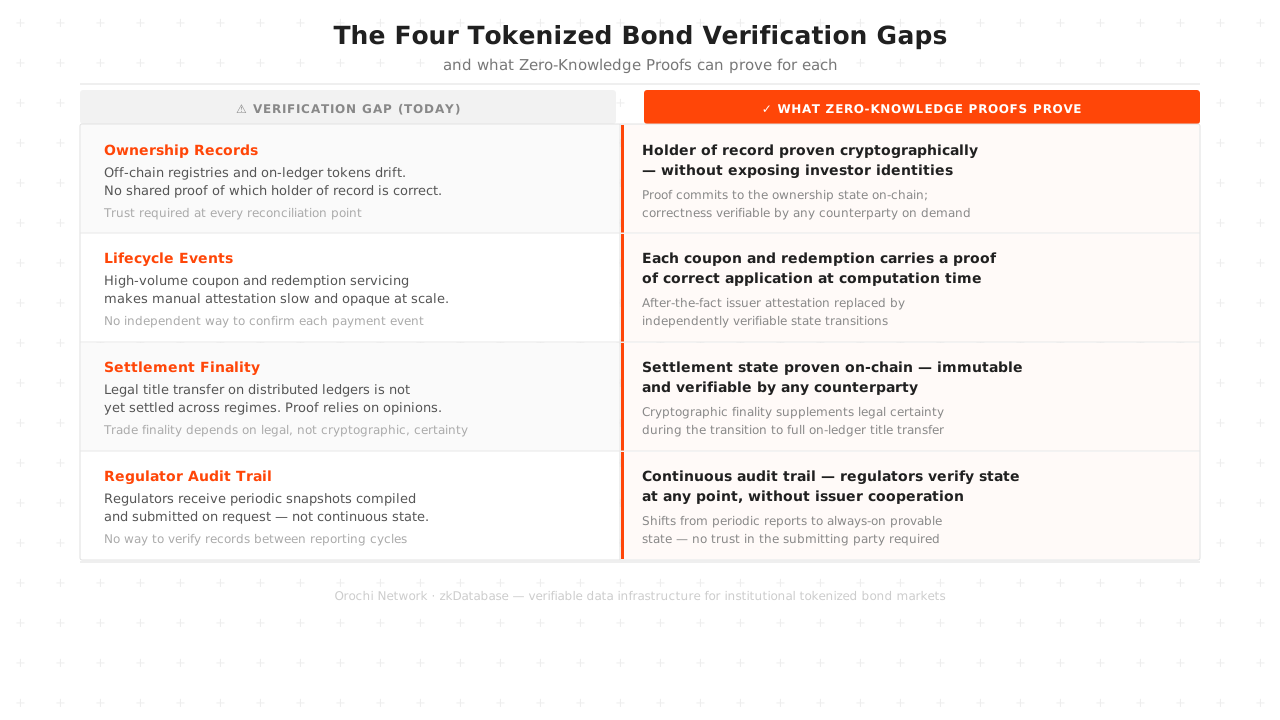 Tokenizing a bond moves the record on-chain; verifiable data infrastructure is what keeps it provable across its life.
Why is verifiable data infrastructure the missing layer for tokenized bonds?
Because scale needs assurance that is mathematical, not reputational. Verifiable data infrastructure lets an issuer or infrastructure provider generate cryptographic proof that a record is correct, so any counterparty or regulator can check it without trusting the party that produced it. For tokenized bonds, that means ownership, coupon application, and settlement state can each carry a proof that travels with the asset.
How do Zero-Knowledge Proofs give regulators access without exposing data?
Zero-Knowledge Proofs let one party prove a statement is true while revealing nothing beyond the statement itself. A provable database such as zkDatabase is built to apply that to off-chain records: it can prove that a bond's holder of record, coupon schedule, or reserve position matches the committed state, while keeping investor identities and commercial terms private. That resolves the tension the Expert Group has to manage, regulators want assurance, issuers need confidentiality, and verifiable computation gives both. Orochi Network builds this verifiable data infrastructure for exactly this class of institutional data.
Bottom line: Tokenizing a bond changes where the record lives. Proving the record stays correct over its life is the harder problem, and it is the one verifiable data infrastructure is designed to solve.
What does this mean for custody, settlement, and privacy in Hong Kong's RWA roadmap?
It means the next phase of tokenized bonds will be judged on provable data quality, not just on whether an asset can be put on a ledger. The presence of CMU OmniClear alongside global banks and digital asset firms points toward standardized custody and settlement that link distributed ledgers with traditional market infrastructure. Privacy is not optional in that design, since institutional issuers and their clients will not publish positions to a transparent chain.
What should issuers and infrastructure providers prepare now?
They should treat verifiable data as a design requirement, not a later add-on. Issuers planning to use the regime should map which lifecycle events need proof, decide what must stay private, and choose infrastructure that can prove state without exposing it. Engaging early, while the legal and regulatory review is still open, is how to shape practices rather than retrofit them.
Tokenized bonds in Hong Kong are now a policy priority rather than a pilot curiosity, and the binding constraint on scale is verifiable data infrastructure. The Expert Group's focus on legal certainty for issuance and transactions surfaces exactly the ownership, lifecycle, settlement, and audit questions that Zero-Knowledge Proofs are built to answer. Issuers and infrastructure providers that build proof into their data layer now will be the ones ready when the regime opens to scale.
Book Advisory Call
Talk to Orochi Network about verifiable data infrastructure for tokenized bond and RWA issuance in Hong Kong and across Asia.
FAQ
What are tokenized bonds and why is Hong Kong focused on them?
Tokenized bonds are fixed-income securities issued and serviced on a distributed ledger rather than through legacy registry systems. Hong Kong is focused on them because the HKMA sees tokenization as a way to modernize its fixed-income market, and on 5 June 2026 it convened a Tokenised Bond Expert Group to move from government pilots toward scaled private-sector issuance.
What is the HKMA Tokenised Bond Expert Group?
The Tokenised Bond Expert Group is a 21-member industry body convened by the HKMA on 5 June 2026 to drive adoption of tokenized bonds. It includes global banks, law firms, market infrastructure provider CMU OmniClear, digital asset firms, and associations. Its mandate is to explore policy measures and feed views into the HKMA and FSTB review of legal and regulatory enhancements.
Why do tokenized bonds need Zero-Knowledge Proofs?
Tokenized bonds need Zero-Knowledge Proofs because scaling beyond pilots requires assurance that is mathematical rather than reputational. Zero-Knowledge Proofs let an issuer prove that ownership records, coupon payments, and settlement state are correct without exposing investor identities or commercial terms, which gives regulators verifiable access while preserving the confidentiality institutional issuers require.
How does verifiable data infrastructure support tokenized bond compliance?
Verifiable data infrastructure supports tokenized bond compliance by attaching cryptographic proof to each record, so counterparties and regulators can confirm correctness without trusting the party that produced it. A provable database such as zkDatabase is designed to prove that off-chain bond data matches committed state, turning periodic reports into continuous, audit-ready verification while keeping sensitive details private.
Related toResearch