Orochi Essentials
Orochi Network's zkDA Layer (Layer 1 DA): Redefining Data Availability for Blockchain
November 10, 2025
7 mins read
Orochi Network’s zkDA Layer, the first Ethereum Foundation-sanctioned Zero-Knowledge Data Availability Layer, ensures secure, scalable, and provably correct data for Web3. Discover how it powers enterprise, AI, and DePINs with verifiable data.


In a blockchain-powered future where applications need provable, secure, and scalable data, Orochi Network's zkDA Layer (Layer 1 DA) leads the way. As the first Zero-Knowledge Data Availability Layer sanctioned by the Ethereum Foundation, Orochi offers a solid foundation for verifiable Web3 infrastructure. By intertwining modular architecture with Zero-Knowledge Proofs, zkDA Layer makes data not only available—but provably correct and chain-interoperable. This post explores the ways in which zkDA Layer unlocks the next generation of Verifiable Data for enterprise, RWA, AI, DePINs, and more.
What is zkDA Layer (Layer 1 DA)?
zkDA Layer (Layer 1 DA) stands for Zero-Knowledge Data Availability Layer. It is a new type of blockchain infrastructure built to ensure that data on the blockchain is not only available but also verifiable, scalable, and privacy-preserving.
Unlike traditional Data Availability Layers (DALs), which merely store and broadcast data, a zkDA Layer uses Zero-Knowledge Proofs (ZKPs) to cryptographically verify the correctness and integrity of that data. This creates a trustworthy foundation for modular blockchain architectures, where different layers (execution, consensus, and data) operate independently but securely.
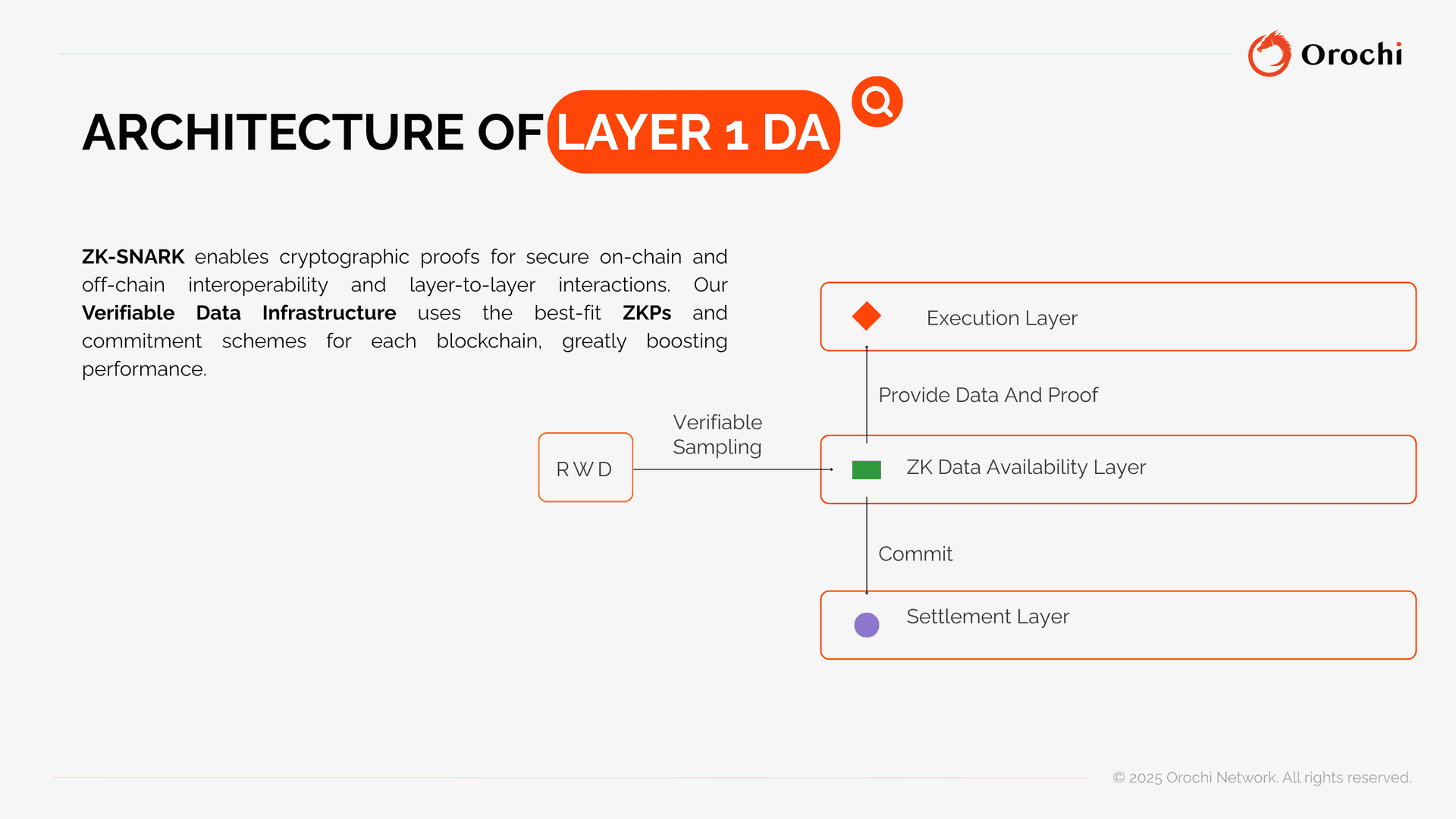
A zkDA Layer combines the following innovations:
-
Native integration with ZKPs for verifiable data integrity
-
Asynchronous consensus for better scalability
-
Support for multiple cryptographic commitment schemes for cross-platform compatibility
-
Verifiable data pipelines to guarantee data trustworthiness across its lifecycle
By offering both performance and verifiability, zkDA Layer (Layer 1 DA) is becoming a core component of next-generation decentralized infrastructure.
Why zkDA Layer (Layer 1 DA) Matters in Modular Blockchain
As blockchain technology evolves, modularity has emerged as the key to scaling efficiently. zkDA Layer (Layer 1 DA) plays a critical role in this landscape by solving the core issue of trustworthy, accessible data.
-
**Modular blockchain **architecture separates consensus, execution, and data availability into independent layers.
-
The **Data Availability Layer (DAL) **ensures blockchain data is accessible and trustworthy.
-
Existing solutions like Celestia and EigenDA combine blockchains with commitment schemes but face serious limitations:
-
**Synchronous systems: **slow down finalization.
-
**Single commitment schemes: **limit compatibility.
-
**No native Zero-Knowledge Proof (ZKP) support: **means no cryptographic proof of data integrity.
Current Limitations in Data Availability Layers
Despite innovation, current DALs still fall short in performance, security, and flexibility. Challenges with current DALs:
-
Synchronous processing = low performance, delays
-
Inflexible = only one proof system
-
Lack of verifiability = cannot confirm data correctness
-
Limited innovation = just storage, no trust guarantee
Introducing Orochi Network’s zkDA Layer (Layer 1 DA)
Orochi Network introduces the world’s first ZK-centric Layer 1 Data Availability Layer that overcomes legacy limitations with built-in verifiability, modular architecture, and cross-platform compatibility.
Key Features of zkDA Layer (Layer 1 DA):
Built from the ground up with enterprise-grade features, zkDA Layer (Layer 1 DA) provides the critical components needed for verifiable, scalable, and flexible blockchain infrastructure.
-
ZK-Centric Design:
-
Built from the ground up to support ZKPs.
-
Enables native
ZK-data-rollups
for scalable, private data processing.
-
Verifiable Data Pipeline:
-
Includes
cryptographic proofs
at each stage—sampling, storage, retrieval.
-
Ensures end-to-end data integrity and transparency.
-
Proof-System Agnostic:
-
Compatible with Pickles, Halo2, Nova, ZK-STARK, CairoVM.
-
Flexible integration with evolving cryptographic ecosystems.
-
Blockchain Agnostic:
-
Connects seamlessly with multiple Layer 1s and rollups.
-
Future-proof design for enterprise-grade applications.
-
Succinct Hybrid aBFT Consensus:
-
Asynchronous Byzantine Fault Tolerance (aBFT) improves finality.
-
DAG-based architecture reduces latency and increases performance.
Architecture of zkDA Layer (Layer 1 DA)
Built for adaptability and performance, the architecture of zkDA Layer delivers a flexible foundation for blockchain scalability.
Modular and Scalable
Modularity is at the heart of zkDA Layer, enabling it to integrate new cryptographic tools with ease.
- Allows easy integration of new commitment schemes:
Merkle Tree, Verkle Tree, KZG
- Separation of components = high performance + high customizability
ZK-data-rollups for Scalable Proofs
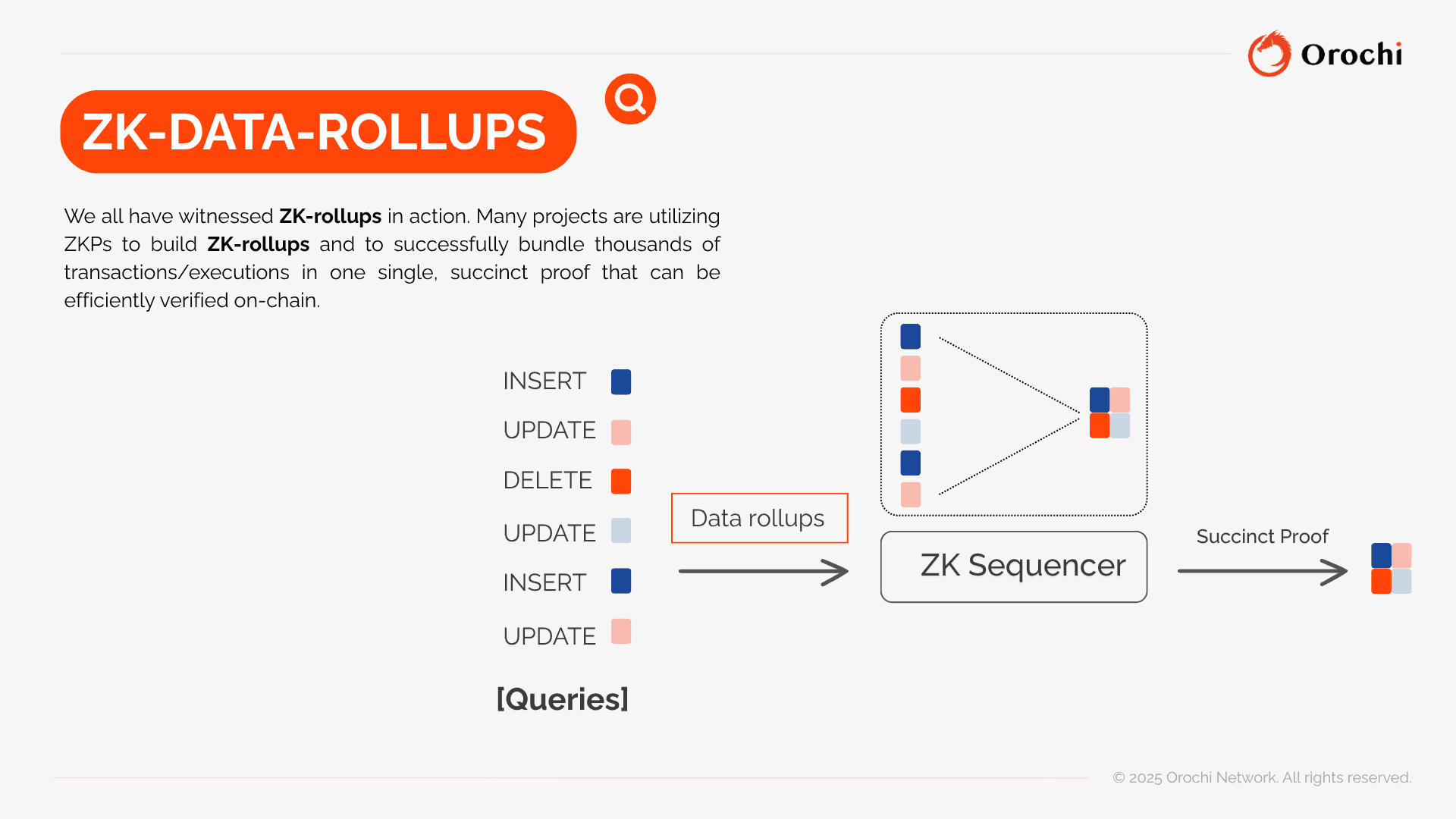
ZK-data-rollups empower fast, lightweight proof aggregation for high-throughput applications.
- Aggregates large data volumes into
one succinct proof
- Reduces gas costs and on-chain verification time
Verifiable Data Pipeline
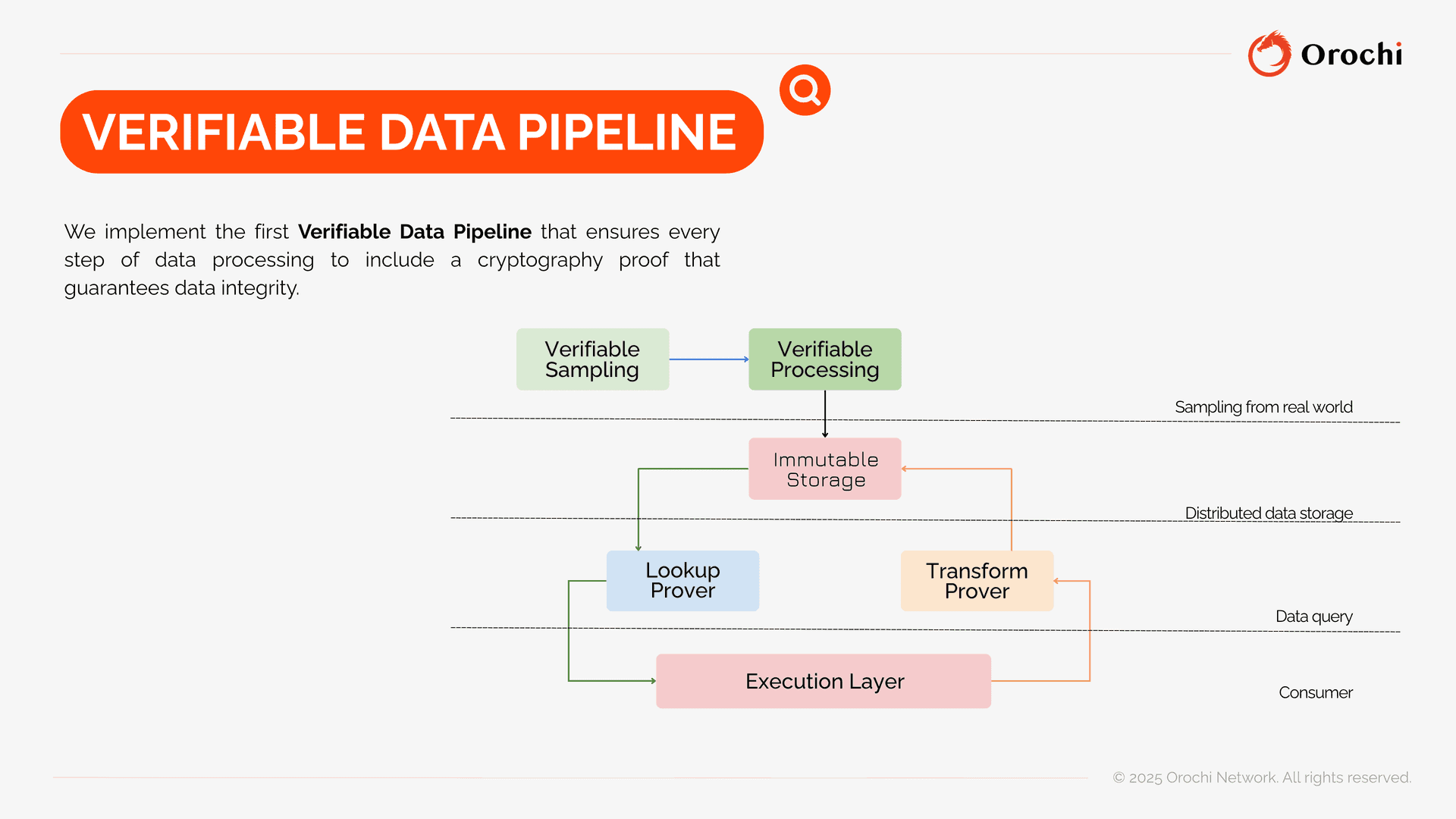
With cryptographic validation baked into each step, the data pipeline ensures end-to-end security.
-
Verifies every step:
-
Sampling: Proof of how data was selected
-
Storage: Proof of data integrity
-
Retrieval: Proof that returned data is untampered
zkDA Layer (Layer 1 DA) Development Roadmap
Orochi Network’s long-term roadmap brings continuous improvements to performance, compatibility, and developer experience.
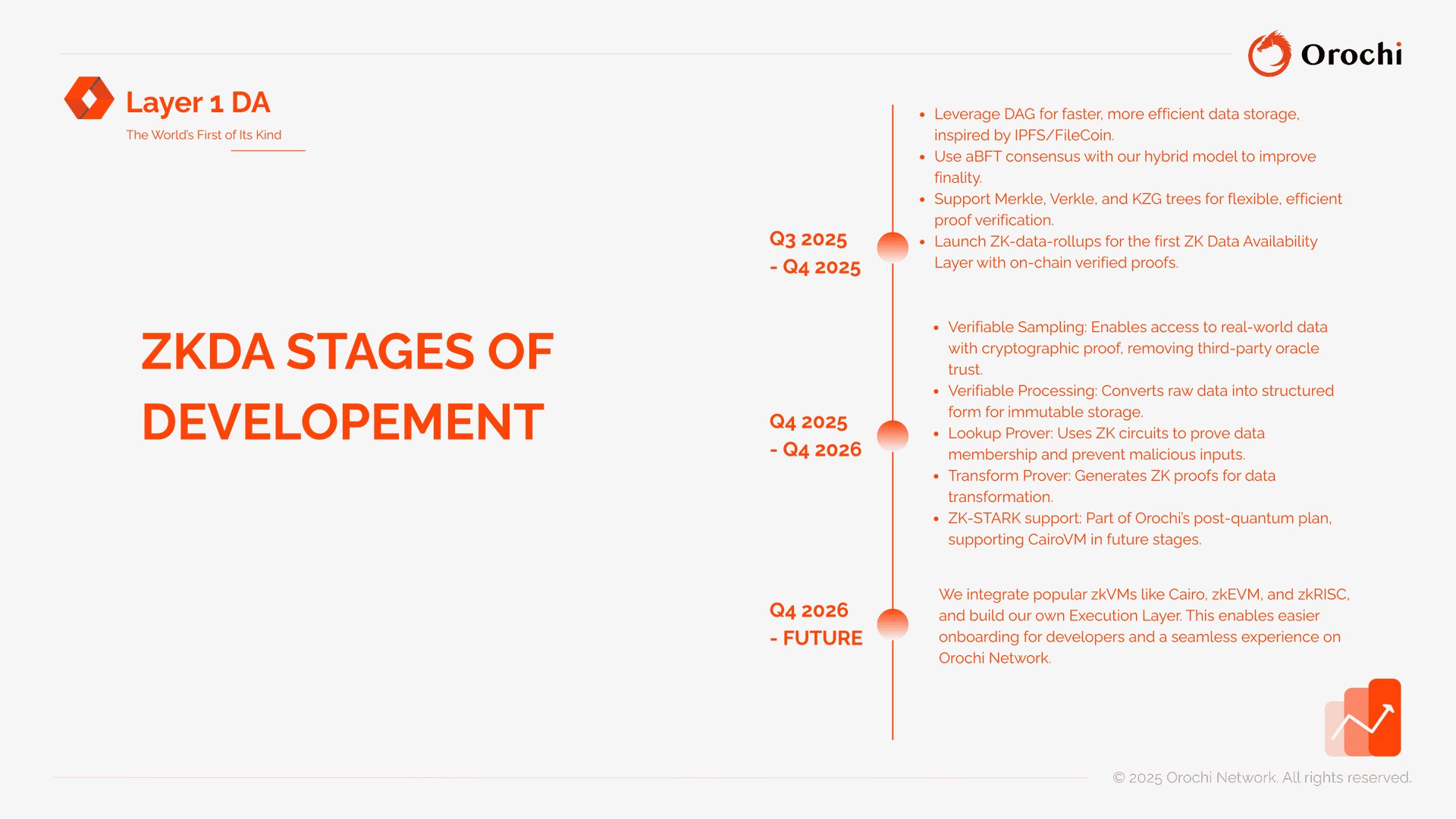
Stage 1: ZK-Friendly Data Availability Layer (Q3 2024 - Q3 2025)
Laying the foundation with DAG-based design and support for multiple proof schemes.
-
DAG-based distributed data storage inspired by IPFS/Filecoin
-
Succinct Hybrid aBFT Consensus for async finality
-
Multi-commitment support: Merkle, Verkle, KZG
-
First
ZK-data-rollups
for provable data integrity
Stage 2: Verifiable Data Platform (Q4 2025 - Q4 2026)
The next step integrates advanced verifiability modules for real-world data and transforms.
-
Verifiable Sampling: On-chain proof of data origin from real-world sources
-
Verifiable Processing: Proofs for data transformation before storage
-
Lookup + Transform Provers: Prevents malicious or false data insertion
-
ZK-STARK support: Post-quantum secure and Cairo-compatible
Stage 3: Execution Layer Integration (From Q4 2026 Onwards)
The final stage makes zkDA Layer a full-stack platform for building complex apps with embedded ZK execution.
-
Integrates zkVMs: Cairo, zkEVM, zkRISC
-
Custom execution environment for developers building on zkDA Layer
Use Cases of zkDA Layer (Layer 1 DA)
From data-heavy applications to privacy-first services, zkDA Layer supports a wide range of enterprise and blockchain use cases.

-
DePINs & IoT Infrastructure: Secure, verifiable data from sensors and edge devices
-
Tokenized Real-World Assets (RWA): Proof-backed asset data for compliant tokenization
-
AI/ML Pipelines: Verifiable data transformations supporting responsible AI
-
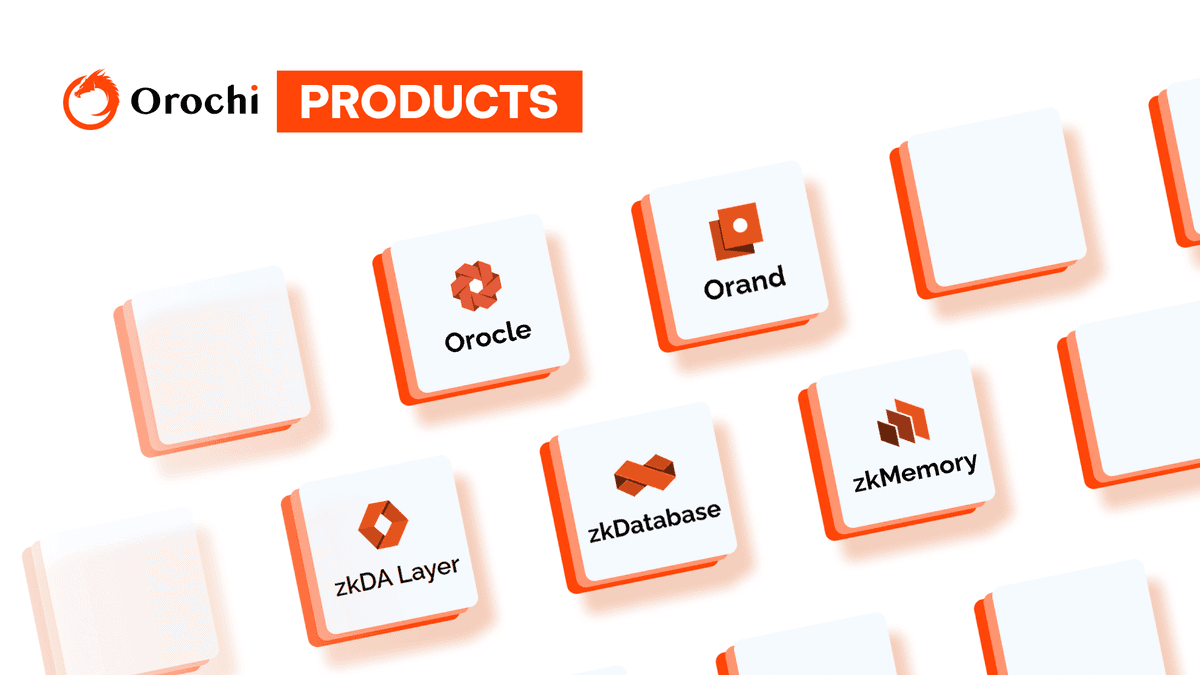
Gaming & Randomness: Fairness via Orand, Verifiable Randomness generator
-
DeFi & Oracles: Real-world data with Orocle for finance, insurance, and derivatives
-
Enterprise Data Management: zkDatabase enables structured, cryptographically verified data storage and access
Why Businesses Should Care About zkDA Layer (Layer 1 DA)
For enterprises and developers, zkDA Layer brings provable trust, performance, and interoperability at scale.
- Enterprises need scalable, verifiable infrastructure
to handle growing data and compliance needs.
-
zkDA Layer provides:
-
Verifiable access to real-world data
-
Multi-chain compatibility
-
Native ZKP integration = stronger privacy & security
-
Future-proofed architecture for AI, DePINs, and RWA tokenization
About Orochi Network
Orochi Network stands out as the world’s first Zero-Knowledge Data Availability Layer (zkDA Layer/Layer 1 DA), officially recognized and supported by the Ethereum Foundation—a strong endorsement of its pioneering approach to verifiable Web3 infrastructure.
This marks not just a milestone for Orochi but a shift in how blockchain projects are built: from simple data storage to verifiable, cryptographically backed pipelines. Orochi’s Verifiable Data Infrastructure is trusted by a broad spectrum of stakeholders—from dApps and enterprises to public infrastructure projects, featuring integrations across ecosystems like Ledger, Mina, Nexus, Plume, and even Bitcoin L2 networks such as B².
FAQs
Q1: What makes Orochi’s zkDA Layer different from other Data Availability solutions?
Orochi’s zkDA Layer embeds Zero‑Knowledge Proofs natively, delivering verifiable data integrity, asynchronous aBFT finality, and multi‑commitment support (Merkle, Verkle, KZG) for cross‑ecosystem compatibility. Traditional DALs mainly store/broadcast data and lack native ZKP verification.
Q2: Which proof systems and chains does zkDA Layer support?
It’s proof‑system agnostic (Pickles, Halo2, Nova, ZK‑STARK, CairoVM) and blockchain agnostic, integrating with multiple L1s and rollups. This ensures future‑proof interoperability across enterprise and Web3 stacks.
Q3: What real-world use cases benefit from zkDA Layer?
DePIN/IoT data verification, RWA tokenization with provable asset data, AI/ML pipelines with verifiable transforms, gaming randomness via Orand, DeFi oracles with Orocle, and enterprise zkDatabase for structured, cryptographically verified storage.
Related toOrochi Essentials