Research
Allocation Vaults: The Curator Layer Deciding Which RWA Gets Financed
July 28, 2026
8 mins read
Allocation vaults have become the primary distribution channel for tokenized assets in DeFi. A curator underwrites the collateral and sets the risk parameters. The constraint is the data: a curator can only finance what it can verify.


TL;DR: Allocation vaults are smart-contract vehicles where a curator, acting as an on-chain margin desk, underwrites tokenized collateral and deploys stablecoin liquidity against it. They are now the main channel routing capital into RWA. Their limit is verification: a curator prices the data it cannot independently confirm as risk, which caps how much tokenized collateral gets financed.
When tokenized private credit or Treasuries reach DeFi, one layer quietly decides which of them actually get financed: the allocation vault and its curator. zkDatabase gives that curator continuous, cryptographic evidence of collateral state, so underwriting reflects what is provable, not what is reported.
Key Takeaways
- Allocation vaults are now the primary distribution infrastructure routing on-chain capital into tokenized real-world assets.
- A curator, or risk manager, sits at the center: it approves eligible collateral, sets risk parameters, and allocates stablecoin liquidity, functioning like a prime broker's margin desk.
- The on-chain distribution stack has five layers: asset issuer, tokenization platform, lending protocol, risk manager, and distribution platform.
- Without a credible curator, a tokenized asset can exist on-chain yet remain unfinanceable at scale.
- zkDatabase lets the curator verify collateral state with Zero-Knowledge Proofs, replacing trust in reported data with on-chain evidence.
What are allocation vaults and who is the curator?
An allocation vault is a smart-contract vehicle, built on a DeFi lending protocol, where a curator underwrites eligible collateral and deploys depositor stablecoins against it across isolated markets. The closest traditional analogue is a prime broker's collateral and margin desk. Depositors supply liquidity, usually a stablecoin; the curator decides what that liquidity can be lent against and on what terms.
The trust model differs from a traditional fund in one structural way: rules are enforced by code, not courts. A general partner is bound by a limited-partnership agreement that you sue over after the fact. A curator is bound by smart-contract parameters that enforce ex ante, where an out-of-policy action simply fails to execute. That makes the parameters, and the data they depend on, the entire risk surface.
This is why the curator is the decisive actor in RWA distribution. The asset issuer mints; the tokenization platform wraps; the lending protocol executes. But the curator is the one taking an underwriting view on whether a tokenized asset is safe to finance.
Why is the curator the bottleneck for RWA in DeFi?
The curator is the bottleneck because a tokenized asset only becomes financeable once a credible risk manager will underwrite it, and underwriting depends on data the curator can verify. An asset can be minted, wrapped, and listed, yet sit idle if no curator will allocate against it. As operator surveys now show, distribution and financing, not issuance, are the binding constraints on tokenized assets.
The five-layer distribution stack makes the dependency explicit. Each layer hands risk to the next, and the curator absorbs most of it.
| Layer | Traditional analogue | Function | Verifies the asset? |
|---|---|---|---|
| Asset issuer | Fund / originator | Creates the underlying RWA | Self-reports |
| Tokenization platform | Transfer agent | Wraps the asset as a token | Reports token state |
| Lending protocol | Exchange / clearing | Executes lending, liquidations | No, asset-agnostic |
| Risk manager (curator) | Margin desk | Underwrites collateral, sets parameters | Must verify, often cannot |
| Distribution platform | Broker front-end | Aggregates deposits, shows yield | No |
The lending protocol is deliberately asset-agnostic: it enforces parameters and uses oracle feeds for pricing and liquidation, but it does not underwrite. So the judgment about collateral quality lands entirely on the curator, who frequently has to take that judgment on reported data rather than verifiable data.
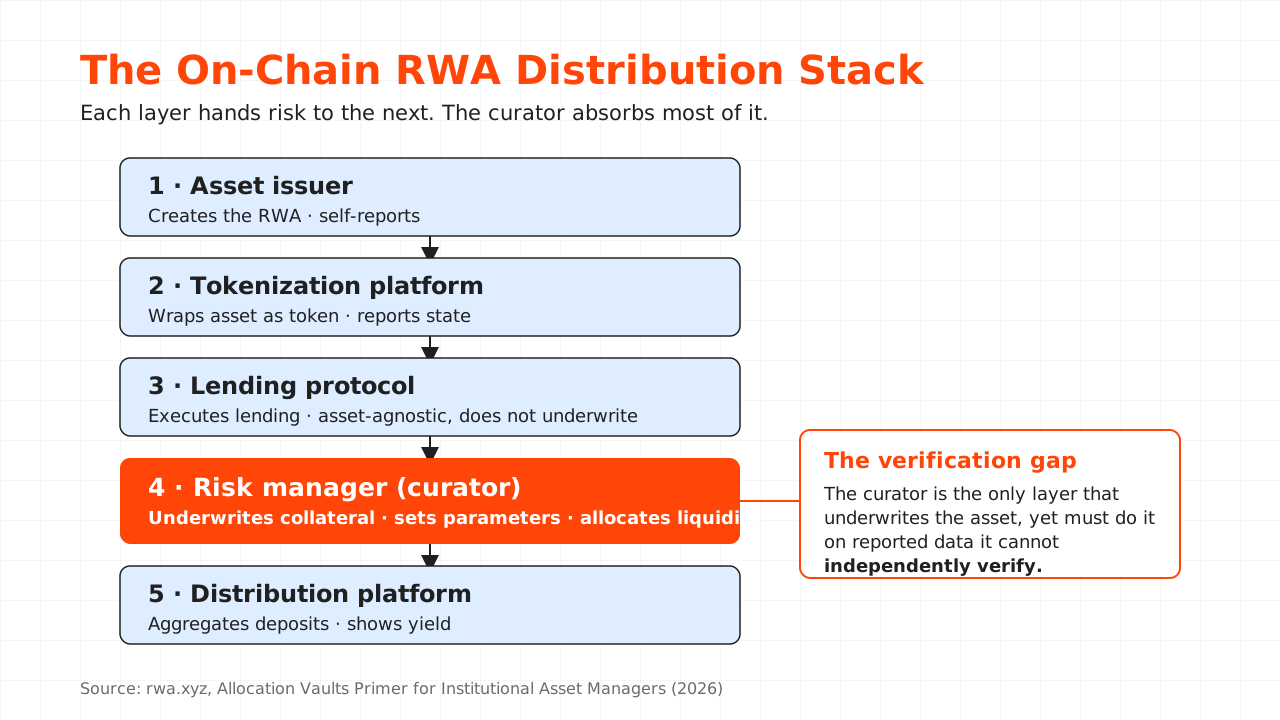 The curator is the only layer that underwrites the collateral, and the only layer forced to do it on reported data it cannot independently verify.
What data must a curator verify before financing tokenized collateral?
Before allocating against tokenized collateral, a curator needs to confirm the asset is real and segregated, that its valuation is current, and that its quality has not drifted since onboarding. Each of these is a continuous question, not a one-time check, because a borrowing position lives 24/7 while the underlying reporting often does not.
- Existence and segregation: does the token represent a real, ring-fenced asset, not a claim that has been pledged elsewhere?
- Valuation: is the NAV or mark current and correctly computed, or is the oracle repeating a stale off-chain figure?
- Quality drift: for private credit collateral, have covenants held and has borrower performance changed since the vault listed it?
When the curator cannot confirm these continuously, it does the rational thing: it widens the safety margin. Lower loan-to-value, tighter caps, or no listing at all. That conservatism is the price of unverifiable data, and it is exactly what keeps RWA utilization low, the same dynamic behind the broader RWA activation gap.
How does verifiable data change curator underwriting?
Verifiable data changes underwriting by replacing the curator's trust assumptions with cryptographic evidence, so risk parameters can track reality instead of uncertainty. Instead of consuming a reported NAV or a custodian's letter, the curator verifies a proof that the underlying data satisfies the stated condition, generated before anything reaches the chain.
For tokenized private credit, that means the curator can confirm borrower-level performance and covenant status without the loan tape being exposed. For a tokenized fund, it means proving the NAV was computed correctly without publishing the position book. The sensitive record stays private; the condition the curator underwrites against is provable. This is the practical link between tokenized private credit verification and whether a vault can finance it at scale.
zkDatabase does not replace the curator's judgment, the auditor, or the custodian. It gives the curator a data point it can verify without trusting whoever produced it, which is the difference between underwriting blind and underwriting on evidence.
Bottom line: The curator is the market's risk underwriter for tokenized assets, and an underwriter is only as good as the data it can verify. Cryptographic proof is what lets the curator finance more without taking on more hidden risk.
How does zkDatabase fit the allocation vault stack?
zkDatabase sits between an asset's off-chain data and the curator that has to underwrite it, turning reported collateral state into Verifiable Data the vault can check on-chain. It targets the exact handoff where financing stalls: the moment a risk manager decides whether tokenized collateral is safe to allocate against.
- Pain: the curator underwrites on reported NAV, custody letters, and periodic covenant updates it cannot independently confirm.
- Mechanism: zkDatabase produces Zero-Knowledge Proofs across the asset's data pipeline, from ingestion to on-chain verification.
- Outcome: the vault verifies existence, valuation, and covenant status continuously, without exposing the data behind them.
For institutional asset managers running on-chain strategies, this is what makes the difference between institutional DeFi that institutions can underwrite and a market that stays stuck at single-digit utilization.
Conclusion
Allocation vaults turned the curator into the most important actor in RWA distribution: the on-chain margin desk that decides which tokenized assets get financed and at what terms. That decision is a verification problem. A curator prices unverifiable data as risk, and that risk shows up as conservative parameters and idle collateral. Verifiable Data Infrastructure is how the curator's underwriting moves from trusting reports to checking proofs. zkDatabase is built to give the curator that evidence, so more tokenized collateral can be financed without importing hidden risk into the vault.
Explore zkDatabase
See how a Verifiable Data Pipeline gives curators on-chain evidence of collateral state instead of reported figures.
FAQ
What are allocation vaults in DeFi?
Allocation vaults are smart-contract vehicles, built on DeFi lending protocols, where a curator underwrites eligible collateral and deploys depositor stablecoin liquidity against it across isolated lending markets. They function like an on-chain prime-broker margin desk and have become the primary channel routing capital into tokenized real-world assets. Their defining feature is that risk rules are enforced by code rather than by contract law.
What does a curator or risk manager do in an allocation vault?
A curator, also called a risk manager, approves which collateral a vault can accept, sets the risk parameters such as loan-to-value and caps, and allocates stablecoin liquidity across markets. It is the underwriting function of the stack. Because the lending protocol itself is asset-agnostic, the curator carries the judgment about whether a tokenized asset is safe to finance.
Why do tokenized assets stay unfinanced even after issuance?
Tokenized assets stay unfinanced because issuance does not make an asset financeable; a credible curator still has to underwrite it. When the curator cannot verify the collateral's existence, valuation, and quality continuously, it applies conservative parameters or declines to list the asset. The constraint is verification cost and underwriting risk, not a shortage of tokenized supply.
How does zkDatabase support allocation vault curators?
zkDatabase generates Zero-Knowledge Proofs over an asset's off-chain data, so a curator can verify collateral existence, NAV, and covenant status on-chain without seeing the underlying data. This replaces reported data with Verifiable Data, letting the curator set risk parameters against what is provable rather than what is attested, which is the condition for financing more tokenized collateral safely.
Related toResearch