Real - World Assets
RWA as DeFi Collateral: The Data Integrity Problem Nobody Talks About
July 28, 2026
12 mins read
Aave Horizon has crossed $550M in RWA deposits. Lending protocols are building on tokenized treasuries and private credit as collateral. But the collateral data powering these positions cannot be cryptographically verified — and that gap is growing.


TL;DR: Aave Horizon holds $550M in tokenized RWA deposits. The collateral values powering those positions cannot be cryptographically verified. The oracle infrastructure confirms whether a reported NAV falls within pre-defined bounds, it does not prove the underlying data was correct. When that gap closes with erroneous liquidations, the cost is real. zkDatabase provides end-to-end cryptographic proof across the collateral data pipeline.
The RWA as DeFi collateral thesis is no longer speculative. Institutional-grade tokenized assets, U.S. Treasury funds, private credit notes, tokenized money market instruments, are now the collateral base for a new class of on-chain lending markets. The logic is sound: yield-bearing, regulated, off-chain assets backing DeFi loans should reduce volatility risk versus crypto-native collateral. But the model rests on a data assumption that has not been tested under stress. Every collateral position in these markets is valued using NAV data that is reported, relayed, and range-checked, but never cryptographically proven. This is the RWA as DeFi collateral gap that protocol engineers and risk heads need to understand before the market finds out the hard way.
Key Takeaways:
- Aave Horizon's oracle infrastructure validates that reported NAV values fall within pre-defined bounds, this is range-checking, not cryptographic proof of data provenance
- RWA NAV data updates at most once per business day; DeFi lending protocols execute continuously, the gap between those two facts is where erroneous liquidations happen
- A May 2025 oracle malfunction caused $500K+ in erroneous DeFi liquidations, illustrating the cost of trust-based verification at institutional scale
- Apollo's acquisition of a 9% governance stake in Morpho signals that traditional credit is entering DeFi risk parameter governance, without addressing the data verification layer
- zkDatabase's Verifiable Data Pipeline provides cryptographic proof from data ingestion through storage, query, and on-chain verification, closing the gap between "reported" and "proven"
How Does Aave Horizon Actually Work?
Aave Horizon is a permissioned lending market built on Aave V3.3, launched on Ethereum mainnet in August 2025. Institutional counterparties deposit tokenized RWAs, U.S. Treasury funds from Superstate and WisdomTree, tokenized money market instruments from Circle, private credit notes from Centrifuge, and borrow against them. The market hit $440M in deposits within months of launch and has continued growing, with some estimates placing it above $550M by May 2026.
The oracle infrastructure powering collateral valuation uses NAVLink, a system that receives Net Asset Value data from asset issuers and checks whether the reported figure falls within pre-defined upper and lower price bounds. If the number is within range, it publishes to the protocol. If the number is outside range, it rejects. The Decentralized Oracle Network then propagates the value to on-chain smart contracts, which use it to determine collateral ratios, margin requirements, and liquidation thresholds.
This is the part of the architecture that deserves closer scrutiny. The oracle confirms plausibility. It does not prove accuracy. The range bounds are set in advance, which means a systematically incorrect NAV, one that is consistently wrong but consistently wrong within the expected range, passes every check. There is no cryptographic link between the reported value and the underlying assets it represents. The trust assumption sits with the data reporter, not with math.
What Is the Actual Verification Gap?
The data integrity problem in RWA collateral has two dimensions that compound each other.
The first is structural. Most tokenized RWA funds update their on-chain NAV once per business day, typically at market close. DeFi lending protocols run continuously, 24 hours a day. Between those two cadences sits a window where on-chain collateral values are stale, sometimes by hours, sometimes overnight. During that window, a borrower's collateral could have declined in real-world value without the protocol's liquidation engine knowing it. The on-chain price is not wrong because someone lied. It is wrong because it reflects yesterday's calculation.
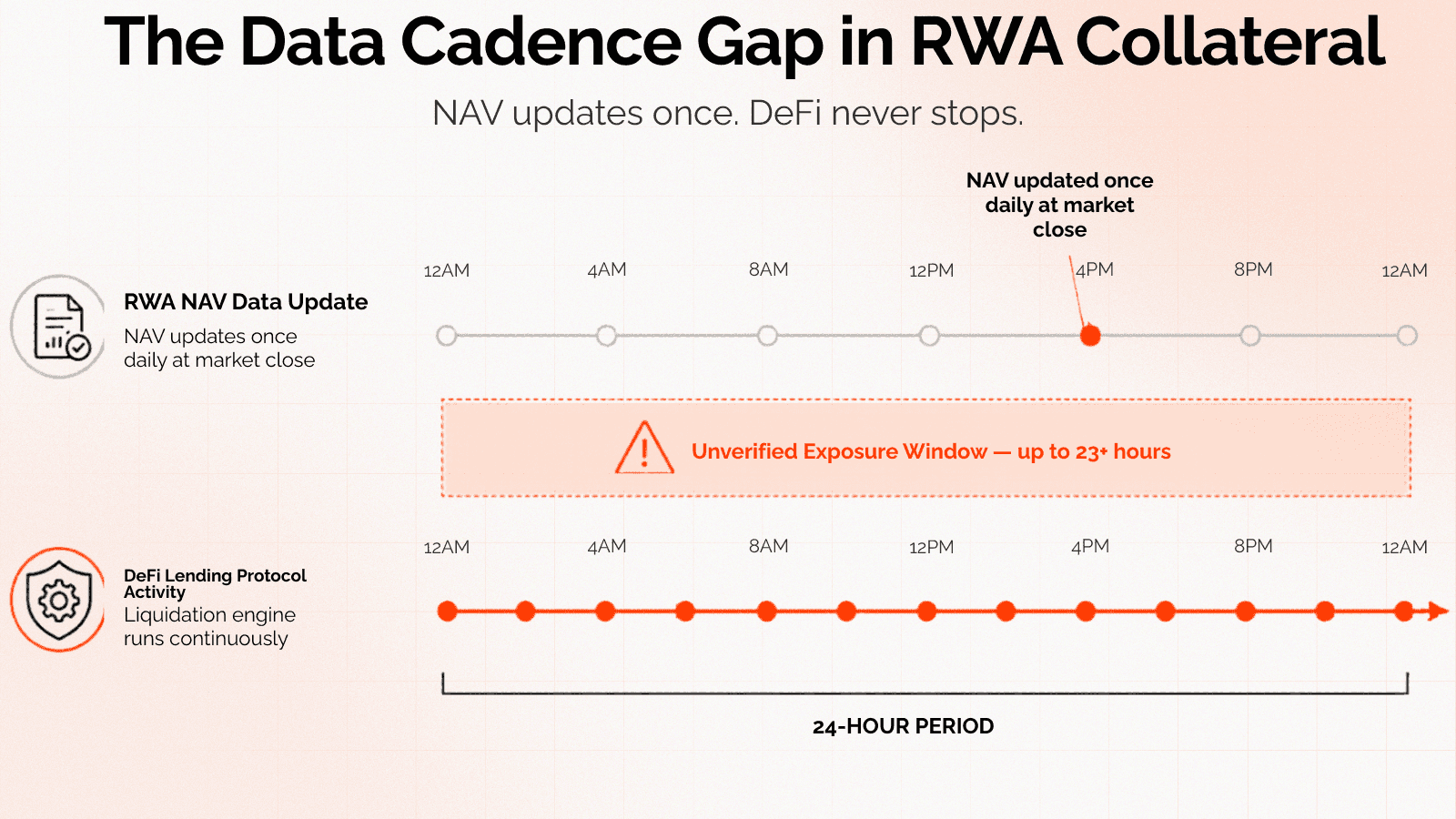 NAV data updates at market close. DeFi liquidation engines run 24/7. The gap between those two facts is where erroneous liquidations happen.
The second dimension is provenance. Even when a NAV update occurs, the data pipeline from fund administrator to oracle to on-chain contract involves multiple trust handoffs. A fund administrator calculates NAV based on custodian records, applies valuation methodologies, and reports a number. That number enters an oracle system that checks whether it is plausible. The oracle does not verify that the calculation was correctly performed. It does not verify that the custodian records were accurate. It does not verify that the methodology was consistently applied. It verifies that the number is within a range. That is a meaningfully weaker guarantee than the one most protocol risk heads assume they are receiving.
The cost of this gap is not hypothetical. In May 2025, an oracle malfunction caused $500K+ in erroneous DeFi liquidations, positions were liquidated not because collateral was actually insufficient, but because the data reaching liquidation contracts was incorrect. It is one of a growing pattern of structural data-verification failures across DeFi, stablecoins, and RWA. At $550M in deposits, the same failure at proportional scale would be an order of magnitude larger. The oracle manipulation risk does not require a malicious actor. It requires only a data error that passes a range check.
Why Does Governance Without Verification Fall Short?
The arrival of traditional credit institutions into DeFi governance is one of the more consequential structural shifts of 2025-2026. Apollo's acquisition of a 9% governance stake in Morpho, giving it direct influence over risk parameters for on-chain credit products, is the clearest example. The logic from Apollo's side is straightforward: if institutional credit is going to flow through DeFi infrastructure, the institutions that understand that credit should help set the parameters governing it.
This is not wrong. But governance of risk parameters and verification of underlying data are different problems. Apollo can help Morpho set appropriate loan-to-value ratios, appropriate collateral concentration limits, appropriate liquidation triggers. What governance cannot do is verify that the collateral data feeding those triggers is correct at any given moment. The risk parameter framework is only as reliable as the data it runs on. If the NAV data for a private credit collateral pool is stale by 18 hours, the most carefully constructed governance framework will produce the wrong liquidation outcome.
The audit layer for RWA problem is not about whether governance structures are well-designed. It is about whether the data those governance structures consume can be cryptographically verified. Currently, it cannot.
What Does Cryptographic Collateral Verification Actually Require?
Understanding why range-checking is insufficient requires understanding what verifiable data infrastructure actually does differently.
In the current model, a fund administrator calculates NAV, reports a value, and the oracle network checks that value against bounds. The data is treated as true if it is plausible. The verification is at the transport layer: did this value arrive through an authorized channel? That is what oracles confirm. Oracles confirm data came through authorized sources. zkDatabase confirms the data was real.
Cryptographic collateral verification operates on a different model. Instead of checking whether reported data is plausible, it generates a proof that the data satisfies specific conditions, and that proof can be verified by anyone, including on-chain smart contracts, without requiring trust in the data reporter. The proof is not a range check. It is a mathematical statement that the reported NAV was derived from a specific set of inputs in a specific way. If those inputs change, or if the derivation changes, the proof fails. No range-bounds gaming can simulate a valid proof.
zkDatabase's Verifiable Data Pipeline implements this model end-to-end: data ingestion, storage, query, and on-chain proof generation are all covered by cryptographic commitments. The proof system uses Groth16, producing 192-byte proofs that cost approximately 200,000 gas to verify on-chain and take less than 0.5 seconds to generate. The on-chain contract does not trust the collateral value. It verifies the proof that the collateral value is correct.
This distinction matters specifically for DeFi lending protocols using RWA collateral. When a liquidation event triggers, the question the protocol needs to answer is not "is this NAV plausible?" It is "is this NAV proven?" At $550M in deposits, those are different questions with different answers and potentially different outcomes.
How Does This Scale as RWA Collateral Grows?
The problem does not stay contained at current scale. The $550M in Aave Horizon deposits represents one market in an ecosystem that is still in early formation. Projections from BCG/Ripple place the tokenized asset market at $9.4 trillion by 2030, with a significant portion expected to serve as collateral in on-chain lending markets. As the collateral base grows, the verification gap does not disappear, it scales.
The growth compounds the risk in a specific way. At small scale, erroneous liquidations from stale or incorrect NAV data are operational problems. At institutional scale, they become systemic risks. A private credit pool with $200M in tokenized notes as collateral, updating NAV monthly because the underlying loans are illiquid, creates extended windows where the on-chain value and the real-world value can diverge materially. The liquidation engine does not know the difference between a correctly reported NAV and a NAV that has not been updated in 23 days.
The regulatory environment is also shifting in ways that increase the verification requirement. MiCA's reserve and asset integrity requirements, now in enforcement phase, demand ongoing data accuracy, not point-in-time attestations. Monthly or daily NAV updates verified only by range-checking do not satisfy continuous verification requirements. As DeFi lending protocols seeking institutional capital access regulated jurisdictions, the verification standard they operate under will need to meet the verification standard regulators require. Those two standards are currently misaligned.
What Does the Verification Layer Look Like in Practice?
For a DeFi lending protocol engineering team evaluating this problem, the implementation path with zkDatabase looks like this:
The protocol's collateral value data enters the zkDatabase Verifiable Data Pipeline at ingestion. Each NAV update from a fund administrator is committed to the database with a cryptographic proof that the value was correctly received and stored. When the protocol queries collateral values for margin calculations, the query result carries a proof that it was correctly retrieved from authenticated data. When that value reaches the on-chain smart contract powering liquidation logic, the contract verifies the Groth16 proof rather than consuming a raw oracle feed.
The result is not a faster oracle. It is a different trust model. The smart contract no longer depends on a range check performed by an off-chain network of nodes. It verifies a mathematical proof that the collateral value derives from authenticated data, correctly computed, correctly stored, and correctly retrieved. That proof is 192 bytes. It costs approximately 200,000 gas to verify. It takes less than 0.5 seconds to generate. It is either valid or it is not.
For risk heads at lending protocols, this changes the liquidation guarantee from "we trust the oracle reported a plausible value" to "the liquidation engine verified a cryptographic proof of collateral value." Those are different guarantees, and the difference matters at institutional scale.
Why This Is the Next Infrastructure Layer, Not a Critique?
Aave Horizon's achievement should not be understated. Building the compliance infrastructure, the institutional partner relationships, and the on-chain market mechanics to attract $550M+ from institutional counterparties required solving problems that had never been solved in production before. The range-checking oracle model is not a design flaw. It is what was available, and it was sufficient to demonstrate that institutional capital will move on-chain when the environment is structured correctly.
The data infrastructure gap is the next problem. It is the one that determines whether Aave Horizon scales to $1 billion, then $4 billion, or whether the oracle trust model produces incidents at scale that force institutional counterparties back to traditional credit markets.
For protocol teams evaluating institutional lending markets of their own, the architectural question is not whether to use an oracle network; oracles remain necessary for data delivery. The question is what verification layer sits underneath the oracle, proving that the delivered value was computed from authenticated inputs before smart contracts execute irreversible on-chain logic.
Aave Horizon demonstrated that demand exists. The $550M in deposits is the proof. The next infrastructure layer is what converts that demand signal into a durable market, one where institutional counterparties can verify computation integrity instead of relying only on the data reporter.
Frequently Asked Questions
Does updating NAV more frequently solve the verification gap?
More frequent updates reduce the staleness problem but do not address the provenance problem. An NAV that updates every hour and is still only range-checked is still only verified for plausibility, not for correctness. The verification gap has two dimensions, cadence and provenance, and frequency updates address only one. Cryptographic verification addresses both.
Is oracle manipulation the primary risk, or is it data error?
Both are real risks, but data error is more likely and harder to detect. Oracle manipulation requires a deliberate attack on the oracle network. Data error requires only a fund administrator that makes an honest mistake in NAV calculation, or a data pipeline that updates inconsistently. Range-checking will not catch a data error that falls within expected bounds. Cryptographic verification will catch any error that changes the underlying computation, regardless of whether it was deliberate.
What is the integration path for a protocol already using existing oracle infrastructure?
zkDatabase's Verifiable Data Pipeline is not a replacement for the entire oracle stack. It functions as a verification layer that sits underneath existing data flows and adds cryptographic proof at each step. A protocol currently using oracle infrastructure for NAV feeds can add zkDatabase to prove that those NAV values derive from authenticated source data, without replacing the existing oracle network. The NoSQL SDK provides a familiar developer interface, and the blockchain-agnostic architecture supports EVM-compatible chains without additional migration overhead.
Related toReal - World Assets