Real - World Assets
Tokenized Fund Data Integrity: The Verifiable Layer That Capital Markets Are Missing
July 28, 2026
10 mins read
Tokenized funds have solved distribution and liquidity. They have not solved the data layer beneath the NAV. Smart contracts execute against fund values no one can verify on-chain, and that gap is where operational and regulatory risk compounds.


TL;DR: Tokenized funds have scaled fast: BlackRock BUIDL crossed $2.5B and tokenized Treasuries hit $10.8B in Q1 2026. The data layer powering them remains manually attested and operator-controlled: NAVs are calculated off-chain and pushed on-chain as trusted feeds no smart contract can verify. A verifiable data layer generating cryptographic proofs for every NAV update closes this gap.
When settlement logic runs against a fund's reported NAV, it either executes on verified inputs or on numbers nobody can independently check. Tokenized fund data integrity decides which: without cryptographic proof that NAV, reserve composition, and compliance conditions were computed from authenticated off-chain inputs, every formal audit cycle leaves a window of unverified data between reporting dates.
Key Takeaways:
- Tokenized fund data integrity is the missing layer between off-chain NAV calculation and on-chain smart contract execution
- NAVs for major tokenized funds typically update once per business day while tokens trade continuously, creating unverified data windows
- Operator-controlled update mechanisms make data integrity a function of process trust, not cryptographic proof
- MiCA's six-monthly audit mandate and HKMA's daily reporting requirements create compliance obligations that periodic attestation alone cannot satisfy continuously
- zkDatabase generates a Zero-Knowledge Proof for each NAV state transition, verifiable by EVM-compatible smart contracts without exposing fund strategy or portfolio data
What Is Tokenized Fund Data Integrity and Why Does It Matter?
Tokenized fund data integrity is the property that a fund's Net Asset Value, asset composition, and compliance status can be verified cryptographically by on-chain smart contracts, not just accepted on the basis of the fund administrator's assertion or a periodic third-party attestation.
Today, none of it is verified cryptographically. The process at every major tokenized fund platform follows the same pattern: a fund administrator calculates NAV off-chain using custody data, the value is pushed to an on-chain oracle or update mechanism, and smart contracts consume that published value as a trusted input. The contract executes against whatever was pushed. It has no way to verify whether the computation was correct, whether the portfolio composition changed since the last update, or whether the published value reflects authenticated administrator data.
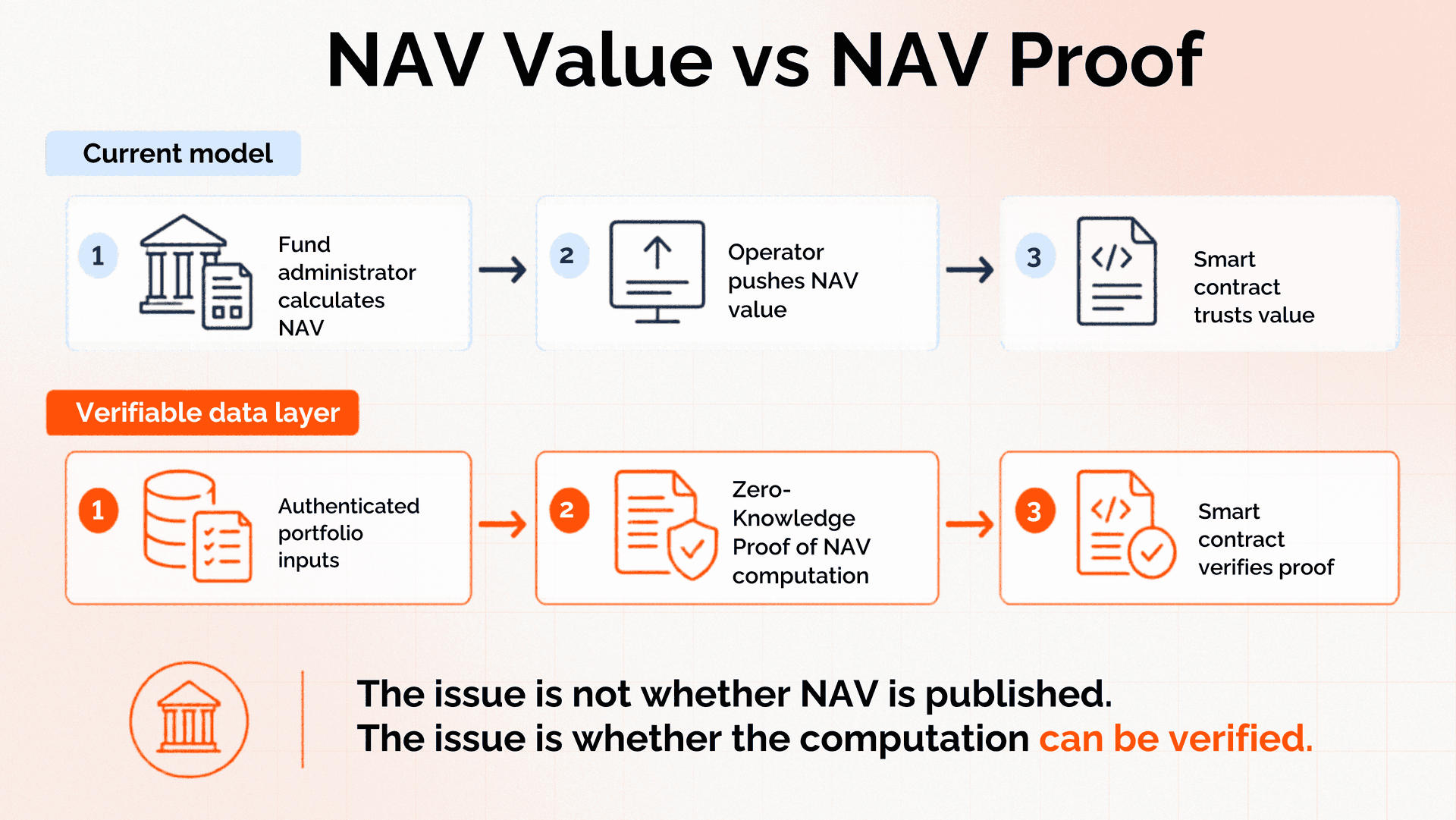 Tokenized fund data integrity requires more than publishing a NAV value. A verifiable data layer proves the NAV was computed correctly from authenticated portfolio inputs.
Tokenized fund data integrity requires more than publishing a NAV value. A verifiable data layer proves the NAV was computed correctly from authenticated portfolio inputs.The scale of the market makes this gap consequential. Tokenized Treasuries reached $10.8B in Q1 2026 across 73 products. BlackRock BUIDL alone crossed $2.5B and expanded to 8 blockchains. Franklin Templeton's FOBXX operates across 10 chains. In May 2026, BlackRock continued deepening its tokenization push with new on-chain fund offerings. The market is not slowing. But the verification layer beneath it has not kept pace with the distribution layer above it.
McKinsey projects tokenized financial assets at $2T by 2030 base case. The infrastructure decisions made during the current scaling window define what verification standard institutional capital operates against for the next decade.
Bottom line: The tokenized fund market has built the distribution rails. The cryptographic verification layer beneath the NAV is the piece those rails currently lack.
What Are the Four Data Gaps in Today's Tokenized Fund Architecture?
Four specific architectural gaps expose tokenized fund issuers and platforms to operational risk, regulatory liability, and settlement failures. None are resolved by the current combination of oracle feeds and periodic attestation.
Gap 1: NAV lag against continuous trading. Most tokenized funds update their on-chain NAV once per business day, typically at market close when the underlying securities settle. Tokens backed by those NAVs trade 24 hours a day, 7 days a week. Between each NAV update, the on-chain price may no longer reflect the portfolio's actual composition. Any protocol using tokenized fund shares as collateral is lending against a stale value for the majority of each trading day.
Gap 2: Operator-controlled update mechanisms. The largest platforms update their on-chain oracle through a single authorized entity. Ondo Finance's update mechanism relies on a trusted address that posts NAV data after reconciliation with the fund administrator. A separate fund-admin-controlled system handles the Securitize tokenized product range. Data integrity is a function of the operator's internal process, not a cryptographic guarantee independent of it.
Gap 3: Multi-chain state fragmentation. When BUIDL operates across 8 blockchains and FOBXX across 10, there is no standardized mechanism to verify reserve or compliance state simultaneously across all deployments. A compliance attestation on Ethereum says nothing about the same asset's state on Arbitrum, Stellar, or Aptos. Institutional counterparties operating across chains have no single, cryptographically consistent view of a fund's reserve position.
Gap 4: Compliance rules executing against unverified inputs. ERC-3643 and ERC-1400 embed compliance logic in token transfer rules. The underlying data those rules depend on, including KYC status, investor eligibility, and exposure limits, comes from off-chain sources that are not cryptographically verified at execution time. A technically compliant transfer can still execute against stale or manipulated eligibility data.
The cost of these gaps is visible in real incidents. A major fiat-backed stablecoin depegged significantly in April 2025 when reserve adequacy could not be demonstrated in real time. A synthetic stable asset lost its peg when a hardcoded oracle continued pricing the asset at $1.00 despite an undisclosed structural change. In both cases, the data layer failed before the collateral did.
Reviewing the off-chain risks in tokenization shows these are not isolated failures. They reflect structural dependence on data pipelines that have no cryptographic integrity guarantee.
Bottom line: These four gaps are structural, not vendor-specific. Every major tokenized fund platform shares them because no verifiable data layer exists between off-chain administration and on-chain settlement.
How Does zkDatabase Solve the Tokenized Fund Data Integrity Problem?
zkDatabase sits between the fund administrator's systems and the on-chain smart contracts that consume NAV data and execute settlement logic. Every data operation: an NAV update, a reserve composition change, an eligibility status update, generates a Zero-Knowledge Proof. The on-chain contract verifies that proof independently. It does not trust the administrator's assertion; it verifies the computation.
Four capabilities address the gaps described above.
Verifiable NAV computation. zkDatabase generates a Zero-Knowledge Proof that a NAV was computed correctly from authenticated inputs, not just that a value was delivered through an authorized channel. The smart contract receives cryptographic confirmation that the methodology was followed over committed inputs. Fund strategy, portfolio holdings, and counterparty positions remain encrypted off-chain.
Continuous audit trail between formal cycles. Every state transition generates a proof timestamped and cryptographically linked to the previous state. MiCA's six-monthly audit mandate and HKMA's daily reporting requirements both draw on this continuous record, not a batch extraction at audit time. The evidence is already generated; the auditor reviews it rather than requesting fresh raw data disclosure.
Selective disclosure for compliance verification. Eligibility checks, including KYC status, investor jurisdiction, and exposure thresholds, are proven as TRUE or FALSE conditions without publishing the underlying identity data or portfolio position. ERC-3643 and ERC-1400 transfer rules execute against cryptographically verified conditions, not assertions from an off-chain source.
Cross-chain proof portability. Zero-Knowledge Proofs generated by zkDatabase are verifiable on compatible EVM chains via standard verification contracts. For platforms deployed across multiple EVM networks, the same proof structure can carry across deployments where compatible verifier contracts and integrations are deployed, reducing the cross-chain data fragmentation that affects every major tokenized fund.
In March 2026, BlackRock BUIDL added an independent verification layer to provide "independently verified holdings-level data" that continuously attests to the availability, freshness, and integrity of the fund's asset composition. This signals that the world's largest tokenized fund is actively seeking verification infrastructure beyond what standard oracle attestation provides.
| Dimension | Current Model (Operator Oracle) | Verifiable Data Layer (zkDatabase) |
|---|---|---|
| NAV update mechanism | Operator pushes attested value to oracle | Zero-Knowledge Proof generated at each computation |
| Verification target | Data transport confirmed | Computation correctness proven |
| Data exposure during audit | Raw portfolio data disclosed to auditor | Auditor verifies proof record; underlying data stays encrypted |
| Cross-chain state | Each chain is an independent trust context | Proofs reusable across compatible EVM deployments |
| Compliance rule integrity | Rules execute against unverified inputs | Rules execute against cryptographically proven conditions |
| Regulatory reporting | Manual batch extraction per reporting cycle | Continuous cryptographic record; on-demand evidence |
Bottom line: The platform operator's role shifts from trusted data publisher to verified computation runner. The proof verifies the result against committed inputs. The strategy remains private.
Which Capital Markets Use Cases Are Most Immediately Ready for a Verifiable Data Layer?
Three tokenized fund architectures have the highest structural readiness for a verifiable data layer: those where NAV lag, operator dependency, or compliance exposure is already creating visible operational pressure.
Intraday-priced tokenized funds. One major tokenized fund received SEC approval for 24/7 intraday trading in February 2026 and grew 2,466% in AUM during 2025. An intraday pricing model requires continuous, verifiable NAV evidence. Once-per-day oracle updates are not compatible with an intraday trading architecture at institutional scale.
Tokenized credit used as DeFi collateral. Protocols managing billions in active loans use tokenized credit positions that DeFi protocols treat as collateral. Loan performance data including defaults, delinquencies, and covenant status is currently updated monthly. Collateral monitoring needs real-time data integrity, not monthly snapshots, to support automated liquidation triggers.
Multi-chain institutional fund deployments. Any fund operating across five or more chains faces the cross-chain verification problem. Without a consistent cryptographic data layer, each chain is a separate trust assertion. zkDatabase's proof structure provides the unified verification baseline that multi-chain institutional capital requires.
The broader data provenance infrastructure question is now active at the market's leading platforms.
Tokenized fund data integrity is the infrastructure problem that distribution scale has made urgent. The tokenized fund market has built the rails. The verification layer beneath the NAV is the piece the rails currently lack. A verifiable data layer provides that missing guarantee: proving computation correctness at each data operation, preserving portfolio confidentiality, and generating the continuous evidence record that MiCA and HKMA compliance can draw on. zkDatabase provides that layer between the fund administrator and the on-chain smart contract that settles against its data.
Talk to Sales
Explore how a verifiable data layer integrates with your tokenized fund architecture.
Read Case Study
See how tokenization platforms address the NAV verification gap with zkDatabase.
Frequently Asked Questions
What is tokenized fund data integrity?
Tokenized fund data integrity is the cryptographic guarantee that a fund's Net Asset Value, reserve composition, and compliance conditions published to on-chain smart contracts match the actual off-chain state of the underlying assets. It is verified by Zero-Knowledge Proof rather than by trust in the fund administrator's update mechanism or periodic third-party attestation.
How does a verifiable data layer differ from an oracle feed for tokenized funds?
An oracle feed relays a NAV value from an off-chain source to an on-chain contract. It confirms data transport, not whether the underlying computation was correct or the portfolio composition was accurately reported. A verifiable data layer generates a Zero-Knowledge Proof of computation correctness, allowing the smart contract to verify that the methodology was followed and the inputs were verified, not just that a value was delivered.
Does zkDatabase replace the tokenized fund's external auditor?
No. External audit requirements under MiCA, HKMA, and applicable securities law remain in effect and must be fulfilled by licensed auditors. zkDatabase adds a continuous cryptographic evidence layer between formal audit cycles: generating timestamped Zero-Knowledge Proofs of each data state transition that auditors can review on demand, rather than requiring fresh raw data extraction at each reporting cycle.
Related toReal - World Assets