
Research
GENIUS Act Redemption: What Stablecoin Issuers Need to Prove in Two Business Days
July 14, 2026
9 mins read
The proposed two-business-day redemption standard turns stablecoin compliance into an operational proof problem across liquidity, reserves, custody, and reconciliation.


GENIUS Act Redemption: What Stablecoin Issuers Need to Prove in Two Business Days
TL;DR: The GENIUS Act requires issuers to publish clear redemption policies, while the OCC's proposed implementing rule defines timely redemption as no later than two business days after a request. The proposal also creates a seven-calendar-day stress window if redemption demands exceed 10% of outstanding issuance value in 24 hours.
Stablecoin redemption requirements under the GENIUS Act are no longer only a policy topic; they are an operational data problem. Meeting a two-business-day outer limit is a workflow question, and zkDatabase can create cryptographic evidence for the data controls behind that workflow.
Key Takeaways
- Stablecoin redemption requirements under the GENIUS Act center on clear policies, timely redemption, reserve disclosures, and monthly reserve reporting.
- The two-business-day redemption period is in the OCC's proposed rule, not a finalized universal rule as of this draft date.
- Issuers need operational proof across token supply, reserve composition, custodian balances, liquidity access, fees, stress thresholds, and exceptions.
- Periodic attestations can support public reporting but do not by themselves prove intraday readiness for redemption workflows.
- zkDatabase can create cryptographic evidence for reserve and reconciliation data, while formal compliance depends on final rules and issuer controls.
What do stablecoin redemption requirements under the GENIUS Act actually say?
Stablecoin redemption requirements under the GENIUS Act require permitted payment stablecoin issuers to disclose redemption policies and maintain reserves backing outstanding payment stablecoins. The law sets the framework, while regulators are filling in operational details through rulemaking.
The enrolled GENIUS Act text on Congress.gov requires issuers to publicly disclose clear redemption procedures, disclose fees in plain language, publish monthly reserve composition, and have monthly reserve information examined by a registered public accounting firm.
The two-business-day detail comes from the OCC's proposed implementation. In the March 2, 2026 Federal Register proposal, the OCC proposed that "timely" redemption would mean redeeming no later than two business days following the requested redemption date.
The same OCC proposal also defines a stress scenario: if redemption demands exceed 10% of outstanding issuance value in a single 24-hour period, the timely redemption period would extend to seven calendar days, and the issuer would have to notify the OCC through its supervisory office within 24 hours. That proposed exception makes the operational question sharper: an issuer must know when the threshold has been crossed, which requests are outstanding, and whether any earlier redemption would unfairly advantage some holders.
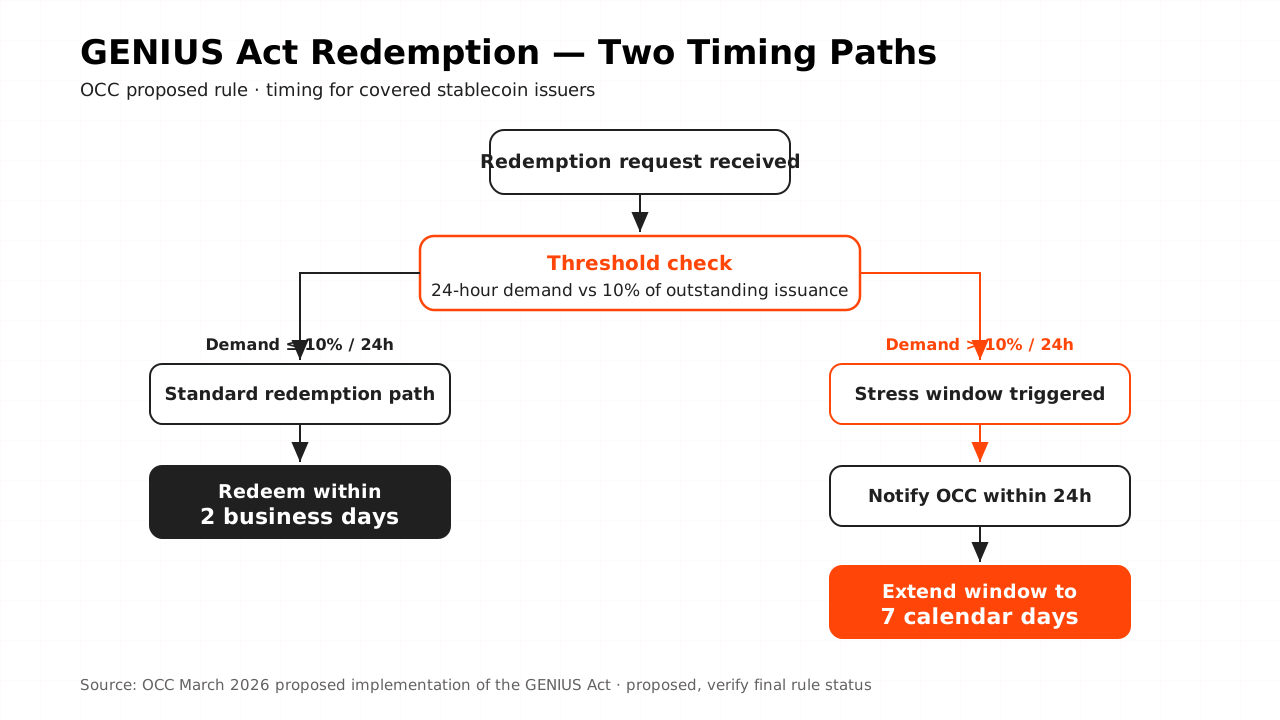 Under the OCC proposal, redemption follows a two-business-day standard unless 24-hour demand exceeds 10% of outstanding issuance, which extends the window to seven calendar days and triggers OCC notification.
That distinction matters. A blog should not treat a proposed rule as final law. The safer reading is: the GENIUS Act created the redemption-policy framework, and the OCC proposed a two-business-day interpretation for OCC-supervised entities. As of this draft date, teams should verify the final rule status before publishing.
Why does a two-business-day redemption window change issuer operations?
The tightest version of that pressure is intraday settlement and reserve proof, where the reconciliation has to hold within a single settlement window rather than across two days.The issuer must know not just that reserves exist, but that they are available, eligible, reconciled, and tied to valid redemption requests.
For a simple issuer on one chain with one custodian, this is already a control challenge. For a large issuer, the workflow may involve multiple chains, redemption partners, custodians, banking rails, jurisdictions, fee schedules, and exception policies.
The redemption team has to answer operational questions quickly:
- How many tokens are outstanding across all supported chains?
- Which redemption requests are valid and complete?
- Which reserves are eligible and available for liquidity?
- Which custodian balances match the issuer's books?
- Which fees apply, and were they disclosed under the policy?
- Has a stress threshold been crossed, and which requests are affected?
- Which limitations or delays are permitted under the applicable rules?
This is why the redemption requirement is a data integrity problem. The issuer's public policy is only credible if the internal systems can prove that the policy can be executed.
For earlier Orochi context on stablecoin regulation, see 2026 Stablecoin Regulatory Expectations.
What must an issuer prove operationally before redemption?
An issuer must prove operationally that the redemption request, token supply, reserve state, liquidity path, and approval process all match. A redemption policy without evidence is a document; a redemption operation needs a control trail.
The most important proof points are:
| Operational proof point | Why it matters |
|---|---|
| Outstanding supply | The issuer must reconcile liabilities across chains before fulfilling redemption requests. |
| Reserve eligibility | The issuer must know which assets qualify under the applicable framework and policy. |
| Reserve liquidity | Eligible reserves still need to be available quickly enough for redemption. |
| Custodian balance parity | Internal ledgers and custodian records must match before funds move. |
| Request validity | The requester, amount, fees, and account instructions must pass policy checks. |
| Stress threshold monitoring | The issuer must know whether redemption demands exceed 10% of outstanding issuance value in a 24-hour period under the OCC proposal. |
| Exception handling | Any delay, limitation, or seven-calendar-day stress window must match the rule, policy, and regulator authority. |
These are not abstract legal concepts. They are database questions, reconciliation questions, and audit-trail questions. If the data does not line up, the issuer may not know whether the redemption can be fulfilled safely within the expected window.
The enrolled Act also requires monthly reserve composition publication and CEO/CFO certification of reserve reports. That increases the cost of weak data controls, because errors move from back-office inconvenience to officer-level risk.
Why are periodic attestations not enough for redemption readiness?
Periodic attestations are useful for public assurance, but they do not prove continuous redemption readiness. A monthly reserve report can confirm a point-in-time condition, while redemption requests arrive on operational time.
The gap is timing. A redemption queue can change in hours. Treasury bills, deposits, repo arrangements, custody movements, chain mint/burn events, and banking instructions can change between reporting dates. If an issuer relies only on a monthly attestation, it may still need manual reconciliation when redemption pressure increases.
Periodic attestation answers: what did the reserve position look like at the reporting date? Redemption readiness asks: can this validated request be fulfilled now, under the published policy, with eligible and available reserves?
That second question needs a live evidence layer. It does not mean audits disappear. It means the audit trail becomes more continuous and easier to examine.
Orochi's article on Zero-Knowledge Proofs for stablecoin reserves covers the reserve-proof side of this
problem.
For a broader market context, Orochi's stablecoin market cap analysis shows why reserve and redemption controls matter as stablecoin usage scales.
How can zkDatabase support redemption evidence without making a compliance claim?
zkDatabase can support redemption evidence by generating proofs over reserve, supply, and reconciliation data. It lets an issuer prove that a defined condition was satisfied without exposing every raw custodian balance, banking record, or internal approval field.
A practical architecture could use zkDatabase to help prove:
- outstanding supply across supported networks matches the issuer's committed supply record;
- eligible reserve records meet a defined threshold;
- a redemption request passed policy checks at a timestamp;
- custodian balances matched internal liabilities for a defined reporting state;
- a stress-threshold or fee limitation was applied according to a disclosed rule.
These proofs can provide infrastructure for audit and reporting workflows. They do not decide whether a redemption policy is legally compliant, whether a regulator will approve an exception, or whether a reserve asset qualifies under final rules. Those questions remain legal and supervisory questions.
Bottom line: zkDatabase adds cryptographic evidence around the data controls behind redemption. It should be framed as an evidence layer, not a legal guarantee.
What should issuers do with the GENIUS Act redemption signal?
Conclusion: stablecoin redemption requirements turn the GENIUS Act discussion into an operational proof problem. The statutory framework requires clear redemption policies and reserve disclosures, while the OCC's proposed rule would set a two-business-day interpretation of timely redemption for covered issuers and a seven-calendar-day stress window after a 10% redemption-demand threshold.
For stablecoin issuers, the practical challenge is proving the workflow: supply, reserves, liquidity, custody, fees, approvals, and exceptions. zkDatabase can complement audit and reporting processes by making those data states verifiable without unnecessary exposure of raw records.
Book Advisory Call
Review which redemption data controls can be turned into cryptographic evidence before the final rule status is locked.
Review which redemption data controls can be turned into cryptographic evidence before the final rule status is locked.
FAQ: What should stablecoin issuers ask next?
What are stablecoin redemption requirements under the GENIUS Act?
Stablecoin redemption requirements under the GENIUS Act include public redemption policies, clear fee disclosures, reserve backing, and monthly reserve composition reporting. The law requires timely redemption procedures, while the OCC's March 2026 proposed rule would define timely redemption as no later than two business days after the requested redemption date for covered OCC-supervised issuers.
Is the two-business-day redemption rule final?
The two-business-day redemption standard appears in the OCC's proposed implementation of the GENIUS Act, so final status should be verified before publication. The underlying GENIUS Act requires clear and timely redemption procedures, but the specific two-business-day interpretation is tied to regulator rulemaking. Treat it as proposed unless final rules confirm it.
What data must a stablecoin issuer reconcile for redemption?
A stablecoin issuer must reconcile outstanding token supply, valid redemption requests, reserve composition, custodian balances, liquidity access, fees, stress thresholds, and exception rules. For multi-chain issuers, the supply side can be especially complex because mint, burn, bridge, and treasury movements may sit across several networks and internal systems.
Can zkDatabase prove compliance with the GENIUS Act?
zkDatabase cannot prove legal compliance with the GENIUS Act by itself. It can create cryptographic evidence that specific reserve, supply, or redemption conditions were satisfied against committed data. That evidence can support audit, reporting, and control workflows, while legal compliance depends on final rules, governance, and regulator interpretation.
Related toResearch