



Stablecoin
Intraday Liquidity Risk in Stablecoin Settlement Rails
July 14, 2026
13 mins read
As card networks add intraday, weekend, and holiday stablecoin settlement, monthly attestation leaves every window an unverified reserve position.


TL;DR: Mastercard's June 2026 expansion adds stablecoin settlement rails to its global card network, supporting USDC, RLUSD, and four other regulated stablecoins across eight blockchains, enabling intraday, weekend, and holiday settlement windows. It is silent on reserve backing proof, reconciliation integrity, and audit-ready selective disclosure. Those three gaps define the intraday liquidity risk issuers on these rails must now manage.
Intraday liquidity risk in stablecoin settlement rises when settlement windows multiply without corresponding verification infrastructure. The payment layer now operates around the clock; what it does not yet include is the cryptographic verification layer that lets issuers, acquirers, and regulators confirm reserve backing at each settlement window. zkDatabase, Orochi Network's verifiable database, provides that layer by generating Zero-Knowledge Proofs over settlement and reserve data so institutions can demonstrate compliance without exposing transaction flows.
Key Takeaways:
- Intraday liquidity risk grows when stablecoin settlement windows expand faster than reserve verification capabilities
- Mastercard officially supports USDC, PYUSD, USDG, USDP, RLUSD, and SoFiUSD across Arbitrum, Base, Canton, Ethereum, Polygon, Solana, Tempo, and XRPL
- The June 2026 announcement preserves existing fraud, dispute, and compliance protections but does not include continuous reserve attestation or on-chain reconciliation proof
- Stablecoin reserve verification using Zero-Knowledge Proofs allows issuers to prove reserve adequacy at each settlement window without exposing counterparty data
- zkDatabase generates cryptographic proofs for settlement records, supporting audit-ready compliance that scales with multi-window intraday operations
What Is Intraday Liquidity Risk in the Context of Stablecoin Settlement?
Intraday liquidity risk in stablecoin settlement is the probability that an issuer or acquirer cannot demonstrate sufficient reserve backing or meet settlement obligations at specific points during a continuous settlement cycle. As settlement windows multiply from end-of-day batches to intraday, weekend, and holiday operations, the window for unverified reserve positions expands proportionally.
Traditional card settlement runs on predictable batch cycles. An issuer's risk team knows that end-of-day settlement requires reserves to clear by a defined cutoff. Intraday settlement changes that math. When a payment network settles on a near-continuous basis across weekends and holidays, reserve liquidity must be demonstrable at any point during the settlement window, not only at scheduled close.
The Basel Committee on Banking Supervision's intraday liquidity monitoring framework was designed for fiat clearing between supervised banks. Stablecoin issuers operating on Mastercard's new rails face a structural equivalent: they must demonstrate that on-chain reserves back every settlement window, on demand, across multiple chains. The current industry standard for that demonstration, a monthly attestation PDF from an accounting firm, does not match that cadence.
The difference is not a technicality. Monthly attestation PDFs prove reserve adequacy once per month, while intraday settlement can generate dozens of settlement windows per day. Each uncovered window is an unverified reserve position.
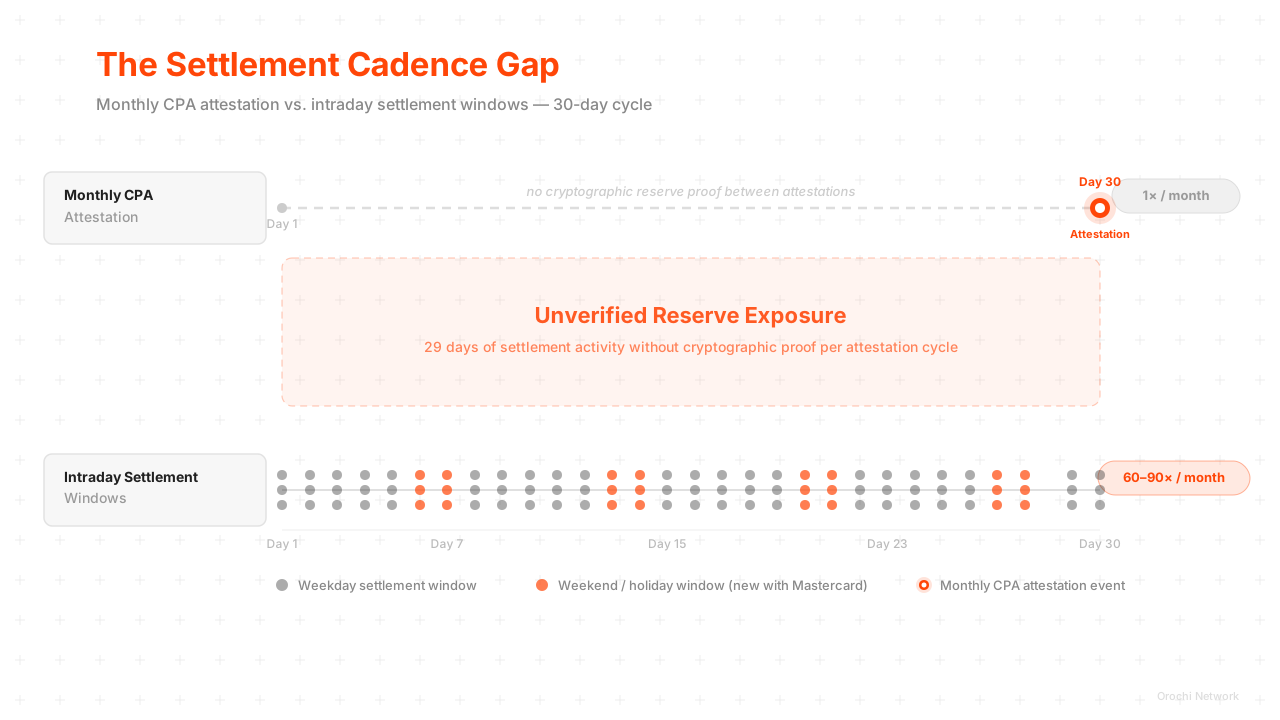 Monthly attestation proves reserve adequacy once per month. Mastercard's intraday settlement rails generate 60–90 settlement events per cycle — each an unverified reserve position without cryptographic proof. Stablecoin transaction volume reached $4.5 trillion in Q1 2026, according to a16z's 2026 State of Crypto report. The aggregate exposure from unverified intraday positions at that scale is not marginal.
How Does Mastercard's June 2026 Stablecoin Settlement Expansion Work?
Mastercard's June 2026 expansion adds intraday, weekend, and holiday settlement windows to its card network, enabling both fiat currency and on-chain stablecoin settlement. The official announcement names six supported stablecoins: USDC from Circle, PYUSD, USDG, and USDP from Paxos, RLUSD from Ripple, and SoFiUSD from SoFi. Supported blockchains include Arbitrum, Base, Canton, Ethereum, Polygon, Solana, Tempo, and XRPL.
Initial rollout covers the United States and Latin America, with five named early partners: ARQ (formerly DolarApp), CBW Bank, Cross River, Lead Bank, and Nuvei. Mastercard describes further global expansion planned through 2026, subject to local regulation. The network preserves existing fraud safeguards, dispute resolution processes, and compliance controls already operating within Mastercard's settlement infrastructure.
Mastercard is framing this as production infrastructure, not a pilot. The announcement describes the expansion as "a foundation for programmable, always-on payments." The supported stablecoins are all regulated entities subject to reserve requirements under the GENIUS Act in the US, MiCA in the EU, the MAS stablecoin framework in Singapore, and equivalent frameworks in other jurisdictions. These are payment rails, not speculative instruments.
Raj Dhamodharan, Mastercard's head of blockchain and digital assets, described the move as adding settlement flexibility while preserving the security and compliance properties that network participants already depend on. That framing is accurate for what Mastercard does control: routing, fraud detection, dispute resolution. It says nothing about what happens at the data layer above those rails.
Explore Stablecoin Settlement Infrastructure
Review how zkDatabase maps to stablecoin reserve verification and intraday settlement compliance requirements.
What Verification Gaps Does the Mastercard Expansion Leave Open?
The Mastercard announcement is explicit about what it adds and informative about what it does not address. The official release covers settlement timing windows, chain and stablecoin support, partner routing, and preservation of existing network safeguards. It does not address four verification requirements that institutions in regulated jurisdictions need alongside payment rails.
Reserve backing proof at intraday intervals. The announcement confirms that supported stablecoins are regulated. It does not specify how issuers prove that reserves back the settlement flow at each intraday window. A stablecoin that settles at 9am, 1pm, and 5pm on a Saturday requires demonstrable reserve adequacy at each point. Monthly attestation PDFs do not provide that granularity.
On-chain reconciliation integrity. When a settlement transaction routes across Ethereum and Solana in the same cycle, the reconciliation record spans two chains and potentially multiple counterparties. The announcement does not describe a mechanism for producing a verifiable, unified reconciliation record. Acquirers and issuers relying on off-chain reconciliation tools carry the same operational fragility that exists in conventional fiat settlement infrastructure.
Selective disclosure for regulatory reporting. Cross-border stablecoin settlement generates AML and travel rule obligations across multiple jurisdictions simultaneously. An issuer settling across US and Latin American markets must produce transaction-level compliance evidence for regulators in each jurisdiction, without exposing the full transaction flow to counterparties or regulators in other markets. Mastercard mentions alignment with regulatory frameworks but does not specify how issuers produce jurisdiction-specific disclosures.
Verifiable data provenance for audits. Regulators and institutional counterparties increasingly require that compliance claims trace back to a verifiable data source, not a reported value. An attestation that states "reserves were sufficient at the time of settlement" is a trust relationship. A cryptographic proof that the reserve record existed, was unmodified, and met the required threshold at settlement time is a verifiable fact. The distinction matters when a regulator examines an intraday position after the fact.
Fireblocks' 2025 State of Stablecoins survey found 90% of financial services firms are taking active steps on stablecoin adoption, with infrastructure readiness cited as the top constraint for institutional deployment at scale. The payment rails Mastercard is building address one dimension of that readiness. The verification layer above those rails is the dimension that still needs to be built.
Why Does Stablecoin Reserve Verification Become Critical at Intraday Settlement Scale?
Stablecoin reserve verification becomes critical at intraday settlement scale because the gap between settlement cadence and attestation cadence defines the window of unverified reserve exposure. An issuer operating under monthly attestation while settling multiple times per day carries unverified reserve positions across the 29 days between reports. When those positions accumulate across intraday windows, weekends, and holidays, the aggregate is substantial.
The GENIUS Act, enacted in 2025, requires stablecoin issuers to hold 100% of issued value in qualified liquid assets and publish monthly reserve disclosures. Monthly is the statutory minimum for public reporting. It does not prevent regulators from requiring more granular verification on demand, and it says nothing about the cadence for intraday settlement operations.
MiCA's ongoing reserve reporting requirements for e-money token issuers include continuous reserve management obligations that go beyond periodic disclosure. An issuer that cannot demonstrate reserve adequacy at the moment a regulator examines an intraday settlement window has a compliance gap, not just a reporting lag.
For issuers operating on Mastercard's new rails, the question is not whether to comply with these frameworks. The question is how to demonstrate compliance at the granularity the rails now demand. Continuous reserve verification using cryptographic proofs is the mechanism that matches the cadence of intraday settlement to the requirements of regulatory examination.
Monthly attestation was designed for monthly settlement cycles. Intraday settlement requires a different verification model.
How Can Zero-Knowledge Proofs Address Intraday Liquidity Risk in Settlement?
Zero-Knowledge Proofs address intraday liquidity risk in settlement by generating cryptographic proof that reserve conditions existed at a specific point in time, without exposing the underlying reserve composition, counterparty identities, or transaction flows. An issuer can prove, on demand, that reserves exceeded settlement obligations at each intraday window. Regulators can verify that proof without receiving the full reserve dataset.
This is the core distinction between attestation and proof. An attestation says "an accounting firm confirmed our reserves were sufficient on the 15th of last month." A cryptographic proof states that the reserve record was committed on-chain at a specific time, met the required threshold, and has not been modified since. The first is a trust relationship. The second is a verifiable fact.
| Dimension | Monthly CPA Attestation | Continuous Zero-Knowledge Proof Verification |
|---|---|---|
| Verification cadence | Monthly or quarterly | Intraday or on-demand |
| Reserve data exposure | Full data visible to auditor | No underlying data exposed |
| On-chain verifiable | No | Yes |
| Regulatory access method | PDF report | Verifiable proof commitment |
| Settlement window alignment | End-of-day, batch | Intraday, weekend, holiday |
| Cross-chain reconciliation | Manual, off-chain | Cryptographic, multi-chain |
For the specific verification requirements Mastercard's expansion creates, Zero-Knowledge Proofs support three operational needs:
Intraday reserve proof. At each settlement window, the issuer's reserve data generates a proof that the current reserve balance met or exceeded the settlement obligation. The proof is committed on-chain. Regulators, acquirers, or audit functions can verify the proof without accessing reserve composition or holder data.
Cross-chain reconciliation proof. A settlement transaction touching Ethereum and Solana in the same cycle can produce a unified reconciliation proof covering both legs. The proof demonstrates that the transaction state on both chains matches the intended settlement record, without requiring a centralized reconciliation system.
Selective jurisdiction disclosure. An issuer can generate a compliance disclosure for a US regulator that proves AML compliance for US-settled transactions without exposing the Latin American transaction flow. Zero-Knowledge Proofs make jurisdiction-specific selective disclosure computable from a single underlying dataset rather than requiring separate data silos per jurisdiction.
The 2026 stablecoin regulatory landscape across GENIUS Act, MiCA, and MAS frameworks all point toward this capability as a practical requirement for institutional stablecoin operations.
How Does zkDatabase Provide Verifiable Proof for Stablecoin Settlement Data?
zkDatabase provides verifiable proof for stablecoin settlement data by treating every data record as a provable state. Each settlement record, reserve balance entry, or reconciliation transaction generates a Zero-Knowledge Proof that any counterparty or regulator with access to the proof can verify. The underlying data remains off-chain and private. The proof travels on-chain as a verification commitment.
The architecture uses a Merkle tree structure to organize settlement records. Each tree update generates a proof of the state transition: the change from one balance or status to another is cryptographically committed. An issuer settling across Mastercard's eight supported blockchains can maintain a single provable state tree covering all chains, with each intraday settlement window triggering a proof update.
For stablecoin issuers operating on Mastercard's rails, the workflow maps as follows. The issuer connects reserve and settlement data to zkDatabase. Settlement records flow in as they finalize across chains. Reserve balance updates flow in from the issuer's treasury system. zkDatabase generates a Zero-Knowledge Proof for the reserve state at each defined settlement window. The proof confirms that the reserve balance exceeded the settlement obligation at that time. It does not expose reserve composition, custodian identities, or the distribution of reserves across instruments.
The proof is then committed on-chain on the issuer's chosen verification chain, all of which are among Mastercard's supported blockchains. Regulators and counterparties access the proof commitment, not the underlying data.
Why Zero-Knowledge Proof of Reserves complements CPA attestation is documented in detail in Orochi's stablecoin verification series. The short version: CPA attestation and cryptographic proof answer different questions. Attestation answers "did an accountant verify this?" Proof answers "can anyone verify this, at any time, without trusting an intermediary?" Both have a role. For intraday settlement, only one of them runs at settlement speed.
Orochi Network provides zkDatabase as the core engine for Verifiable Data Infrastructure in institutional stablecoin and RWA operations, backed by $20M in funding from the Ethereum Foundation and leading institutional investors.
The payment network Mastercard is building at the network layer needs a verifiable data layer to be enterprise-ready. zkDatabase is designed to be that layer.
Book Advisory Call
Discuss how zkDatabase maps to your stablecoin reserve verification and intraday settlement compliance requirements.
FAQ
What is intraday liquidity risk in stablecoin settlement?
Intraday liquidity risk in stablecoin settlement is the probability that an issuer or acquirer cannot demonstrate sufficient reserve backing or meet settlement obligations at specific points during a continuous or multi-window settlement cycle. As payment networks like Mastercard expand to intraday, weekend, and holiday settlement windows, issuers must prove reserve adequacy at each interval, not only at end-of-day or monthly reporting dates. This requires verification infrastructure that operates at the cadence of settlement, not the cadence of traditional auditing.
How does Mastercard's June 2026 expansion change compliance requirements for stablecoin issuers?
Mastercard's June 2026 expansion integrates USDC, PYUSD, USDG, USDP, RLUSD, and SoFiUSD into card settlement across eight blockchains, adding intraday, weekend, and holiday settlement windows. For issuers, this exposes a compliance gap: the GENIUS Act's monthly reserve disclosures and MiCA's ongoing reserve requirements were designed for end-of-day settlement models. Intraday settlement demands reserve verification at each window, not monthly snapshots. Issuers now need verification infrastructure that matches the cadence Mastercard's rails enable.
What does stablecoin reserve verification require at intraday settlement scale?
Stablecoin reserve verification at intraday settlement scale requires the ability to prove, on demand, that reserves exceeded settlement obligations at each settlement window throughout the operating day. Monthly attestation PDFs and periodic CPA audits cannot satisfy that requirement. Continuous verification requires cryptographic proof of reserve state at each relevant point, with audit-ready evidence accessible to regulators or counterparties without exposing full reserve composition or counterparty data. Zero-Knowledge Proofs are the mechanism that makes this technically and operationally achievable at the cadence intraday settlement demands.
How do Zero-Knowledge Proofs help manage intraday liquidity risk without exposing reserve data?
Zero-Knowledge Proofs generate mathematical proof that a statement about data is true without revealing the underlying data. For intraday liquidity risk management, an issuer can prove reserve adequacy at each settlement window without disclosing reserve composition, custodian identities, or counterparty details. The proof is verifiable by regulators or smart contracts on any of Mastercard's supported settlement chains. The underlying data remains private. This can support compliance with the transparency requirements of GENIUS Act and MiCA while preserving the confidentiality obligations issuers have toward depositors and institutional counterparties. zkDatabase implements this architecture for institutional-grade stablecoin settlement operations.
Related toStablecoin


