About zkDatabase
Why Orochi Built zkDatabase: The Data Integrity Gap
July 14, 2026
8 mins read
Orochi built zkDatabase to close the gap between what tokenized-asset platforms claim about their data and what they can actually prove on-chain.


TL;DR: Orochi built zkDatabase to close the institutional data integrity gap: the distance between what a tokenized asset platform claims about its off-chain data and what it can cryptographically prove on-chain. Oracles move data, databases store it, and auditors check it periodically. None of them prove the underlying data was correct at the moment a smart contract acted on it.
By May 20, 2026, distributed tokenized Real-World Asset value reached $33.85 billion excluding stablecoins, per RWA.xyz data cited by CoinLaw, yet much of that infrastructure could publish numbers without proving them. That is the environment zkDatabase was built for, and this post explains the reasoning behind its design.
Key Takeaways
- The case for verifiable data infrastructure starts with one gap: institutions can report off-chain asset data, but they cannot prove it was correct when a contract acted on it.
- Oracles confirm data arrived through authorized sources. They do not confirm the underlying fact was true.
- Periodic attestation describes a moment in the past. Tokenized assets trade continuously, so the proof and the activity fall out of sync.
- zkDatabase generates a cryptographic proof over the data pipeline, so on-chain contracts verify proofs instead of trusting a reported value.
- This is positioning for the institutional buyer: the gap is not technical curiosity, it is regulatory and counterparty risk.
What Is the Institutional Data Integrity Gap?
The institutional data integrity gap is the space between a claim and a proof. A platform claims its tokenized fund is fully backed, its reserves are sufficient, or its collateral is current. Users, partners, and regulators are asked to trust that claim. The platform cannot show, in a way anyone can independently check, that the underlying data was correct at the moment it mattered.
This pattern repeats across every institutional segment. A stablecoin issuer says reserves are 1:1. A real-world asset fund says net asset value is accurate. A lending protocol says collateral is sufficient. Each statement is a claim wrapped in a trust assumption. The data exists, but the proof does not travel with it.
For retail, a quarterly statement was good enough. Institutional capital does not work that way. When an allocator underwrites a position, the question is not "what does your dashboard say" but "how do you know, and how can we check." That question is what exposed the gap.
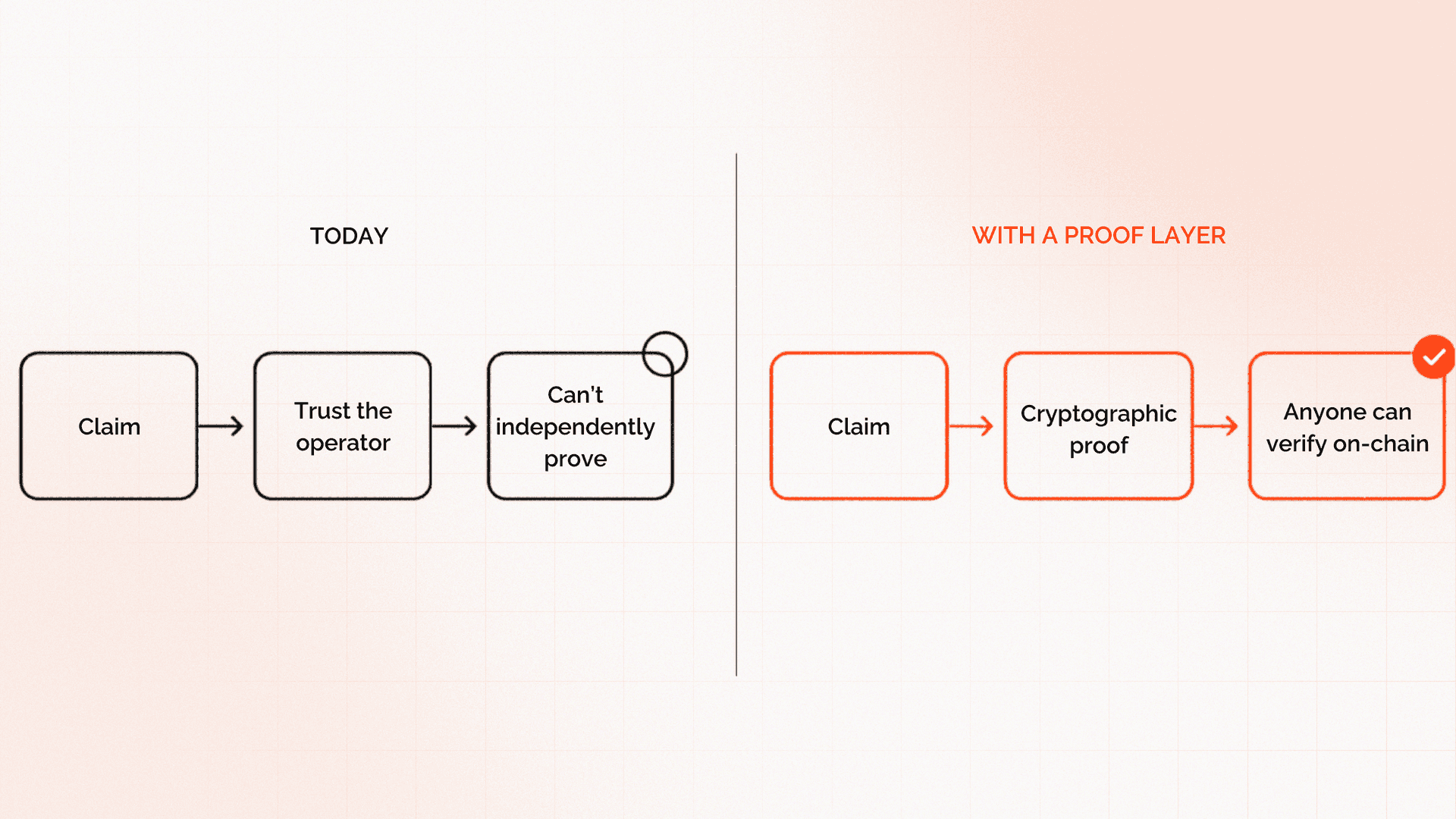 Reported data asks you to trust the operator; a proof lets anyone verify it.
Why Don't Oracles Close the Data Integrity Gap?
Oracles do not close the gap because they are a transport layer, not a proof layer. An oracle confirms that data came through authorized sources and reached the chain. It does not confirm the data was real before it entered the pipeline.
This is a distinction institutions feel during incidents. When a price feed is manipulated upstream, the oracle relays the manipulated value correctly. The transport worked. The fact was wrong. The contract that consumed it had no way to tell the difference, because it received a published value, not a proof about how that value was produced.
Oracles solved a real problem, and tokenized markets run on them today. The point is not that they failed. It is that confirming delivery and proving correctness are two different jobs, and institutional data integrity needs both. Strengthening the data layer underneath the feed is where zkDatabase verifies what oracles assume.
Why Isn't a Traditional Database or Audit Enough?
A traditional database stores data correctly but cannot prove it was not changed. Anyone with operator access can alter a record, and nothing in the system produces evidence that the value a contract read is the value that was originally written. Storing data correctly still requires someone to trust the operator.
Audits add a second control, but they describe a moment in the past. An attestation tells partners what was true on the audit date. It says nothing about the days between audits, which is exactly when tokenized assets keep trading, settling, and being used as collateral. The reporting cadence and the activity cadence do not match, and the mismatch is where risk accumulates.
This is the structural reason a stronger control was needed. Better databases and more frequent audits improve the situation, but they do not change the trust model. The reader is still being asked to trust the operator or the auditor. A cryptographic proof changes who, or what, you have to trust. For the deeper version of this argument, see why data integrity defines RWA asset trust.
What Did Orochi Build zkDatabase to Do Instead?
Orochi built zkDatabase to generate proof across the data pipeline, so verification does not depend on trusting the operator. The reasoning was specific: real-world asset data lives off-chain, on-chain contracts need verifiable state, and privacy rules prevent publishing the raw records. zkDatabase was built so data can carry its own evidence without moving the underlying records on-chain. Data goes in, a cryptographic proof comes out, and on-chain contracts verify the proof rather than the claim.
The mechanism matters because it changes the question institutions can answer. Instead of "trust our reported value," a platform can say "verify the proof yourself." A stablecoin issuer can prove reserve conditions without exposing custodian holdings. A fund can prove a net asset value calculation without revealing positions. A lender can prove collateral sufficiency without publishing the borrower's book. These are the use cases that defined the build, and they map directly to how zkDatabase applies to real-world assets.
The zkDatabase mainnet is live, and the product is built on Zero-Knowledge Proofs with privacy preserved by design. It is not a replacement for auditors, oracles, or regulators. It is the missing proof layer that lets the data those parties rely on carry its own evidence. zkDatabase can provide cryptographic infrastructure that supports audit and reporting workflows; it does not by itself guarantee regulatory compliance, and the proof confirms a data condition rather than a real-world legal fact.
Bottom line: Orochi built zkDatabase because the institutional market was missing a layer, not a product feature. The application layer, the oracles, and the capital all arrived. What had not kept pace was a way to prove the data underneath.
Why Does Closing This Gap Matter Now?
Closing the data integrity gap matters now because institutional capital is already on-chain and brings institutional due diligence with it. By May 20, 2026, distributed tokenized Real-World Asset value reached $33.85 billion excluding stablecoins, per RWA.xyz data cited by CoinLaw, with private credit a growing share of that total.
That capital does not accept a snapshot the way retail did. Underwriting, counterparty checks, and regulatory reporting all ask the same question: can you prove it, continuously, not quarterly. Platforms that can answer that question with cryptographic evidence have a different conversation with allocators than platforms that can only point at a report.
This is why verifiable data infrastructure is becoming a stronger institutional buying criterion rather than a nice-to-have. As the market matures, "trust me" carries less weight than "verify it yourself." Closing the gap is what lets institutions treat the underlying data as provable rather than reported, which connects directly to the data integrity blocker in institutional DeFi.
Conclusion
Verifiable data infrastructure exists to answer one question that traditional infrastructure cannot: can you prove your data was correct when it mattered, without exposing it. Orochi built zkDatabase to close that gap for institutions moving real assets on-chain. Oracles move the data, databases store it, and audits check it periodically, but none of them make the data prove itself. zkDatabase does, with Zero-Knowledge Proofs, so on-chain programs, partners, auditors, and regulators can evaluate cryptographic evidence alongside their existing controls instead of relying on the operator's word.
Read the docs → See how the verifiable database turns off-chain asset data into proofs your contracts can check: https://docs.orochi.network/orochi-network
FAQ
What is the institutional data integrity gap that verifiable data infrastructure addresses?
The institutional data integrity gap is the distance between reported data and provable data. Institutions can publish off-chain asset data such as reserves, net asset value, or collateral status, but they cannot cryptographically prove that data was correct when a smart contract acted on it. Verifiable data infrastructure closes the gap by attaching a proof to the data that anyone can check on-chain.
Why did Orochi build zkDatabase instead of using oracles?
Orochi built zkDatabase because oracles and proof systems do different jobs. An oracle confirms data came through authorized sources and reached the chain, but it does not prove the underlying fact was true before entering the pipeline. zkDatabase generates a cryptographic proof over the data itself, so contracts verify a proof rather than trust a reported value. It can complement oracle feeds rather than only replacing them.
Does zkDatabase replace audits or guarantee compliance?
No. zkDatabase does not replace auditors and does not guarantee regulatory compliance. It provides cryptographic infrastructure that can support audit, reporting, and data integrity workflows by letting institutions produce verifiable evidence of data conditions continuously, between formal attestation cycles, without exposing the underlying raw data.
How does zkDatabase keep data private while still proving it?
zkDatabase uses Zero-Knowledge Proofs, which prove a statement about data is true without revealing the data itself. A stablecoin issuer can prove reserve conditions without exposing custodian holdings, and a fund can prove a net asset value calculation without revealing positions. The proof travels on-chain while the sensitive data stays private.
Related toAbout zkDatabase