Research
Net Assets Value Data (NAV)
February 23, 2026
20 mins read
Explore how NAV powers tokenized funds and how zkDatabase enables verifiable, real-time NAV for institutional finance.


Net Asset Value (NAV) determines whether a fund can process redemptions, whether collateral can be mobilized, and whether a tokenized share represents a legitimate claim on underlying assets. In traditional finance, NAV is calculated once daily, published after market close, and verified through periodic audits. But tokenized funds require intraday NAV for continuous issuance, cross-platform collateral systems need real-time verifiable valuations, and regulators are shifting from trust-based oversight to proof-based compliance. The bottleneck isn't computation, it's verification at institutional scale.
When counterparties, regulators, or smart contracts need to confirm a published NAV figure, they must either trust the publisher's reputation or reconstruct the entire calculation independently. zkDatabase solves this by making the database itself verifiable: a SQL-compatible backend that produces cryptographic proofs of query correctness, allowing fund administrators to run existing NAV calculations while providing mathematical proof that every published figure was derived correctly from stated inputs.
What Is Net Asset Value (NAV) in Institutional Fund Operations?

Net Asset Value (NAV) is the official accounting record of a fund's per-share worth at a given time. It's calculated by subtracting total liabilities from total assets (securities, cash, derivatives, receivables) and dividing by outstanding shares.
NAV functions as the operational backbone of institutional fund infrastructure. It determines redemption eligibility, subscription pricing, collateral valuation for margin calls, and regulatory compliance with leverage or concentration limits. Asset managers use NAV for capital allocation. Banks reference it to price credit lines. Custodians validate settlement instructions against it. Regulators audit NAV to verify risk parameters and investor protection.
Without accurate, current NAV, funds cannot process subscriptions or redemptions, counterparties cannot execute collateral agreements, and compliance reporting breaks down. For mutual funds, ETFs, private credit vehicles, and tokenized funds, NAV serves as the legal basis for fiduciary accountability, the tax treatment reference point, and the data primitive connecting fund operations to broader financial systems. It's non-negotiable infrastructure, nearly every institutional process depends on its accuracy and availability.
Why Does NAV Become a Hard Infrastructure Problem at Scale?
Traditional NAV infrastructure was built for a world that no longer exists. Fund administrators calculate NAV once daily, after markets close, using data that arrives hours late. The workflow looks like this:
- Custodians send end-of-day holdings reports
- Market data vendors provide closing prices
- Administrators apply accounting policies manually
- NAV publishes the next morning
This batch-based model assumes predictable investor schedules, static pricing between calculation windows, and manual reconciliation between counterparties.
Traditional NAV calculation—designed for once-daily, post-market processing—creates a cascading failure across four critical operational layers when applied to modern institutional requirements. Timing constraints prevent intraday redemptions because no authoritative valuation exists between calculation windows; a tokenized real estate fund offering hourly liquidity can't honor redemption requests at 2 PM using NAV calculated at yesterday's market close.
- Scale and reconciliation bottlenecks: Emerge when manual processes face thousands of daily transactions across custodians reporting holdings in different formats with different latencies, a multi-custodian private credit fund receiving DTCC feeds, prime broker reports, and direct custodian files can't reconcile discrepancies fast enough to meet same-day settlement obligations.
- Audit and compliance gaps: Create systemic risk when regulators demand real-time leverage monitoring but receive reports 18 hours after positions change, while counterparties need collateral verification within minutes for trades settling on T+0 rails.
- Geographic coordination failures
Strand Asia-Pacific investors wait 12+ hours for US market to close before accessing NAV, effectively blocking cross-border capital flows in funds operating continuous subscription windows. This isn't a speed problem requiring faster batch cycles it. It's an institutional constraint problem requiring verifiable automation.
Modern NAV infrastructure must simultaneously deliver continuous calculation for operational needs while satisfying strict legal liability for investor harm (even from third-party data errors), contractual SLA penalties for delays, complete audit trails showing data lineage from every pricing feed and corporate action, independent verification without workflow reconstruction, and cryptographic proof against post-calculation tampering.
The operational paradox is stark: institutions need continuous NAV for tokenized assets and real-time settlement, but cryptographic auditability for regulators and counterparties; manual processes can't scale beyond batch windows, off-chain databases can't prove integrity, and smart contract rewrites break compatibility with existing SQL-based compliance tooling that cost millions to build and certify.
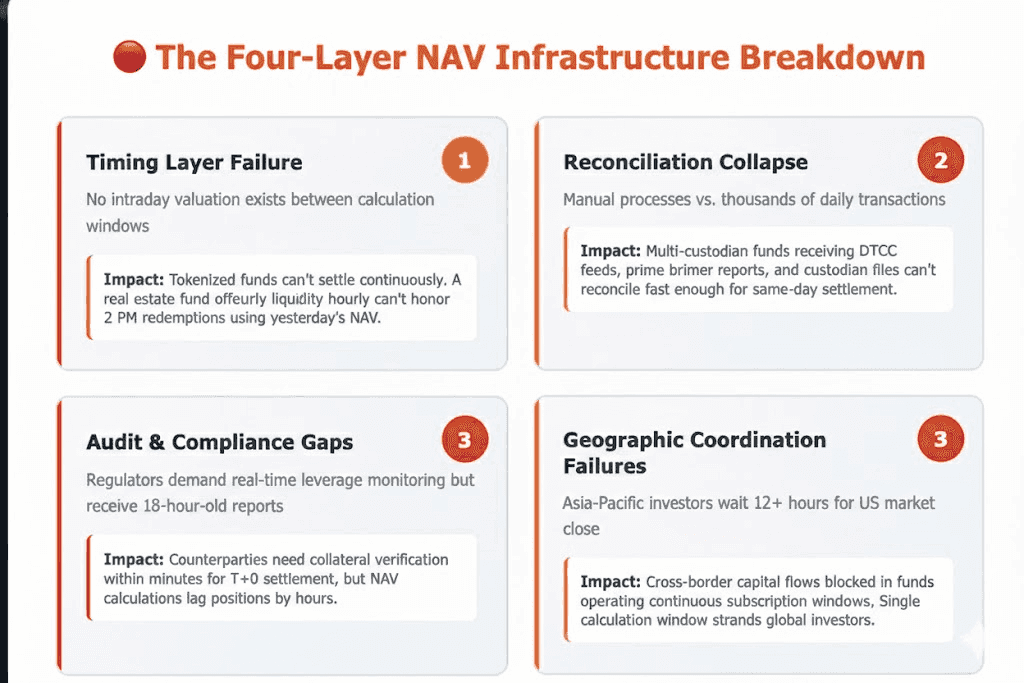
The four-layer breakdown:
- Timing layer failure: No intraday valuation → tokenized funds can't settle continuously
- Reconciliation collapse: Manual processes vs. thousands of transactions → settlement delays compound
- Audit lag risk: 18-hour reporting gaps → regulators can't monitor real-time leverage
- Geographic friction: Single calculation window → cross-border investors locked out during local trading hours Example case: A tokenized private credit fund with $2B AUM operates across New York, London, and Singapore. An institutional investor in Singapore wants to redeem $50M at 10 AM local time (9 PM ET previous day). Under batch NAV:
(1) No official valuation exists—last NAV published 21 hours ago;
(2) Fund can't honor redemption until next US market close, 15 hours away;
(3) Investors face overnight market risk on capital they intended to deploy elsewhere;
(4) Fund administrator manually reconciles three custodian feeds in different schemas before calculating NAV; (5) By the time NAV publishes, underlying credit positions have repriced, but calculation uses stale data.
(6) Auditor later flags 8-hour gap between position changes and NAV reflection, questioning compliance with leverage limits during that window.
How Are NAV Calculations Traditionally Performed in Fund Operations?
NAV calculation is a multi-party workflow orchestrated across fund administrators, transfer agents, and custodians operating separate systems that must be manually reconciled before publishing an official valuation. The process begins hours after markets close and relies on sequential data handoffs between entities without integrated infrastructure.
-
Fund administrator workflow starts when custodians transmit end-of-day holdings files—via SFTP, email, or proprietary portals—showing fund securities and quantities. Administrators load these into accounting systems (SS&C GlobeOp, Northern Trust Hedgevest, BNY Mellon Eagle) that don't natively interoperate with custodian formats. Data arrives in conflicting schemas: one custodian sends DTCC files with CUSIPs, another uses ISINs in CSVs, a third provides PDFs requiring manual re-keying. Administrators spend 1-3 hours reconciling discrepancies—if a custodian reports 10,000 shares but prior records show 9,500, phone calls verify whether the gap represents a trade, corporate action, or transmission error.
-
Pricing data ingestion happens separately. Market data vendors (Bloomberg, Refinitiv, ICE) provide closing prices for public securities. For illiquid assets—private credit, real estate, OTC derivatives—administrators apply manual valuations: analysts review loan performance and assign fair values, appraisers provide quarterly estimates amortized daily, specialists calculate derivative marks using counterparty models. Each valuation requires audit documentation. Pricing data doesn't arrive synchronized with holdings data, creating reconciliation windows matching positions to prices across different formats.
-
Corporate actions processing adds manual intervention. Dividends, splits, mergers, and calls require adjusting holdings and cash before calculating NAV. A dividend effective today but announced after yesterday's NAV requires manually crediting cash and verifying amounts against custodian reports. Administrators track actions through vendor feeds (DTCC, Bloomberg), custodian notifications, and issuer announcements, then apply accounting treatments from the fund prospectus. If a corporate action affects 3% of the portfolio, the entire NAV calculation waits.
Expense accruals are calculated separately from assets. Management fees accrue daily based on average NAV; performance fees require tracking high-water marks; operating expenses are estimated monthly then reconciled when invoices arrive. Each accrual needs manual journal entries with audit documentation.
Transfer agent coordination happens after preliminary NAV calculation. Transfer agents (DST, SS&C, BNY Mellon) maintain shareholder registries and process subscriptions/redemptions. They send share-outstanding reports that may not match administrator records if late-day trades haven't settled. A 3:59 PM redemption might appear in the transfer agent's system but not the custodian's holdings file. Administrators manually reconcile share counts before finalizing NAV.
Custodian reconciliation creates the longest bottleneck. Custodians report positions daily but operate on different calendars and cut-offs than administrators. A 3:55 PM trade may settle after the custodian's reporting deadline, excluding it from holdings files. Administrators manually track unsettled trades and estimate settlement impact. Cash balances are especially problematic: custodians report as of 5 PM, but administrators need 4 PM market-close figures, requiring manual adjustments for transfers, dividends, and fees in the one-hour gap.
Final NAV publication happens only after all reconciliations complete and a senior accountant reviews for anomalies—NAV moving >2% without corresponding market moves triggers investigation. Once approved, NAV goes to the transfer agent for pricing subscriptions/redemptions, regulatory filings (EDGAR for mutual funds), and custodian reconciliation. This workflow takes 4-8 hours for simple funds, 12+ hours for complex multi-custodian structures.
This workflow persists because it evolved incrementally over decades, with each participant optimizing their own systems without shared real-time infrastructure. It works for daily cycles with next-morning tolerance, but fails under continuous settlement, intraday liquidity, or cross-border operations where "end of day" has no universal definition.
What Are the Tradeoffs Between Intra-Day NAV Transparency and End-of-Day Audits?
Intra-day NAV transparency and end-of-day audits represent fundamentally different approaches to fund valuation. Smart contracts, driven intra-day systems calculate NAV continuously as pricing data updates, enabling immediate investor transactions, real-time collateral management, and instant regulatory visibility.
Off-chain end-of-day audits calculate NAV once per day after market close, with fund accountants manually reconciling discrepancies, applying judgment to illiquid valuations, and obtaining officer approval before publication.
The core tradeoff is automation speed versus verification depth: intra-day systems process calculations in seconds but depend entirely on input data quality with no manual intervention to catch errors, while end-of-day audits sacrifice speed for human review of pricing exceptions, corporate actions, and accounting policies that have no programmatic equivalent.
Asset managers must choose their approach based on three dimensions:
- Automation level determines operational tempo. Tokenized funds supporting continuous issuance require intra-day NAV because investor activity doesn't stop at market close. Funds with quarterly redemption windows can operate on end-of-day cycles without operational friction.
- Risk surface expands with calculation frequency. Every published NAV is a potential litigation event if incorrect—intra-day systems multiply this exposure by publishing dozens of NAV figures per day. End-of-day workflows compress risk into a single daily calculation with extensive audit trails and officer sign-off.
- Compliance posture varies by jurisdiction. SEC-registered US mutual funds face strict NAV error liability and typically require end-of-day workflows. Offshore funds or private vehicles may accept higher automation risk for operational flexibility.
The decision depends on asset type, fund structure, and jurisdiction. Funds holding liquid exchange-traded securities with reliable pricing can implement intra-day NAV with manageable risk. Funds holding illiquid assets—private equity, real estate, unlisted securities—must use end-of-day processes because these positions require manual valuations from appraisers or broker quotes. Tokenized fund structures that settle on-chain need programmatically accessible NAV, favoring smart contract automation. Regulated structures under MiCA, UCITS, or the Investment Company Act face different NAV error liability and audit requirements that constrain implementation choices.
The emerging institutional requirement is to operate both models simultaneously: maintain end-of-day audit rigor for legal accountability while providing intra-day transparency for integration with real-time settlement systems and on-chain compliance monitoring—which is why verifiable computation infrastructure that produces cryptographic proof of NAV correctness is becoming operationally necessary.
Why Does NAV Break Down When Funds and Collateral Are Tokenized?
Tokenization transforms Net Asset Value from a reported accounting figure into executable infrastructure that directly controls asset movement, investor transactions, and collateral operations. In traditional fund structures, NAV is published after calculation and verification are complete—investors request redemptions based on the published figure, but settlement happens days later through off-chain processes involving transfer agents, custodians, and wire transfers. This delay creates a buffer where errors can be caught, discrepancies can be reconciled, and operational exceptions can be resolved manually before capital actually moves.
Tokenized funds operate continuously because blockchain networks don't close. Traditional NAV infrastructure cannot support this operational model:
- Investors expect to redeem shares at any time—weekends, holidays, during Asian market hours when US administrators are offline
- Traditional NAV calculations happen once per day, during business hours, using data that arrives hours after markets close
- Tokenized funds must either restrict redemptions to narrow windows (defeating the purpose of tokenization) or calculate NAV continuously using automated systems with no manual oversight
- Continuous calculation significantly expands the risk surface for errors that immediately affect settlement
Why Is Offchain NAV Data a Structural Risk for Onchain Systems?
Offchain NAV data creates systematic vulnerabilities when used as input to onchain financial systems because it operates on trust assumptions that blockchain infrastructure was designed to eliminate. Traditional NAV workflows depend on fund administrators publishing figures through controlled channels—investor portals, regulatory filings, transfer agent systems—where counterparties trust the publisher's reputation, audit history, and legal accountability.
Onchain systems have no legal recourse, no audit trails, and no ability to verify that published NAV figures are mathematically consistent with the underlying holdings and pricing data they claim to represent.
Offchain NAV calculations happen on batch schedules—typically once per day after market close—but onchain systems operate continuously and execute transactions the moment NAV data becomes available:
- Smart contracts can't distinguish between current NAV (calculated seconds ago) and stale NAV (published 18 hours ago but cached in an oracle)
- DeFi protocols querying NAV for collateral valuations may trigger liquidations based on yesterday's data while actual fund value has changed significantly
- Time-zone mismatches create systematic errors when Asian investors trade tokenized US fund shares using NAV calculated during US business hours
- No cryptographic timestamp proves when the NAV calculation actually occurred or whether the input data was current at calculation time
What Did the Smart NAV Pilot by DTCC Demonstrate?
The DTCC's Smart NAV pilot was a collateral mobility initiative designed to solve a fundamental operational problem in institutional finance: fund shares are high-quality assets that should function as collateral, but the infrastructure to use them this way doesn't exist at scale. Banks, broker-dealers, and asset managers hold trillions of dollars in mutual fund and money market fund shares on their balance sheets, but these positions remain operationally stranded—they can't be efficiently pledged as collateral for repo transactions, margin requirements, or clearing obligations because there's no standardized, real-time way to verify their value and transfer them programmatically across counterparties.
Counterparties accessed current NAV programmatically rather than waiting for end-of-day fund administrator reports
Collateral valuations updated automatically as NAV changed, enabling intraday margin adjustments without manual reconciliation
Settlement instructions executed based on verified NAV figures, eliminating the trust gap where one party questions whether the other party's valuation is accurate
How Does Tokenizing NAV Change Collateral Mobility for Banks?
Tokenizing NAV transforms fund shares from accounting entries into programmable collateral that banks can move, pledge, and reuse with the same operational efficiency as cash or government securities. The institutional incentive is straightforward: banks hold hundreds of billions in money market fund shares and other liquid fund positions on their balance sheets, but these assets remain operationally siloed—they can't be efficiently pledged to meet margin calls, posted to central counterparties, or rehypothecated to support client financing activities.
-
Programmable collateral acceptance: Clearing houses can automatically accept tokenized fund shares as margin collateral because they can verify NAV in real-time and adjust margin requirements as valuations change, eliminating bilateral credit agreements and manual valuation processes
-
Reduced capital buffers: Banks can pledge fund positions instantly when liquidity needs arise, meaning the same capital serves dual purposes—invested in yield-generating funds during normal operations, available as collateral during stress. A global bank reducing liquidity buffers by 50 basis points across a $500 billion balance sheet creates hundreds of millions in annual opportunity cost savings
-
Faster asset reuse: When banks receive tokenized fund shares as collateral from clients, they can immediately verify NAV and repledge those shares to meet their own obligations without waiting for settlement or custodian confirmation—traditional collateral chains involve days of lag.
-
Increased collateral velocity: Programmable NAV enables real-time collateral substitution throughout the trading day. Banks can optimize collateral allocation continuously, moving fund shares between uses (margin, repo, clearing) as requirements change, meaning the same pool of assets supports more financing activity
-
Cross-border efficiency: Collateral arrangements can operate continuously because NAV verification doesn't depend on business hours or time-zone coordination between fund administrators in different jurisdictions
Banks care about collateral mobility because it directly affects their cost of funding, capital efficiency, and ability to serve clients without tying up excess liquidity. Tokenization is relevant only because it creates infrastructure for programmable verification, which zkDatabase supports by providing Verifiable Data Pipelines that deliver NAV calculations with cryptographic proof of correctness, enabling counterparties to accept fund shares as collateral at scale without manual processes, trust assumptions, or settlement delays.
Why Is Verifiability the Missing Layer in NAV Data Pipelines?
Verifiability means that anyone receiving a NAV figure can independently confirm three properties without trusting the publisher or re-executing the entire calculation: the NAV was computed correctly from stated inputs (proven correctness), the inputs were current at the time of calculation (proven freshness), and the calculation applied the documented accounting rules and transformations (proven transformation).
- Cryptographic proof that published NAV is mathematically consistent with underlying data—holdings quantities, security prices, accruals, liabilities
- Any counterparty can verify the proof in seconds without accessing raw data or trusting the publisher
- If inputs change or calculation contains errors, the proof fails verification, making manipulation immediately detectable
- Eliminates scenarios where administrators publish incorrect NAV due to software bugs, data entry errors, or undetected pricing discrepancies
What Does It Mean to Prove NAV Data Instead of Publishing It?
Proving NAV data means delivering the NAV figure alongside a mathematical certificate that demonstrates how the calculation was performed, when it was performed, and that the result is internally consistent with the stated inputs.
This is fundamentally different from traditional NAV publication, where fund administrators release the final number and counterparties either trust it based on the publisher's reputation or conduct independent verification by re-executing the entire calculation using their own data sources and systems.
With proven NAV, the verification happens instantly using the certificate—no need to trust the publisher, no need to access proprietary databases, no need to reconstruct the workflow.
Proof of calculation demonstrates that the published NAV was derived correctly from the specified inputs using the documented formula and accounting rules:
The proof shows that if you start with the stated holdings (100,000 shares of Security A at $50, 50,000 shares of Security B at $75) and apply the correct operations (sum the values, subtract liabilities, divide by outstanding fund shares), you arrive at the published NAV.
How Does zkDatabase Support Verifiable NAV Data Workflows?
zkDatabase supports Net Asset Value (NAV) workflows by turning NAV calculations into provable database operations, not just reported results. It operates as a noSQL-compatible, production-grade database that generates cryptographic proofs alongside standard query outputs, allowing fund administrators to preserve existing NAV logic while adding a verifiable execution layer.
In institutional environments, NAV is not a theoretical formula, it is a live operational output used for pricing, redemptions, collateralization, and regulatory reporting. zkDatabase integrates directly into these workflows and ensures that every NAV calculation can be independently verified without exposing sensitive data or requiring counterparties to trust the database operator.
How Does zkDatabase Handle Offchain NAV Data Without Exposing It?
zkDatabase is designed to support Net Asset Value (NAV) workflows without forcing institutions to move sensitive financial data onto public infrastructure. It separates data storage from verifiability, allowing NAV to be proven correct without revealing underlying accounting records. Institutional NAV operations, the underlying data includes:
- Portfolio positions
- Market price feeds
- Cash balances
- Liabilities and accrued expenses
- Fee and valuation logic
zkDatabase keeps this data:
- Stored off-chain within existing institutional infrastructure
- Structured using current accounting schemas
- Governed by internal access controls and compliance policies
What Does the Future of NAV Look Like in Tokenized Capital Markets?
The future of Net Asset Value (NAV) in tokenized capital markets is defined not by speculation, but by infrastructure evolution. As assets become digitally represented and accessible across programmable systems, NAV transitions from a once-daily accounting output to a continuously consumed, operationally critical data input.
This shift does not eliminate traditional controls. Instead, it increases the demands placed on valuation systems. NAV must support continuous interaction across trading systems, collateral platforms, custodians, and regulatory frameworks—without compromising institutional standards.
The defining characteristics of this future are continuous valuation and verifiable infrastructure.
Why Will NAV Infrastructure Matter More Than Token Standards?
In tokenized capital markets, tokens are merely interfaces — they represent an asset, a share class, or a tradable instrument, but they do not define the integrity of the data that drives their value. In contrast, NAV infrastructure is foundational: it determines whether systems that rely on NAV can operate with certainty, compliance, and interoperability at production scale.
Token standards like ERC-20 or ERC-1400 define how shares are represented and transferred on-chain, but they don't address the operational challenge of determining what those tokens are worth. A tokenized money market fund share can use any compliant token standard, but its value depends entirely on the accuracy and availability of the underlying NAV calculation.
Token interoperability is irrelevant if counterparties can't verify the NAV those tokens represent. The institutional question isn't "can we move this token?" but "can we trust the valuation used to price it, margin it, or accept it as collateral?
Conclusion
Net Asset Value (NAV) is the foundational data primitive that determines whether tokenized funds can process redemptions, whether collateral systems can accept fund shares programmatically, and whether institutional capital markets can operate with the continuous settlement, real-time verification, and cryptographic auditability that on-chain finance demands. Traditional NAV infrastructure—built for daily batch calculations, manual reconciliation, and trust-based distribution—cannot support the operational requirements of 24/7 liquidity, instant settlement, and on-chain composability.
The missing layer is verifiable computation: infrastructure that produces cryptographic proof of NAV correctness alongside the calculation itself, enabling any counterparty to verify results in seconds without trusting the publisher or re-executing the workflow.
zkDatabase addresses this gap by providing Verifiable Data Infrastructure purpose-built for institutional NAV pipelines. It allows fund administrators to maintain their existing operational workflows while adding the verification layer that tokenized systems require—making NAV calculations independently auditable, continuously available, and cryptographically provable at production scale.
For infrastructure and compliance teams navigating tokenization, the path forward is clear: invest in verifiable NAV infrastructure first, optimize token standards second, because institutional adoption depends on data integrity, not interface compatibility.
FAQs
What is Net Asset Value (NAV) in tokenized funds?
Net Asset Value (NAV) is the per-share value of a fund, calculated as assets minus liabilities divided by outstanding shares.
In tokenized funds, NAV determines redemption pricing, collateral eligibility, and regulatory compliance. Unlike traditional funds that publish NAV once daily, tokenized markets require intraday and verifiable NAV to support continuous settlement and 24/7 liquidity.
Why does traditional NAV infrastructure struggle with tokenization?
Traditional Net Asset Value (NAV) systems rely on end-of-day batch calculations, manual reconciliation, and trust-based publication.
This model fails in tokenized capital markets where smart contracts, collateral systems, and cross-border investors require real-time, independently verifiable valuations—not delayed reporting.
How does zkDatabase improve NAV verification?
zkDatabase turns NAV calculations into provable database queries.
It generates cryptographic proof that the NAV was calculated correctly from current inputs—without exposing sensitive data.
This enables institutions to maintain existing workflows while adding verifiable, audit-ready NAV infrastructure suitable for tokenized assets and programmable collateral systems.
Related toResearch