


Capital Market
Private On-chain Credit 2026: The Trillion-Dollar Opportunity
February 5, 2026
10 mins read
Dive into the 2026 Private On-chain Credit market, a $2 trillion opportunity. Discover how Centrifuge, Maple, and Goldfinch are pivoting to "privacy-first" models with zkDatabase to unlock institutional capital.


The crypto market of 2024 was defined by volatility and speculative leverage. The market of 2026 is defined by something far more boring, yet infinitely more valuable: Real Yield.
We are witnessing a structural shift in global finance: the return of a "Buyer’s Market" in private credit. With traditional banks retreating from lending due to stricter capital requirements (Basel III endgame), a massive void has opened for alternative lenders.
Institutional giants like BlackRock and Morgan Stanley estimate the private credit market will exceed $2.3 trillion by 2026. However, a critical bottleneck remains. While these institutions are eager for the efficiency and liquidity of blockchain rails, they are paralyzed by the "Transparency Paradox."
No hedge fund wants its borrowing strategy visible on Etherscan. No supply chain financing company can expose its client list to competitors on a public ledger.
For Private On-chain Credit to scale from a niche experiment to the global financial backbone, it requires a missing infrastructure layer: Verifiable Privacy. This is where the convergence of Real-World Assets (RWA) and zkDatabase technology becomes the defining narrative of the next cycle.
What is private on-chain credit ?
Private on-chain credit represents the migration of traditional debt financing onto blockchain rails, where smart contracts replace manual back-office operations to automate the origination, funding, and lifecycle management of loans. Instead of relying on volatile crypto over-collateralization, this model enables businesses to access capital based on Real-world assets (RWAs), cash flows, and creditworthiness while benefiting from instant (T+0) settlement and programmable enforcement.
To understand why private on-chain credit is an inevitable evolution, we must first revisit where the market began:
DeFi 1.0: The “Pawn Shop” Era
The early success of DeFi lending protocols such as Aave and Compound was built on a simple but powerful model: over-collateralized lending. In this system, borrowing $100 requires depositing $150 worth of crypto assets like ETH or BTC. The mechanism is fully trustless, identity, reputation, and credit history are irrelevant. If collateral value drops below a threshold, smart contracts automatically liquidate the position.
While this design maximizes safety and censorship resistance, it is fundamentally capital-inefficient. Liquidity circulates primarily among traders seeking leverage for speculation, rather than flowing into productive economic activities. As a result, DeFi 1.0 lending largely failed to serve real-world businesses that require working capital to grow.
Private Credit 2.0: The Real-World Asset Era
Private Credit 2.0 marks the shift toward under-collateralized or off-chain-collateralized lending, mirroring how credit operates in the global financial system. Under this model, borrowers access capital based on business fundamentals such as cash flow, operational performance, and ownership of real-world assets that including invoices, inventory, real estate, or receivables.
This approach is far more capital-efficient. Instead of locking excess crypto collateral, liquidity is directed into the real economy supporting SMEs, fintech lenders, and asset-backed financing structures that generate tangible economic value rather than circulating within a purely crypto-native loop.
The defining variable, however, is no longer collateral. It is verification.
The Core Challenge: Trust Requires Verification
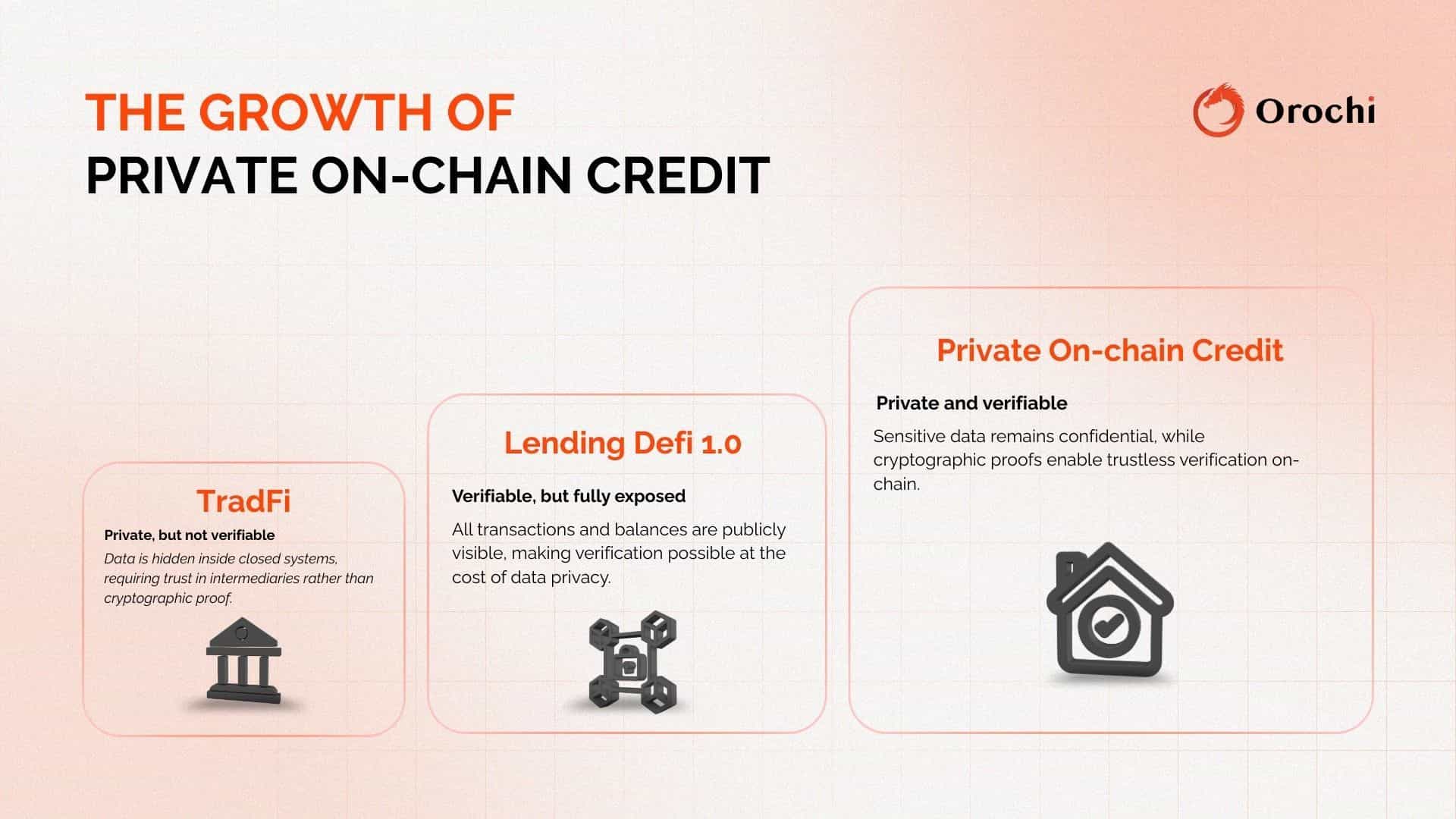
The transition from fully trustless systems (DeFi 1.0) to trust-minimized credit systems (Private Credit 2.0) introduces a fundamental friction point:
- In traditional finance, verification happens inside opaque black boxbanks, credit bureaus, and custodians. Data is private, but slow, fragmented, and unverifiable by external parties.
- In Web3, verification happens in a glass house. To prove creditworthiness on-chain today, borrowers must expose sensitive financial data to a public ledger,an unacceptable trade-off for any serious business or institution.
The Landscape of Private On-chain Credit: Who is Doing What in 2026?
Private on-chain credit has moved beyond experimental pilots into a production-grade financial layer. By 2026, a small group of protocols has emerged as category leaders, each solving a different bottleneck in the migration of real-world credit and capital markets onto blockchain infrastructure.
Rather than competing directly, these platforms occupy distinct but complementary roles across asset origination, liquidity distribution, and private settlement.
Centrifuge: The Operating System for On-chain Credit Funds
Centrifuge has evolved from an early RWA bridge into a full-stack operating system for managing on-chain credit portfolios. Its infrastructure enables asset originators, fund managers, and institutions to tokenize, manage, and finance real-world assets directly on-chain.
What Centrifuge Enables
- On-chain Credit Funds: Institutional-grade fund structures where portfolios, cash flows, and investor positions are managed programmatically.
- White-label Tokenization: Financial institutions can launch branded, compliant tokenized asset platforms without building bespoke blockchain infrastructure.
- Portfolio-Level Verifiability: Through oracle-based verification layers, asset pools can be monitored in near real time while keeping borrower-level data confidential.
Centrifuge demonstrates that private credit funds can operate natively on-chain without exposing sensitive borrower or deal-level information, laying the foundation for scalable, compliant private credit markets.
Ondo Finance: Liquidity and Securitization at Internet Scale
Ondo Finance has positioned itself as a primary gateway for bringing traditional financial instruments, such as U.S. Treasuries and public-market exposures onto blockchain rails.
What Ondo Enables
- Tokenized Yield Products: On-chain access to government securities and diversified financial instruments.
- Capital Recycling: Idle DeFi liquidity can be redeployed into low-risk, yield-bearing real-world assets.
- Multi-chain Distribution: Expansion into high-throughput environments allows near-instant settlement and global accessibility.
Ondo bridges the gap between institutional-grade financial products and on-chain liquidity, proving that tokenized securities can function as core building blocks for private on-chain credit systems.
Maple Finance: The Institutional Capital Markets Layer
Maple Finance has transitioned from a pure undercollateralized lending protocol into a broader institutional capital markets platform designed for professional asset allocators.
What Maple Enables
- Curated Credit Pools: Structured lending markets managed by professional delegates.
- Simplified Access Layers: User-facing products abstract credit complexity while maintaining institutional risk standards.
- Expanded Collateral Frameworks: Support for multi-asset collateral across multiple blockchain environments.
Maple illustrates how DeFi-native infrastructure can evolve into institutional-grade credit markets without relying on retail speculation or over-collateralization.
Private on-chain credit in 2026 is no longer defined by individual protocols, but by an emerging modular stack. Public blockchains handle settlement and composability, while specialized platforms manage asset origination, liquidity distribution, and private execution. However, across all leading implementations, a shared gap remains: the absence of a unified, cryptographically verifiable data layer capable of proving creditworthiness, portfolio integrity, and compliance without exposing proprietary financial data. This unresolved gap sets the stage for verifiable data infrastructure to become the critical backbone of the next generation of private on-chain credit.
The Infrastructure Solution: zkDatabase & Orochi Network
In the era of DeFi 2.0, zkDatabase is not merely storage; it serves as Verifiable Data Infrastructure. It resolves the single biggest bottleneck preventing institutional capital deployment: the lack of a cryptographic tie between real-world off-chain data and on-chain asset states.
Below are the four core use cases that are reshaping the credit market:
On-chain Credit with Off-chain Trust
Critical financial signals required for underwriting (such as corporate cash flow, FICO scores, and invoice payment history) currently reside in siloed Web2 servers. Lending protocols are forced to blindly trust PDF uploads or centralized Oracles that can be manipulated.
- The zkDatabase Solution:
- Mechanism: zkDatabase acts as a computational "black box." It securely connects to original data sources (Bank APIs, ERPs) and processes the raw data off-chain.
- The Result: Instead of publishing sensitive payrolls on-chain, zkDatabase generates a Trust Proof. For example: "Verifying that Company A has EBITDA > $5M and positive cash flow for the last 12 months." Smart Contracts use this proof to automatically approve credit lines without human intervention.

Capital Markets Settlement & Tokenized Collateral
Real-world assets (RWA) constantly change state off-chain (e.g., goods are damaged, a property faces litigation, or market valuations shift). Blockchains remain "blind" to these changes until it is often too late, leading to bad debt risks.
- The zkDatabase Solution:
- Mechanism: zkDatabase maintains a verifiable digital twin of the off-chain asset, continuously verifying critical facts such as custody, liens, and valuation updates.
- The Result: The system executes Real-time Covenant Monitoring. If the real-world asset value drops below a safety threshold, zkDatabase automatically generates a proof to trigger an on-chain Liquidation or Margin Call, eliminating the latency of manual audits.
Reserve-Backed Liabilities & Proof of Solvency
Monthly audit attestations are merely static "snapshots" in time. They fail to prove Continuous Solvency and cannot prevent a fund from moving assets immediately after the snapshot is taken.
- The zkDatabase Solution:
- Mechanism: zkDatabase continuously tracks Total Assets (in banks/treasuries) against Total Liabilities (issued tokens/loans) in real-time.
- The Result: It creates a Private Proof of Solvency. Lenders can verify at any block that "Assets > Liabilities" without ever knowing the fund's specific stock holdings or proprietary trading strategies.
Encoded Compliance (Private KYC)
Institutional DeFi mandates KYC/KYB (Know Your Business), but Data Privacy Laws (like GDPR) strictly prohibit placing Personally Identifiable Information (PII) on a public blockchain.
- The zkDatabase Solution:
- Mechanism: It decouples Data from Proof. Identity data remains secure in the user's wallet or zkDatabase's encrypted storage.
- The Result: To participate in a lending pool, an entity submits only a Compliance Proof: "This wallet belongs to a verified US entity and is not on any Sanctions List." This creates a "Clean Pool" environment that satisfies MiCA and GENIUS Act standards without data exposure.
Why 2026 is the Inflection Point
2026 marks the inflection point for private on-chain credit as zero-knowledge technology matures, regulatory frameworks solidify, and global capital shifts from speculative yield to structured, real-world credit markets.
- Technological Maturity: ZK technology has evolved from slow, expensive theoretical math to efficient, production-ready infrastructure (like Mina Protocol and Orochi’s zkTLS).
- Regulatory Pressure (The GENIUS Act & MiCA): New global regulations mandate strict AML/KYC compliance. However, data privacy laws (GDPR) simultaneously forbid public data exposure. Private On-chain Credit via ZK is the only technology that satisfies both regulators (compliance) and privacy laws (secrecy).
- The Yield Hunt: With interest rates stabilizing, the "free money" era is over. Investors are forced to seek alpha in complex, operational on-chain credit markets, demanding the sophisticated infrastructure described above.
Private on-chain credit becomes viable not because institutions suddenly embrace transparency, but because cryptographic systems finally allow verification without disclosure.
Conclusion
The future of finance is not about choosing between transparency and privacy. It is about Selective Disclosure.
By 2026, the most successful lending protocols will be those that adopt the mantra: "Verify, Don't Reveal." They will use zkDatabase to mathematically prove their integrity while fiercely protecting their proprietary data.
For institutional investors, the message is clear: The infrastructure to deploy billions on-chain safely is finally here. For developers, the race is on to build the "Black Box" credit models that will power the next generation of global finance.
FAQS
What is private on-chain credit?
Private on-chain credit is a blockchain-based lending model that enables loans backed by real-world assets or creditworthiness while preserving borrower confidentiality through cryptographic verification.
How is private on-chain credit different from traditional DeFi lending?
Traditional DeFi lending relies on over-collateralization and full transparency, whereas private on-chain credit prioritizes capital efficiency, allowing undercollateralized or off-chain-collateralized loans without exposing sensitive financial data.
What role do zero-knowledge proofs play in private on-chain credit?
Zero-knowledge proofs enable lenders and protocols to verify financial conditions such as solvency, compliance, or asset backing, without accessing the underlying sensitive data.
What problem does zkDatabase solve in private on-chain credit?
zkDatabase provides verifiable data infrastructure that connects off-chain financial data to smart contracts through cryptographic proofs, removing the need to publish raw data on-chain or trust centralized oracles.
Related toCapital Market


