Capital Market
What Is Capital Market in 2026? Structure, Evolution, and Future Outlook
January 16, 2026
10 mins read
What is Capital Market in 2026? Definition, primary vs secondary markets, key participants, and why Orochi verifiable data improves trust and compliance.


What is Capital Market in 2026? Picture a founder walking into a meeting with two numbers: the cost of capital and the cost of waiting. In plain terms, capital markets are financial systems where companies and governments raise long-term funding through equities and debt, while investors allocate capital in search of return.
The mechanics are old, but the expectations are new. Capital markets connect issuers and investors through primary issuance and secondary trading, shaping liquidity, pricing, and the flow of money across modern economies. In this article, we’ll explore how capital markets work, how the primary and secondary capital markets differ, who the capital market participants are, what capital market instruments dominate 2026, and why data integrity is becoming a structural advantage, including how Orochi approaches verifiable capital market data.
What Is Capital Market?
In 2026, the cleanest way to explain What is Capital Market is to describe what it does, not what it sounds like. Capital markets are financial exchanges where entities that need long-term funding can sell financial assets to investors who want to invest or lend, most commonly through stocks and bonds. Another widely used framing is that capital markets bring buyers and sellers together efficiently, and physical trading floors matter less because most transactions now happen electronically.
The reason this definition still matters is that it tells you where power lives. When capital markets are healthy, long-term projects get funded at predictable rates. When they are stressed, even good businesses start acting like survivalists.
What is the core purpose of capital markets?
The core purpose is simple, but the consequences are huge:
- Raise long-term funding for companies and governments
- Channel savings into productive investment rather than idle cash
- Support economic growth and innovation by funding expansion
That is why Investopedia calls capital markets “a crucial part of a functioning modern economy” because they move money from those who have it to those who need it for productive use.
Capital markets vs financial markets
People often mix up financial markets vs capital markets, so here’s the practical split.
Capital markets focus on long-term instruments, primarily equities and longer-dated debt. Financial markets include capital markets plus short-term funding venues, often referred to as money markets. This is where the difference between capital market and money market shows up: money markets solve near-term liquidity needs, while capital markets fund multi-year growth.
How Capital Markets Work in Practice
To understand how capital markets work, follow the lifecycle of a security. First it is issued, then it is traded, then it is settled. That cycle repeats across equities and debt, across countries, across economic regimes.
The “infrastructure” part matters more in 2026 because market plumbing is being tightened. In the U.S., the securities market moved to a T+1 settlement cycle (settlement one business day after trade date), with the SEC explicitly framing shorter settlement as reducing risk and improving resilience. That kind of upgrade ripples through brokers, custodians, clearinghouses, asset managers, and even corporate treasury teams.

How do companies and governments raise money in capital markets?
Issuers raise money by creating securities and selling them to investors:
- Issuing equity (stocks): selling ownership claims on future cash flows
- Issuing debt (bonds): borrowing money with defined interest payments and a maturity date
In real public issuance, underwriters, disclosures, and regulatory filing processes exist to reduce information asymmetry between issuers and investors. Investopedia’s description of primary markets highlights underwriting, prospectuses, and the fact that new issues are subject to strict regulation.
Investor participation and liquidity
Investors participate by buying securities for return, but they rely on liquidity to manage risk. This is where secondary markets do their most important work: they let investors change their minds without collapsing the system.
A simple mental model for 2026: investors are not only pricing earnings and interest rates. They are also pricing execution risk, settlement risk, and data quality risk. Faster markets make bad data hurt faster.
What Are the Primary and Secondary Capital Markets?
If you want one concept that explains the structure of capital markets, it is the distinction between creation and trading. The primary and secondary capital markets are not academic categories. They are different economic functions with different incentives.
Primary market: issuance and capital formation
The primary market is where new securities are created and sold:
- IPOs and follow-on offerings for equities
- New bond issuance for companies and governments
- Fresh capital goes to the issuer
This is the “capital formation” side of the system. In a well-functioning primary market, growth can be funded without forcing every company into bank debt.
Secondary market: liquidity and price discovery
The secondary market is where existing securities are traded:
- Investors trade with each other, not with the issuer
- Liquidity makes long-term investing feasible
- Prices update continuously through supply and demand
Capital markets are divided into primary markets (new issues) and secondary markets (trading existing securities). If you need primary market vs secondary market explained in one line: the primary market funds issuers, the secondary market funds confidence.
Key Participants in Capital Markets
Markets look abstract until you map the humans and institutions inside them. Capital markets work because different players accept different risks for different reasons.
Issuers
Issuers are the entities raising long-term capital:
- Corporations financing expansion, acquisitions, and R&D
- Governments financing infrastructure and public spending
- Public institutions issuing for policy-driven objectives
Investors
Investors provide capital and absorb risk:
- Retail investors, increasingly via digital platforms
- Institutional investors like pensions and insurers
- Asset managers and funds allocating at scale
In 2026, the institutional bid matters because it stabilizes markets across cycles. Retail can move price. Institutions determine whether the market remains investable at scale.
Intermediaries and exchanges
Intermediaries make the market usable:
- Exchanges and trading venues for order matching and price visibility
- Brokers and dealers for access and execution
- Clearing and settlement systems to reduce counterparty risk
This “middle layer” is often ignored until something breaks. Shorter settlement cycles and tighter compliance expectations make this layer more measurable, more audited, and more expensive to run well.
Capital Market Instruments in 2026
Talk about capital market instruments long enough and you’ll reinvent the same two pillars: equity and debt. Most products are variations on ownership and borrowing.
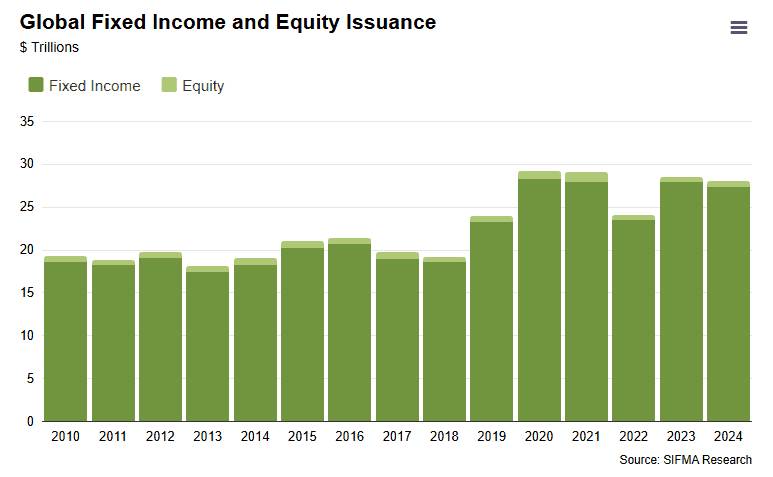
A useful reality check: global capital markets are massive. SIFMA reports global equity market capitalization at $126.7 trillion in 2024 and global fixed income markets outstanding at $145.1 trillion in 2024. That scale shapes everything, from regulation to technology budgets to the pace of market modernization.
Equity instruments
Equity represents ownership:
- Shareholders may receive dividends and capital gains
- Equity can include voting rights depending on share class
- Higher upside potential typically comes with higher volatility
Equity capital is long-duration confidence. When confidence is cheap, companies raise equity easily. When confidence is expensive, they avoid dilution and lean on debt or private markets.
Debt instruments
Debt instruments are loans packaged as securities:
- Bonds pay interest and return principal at maturity
- Key risks include credit risk and interest rate risk
- Terms vary by maturity, seniority, covenants, and collateral
Debt is often perceived as “safer,” but in 2026 the market has learned to separate “contractual safety” from “market safety.” Duration, liquidity, and credit conditions can make “safe” assets behave violently in stressed regimes.
Verifiable Data Infrastructure for Capital Markets
The future-facing shift is not just digitization, it is verification. As capital markets become more data-driven, trust increasingly depends on whether critical data can be checked, replayed, and audited without turning every workflow into a manual investigation.
This is where the conversation around digital capital markets, tokenized capital markets, and on-chain capital markets becomes practical. Web3 narratives often emphasize tokenization, decentralized exchanges, smart contracts, and increased transparency as defining features of Web3 capital markets. The strategic question is what happens when these systems meet institutional requirements for auditability, compliance, and cross-platform reconciliation.
Orochi Network and verifiable capital market data
In this context, Orochi Network frames verifiable data infrastructure as a way to make market-critical data provable, not merely publishable. The idea is not to replace existing market structure overnight. The goal is to make reporting, compliance checks, and multi-party reconciliation more defensible when data moves across systems and networks.
zkDatabase - Audit-grade data integrity for Capital Market
zkDatabase delivers audit-grade data integrity for modern capital markets by turning every data update, calculation, and report into a cryptographically verifiable event.
Instead of relying on raw databases or manually prepared reports, auditors, regulators, and counterparties can independently verify the accuracy of financial data using Zero-Knowledge Proofs, without accessing sensitive underlying information.
At the heart of zkDatabase is a Verifiable Data Pipeline built on zk-Data-Rollups. This pipeline captures how financial data moves through the system:
From when it is ingested, to how it is updated, calculated, and reported.
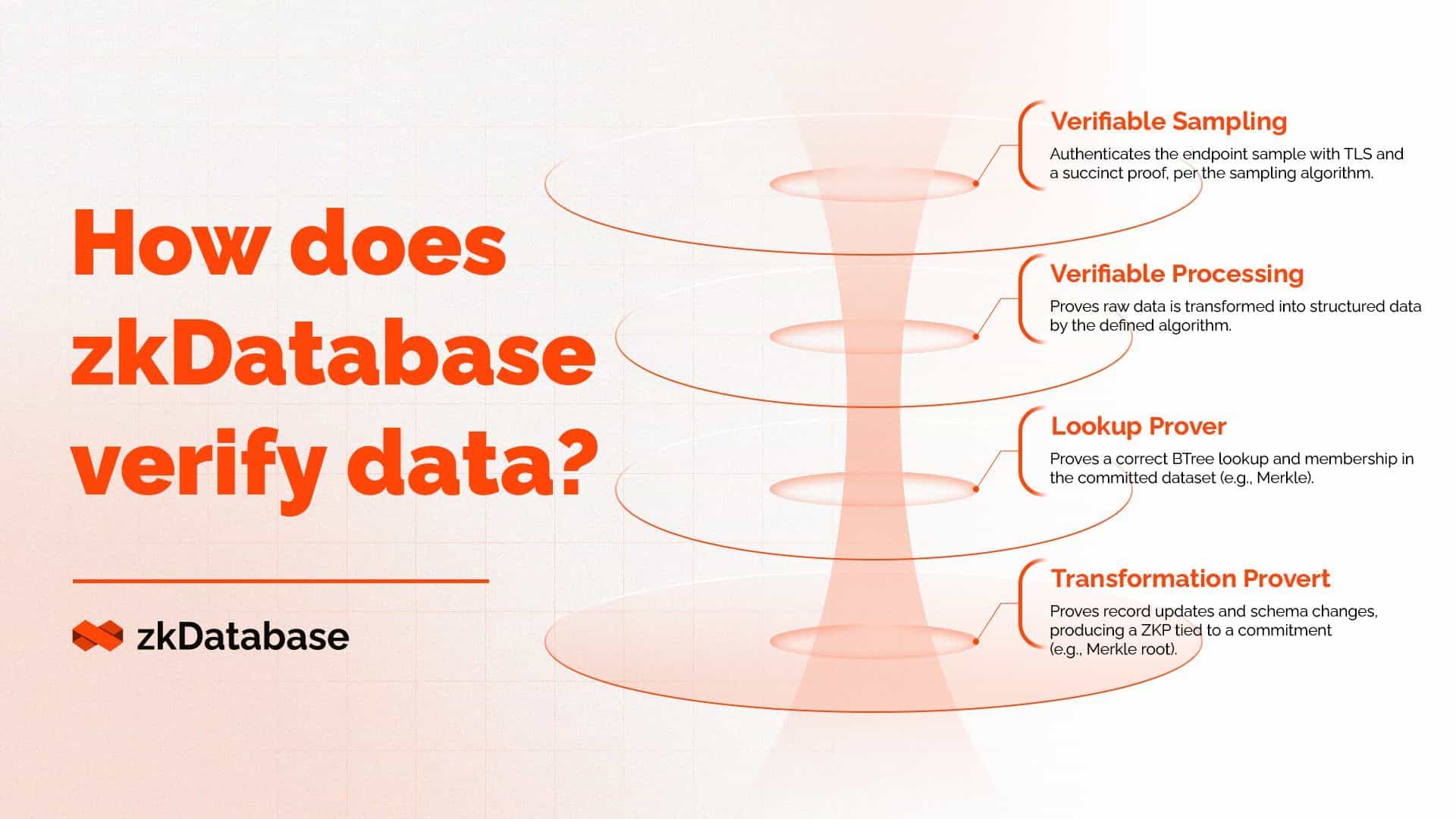
Each step is recorded as a secure state change inside a zk-Data-Rollup, creating a continuous and tamper-proof history of the data. Rather than trusting that a report was generated correctly, anyone can verify that it was produced from the right data, using the right rules, at the right time.
To make this work at real-world scale, zkDatabase uses Groth16, a highly efficient zero-knowledge proof system. Groth16 makes it possible to generate small, fast, and low-cost proofs for complex financial data, enabling real-time verification of things like:
- Asset balances
- Reserve reports
- NAV calculations
- And compliance checks
zkDatabase creates a continuous integrity layer across the entire market data lifecycle, from trade records and custody statements to financial reports and regulatory disclosures, giving institutions, regulators, and investors a shared, provable source of truth.
This is how capital markets move from trusting data to verifying data.
Conclusion
What is Capital Market in 2026? It is still the long-term funding engine that powers growth, investment, and liquidity, but it now operates in a world where speed, settlement discipline, and data integrity shape trust. Capital markets still rely on the same structure: issuers raise funds in primary markets, investors trade risk in secondary markets, and intermediaries keep execution and settlement orderly.
The shift is that capital markets are becoming more digital and data-driven, and the operational layer is no longer invisible. With global equities and fixed income at massive scale, verification and auditability increasingly decide who can participate confidently, especially in hybrid environments. That is why zkDatabase fits the future-facing direction: it treats integrity as something you can prove, supporting trusted, future-ready capital market data workflows that scale without scaling blind trust.
FAQs
Question 1: What is Capital Market in 2026 and why does it matter?
It is the system where companies and governments raise long-term funding through stocks and bonds, and where investors allocate capital for returns. It matters because it supports liquidity, price discovery, and efficient capital allocation, which directly influences economic growth, business expansion, and investment confidence.
Question 2: What is the difference between primary and secondary capital markets?
Primary and secondary capital markets differ by purpose. The primary market is where new securities are issued (IPOs or new bonds) so issuers raise fresh capital. The secondary market is where existing securities trade between investors, creating liquidity and continuous pricing, which helps lower future funding costs for issuers over time.
Question 3: How can verifiable data infrastructure improve capital markets?
Verifiable data infrastructure reduces reporting and compliance friction by proving data integrity and auditability across systems. Orochi Network’s zkDatabase supports proof-based verification for updates and queries.
Related toCapital Market