Stablecoin
Stablecoin Regulation Comparison: US vs EU vs Hong Kong vs Singapore
October 22, 2026
15 mins read
The GENIUS Act, MiCA, Hong Kong's Stablecoin Ordinance, and Singapore's MAS framework all require reserve backing and attestation — but diverge sharply on frequency, format, and enforcement. Here is what each jurisdiction actually requires in 2026.


TL;DR: The GENIUS Act (US), MiCA (EU), Hong Kong's Stablecoin Ordinance, and Singapore's MAS framework each demand 100% reserve backing and independent attestation, but differ on frequency, ranging from Hong Kong's daily reserve statements to the EU's semi-annual audit. No jurisdiction accepts cryptographic proof as a compliance mechanism, creating a continuous verification gap that grows with an issuer's jurisdictional footprint.
The stablecoin regulation comparison across the United States, European Union, Hong Kong, and Singapore reveals a market that has moved from regulatory ambiguity to operational obligation in under two years. As of May 2026, the GENIUS Act is signed law, MiCA is fully applicable, Hong Kong's Stablecoin Ordinance is active, and Singapore's MAS framework is hardening into statute. For CEOs and compliance heads at issuers operating across these jurisdictions, the practical question is no longer whether to comply. It is how to meet four overlapping attestation calendars simultaneously, without the continuous proof infrastructure that regulators have not yet sanctioned but the market increasingly demands.
Key Takeaways:
- The stablecoin regulation comparison across US, EU, Hong Kong, and Singapore shows convergence on 100% reserve backing but sharp divergence on attestation frequency, auditor standards, and enforcement mechanisms.
- Hong Kong is the most operationally demanding, daily reserve statements, weekly HKMA reporting, and random-day attestation sampling designed explicitly to prevent window dressing.
- The EU's MiCA imposes the highest financial penalties (up to €5M or 12.5% of annual turnover) and the only jurisdiction with a hard delisting deadline: July 1, 2026.
- The GENIUS Act introduces personal liability, CEO and CFO certification under criminal penalty, making US compliance a board-level risk, not just an operations issue.
- No jurisdiction mandates or accepts cryptographic proof of reserves, creating a structural gap between attestation snapshots and continuous reserve integrity.
What Does Each Jurisdiction Actually Require in 2026?
Each framework is built on the same foundation, reserves must equal or exceed outstanding stablecoin value at all times, but the operational requirements that flow from that principle differ enough to constitute four distinct compliance programs for any issuer operating across all four.
United States (GENIUS Act, signed July 18, 2025). The GENIUS Act establishes the first federal stablecoin framework. Reserves must be held 1:1 in US dollars, short-term Treasuries, overnight reverse repurchase agreements, or Federal Reserve credits. Monthly reserve reports must be published on the issuer's website, examined by a PCAOB-registered accounting firm, and, critically, certified personally by the CEO and CFO. False certification carries criminal penalties. Issuers above $50 billion in outstanding supply must additionally undergo annual GAAP audits under full PCAOB standards. Final OCC regulations are targeted for July 2026, with an effective date of January 18, 2027. The GENIUS Act prohibits stablecoin holders from receiving interest or yield. On cryptographic proof: the AICPA released voluntary criteria for digital asset attestations in March 2025, but no federal mandate exists for on-chain or cryptographic reserve verification.
European Union (MiCA, fully applicable December 30, 2024). MiCA distinguishes between Asset-Referenced Tokens (ARTs) and E-Money Tokens (EMTs), with separate but parallel reserve requirements under Articles 36 and 54-55 respectively. ARTs must undergo independent audit every six months, with results published within two weeks of the reference date. Tokens exceeding €100 million in issued value must submit quarterly reports to competent authorities, and all issuers must disclose reserve composition publicly on a monthly basis. The EBA has direct supervisory authority over significant issuers. Crucially, two RTS on reserve composition eligibility remain unresolved as of March 2026. The EBA and European Commission have disputed which assets qualify as highly liquid, leaving compliance teams unable to finalize reserve architecture even as the July 1, 2026 grandfathering expiry approaches. Non-compliant issuers face delisting from EU markets. On cryptographic proof: MiCA is entirely silent, neither mandating nor prohibiting cryptographic reserve verification mechanisms.
Hong Kong (Stablecoin Ordinance, passed May 2025, effective August 1, 2025). Hong Kong's framework, supervised by the HKMA, is the most operationally intensive of the four. Licensees must prepare daily reserve statements covering outstanding stablecoin par value and reserve market value and composition. These reports go to the HKMA weekly. Independent external attestation is required at a regular HKMA-approved frequency, and, unlike any other jurisdiction, the attestation must cover at least one randomly selected business day during the period, in addition to the period-end date. This random-day sampling requirement is deliberate: it prevents issuers from concentrating reserves around known attestation dates. Smart contract audits may be required by the SFC on a case-by-case basis. First licenses were expected Q1-Q2 2026; as of April 2026, zero had been issued. On cryptographic proof: the HKMA Supervision Guideline is silent.
Singapore (MAS SCS framework, finalized August 2023, legislation expected mid-2026). Singapore requires 100% reserve backing in cash, cash equivalents, or government debt securities with residual maturity of three months or less and a minimum credit rating of AA-. Monthly independent attestation by an external audit firm is mandatory, with results published on the issuer's website and submitted to MAS by the end of the following month. Annual external audit is also required. Stablecoin issuers are prohibited from lending or staking reserve assets. Multi-jurisdiction issuance is not permitted, each currency peg requires a separate entity and separate reserves. Only two entities, StraitsX and Paxos Digital Singapore, have been publicly acknowledged by MAS as substantively compliant with the upcoming framework. On cryptographic proof: MAS has issued no guidance on on-chain attestations or cryptographic reserve verification.
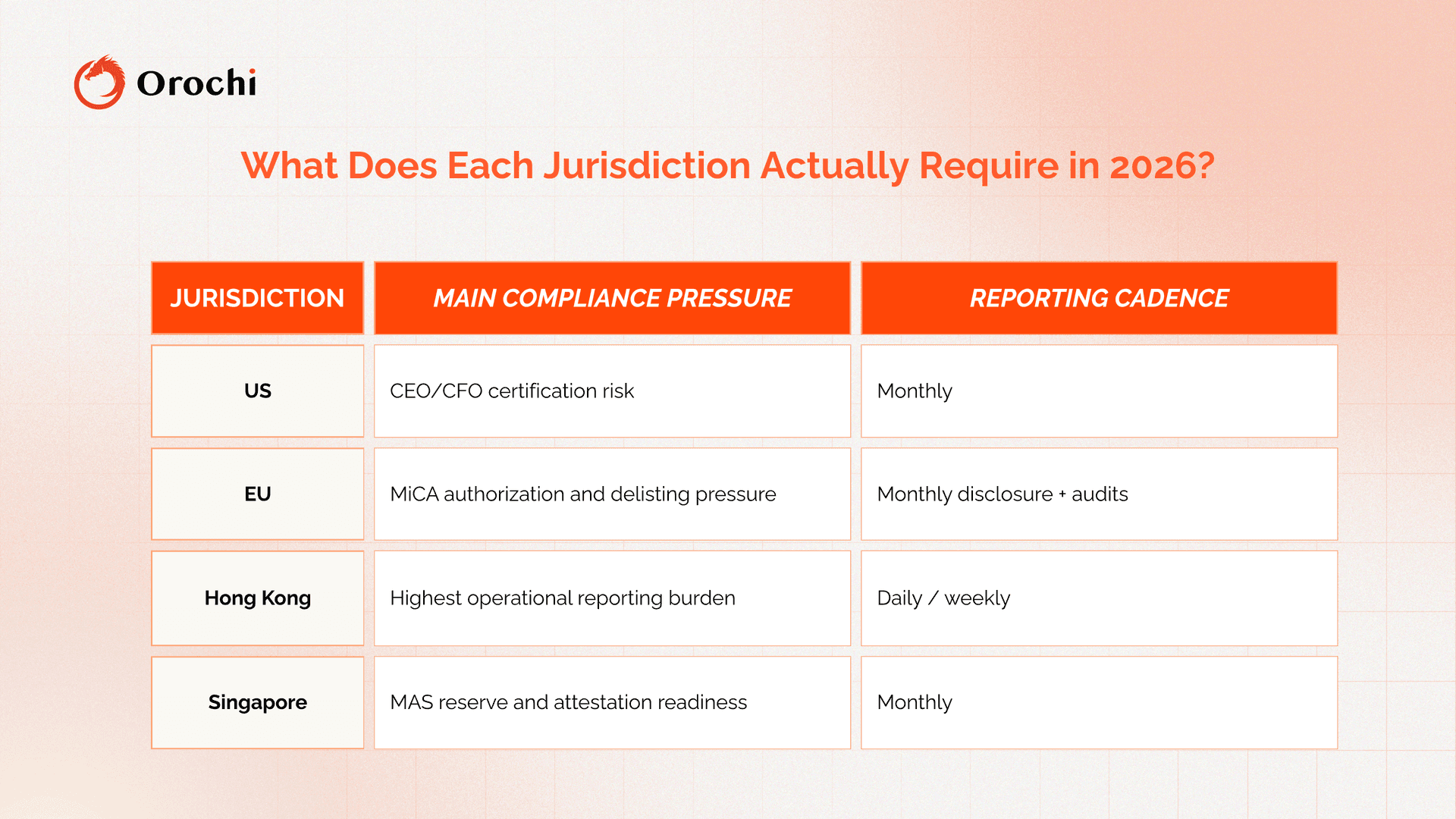
Stablecoin frameworks converge on reserve backing, but diverge sharply on reporting cadence. The US, EU, Hong Kong, and Singapore each create a different attestation clock for issuers to manage. The shared gap is reserve verification between reporting cycles, where reserve integrity is still asserted rather than continuously proven.
How Do Reserve Requirements Differ Across Jurisdictions?
The table below provides a direct comparison of operational requirements. For any issuer operating across multiple jurisdictions, the most demanding standard in each row sets the operational floor.
| Requirement | United States (GENIUS Act) | European Union (MiCA) | Hong Kong (Stablecoin Ordinance) | Singapore (MAS SCS) |
|---|---|---|---|---|
| Reserve standard | 1:1 in USD, short-term Treasuries, overnight repos, Fed Reserve credits | 100% at all times; eligible assets disputed (EBA vs. Commission) | 100% par value; overcollateralization expected by HKMA | 100% in cash, cash equivalents, or government debt ≤3 months, min AA- |
| Attestation frequency | Monthly (PCAOB-registered accounting firm examination) | Semi-annual independent audit (ARTs); monthly public disclosure | Regular external attestation at HKMA-approved frequency; includes random-day sampling | Monthly independent attestation by external audit firm |
| Reporting to regulator | Monthly public report; annual GAAP audit (>$50B issuers) | Quarterly to competent authorities (>€100M issued value); daily CASP-to-issuer data | Weekly to HKMA | Monthly to MAS |
| Who audits | PCAOB-registered accounting firm | Qualified statutory auditor; EBA supervises significant issuers | Qualified independent external auditor | External audit firm; MAS-supervised |
| Cryptographic proof accepted? | No federal mandate; AICPA voluntary criteria only | Not addressed; neither mandated nor prohibited | Not addressed | Not addressed |
| CEO/CFO personal liability | Yes, criminal penalties for false certification | No equivalent provision | Not specified | Not specified |
| Penalty for non-compliance | Criminal penalties for false CEO/CFO certification | Up to €5M or 12.5% of annual turnover (whichever higher) | HK$5M + potential criminal prosecution; HK$100,000 daily for continuing offences | Up to S$1M per offence; imprisonment up to 7 years for market misconduct |
| Effective date / status | Signed July 18, 2025; final OCC rules due July 2026; effective January 18, 2027 | Fully applicable December 30, 2024; grandfathering expires July 1, 2026 | Effective August 1, 2025; first licenses pending | Framework August 2023; PSA legislation expected mid-2026 |
| Interest/yield to holders | Prohibited | Not prohibited under MiCA | Not specified | Prohibited (no lending or staking) |
What Does This Mean for Multi-Jurisdiction Stablecoin Issuers?
The practical implication of operating across all four frameworks is that compliance does not stack, it compounds.
An issuer with operations across the US, EU, Hong Kong, and Singapore faces four separate attestation programs with four separate auditor relationships, four separate reporting cadences to four separate regulators, and four separate legal entities with segregated reserves (no passporting exists in any jurisdiction). The compliance cost scales linearly with jurisdictional expansion. A 2024 PwC analysis found that the combination of monthly GENIUS Act attestations and semi-annual MiCA audits alone could require 14-16 separate CPA engagement cycles per year per issuer before accounting for Hong Kong and Singapore. We cover the US reserve rules in more detail in GENIUS Act stablecoin requirements for issuers.
The tightest standard across all four jurisdictions determines the operational floor. That floor is Hong Kong's: daily reserve statements, weekly regulatory reporting, and random-day attestation sampling. Every other jurisdiction's requirements fit within Hong Kong's cadence, meaning an issuer built to satisfy HKMA's stablecoin framework has already built the infrastructure to satisfy the others. The challenge is that Hong Kong's licensing backlog means the systems must be in place before a license is granted, not after.
The EU's MiCA adds a different pressure: the July 1, 2026 hard delisting deadline. Issuers that have not received authorization by that date face removal from EU markets, and the disputed RTS on eligible reserve assets means compliance teams are making architectural decisions without final regulatory clarity on what their reserves are permitted to hold.
The US GENIUS Act introduces a governance dimension that the other frameworks do not: personal criminal liability for CEO and CFO certification. This shifts reserve attestation from an operations function to a board-level risk, with direct accountability on named executives. Combined with the AICPA's January 2026 criteria covering operational controls including private key management and multi-chain token supply reconciliation, the US framework requires the deepest internal control buildout of the four.
Across all four jurisdictions, the same structural gap persists: attestations are point-in-time snapshots. Hong Kong's monthly attestation tells the market what the reserve position was on a specific date (and one random date during the month). The EU's semi-annual audit tells the market what the reserve position was six months ago. Between those moments, reserve integrity is asserted, not proven.
This is not a regulatory oversight, regulators are aware that blockchain systems generate continuous, cryptographically verifiable data. The EU's DLT Pilot Regime has already demonstrated the concept of direct regulator access to blockchain data, and Hong Kong's ASPIRe roadmap signals automated reporting infrastructure. But as of May 2026, not one of the four frameworks accepts cryptographic proof of reserves as a substitute for traditional auditor attestation. The regulatory window for that transition is narrowing, but it has not yet opened.
Where Does Verifiable Data Infrastructure Fit?
The core compliance challenge for multi-jurisdiction stablecoin issuers is not understanding what regulators require. It is building the data infrastructure to prove it, continuously, not just at the next attestation date.
Every jurisdiction's framework is built around a periodic snapshot: an auditor checks the books, a report is filed, and the cycle resets. The AICPA has explicitly noted that monthly attestations are point-in-time snapshots and that issuers "sometimes struggle to maintain a unified view of total supply across all chains" between cycles. Hong Kong's random-day sampling requirement was designed precisely because regulators recognized the snapshot problem, window dressing is only possible when attestations are predictable.
The operational gap is clear: stablecoins operate 24 hours a day, seven days a week, across multiple chains simultaneously. Reserve positions change continuously. An attestation tells the market what was true on one day. The other 29 days of the month are unproven.
Verifiable compliance infrastructure addresses this gap at the data layer, not by replacing the auditor, but by providing continuous cryptographic proof that reserve data has not been altered between attestation cycles. zkDatabase, built on Zero-Knowledge Proofs (ZKPs), generates mathematical proof over every state change in a reserve data pipeline. The proof is on-chain verifiable, meaning any counterparty, regulator, investor, or smart contract can verify reserve integrity at any point in time, not only when an audit report is published.
This matters for each jurisdiction differently:
For US issuers facing GENIUS Act monthly CEO/CFO certification, continuous ZKP-backed reserve data reduces the internal control risk that the attestation is based on. The CEO is certifying a reserve position. zkDatabase proves that the underlying data supporting that position has not been manipulated between the data source and the attestation output.
For EU issuers operating under MiCA's semi-annual audit with monthly public disclosure, the six-month gap between audits represents six months of unproven reserve integrity. ZKP-backed continuous verification closes that gap without adding auditor cost.
For Hong Kong issuers facing random-day sampling, the operational challenge is having audit-ready reserve data on any given day, not just the period-end. zkDatabase proves reserve integrity on every day, eliminating the operational scramble that random-day sampling is designed to prevent.
For Singapore issuers facing twice-monthly de facto attestation expectations (StraitsX's voluntary cadence is already the market benchmark), continuous ZKP verification enables the frequency without the proportional increase in auditor cost.
The off-chain to on-chain data integrity problem is the same in every jurisdiction: reserve data originates off-chain (at custodians, banks, and fund administrators), travels through internal systems, and is presented on-chain or in regulatory reports. At every step in that pipeline, data can be altered without detection. Zero-Knowledge Proofs solve this by generating mathematical proof that the data has not changed, proof that anyone can verify, without seeing the underlying data.
To understand the technical mechanism behind how zkDatabase generates these proofs, see our explainer on Zero-Knowledge Proofs.
Conclusion
The stablecoin regulation comparison across the US, EU, Hong Kong, and Singapore in 2026 reveals a market that has reached regulatory maturity faster than the compliance infrastructure to support it. All four frameworks demand 100% reserve backing and independent attestation. All four impose meaningful penalties for non-compliance. And all four converge on the same critical gap: the period between attestations is unverified.
For compliance heads at multi-jurisdiction issuers, the operational question is not whether the next audit will pass. It is what happens to reserve integrity in the 29 days before anyone checks. For CEOs now personally certifying reserve statements under US criminal liability, the question is whether the data pipeline underlying that certification is provably accurate, not just reported accurate.
zkDatabase provides continuous cryptographic proof of reserve data integrity, on any day, at any time, verifiable by any counterparty, without exposing sensitive reserve composition data. As jurisdictions move from periodic snapshots toward direct regulator access to reserve data (a trend already visible in the EU's DLT Pilot Regime and Hong Kong's ASPIRe roadmap), issuers built on verifiable data infrastructure are building for the compliance requirement of 2026 and the one regulators are building toward.
For more background on stablecoin regulation and MiCA stablecoin compliance, see our related explainers.
Schedule a consultation with our team to walk through how zkDatabase maps to your specific compliance architecture.
FAQ
Q1: What is the key difference in the stablecoin regulation comparison between the US, EU, Hong Kong, and Singapore?
The stablecoin regulation comparison across these four jurisdictions shows convergence on 100% reserve backing but significant divergence on attestation frequency and enforcement. Hong Kong requires daily reserve statements and weekly regulatory reporting, the most demanding cadence globally. The EU's MiCA mandates semi-annual independent audits with a hard July 1, 2026 delisting deadline. The US GENIUS Act requires monthly attestation with criminal liability for false CEO/CFO certification. Singapore requires monthly independent attestation with annual audit. No jurisdiction accepts cryptographic proof as a substitute for traditional auditor attestation.
Q2: Does any jurisdiction accept cryptographic proof of reserves as a regulatory compliance mechanism?
No. As of May 2026, none of the four major stablecoin jurisdictions, the United States, European Union, Hong Kong, or Singapore, mandates or formally accepts cryptographic proof of reserves as a substitute for traditional independent auditor attestation. The AICPA released voluntary criteria for digital asset attestations in March 2025, but these are non-binding. The EU's DLT Pilot Regime has enabled direct regulator access to blockchain data, and Hong Kong's ASPIRe roadmap signals movement toward automated reporting, but cryptographic proofs have no formal compliance status in any framework as of this writing.
Q3: What is the compliance burden for stablecoin issuers operating across all four jurisdictions simultaneously?
Operating across all four jurisdictions requires four separate regulatory entities with segregated reserves (no jurisdiction allows passporting of compliance), four separate attestation programs with different auditor standards, and four separate reporting cadences: daily in Hong Kong, monthly in the US and Singapore, and quarterly (with monthly public disclosure) in the EU. The tightest combination is EU MiCA and Hong Kong's Stablecoin Ordinance: MiCA's disputed reserve composition rules create architectural uncertainty while Hong Kong's random-day sampling requires continuous audit-readiness. Industry estimates suggest multi-jurisdiction issuers face 14-16 separate CPA engagement cycles per year before accounting for internal control buildout under the GENIUS Act's CEO/CFO certification requirements.
Related toStablecoin