Real - World Assets
RWA Tokenization Audit: Why Reported Asset Data Is Not Enough
July 14, 2026
8 mins read
An RWA tokenization audit confirms one date — not the gaps between audits, while assets keep trading. Why reported data falls short for allocators.


TL;DR: An RWA tokenization audit verifies what an issuer reported on a specific date. It does not prove the underlying asset data stayed correct in the weeks between audits, when tokenized assets keep trading, settling, and serving as collateral. For institutional allocators, reported data leaves a verification gap that periodic audit alone cannot close.
Distributed tokenized Real-World Asset value reached $33.85 billion by May 20, 2026, per RWA.xyz data cited by CoinLaw, and institutional allocators underwrite those assets continuously, not on audit dates. An RWA tokenization audit speaks to the past; zkDatabase can provide cryptographic evidence of asset state between audit cycles.
Key Takeaways
- An RWA tokenization audit confirms reported data on a date; it does not prove the data stayed correct between dates.
- The core problem is cadence: audits are periodic, tokenized assets are continuous.
- Reported asset data carries a trust assumption: the reader must trust the issuer or the auditor.
- Asset lifecycle verification adds proof at each state change, not just at the audit checkpoint.
- zkDatabase can complement audits by generating cryptographic evidence of asset conditions continuously, without exposing the raw asset data.
What Does an RWA Tokenization Audit Actually Verify?
An RWA tokenization audit verifies that an issuer's reported asset data matched supporting records as of a specific date. Depending on the asset, jurisdiction, issuer, and engagement scope, an auditor reviews items such as ownership documents, valuations, and reserve or collateral figures, then issues an opinion. That opinion is a point-in-time statement about reported data, and its scope varies from one engagement to the next.
This is useful and, in many cases, required. But it is important to be precise about what it covers. The audit confirms the reported numbers were consistent with evidence the auditor reviewed. It does not produce an ongoing, independently checkable proof that the data remains correct after the auditor leaves.
For an asset that sat still, that distinction would be minor. Tokenized assets do not sit still. They trade, change hands, get pledged as collateral, and update their underlying state continuously, which is where reported data starts to fall behind — and where proving on-chain token state matches the custodied assets becomes the unsolved problem underneath tokenization services like the DTCC's. The deeper structural version of this argument is covered in the audit layer for RWA.
Why Is Reported Asset Data Not Enough for Institutions?
Reported asset data is not enough because it carries a trust assumption that institutional allocators are no longer willing to accept on faith. When an issuer reports ownership, valuation, or collateral status, the partner consuming that data has to trust the issuer's process or the auditor's last visit. There is no proof attached to the number that the partner can check independently.
Institutional due diligence is built to find exactly this kind of gap. An allocator underwriting a tokenized position asks how the data was produced, who can change it, and what happens between reporting dates. "Our records show" is an answer for retail. It is the start of a longer conversation for a credit desk or a fund of funds.
The cadence mismatch is the heart of it. An audit describes one moment; the asset lives through thousands of moments before the next audit. The interval between reports is precisely where mispriced collateral, stale valuations, and undetected changes accumulate. This is the same structural failure described in RWA tokenization data integrity.
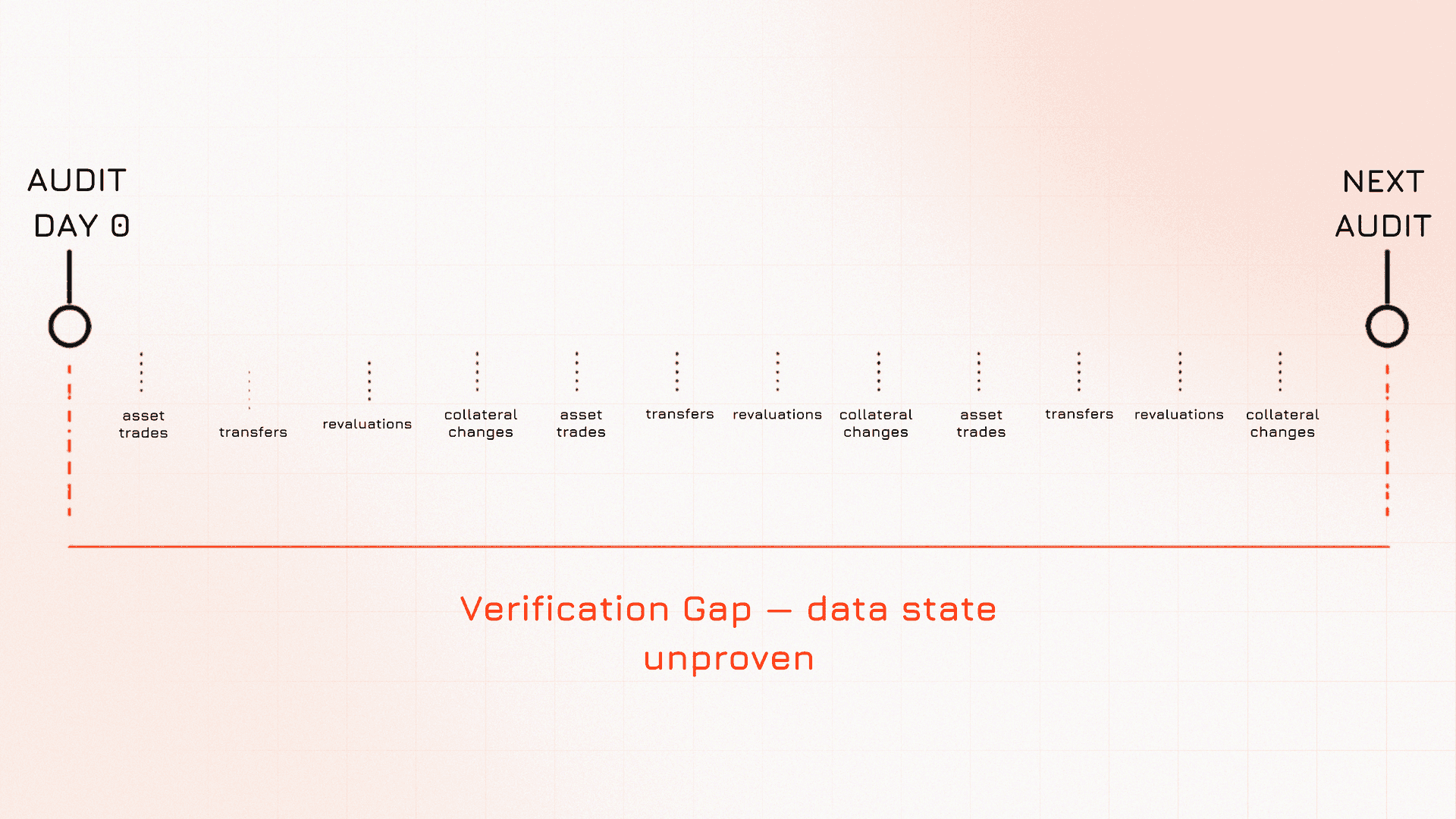 An audit fixes one date; the asset keeps moving until the next one.
What Is Asset Lifecycle Verification, and How Is It Different?
Asset lifecycle verification means proving an asset's data at each state change across its life, not only at an audit checkpoint. Onboarding, valuation updates, custody transfers, and collateral status each produce a verifiable record, so the proof and the asset move together rather than falling out of sync.
The difference from a traditional audit is continuity and independence. Instead of a single opinion on a single date, lifecycle verification produces evidence at every step. In practice, the platform commits the asset data, zkDatabase generates a proof at each state change, the proof is published on-chain, and an authorized verifier such as a counterparty, contract, or auditor checks whether the defined condition held. This is the model behind proving ownership, custody, and valuation on-chain.
This does not remove the auditor. A regulator may still require a formal audit, and a counterparty may still want one. Lifecycle verification fills the space the audit cannot reach: the time between audits, and the question of whether the data changed after it was reported.
Bottom line: A tokenization audit answers "was the reported data correct on this date." Asset lifecycle verification answers "is the committed data still satisfying its conditions right now, and can I check it myself." Institutions increasingly need both.
| Control | What it checks | Timing | What it misses |
|---|---|---|---|
| Audit | Reported records against evidence | Point-in-time | State changes between cycles |
| Attestation | A stated condition | Periodic | Source-data integrity |
| Lifecycle proof | A defined data condition over committed inputs | Per state change or on demand | Legal interpretation and source-document validity |
How Does zkDatabase Support RWA Tokenization Audit Workflows?
zkDatabase supports RWA tokenization audit workflows by generating a cryptographic proof for the asset data at each state change, so the evidence is continuous and independently verifiable. On-chain contracts and counterparties verify proofs instead of trusting a reported value, and the underlying asset data can stay private.
In practice, this means an asset platform can prove that ownership is intact, that a valuation followed the stated method, or that collateral remains sufficient, all without exposing the sensitive records behind those facts. The proof is produced as the data changes, which is what closes the gap between audit cycles. This is the verifiable data pipeline applied to assets, and it maps to how zkDatabase applies to real-world assets.
To be clear about the boundary: zkDatabase can provide cryptographic infrastructure that complements an audit. It does not replace auditors, and it does not by itself guarantee that a platform is compliant. It reduces reliance on issuer or operator trust for defined data conditions between audits; it does not remove the need to trust source documents, custody arrangements, legal structure, or the scope of the audit itself. For the broader case, see why tokenized assets need a new audit model.
Conclusion
An RWA tokenization audit is necessary, but reported asset data alone is not enough for institutions allocating into tokenized markets. The audit verifies a moment; the asset lives through the interval. That interval, where data can drift or change without independent proof, is the verification gap institutional capital now underwrites against. zkDatabase closes it with Zero-Knowledge Proofs that make asset data provable at every state change, complementing the audit rather than replacing it, so allocators can verify the data instead of trusting the report.
Talk to our team about audit-grade verification → See how verifiable asset data can support your tokenization audit and reporting workflows: https://orochi.network/partnership
FAQ
What does an RWA tokenization audit verify, and what does it miss?
An RWA tokenization audit verifies that an issuer's reported asset data, such as ownership, valuation, and collateral, matched supporting records on the audit date. It misses the interval between audits. Because tokenized assets keep trading and updating, the audit cannot prove the data stayed correct after the auditor's review, which is where most verification risk accumulates.
Why is reported asset data not enough for institutional allocators?
Reported asset data is not enough because it carries a trust assumption with no attached proof. An allocator has to trust the issuer's process or the auditor's last visit, rather than independently checking the data. Institutional due diligence specifically probes how data is produced, who can change it, and what happens between reporting dates.
What is asset lifecycle verification?
Asset lifecycle verification is the practice of proving an asset's data at each state change across its life, including onboarding, valuation updates, custody transfers, and collateral status. Instead of one opinion on one date, it produces continuous, independently verifiable evidence, shifting the trust model from trusting the operator to verifying the proof at any point.
Does zkDatabase replace an RWA audit?
No. zkDatabase does not replace an RWA audit and does not guarantee compliance. It provides cryptographic infrastructure that can complement an audit by proving asset data continuously between audit cycles, using Zero-Knowledge Proofs so the underlying records stay private while the proof is verifiable on-chain.
Related toReal - World Assets