Stablecoin
The Stablecoin Stack: Mapping the New Financial Infrastructure
July 14, 2026
10 mins read
The stablecoin stack is the layered infrastructure now forming under global finance, from settlement blockchains to on-chain credit. This explainer maps each layer, credits a16z's market map, and names the one layer still missing: verifiable data.


TL;DR: The stablecoin stack is the layered infrastructure now forming under global finance: settlement blockchains, banking, issuers, liquidity, bank connectivity, applications, and credit. Each layer is maturing fast, but the data flowing through it is still attested, not cryptographically proven. Verification is the layer still missing.
Money is moving onto stablecoin rails faster than most institutions realize, and the stablecoin stack is what turns a dollar token into a working financial system. This explainer maps each layer, credits a16z crypto's market map, and names the one layer the map leaves open: verifiable data.
Key Takeaways
- The stablecoin stack spans roughly seven layers, from settlement blockchains up to on-chain credit, and it is consolidating fast.
- Stablecoins have shifted from a trading tool to local payments infrastructure. Intra-country transfers rose from about 50% to 70% of volume between January 2024 and January 2026 (a16z crypto, citing Allium).
- Regulation is acting as a growth trigger, not a brake. MiCA created a non-USD stablecoin market that barely existed before.
- Credit is the stack's second act, and the higher-stakes one.
- Every layer assumes the data it runs on is true. Today that data is attested by reports and admin keys, not cryptographically proven.
What is the stablecoin stack?
The stablecoin stack is the layered infrastructure being built on stablecoins, from settlement blockchains through banking, issuance, liquidity, applications, and credit. a16z crypto's 2026 market map frames it as a new banking-as-a-service built on on-chain rails instead of rented bank licenses.
The structural point is bigger than growth charts. The previous banking-as-a-service wave was fintechs renting a bank license and plugging into legacy core systems. This one combines account, payment, foreign-exchange, and credit functions into end-to-end products on self-custodial wallets, a set of capabilities that needed a dozen regional licenses a decade ago. Consolidation is already visible: Stripe acquired Bridge and Privy, and Mastercard acquired BVNK, as incumbents move to secure stack positions before the infrastructure layer settles.
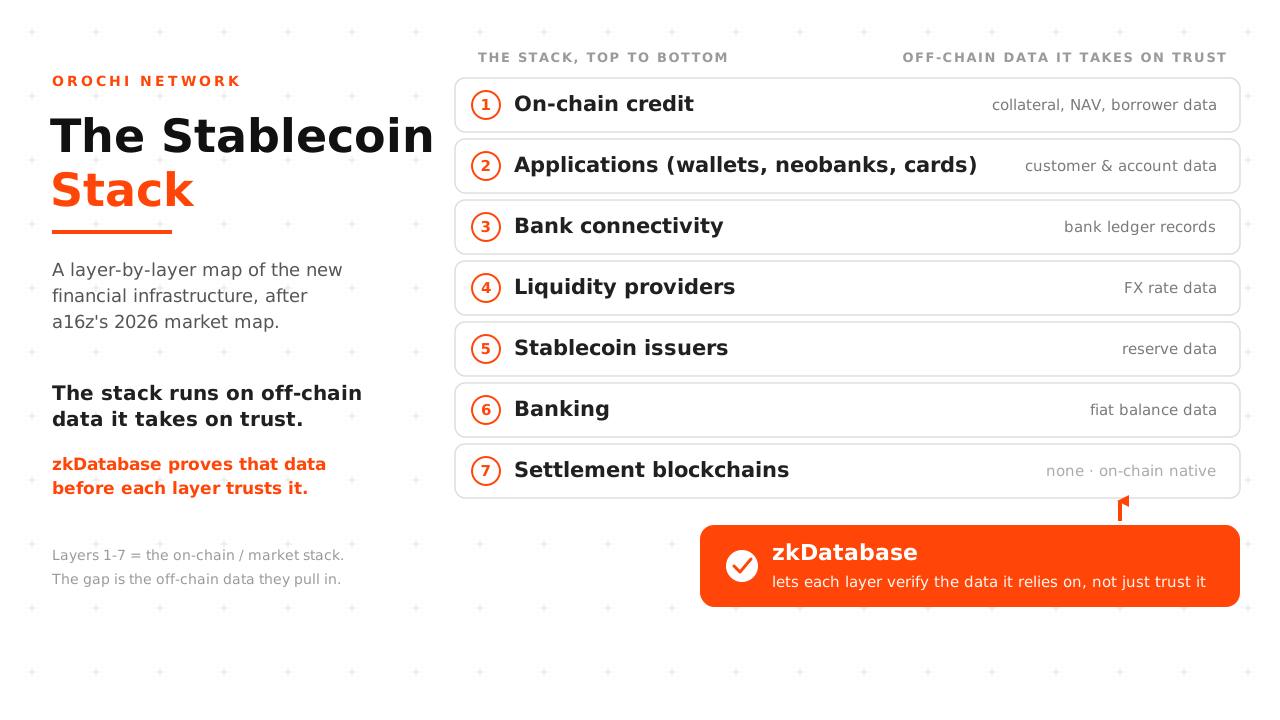 The stablecoin stack, layer by layer. zkDatabase proves the off-chain data each layer relies on, at the point it enters the stack.
Here is the stack at a glance, with the part each layer takes on trust:
| Layer | What it does | Where the data is taken on trust |
|---|---|---|
| Settlement blockchains | Move and settle value | On-chain state, self-verifiable (the exception) |
| Banking | Connects fiat to on-chain rails | Reserve and balance reporting |
| Issuers | Mint and redeem the stablecoin | Reserve adequacy and composition |
| Liquidity providers | Convert stablecoins to local fiat | Pricing and settlement integrity |
| Bank connectivity | Translates on-chain to legacy core systems | Audit trail of every record change |
| Applications | Wallets, neobanks, cards, credit | Customer and balance data |
| On-chain credit | Lends against real assets and receivables | Collateral value, NAV, borrower data |
Settlement blockchains now split into three competing categories
The old assumption that all blockchains compete for the same use cases has broken down. a16z's map identifies three settlement categories: general-purpose chains, payments-specific chains, and institutional networks, each built for a different performance and compliance profile.
General-purpose chains remain the home of trading, lending, and DeFi. Payments-specific chains are emerging for financial services that need stablecoin-native gas fees and predictable transaction costs, so a fintech can model the cost of millions of payments. Institutional networks target regulated entities that need programmability and privacy without giving up the compliance frameworks they are legally required to keep. Two of the three categories are defined by a privacy-and-compliance requirement at once, which is the hardest combination to satisfy and a recurring theme higher up the stack.
Banking, issuance, and liquidity are the money-movement layers
The middle of the stack carries the actual movement of money: crypto-friendly banks opening fiat connectivity, issuers competing on regulatory position, and liquidity providers closing the gap to local currency. Each is maturing, and each still rests on reported data rather than proof.
Why is the banking layer loosening?
For a decade the banking layer was where crypto-native finance hit a wall, with partner relationships hard to win and easy to lose. That is meaningfully better now. A cohort of crypto-friendly banks is building connectivity between on-chain infrastructure and traditional fiat systems, which makes the on-ramp and off-ramp problem more tractable across the whole stack.
What is the issuer charter race?
Since the GENIUS Act passed, issuers have scrambled for an OCC National Trust Charter. The near-term benefit is legitimacy. The longer-term prize is structural: if charter holders eventually gain direct Federal Reserve rail access, early movers become wired into the core of the financial system. As a16z puts it, the race is less about branding than about where in the payment hierarchy an issuer ends up sitting. Notice what that race buys, though: regulatory standing, not a cryptographic proof of reserves.
Where does liquidity still break?
Stablecoins solved the middle mile of cross-border payments but not the last mile. Liquidity between stablecoins and local fiat remains thin in many emerging markets, which means slippage and unreliable pricing. It is closing through three channels at once: stablecoin-compatible foreign-exchange providers, regional exchanges with deep local relationships, and eventually banks settling stablecoin trades directly. A separate bank-connectivity layer translates on-chain activity into the legacy core systems most banks still run.
Applications are where neobanks and crypto wallets converge
The application layer is collapsing into one product. Exchanges are adding accounts, cards, and rewards while neobanks integrate crypto, and in weak-banking markets the real story is dollar access, not crypto.
In large parts of Latin America, sub-Saharan Africa, and Southeast Asia, stablecoins give businesses dollar-denominated operations that local infrastructure could not provide: vendor payments, collections, and treasury. a16z frames the sequence cleanly. Dollar access is the wedge, the payments layer is where the account gets opened, and the credit and investing layers are where the business gets built. That last point sets up the most consequential layer of all.
On-chain credit is the stablecoin stack's second act
If payments is the first act, credit is the second and larger one. A world with trillions of dollars in stablecoin float creates demand to put that capital to work, and the result is a new on-chain credit market lending against real assets and receivables.
This is not the crypto-against-crypto lending of early DeFi. It rhymes with private credit over the last decade: as banks retreated under regulatory pressure, private credit funds grew from a niche into a multi-trillion-dollar market. On-chain credit is structurally similar, with capital forming outside the traditional banking system, except the infrastructure underneath is open, programmable, and global. The catch is that productive credit only works if the lender can verify collateral, Net Asset Value, and borrower data that is, by its nature, confidential. That requirement points straight at the layer the standard map leaves open. See our deeper treatment of on-chain credit verifiable data infrastructure.
The missing layer is verifying the data the stack runs on
Every layer of the stablecoin stack assumes the data passing through it is true: reserves are adequate, NAV is current, collateral is sufficient, compliance holds. Today that data is attested by reports and admin keys, not proven. At trillion-dollar scale, that attested layer is the part of the stack that has not been rebuilt.
This is where a verifiable data layer fits. Today a layer publishes a number, its reserves or its NAV, and everyone downstream has to take its word for it. A verifiable database changes that. It produces a small mathematical proof that the number is real and was calculated correctly, and anyone can check that proof on-chain without ever seeing the private data behind it. Think of it as a receipt anyone can verify but no one can forge. zkDatabase, Orochi Network's verifiable database powered by Zero-Knowledge Proofs, is built to close this gap across the stack:
- Issuers can prove their reserves are fully backed in real time without exposing the full book, a continuous Proof of Reserves (PoR) instead of a quarterly attestation.
- Tokenized-asset and credit protocols can prove their NAV and collateral are sufficient without revealing positions, exactly what on-chain credit needs.
- Banks connecting stablecoin rails to their systems get a tamper-evident record: every change is logged and provable, so edits stay possible but never silent.
The point is not to replace the layers a16z mapped. It is to add the one that lets the rest of the stack prove what it currently only claims. As stablecoins scale, "trust our report" stops satisfying regulators, banks, and credit managers, and verifiable data becomes the load-bearing wall rather than a feature. It is the same shift already visible in institutional DeFi, where stablecoin reserves are still attested even as they become the base asset everything settles against.
Conclusion
The stablecoin stack is a real system upgrade, not a payments story alone. Settlement, banking, issuance, liquidity, applications, and credit are consolidating into open, programmable rails that reach people and use cases the legacy system never served. The layer that has not yet been rebuilt is verification: at scale, attested data is the weak point, and a verifiable data layer is what lets each layer above it prove its claims instead of asserting them.
Explore zkDatabase
See how a verifiable database proves reserves, NAV, and collateral across the stablecoin stack without exposing the underlying data.
FAQ
What is the stablecoin stack?
The stablecoin stack is the layered infrastructure built on stablecoins, spanning settlement blockchains, banking, issuers, liquidity providers, bank connectivity, applications, and on-chain credit. a16z crypto's 2026 market map describes it as a new form of banking-as-a-service built on self-custodial wallets and on-chain primitives rather than rented bank licenses, with incumbents consolidating positions across the layers.
What are the layers of stablecoin infrastructure?
Stablecoin infrastructure has roughly seven layers: settlement blockchains that move value, a banking layer connecting fiat to on-chain rails, issuers that mint and redeem the coin, liquidity providers converting to local fiat, bank-connectivity software translating to legacy systems, applications such as wallets and neobanks, and an emerging on-chain credit market lending against real assets.
Why is on-chain credit the next layer of the stablecoin stack?
On-chain credit is the stack's second act because trillions in stablecoin float create demand to put capital to work productively. Unlike early DeFi lending, it finances real assets and receivables, mirroring how private credit grew as banks retreated. It depends on verifying confidential collateral and NAV data, which makes a verifiable data layer a structural requirement rather than an option.
What is the missing layer in the stablecoin stack?
The missing layer is verification. Every layer of the stablecoin stack assumes its underlying data, such as reserves, NAV, and collateral, is accurate, but that data is attested by reports and admin keys rather than cryptographically proven. A verifiable data layer powered by Zero-Knowledge Proofs lets each layer prove its claims on-chain without exposing the sensitive data behind them.
Related toStablecoin