Institutional DeFi
Stablecoins Are DeFi's Base Asset. Their Reserves Are Still Attested.
July 15, 2026
8 mins read
Stablecoins price and settle nearly every RWA and DeFi position. They are the base asset under allocation vaults, tokenized bond trades, and on-chain credit. Yet their reserve backing is still confirmed by periodic attestation, which makes one verification gap systemic.


TL;DR: Stablecoin reserve verification is a systemic problem because stablecoins are the base settlement and collateral asset across DeFi and RWA: they price NAV, supply vault liquidity, and settle tokenized bond trades. When that asset is backed by periodic attestation rather than continuous proof, one verification gap propagates through the stack. zkDatabase makes reserve state provable on-chain without exposing reserve composition.
The moment a stablecoin's backing is only attested rather than continuously proven, the risk stops being the issuer's alone: every vault, trade, and loan priced against that token inherits the same blind spot. That is what makes stablecoin reserve verification a systemic problem rather than a single-issuer one. zkDatabase lets an issuer prove reserve adequacy continuously and on-chain, turning an attested claim into Verifiable Data.
Key Takeaways
- Stablecoin reserve verification is systemic because stablecoins are the base settlement and collateral asset under DeFi and RWA, not an isolated product.
- Stablecoin transaction volume reached roughly $4.5 trillion in a single quarter (a16z, Q1 2026), and stablecoins supply the liquidity inside the allocation vaults financing tokenized assets.
- This is the same attestation gap behind a wider set of reserves that were only attested, not proven across DeFi and stablecoins.
- One attested base asset means one verification gap propagates into every market that prices, settles, or borrows against it.
- zkDatabase proves reserve adequacy on-chain with Zero-Knowledge Proofs, so counterparties verify backing without seeing the full reserve composition.
Why is stablecoin reserve verification a systemic problem?
Stablecoin reserve verification is systemic because the stablecoin is the one asset nearly every other on-chain position depends on. It denominates NAV, supplies the borrowing liquidity in lending markets, and settles the cash leg of tokenized asset trades. With stablecoin volume near $4.5 trillion in Q1 2026 according to a16z, the asset is no longer a niche instrument; it is the unit of account for on-chain finance.
The exposure widens whenever settlement rails expand faster than verification, leaving intraday windows where the base asset moves before its backing is re-checked. The base asset's verification quality sets a ceiling on the verification quality of everything built on top of it.
This is the part the market tends to silo. Reserve verification is treated as a stablecoin-issuer compliance task. In a composable system, it is shared infrastructure.
Where do stablecoins sit in the RWA and DeFi stack?
Stablecoins sit at the base of the stack, as the settlement and collateral asset that every higher layer routes through. They are not one collateral type among many; they are the denominator and the cash leg. A failure or doubt at this layer does not stay contained.
| Where the stablecoin is used | Function | What depends on its backing |
|---|---|---|
| Allocation vaults | Liquidity deposited and lent | Every loan the curator allocates |
| Tokenized bond and fund trades | Cash settlement leg | Final value of each settled trade |
| On-chain credit | Borrowing and repayment unit | Loan accounting and collateral math |
| NAV and pricing | Denominator | Reported value of RWA positions |
Each row is a place where a question about reserve adequacy stops being the issuer's problem and becomes the counterparty's. That is why RWA and stablecoin collateral verification cannot be solved one protocol at a time. It has to be solved at the asset.
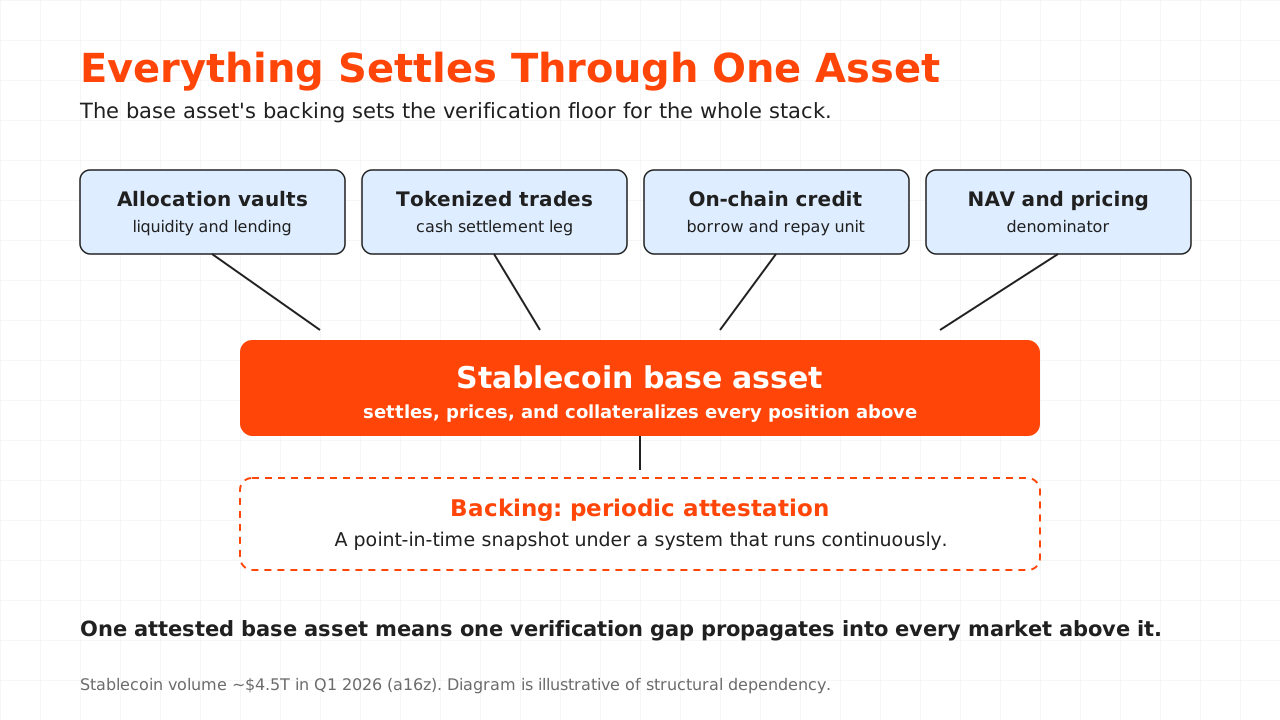 Every on-chain market settles through the same stablecoin base asset, so its periodic-attestation backing sets the verification floor for the whole stack.
Why isn't periodic attestation enough for a base asset?
Periodic attestation is not enough because it confirms reserves at one moment while the positions depending on the stablecoin run continuously. An attestation tells you a reserve held a certain composition on a certain date. It does not prove the backing holds today, and it does not let a counterparty check redeemability at the moment of action.
For a base asset, that gap is amplified by composition. The stablecoin is reused as collateral, settlement, and pricing across many protocols simultaneously, so a stale or unprovable reserve claim is consumed by all of them at the same time. The attestation cadence and the usage cadence are mismatched, the same structural problem that affects institutional DeFi data integrity, concentrated in the asset everything else settles against.
Attestation also asks the counterparty to trust the attester. A network agreeing on a reported figure is not the same as cryptographic proof that the underlying reserve satisfies the backing condition.
Bottom line: For a niche asset, periodic attestation is a reasonable compromise. For the base asset of on-chain finance, it makes the system's trust only as strong as one delayed report.
How does verifiable reserve data contain the risk?
Verifiable reserve data contains the risk by replacing the attested snapshot with continuous cryptographic proof that the backing condition holds, checkable on-chain by any counterparty. Instead of publishing a reserve figure and asking the market to trust it, the issuer proves that reserves satisfy the stated backing, and contracts verify the proof.
The privacy property is what makes this workable for issuers. Reserve composition is commercially sensitive, so the goal is not to publish the holdings but to prove the condition: that backing is adequate, without exposing the full breakdown. zkDatabase generates these Zero-Knowledge Proofs over the reserve data pipeline, so verification is continuous and the composition stays private, the practical meaning of Zero-Knowledge Proof of Reserves at the layer the whole stack depends on.
zkDatabase does not replace the issuer's attestation or auditor. It gives every downstream protocol reserve data it can verify without trusting the attester, which is what keeps one base-asset gap from becoming everyone's gap.
How does zkDatabase fit stablecoin reserve infrastructure?
zkDatabase sits between a stablecoin issuer's reserve systems and the protocols that settle against the token, turning attested reserve state into Verifiable Data. It targets the dependency point: the moment a counterparty has to trust that the base asset is backed.
- Pain: every protocol pricing or settling in the stablecoin inherits the issuer's attestation as a trust assumption.
- Mechanism: zkDatabase produces Zero-Knowledge Proofs over the reserve data pipeline, from ingestion to on-chain verification.
- Outcome: counterparties verify reserve adequacy continuously, without the issuer exposing reserve composition.
For issuers, this is also a positioning move: in a market where the base asset's verifiability sets the ceiling for everything above it, provable backing becomes a competitive standard rather than a compliance afterthought.
Conclusion
Stablecoin reserve verification is not a single-issuer task; it is the verification floor for on-chain finance, because stablecoins are the base asset that settles, prices, and collateralizes nearly every position. Periodic attestation is a reasonable tool for a niche instrument and an underbuilt one for shared infrastructure. When everything depends on one asset, that asset's backing has to be provable continuously, not confirmed quarterly. Verifiable Data Infrastructure is how that floor gets raised. zkDatabase is built to prove reserve adequacy on-chain without exposing composition, so the base asset stops being the system's weakest verification link.
Explore zkDatabase
See how a Verifiable Data Pipeline proves stablecoin reserve adequacy on-chain without exposing reserve composition.
FAQ
What is stablecoin reserve verification?
Stablecoin reserve verification is the process of confirming that a stablecoin is fully backed by the reserves it claims to hold. Most issuers do this through periodic attestation, a point-in-time check by a third party. Because stablecoins are the base settlement and collateral asset across DeFi and RWA, the quality of that verification affects every market that prices or settles in the stablecoin, not just the issuer.
Why is attestation insufficient for stablecoins used in DeFi?
Attestation is insufficient because it confirms reserves at one moment, while the positions depending on the stablecoin run continuously. A stablecoin is reused as collateral, settlement, and pricing across many protocols at once, so a stale or unprovable reserve claim is consumed by all of them simultaneously. Attestation also requires trusting the attester rather than verifying the backing condition cryptographically.
How is a stablecoin a systemic dependency in DeFi?
A stablecoin is a systemic dependency because it is the base asset that denominates NAV, supplies lending liquidity, and settles tokenized asset trades. A doubt about its reserve backing does not stay contained to the issuer; it propagates to every position that prices or settles against it. The base asset's verification quality effectively caps the verification quality of the entire stack above it.
How does zkDatabase verify stablecoin reserves without exposing composition?
zkDatabase generates Zero-Knowledge Proofs over a stablecoin issuer's reserve data, so counterparties can verify on-chain that reserves satisfy the backing condition without seeing the full composition. This converts an attested, point-in-time claim into continuous Verifiable Data. Reserve holdings stay private while the adequacy condition becomes provable, which is what lets every protocol settling in the stablecoin verify its backing directly.
Related toInstitutional DeFi