


Research
The Evolution of Databases: From SQL to zkDatabase
November 20, 2025
7 mins read
Learn how NoSQL evolved to zkDatabase, a step‑by‑step guide to verifiable, privacy‑first data for AI and compliance and Real World Assets (RWAs)


The evolution of databases is accelerating as data becomes one of the most valuable economic assets of the digital age. Organizations now operate in an environment where integrity, privacy, verification, and provability are not optional—they are foundational requirements. AI systems rely on trustworthy inputs, enterprises face stricter compliance obligations, and global digital trade depends on accurate, cross-system data flows.
Traditional databases were never designed for this level of scrutiny. They store information efficiently, but they cannot prove that the data is accurate, untampered, or derived from trusted processes. This gap has significant implications for AI, finance, supply chains, and tokenization. As industries shift toward verifiable and privacy-preserving architectures, zkDatabase emerges as the next leap in data infrastructure, bridging trust, performance, and verifiability in ways previous generations could not.
Phase 1 – The Age of SQL (1970s–2000s)
How SQL Became the Gold Standard for Data Management
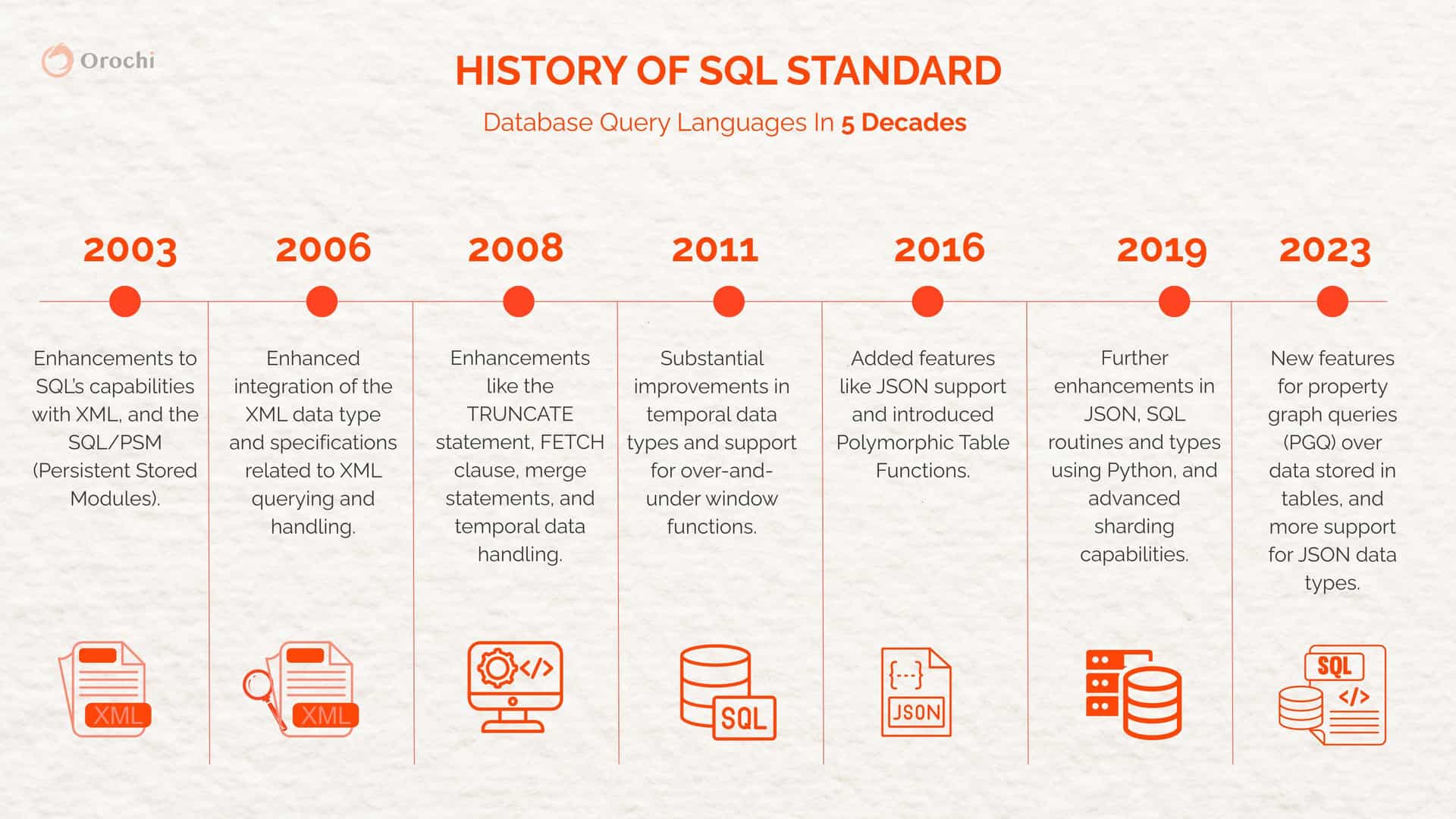
SQL began in the 1970s with Edgar F. Codd’s relational model, a groundbreaking concept that organized data into tables and allowed users to query information through a standardized language. This approach replaced rigid hierarchical structures with flexible, relational logic. Oracle, IBM DB2, MySQL, Microsoft SQL Server, and PostgreSQL popularized SQL, making it the backbone of enterprise systems for decades.
The SQL era dominated because it delivered something revolutionary: a predictable and structured way to store and retrieve data. For banks, hospitals, governments, and large corporations, SQL became synonymous with reliability.
Strengths: ACID Relational Logic
The success of SQL databases came from strict adherence to ACID principles:
- Atomicity ensured that transactions either fully succeeded or fully failed.
- Consistency enforced data correctness and prevented invalid states.
- Isolation guaranteed that transactions did not interfere with each other.
- Durability preserved committed data even during system failures.
Relational logic and schema enforcement brought order and integrity to complex datasets. SQL systems delivered high accuracy, predictable reporting, and structured workflows, critical for mission-critical applications.
The Limits: Trust Is Implicit, Not Verifiable
Despite these strengths, SQL databases rely entirely on implicit trust. Administrators with high privileges can modify records, alter logs, or manipulate data without leaving cryptographically verifiable traces. SQL cannot prove:
- that data hasn’t been tampered with,
- that a query was executed correctly,
- or that records reflect a trusted process.
This implicit trust model becomes a weakness in modern environments where data must be verifiable across systems, regulators, and automated pipelines.
Phase 2 – NoSQL & the Scale Era (2005–2015)
Why NoSQL Emerged: Flexibility, Horizontal Scaling, Big Data
The mid-2000s saw a rapid surge in internet activity, mobile apps, and distributed systems. SQL databases struggled with horizontal scaling, prompting the rise of NoSQL systems like MongoDB, Cassandra, and Couchbase. NoSQL embraced flexible schemas and distributed architectures, allowing companies such as Facebook, Google, and Twitter to handle massive volumes of real-time data.
Trade-offs - Performance vs Consistency
The performance improvements came at a cost. Many NoSQL systems embraced eventual consistency, meaning data integrity was not guaranteed in real time. NoSQL also lacked the rigid structure needed for audit-grade, mission-critical operations.
NoSQL Solved Scale, But Not Trust
Although NoSQL addressed scale challenges, it did not address the issue of trust. It accelerated speed, flexibility, and availability, but like SQL, NoSQL databases cannot cryptographically prove correctness or integrity. They serve modern applications well, but they cannot guarantee tamper-proof or verifiable data.
Phase 3 – Blockchain Databases and the Verifiable Data Revolution
First Attempt at Trustless Data
Blockchain introduced a radically different concept: data that is immutable, publicly verifiable, and decentralized. Systems like Bitcoin and Ethereum proved that data could be secured without relying on a central authority. Every transaction is timestamped, hashed, and recorded in a distributed ledger, making tampering nearly impossible.
Strengths: Immutability, Decentralization
Blockchain brought revolutionary benefits:
- Tamper-proof storage
- Transparent verification
- Trustless consensus mechanisms
- Cryptographic validation of state
For the first time, data could be trusted even when participants did not trust each other.
Weaknesses: Cost, Speed, Lack of Query Flexibility
However, blockchains have significant limitations:
- High storage costs
- Slow throughput
- Limited query capabilities
- Designed for transactions, not general-purpose data workloads
Blockchain databases proved that verifiable trust is possible, but they were too rigid and expensive to replace enterprise databases.
The Trust Gap – Why Modern Systems Need More Than Just “Storage”
The Explosion of AI Pipelines & Unverified Data
AI systems today ingest billions of data points, but most training data is unverifiable. This creates massive risks:
- biased inputs
- manipulated datasets
- hallucination-prone models
- unverifiable inference pipelines
AI needs verifiable data proofs—not just raw data.
RWA Tokenization & the Need for Auditable Records
Real-World Assets (RWA) require transparent records:
- asset ownership
- valuation models
- transaction history
- compliance checks
Traditional databases cannot produce cryptographic audit trails, which are essential for financial regulators.
Cross-System Interoperability & Data Provenance
Enterprises increasingly operate across:
- Cloud platforms
- On-chain systems
- AI models
- and distributed applications.
They must prove where the data originated, how it changed, and whether it can be trusted. Existing databases cannot deliver this level of assurance.
Phase 4 – zkDatabase: The Next Evolution
What a zkDatabase Fundamentally Changes
A zkDatabase introduces a breakthrough approach: every query, update, or computation can be accompanied by a cryptographic proof verifying that the operation is correct. This architecture transforms databases into verifiable trust engines.
A zkDatabase enables systems to trust results without ever seeing the underlying data, merging privacy and transparency into a single architecture.
Difference Between Traditional DB vs zkDatabase
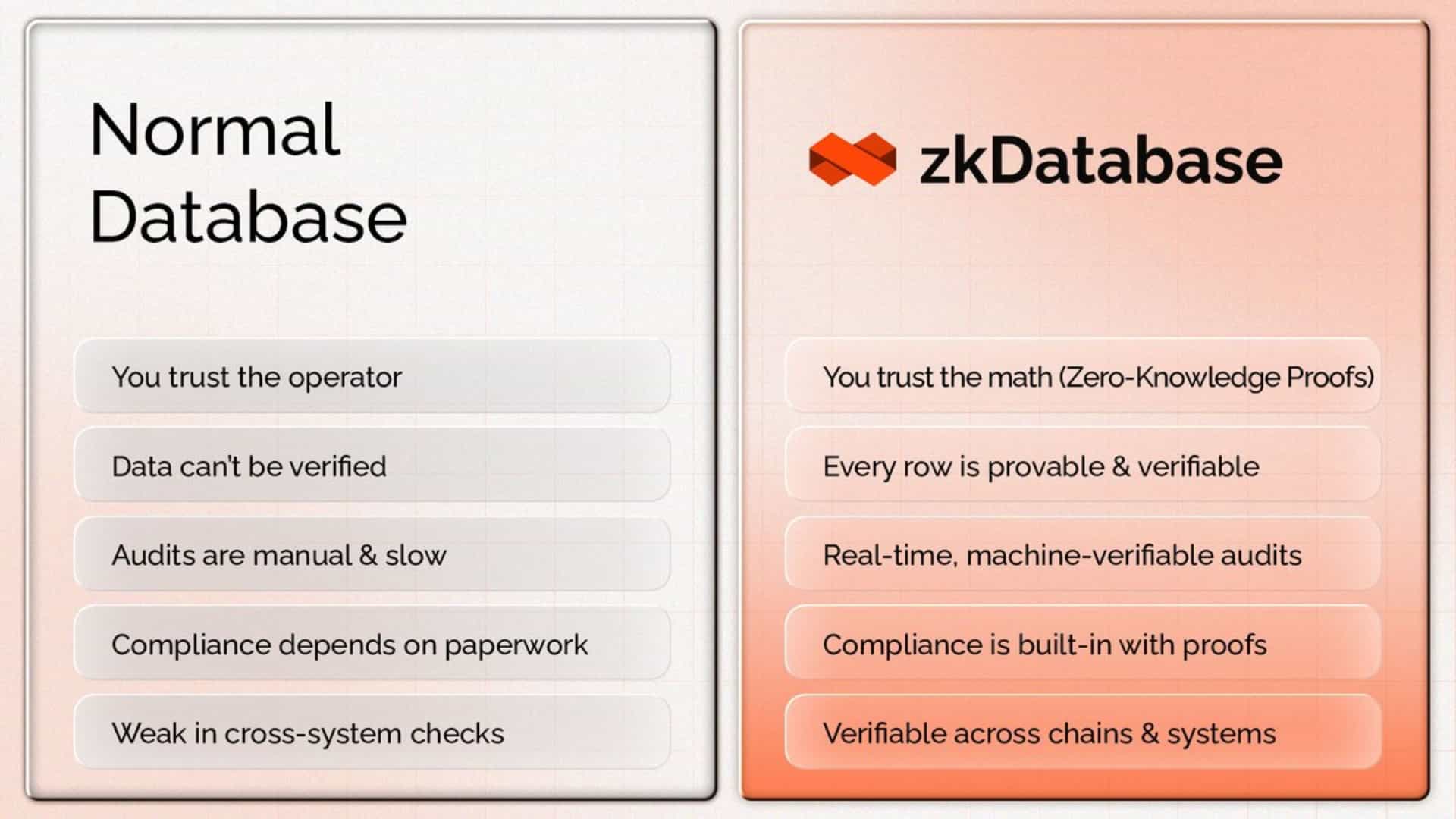
The zkDatabase marks a shift from trust by assumption to trust by mathematics.
How a zkDatabase Works?
At a conceptual level, a zkDatabase introduces three critical layers:
- Real-World Data → Verifiable Sampling
- The pipeline begins with raw real-world data.
- This data enters a Verifiable Sampling stage, where samples are collected and indexed with cryptographic commitments. This ensures that no data point can be inserted, removed, or altered without detection.
-
Verifiable Processing → Structured DataOnce sampled, the data moves into Verifiable Processing, where transformations (cleaning, parsing, normalization, feature extraction, etc.) are executed.Each transformation produces an intermediate proof, confirming that:
- The correct logic was applied
- no hidden alterations were introduced
- outputs match the committed inputs
This results in structured, provably correct data. -
Immutable Storage → Provable Retrieval
- Anyone (AI, another system, a blockchain) can verify proofs instantly.
- No need to trust the database or the operator.
-
Lookup Prover → Data Integrity Validation
This architecture supports Verifiable Data pipelines, cross-chain computation, enterprise compliance, and privacy-first applications.
- Transforming Prover → Proof of Transformation
When data needs to be updated or further transformed, the Transforming Prover generates a Proof of Transformation, demonstrating that:
- The applied transformation is correct,
- Inputs come from verified states,
- outputs follow the defined processing rules.
These proofs are then sent back to immutable storage, updating the committed state without sacrificing traceability.
Real-World Use Cases Where zkDatabase Outperforms SQL/NoSQL
AI Data Integrity for LLMs
AI systems trained on unverifiable data risk producing fraudulent or biased outputs. A zkDatabase can:
- Verify training data integrity
- ensure models use validated inputs
- prove inference correctness
- prevent data poisoning
This unlocks the next generation of trustworthy AI.
RWA Tokenization and Compliance-Grade Audit Trails

Tokenization requires transparent yet private records. zkDatabase supports:
- cryptographic audit logs
- verifiable asset metadata
- proof-based compliance
- cross-platform reporting
This makes it ideal for financial institutions and on-chain asset issuers.
Enterprise Data Privacy - Verifiable Reporting
Enterprises must balance privacy with regulatory verifiability. zkDatabase enables:
- private queries that return proofs
- compliance reports with zero exposure
- secure multi-party computation
Businesses can prove correctness without sharing sensitive information.
Conclusion
The evolution of databases reveals a clear trajectory: from structured SQL systems to flexible NoSQL architectures, to immutable blockchain databases, and finally to zkDatabase, the first model to deliver verifiable, privacy-preserving, and trust-minimized data infrastructure. As organizations move into an era defined by AI, digital assets, and global data networks, zkDatabase represents the technology that will secure the next generation of applications.
Related toResearch


