Research
Top 10 DePIN Crypto Projects in 2026 by Category
October 22, 2026
15 mins read
The top 10 DePIN crypto projects in 2026 by category, from Render and Aethir to Helium and Filecoin, with fresh network data and what changed this year.


The top DePIN crypto projects in 2026 are Render, Aethir, io.net, Akash and Theta EdgeCloud for GPU compute; Helium for wireless; Filecoin for storage; and Bee Maps (formerly Hivemapper), DIMO and Grass for real-world data. DePIN stands for Decentralized Physical Infrastructure Networks: communities supply hardware such as GPUs, hotspots, drives and dashcams, and a blockchain tracks who contributed what and pays them.
2026 changed how these networks pay people. Helium, Bee Maps and Grass moved rewards toward paid usage or USDC this year, and DIMO voted to stop issuing new tokens as weekly driver rewards. This guide groups the leaders by category, shows the latest network data each one publishes, and explains why measurable service is now the test every DePIN project has to pass.
The Top 10 DePIN Projects in 2026 at a Glance
| Project | Category | What it provides | Key 2026 change |
|---|---|---|---|
| Render Network | GPU compute | GPU rendering and AI compute | Dispersed AI compute network; Salad joins through RNP-023 |
| Aethir | GPU compute | Enterprise GPU cloud for AI | Network in 94 countries and 200+ locations |
| io.net | GPU compute | Decentralized GPU cloud for AI | Incentive Dynamic Engine burns part of revenue |
| Akash Network | Compute marketplace | Open marketplace for GPU and cloud compute | Burn-Mint Equilibrium model live since March 2026 |
| Theta EdgeCloud | Edge compute | Hybrid cloud and edge AI computing | 30,000+ node network |
| Helium | Wireless | Hotspots that carry mobile and IoT data | HIP-149 ends Proof-of-Coverage; Helium Mobile sold to Noble Mobile |
| Filecoin | Storage | Decentralized storage network | On-chain cloud storage service live on mainnet |
| Bee Maps (Hivemapper) | Mapping data | Street-level imagery for maps and Physical AI | Rewards paid in USDC instead of HONEY |
| DIMO | Vehicle data | Consent-based connected-car data | DIP-12 approved to end weekly driver reward issuance |
| Grass | Web data | AI training data from shared bandwidth | Stage 2 rewards paid only in USDC |
What Are Decentralized Physical Infrastructure Networks (DePIN) in Crypto?
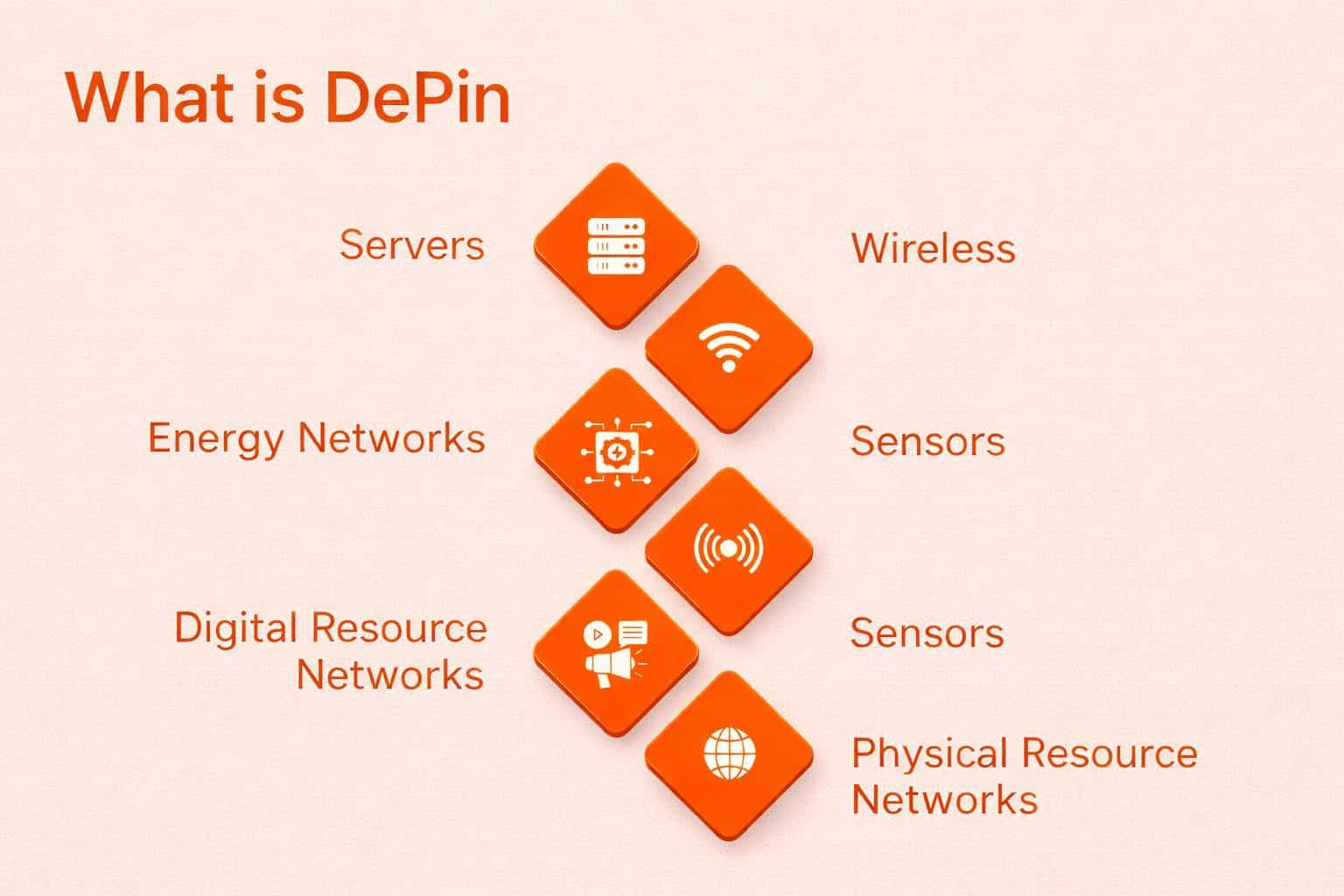
Decentralized Physical Infrastructure Networks (DePIN) are blockchain-coordinated networks that build and run real infrastructure through many independent contributors. People provide physical resources like GPUs, hotspots, hard drives, dashcams or bandwidth, and the protocol tracks contribution, handles payment and enforces the rules. For a longer explainer on the model and how the sector earns revenue, see what DePIN is and how it works.
The clearest way to judge a DePIN network is to ask one plain question: what real-world service is being delivered? If the answer is "wireless coverage", "rendering capacity", "data storage" or "fresh mapping imagery", you are looking at the operating layer, not the token layer.
How Do DePIN Projects Work in Practice?
Most networks end up with the same four working layers once you strip the branding away:
- Hardware layer: devices and operators that carry real cost (capex, power, uptime, maintenance).
- Middleware and verification: measurement, fraud detection and performance accounting (coverage checks, job verification, storage proofs, telemetry).
- Blockchain coordination: settlement of who did what and when, reward distribution, and shared state that apps can reference.
- Token incentives: early supply bootstrapping, then payment settlement and governance, ideally tied more and more to real usage.
Published models cut the stack more finely. An academic survey by Lin et al. describes five layers: infrastructure, blockchain, data, governance and application (arXiv). IoTeX's modular blueprint splits it into nine, from hardware abstraction and connectivity up to identity and governance (IoTeX). The four layers above are a simpler buyer's view of the same stack, and they explain where DePIN projects succeed or stall. Using a blockchain is the easy layer. Running a distributed physical system that can measure service cheaply enough to pay people fairly is what separates the networks in this list from the rest.
Why Are DePIN Crypto Projects Gaining Traction in 2026?
AI compute is still supply constrained. In February 2026 Alphabet guided $175 billion to $185 billion of capital spending for the year, and CEO Sundar Pichai said he expects "to go through the year in a supply constrained way" (Fortune). When even the largest cloud buyers cannot get enough capacity, AI teams look for spare GPU supply outside the hyperscalers. That is the opening decentralized compute networks target.
Cloud waste is rising again. Flexera's 2026 State of the Cloud research found that wasted cloud spend rose to 29%, the first increase in five years (Flexera). Teams that like the cloud are still being pushed to shop around.
The sector earns real revenue, but it is still small. Messari's State of DePIN 2025 report, published in January 2026, put sector on-chain revenue at an estimated $72 million for 2025 against a market cap of roughly $10 billion (Decrypt). That gap is why 2026 became the year networks started paying for usage instead of presence.
How Does AI and Compute Demand Accelerate DePIN Adoption?
Picture a small AI team fine-tuning a model for a client demo. The deadline is close, the cloud bill is high, and the enterprise onboarding queue is slow. Once they hit a provisioning wall, they look for any compute that is real, fast to access and reliable enough to trust.
That is the engine behind DePIN projects for AI compute: time-to-GPU and cost-to-experiment, not ideology. On the supply side, a network only works if it can turn scattered, underused hardware into something that feels like a dependable service. That is why orchestration, verification and fraud controls matter more than token branding.
What Are the Top DePIN Crypto Projects in 2026 by Category?
"Top" here does not mean best token performance. The lens is category leadership: measurable supply, credible verification and a visible path to paid demand. Network figures below are the latest each project or a named third party published, with the date.
Which DePIN Projects Lead AI Compute and GPU Infrastructure?
Render Network (RENDER)
Render started with distributed GPU rendering for creators and is expanding into AI compute. Its public stats page lists more than 82 million frames rendered and 5,600 nodes since launch (Render stats, October 2026). In December 2025 Render launched Dispersed, a network "built to aggregate thousands of globally distributed GPUs" for AI workloads (Render Network), and in 2026 its community approved RNP-023 to bring Salad's GPU network onto Render, with the first milestones live in July (Salad). The lesson is wedge strategy: win one concrete market, then expand into nearby workloads.
Aethir
Aethir runs a decentralized GPU cloud for AI companies, built from independent hardware operators. In June 2026 Aethir said its network spans 94 countries and more than 200 locations, offering H100, H200 and B200 GPUs (Aethir). Aethir sells to enterprises directly, which makes it a useful test of whether decentralized supply can meet enterprise contract terms.
io.net (IO)
io.net targets the GPU provisioning problem for AI teams, with capacity from independent operators in 138 countries. In June 2026 the company reported processing up to 4 billion AI tokens per day and closing an $8 million enterprise contract, its largest to date (io.net via CoinDesk). The same release introduced the Incentive Dynamic Engine, which burns at least half of post-payout network revenue in IO tokens. These are company-reported figures; buyers should still ask about utilization, job success rates and retention.
Akash Network (AKT)
Akash is an open marketplace where providers sell compute and buyers bid for it. In March 2026 its Burn-Mint Equilibrium model went live with Mainnet 17, and by March 31 the network had burned 53,520 AKT (TokenPost). Akash matters to the category because it tests price discovery across many providers.
Theta EdgeCloud (THETA)
Theta describes EdgeCloud as a hybrid cloud and edge AI computing platform, launched in May 2024 (Theta docs). Its March 2026 update described a network of more than 30,000 nodes, much of it consumer GPUs such as the RTX 3090 and 4090 (Theta Network). The open question for Theta is the same as for every compute network: can node participation turn into paid workloads with checkable quality?
Together these five define the compute lane: aggregation, scheduling, verification and buyer trust.
Which DePIN Projects Power Wireless and Connectivity Networks?
Helium (HNT)
Helium is the best-known wireless DePIN network because its hardware footprint is easy to count. 2026 reshaped it. In June, Noble Mobile acquired Helium Mobile, describing a network of 137,000 hotspots (Business Wire), and agreed to keep using the Helium Network. Then the community passed HIP-149, which ends Proof-of-Coverage rewards for both the MOBILE and IOT networks and ties rewards to real use. The proposal notes that data carried by hotspots grew from about 24,000 GB per day in June 2025 to about 97,000 GB per day in April 2026 (HIP-149).
Helium is the clearest 2026 example of the sector's shift: rewards are moving from "a device is plugged in" to "the device carried paid traffic".
Which DePIN Projects Focus on Storage and Data Infrastructure?
Filecoin (FIL)
Filecoin calls itself the world's largest decentralized storage network (Filecoin), and its 2026 focus is paid, useful storage rather than raw capacity. In March 2026 Filecoin launched its on-chain cloud storage service on mainnet (Filecoin). Ecosystem research site FilecoinTLDR reported that the annualized run-rate of Filecoin Pay grew from $663 in January to $59,327 at the end of August 2026 (FilecoinTLDR). The base is small, but the direction is the one storage buyers care about: paid deals, retrieval and auditability.
Which DePIN Projects Are Emerging as Data Networks?
Bee Maps, formerly Hivemapper
Bee Maps turns a physical act, driving with a dashcam, into a data product: fresh street-level imagery for maps and Physical AI. Its site reports 754 million total kilometers mapped and 37% global road coverage (Bee Maps, October 2026). From August 2026 Bee Maps pays contributors in USDC by default and no longer supports HONEY rewards in its app (Bee Maps).
DIMO
DIMO gives developers one consent-based API for live data from connected cars across more than 50 brands (DIMO). Its DIP-12 proposal states the network has grown past 200,000 vehicles on four continents. The approved proposal ends weekly issuance of new DIMO to drivers once enacted and sets a one-time burn of 150 million DIMO from the treasury (DIP-12).
Grass (GRASS)
Grass collects AI training data through users' unused internet bandwidth and says it is trusted by more than 8.5 million users (Grass, October 2026). In its July 2026 holder call, Grass said Stage 2 participant rewards will be paid only in USDC, with no new GRASS emissions (Grass). As with every data network, the hard questions are verification and compliance: who uses the data, for what, and how that is enforced.
Data networks are now a full pillar of DePIN, because AI needs both compute and data with a clear origin.
How Are DePIN Token Incentives Changing in 2026?
Most DePIN tokens solve the same bootstrapping problem: supply must exist before demand arrives. Token emissions pay for early hardware, and the hope is that rewards later shift toward paid usage.
In 2026 that shift stopped being a hope and became policy across the sector:
- Helium ended Proof-of-Coverage and ties rewards to real data use (HIP-149).
- Bee Maps and Grass moved contributor rewards to USDC.
- DIMO approved ending weekly driver reward issuance (DIP-12).
- io.net and Akash added burns that link token supply to network revenue.
The pattern is consistent: networks are cutting the subsidy and paying for measured service. That raises the stakes on measurement. If rewards follow usage, the usage data has to be right. For a deeper look at DePIN token design, see this economic analysis of DePINs.
What Is Proof-of-Service and Why Does It Matter?
Proof-of-service is the principle that rewards should match verifiable contribution: uptime, throughput, coverage plus usage, completed compute jobs, stored data that can be retrieved, and honest telemetry.
It matters because the main attack on DePIN is fake contribution. If a network cannot check service reliably, it pays fraudsters and pushes honest operators away. As rewards move from emissions to usage, proof-of-service becomes the link between incentives and real infrastructure economics.
How Is DePIN Funded and What Do Investors Look for in 2026?
Investors still like the size of DePIN's target markets, but the main question in 2026 is: what turns activity into revenue?
What serious investors look for this year:
- Demand proof: paying customers, repeat usage and predictable workloads.
- Verification quality: how the network measures service and stops fraud.
- Unit economics: subsidy cost against revenue growth, operator churn and utilization.
- Operational and regulatory readiness: especially for wireless, mobility and data networks.
Expect more financing that looks like infrastructure deals: enterprise contracts, hardware financing, revenue-share agreements and token models that burn or buy back with revenue.
How Does DePIN Compare to Centralized Infrastructure Models?
DePIN against centralized infrastructure is an engineering and economics trade, not a moral one.
Centralized infrastructure wins on simplicity: one vendor, one SLA, one procurement path. It also concentrates pricing power and creates single points of failure. DePIN spreads ownership and supply, which can improve resilience and lower marginal cost in some cases, but it needs stronger verification and better orchestration.
The core difference is where the evidence comes from:
- Centralized cloud: the provider's internal controls and audits stand behind the service.
- DePIN: contribution, service quality and accounting are recorded through mechanisms other parties can check.
That is why the top DePIN projects are increasingly judged like infrastructure companies, by reliability and paid usage.
What Are the Key Risks and Challenges Facing DePIN Projects?
A credible DePIN thesis includes the weak points:
- Hardware deployment risk: devices fail, operators leave, maintenance is messy.
- Verification risk: weak measurement invites fraud and breaks incentives.
- Demand concentration: too few buyers can sink revenue if they leave.
- Regulatory exposure: spectrum, privacy, consumer protection and compliance.
- Company and token risk: the company behind a network can fail even when the network works. In July 2026 Storj Labs, the company behind the long-running decentralized storage network Storj, filed for Chapter 11 and said it did not expect service interruptions (CoinDesk).
A network that cannot measure service and match it to demand becomes a subsidy machine. These problems are solvable, but they need discipline and clear data.
What Is the Future Outlook for DePIN in 2026 and Beyond?
DePIN is entering a quieter, more durable phase built on standard business metrics.
Expect:
- Enterprise adoption through narrow wedges: batch compute for training and inference bursts, carrier offload, storage for archiving, mapping data for Physical AI.
- Stablecoin rewards: more networks paying contributors in USDC, which separates operator income from token price.
- Better infrastructure financing: more structured capital for hardware and clearer payback targets.
- Metrics that matter: utilization, churn, paid usage, service quality and fraud rates become the language of success.
The winners will look less like "crypto projects" and more like distributed infrastructure businesses that happen to settle on-chain.
How Can Verifiable Data Infrastructure Strengthen DePIN Networks?
When rewards follow usage, every payment depends on usage data: how much traffic a hotspot carried, which compute jobs finished, what data was stored and served. That data usually lives off-chain with the network operator, and partners, buyers and token holders have to rely on reports to know it was handled correctly.
This is where data integrity becomes part of the architecture. Proof-of-service needs telemetry records that others can check. Compliance needs audit trails that do not expose sensitive operator or customer data. Cross-chain use needs shared evidence that travels with the data.
Orochi Network builds zkDatabase, a verifiable database powered by Zero-Knowledge Proofs. zkDatabase is designed to keep network records off-chain and generate a proof for every update, so a partner or a smart contract can check that the data was stored and processed as claimed without seeing the raw records. We explain the gap this fills in why Orochi built zkDatabase.
FAQs
What makes the top DePIN crypto projects in 2026 different from earlier cycles?
They are judged like infrastructure: utilization, reliability, proof-of-service quality and paid demand. In 2026 several leading networks also moved rewards from token emissions to usage-based or USDC payments.
How do DePIN projects avoid paying people to do nothing?
They tighten verification. They measure real service, such as coverage plus usage, completed jobs and retrievable storage, and tie rewards to those measurements. Helium's HIP-149, which ends Proof-of-Coverage rewards in favor of real use, is a 2026 example.
What are the biggest risks buyers should watch when adopting DePIN infrastructure?
Verification gaps, operator churn, demand concentration, regulatory exposure and the health of the company behind the network. Mature networks publish metrics, enforce proof-of-service and build reporting that buyers can check.
Explore zkDatabase (https://www.zkdatabase.org/) to see how verifiable data can back the usage records your network pays on.
Related toResearch