


What is a Decentralized Identify (DID) ?
January 21, 2026
14 mins read
What is a Decentralized Identifier (DID)? Learn how DIDs enable user-owned digital identity, privacy-preserving verification, and trustless authentication without centralized platforms.


What is a Decentralized Identifier (DID) is a user-controlled digital identifier that enables cryptographic identity verification without relying on centralized platforms or databases. A DID exists to restore ownership and privacy to digital identity, allowing individuals and organizations to prove who they are using cryptography rather than trust. Today, DID matters because it enables privacy-preserving verification, reduces data exposure, and supports interoperable identity systems, an approach actively advanced by Orochi Network through verifiable, audit-ready data infrastructure.
In short, what is a Decentralized Identifier (DID)?
It is a cryptographic identifier controlled by its owner, designed to enable privacy-preserving verification without centralized identity systems.
What Is a Decentralized Identifier (DID)?
A DID (Decentralized Identifier) is a unique digital identifier that enables a person, organization, or system to prove control over an identity without relying on a centralized authority. Unlike traditional identifiers such as usernames or email addresses, a DID is created and controlled by its owner and can be verified cryptographically.
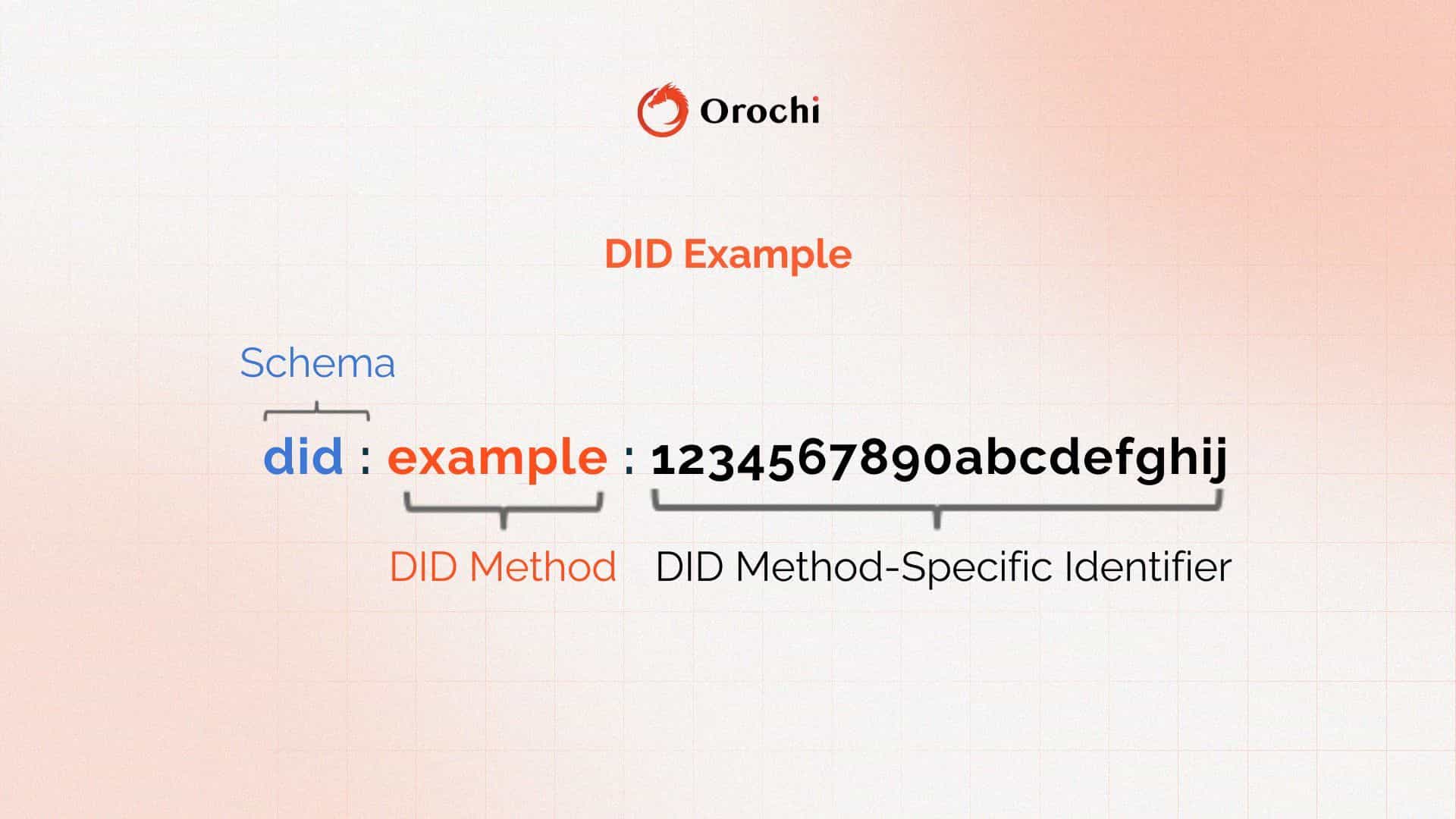
This identifier resolves to a DID Document, which contains the cryptographic material needed to authenticate the DID—such as public keys and service endpoints. Importantly, the DID itself does not contain personal data. Instead, it points to verifiable information that allows others to confirm ownership and establish trust.
Because a DID is independent of any single platform, registry, or provider, it forms the foundation of decentralized identity systems where users maintain full control over how their identity is used and verified across different applications and ecosystems.
How does a Decentralized Identifier (DID) Work?
To understand what is a Decentralized Identifier (DID) in practice, it helps to look at its lifecycle at a high level. A DID follows four simple steps: creation → registration → resolution → verification. Together, these steps allow an identity to be verified securely without exposing personal data or depending on a central authority.
First, a user creates a Decentralized Identifier (DID) by generating cryptographic keys. These keys give the user control over the DID, similar to how a private key controls a crypto wallet. The DID is then registered using a DID method, which may reference a blockchain or decentralized network. Importantly, no personal information is stored during this process.
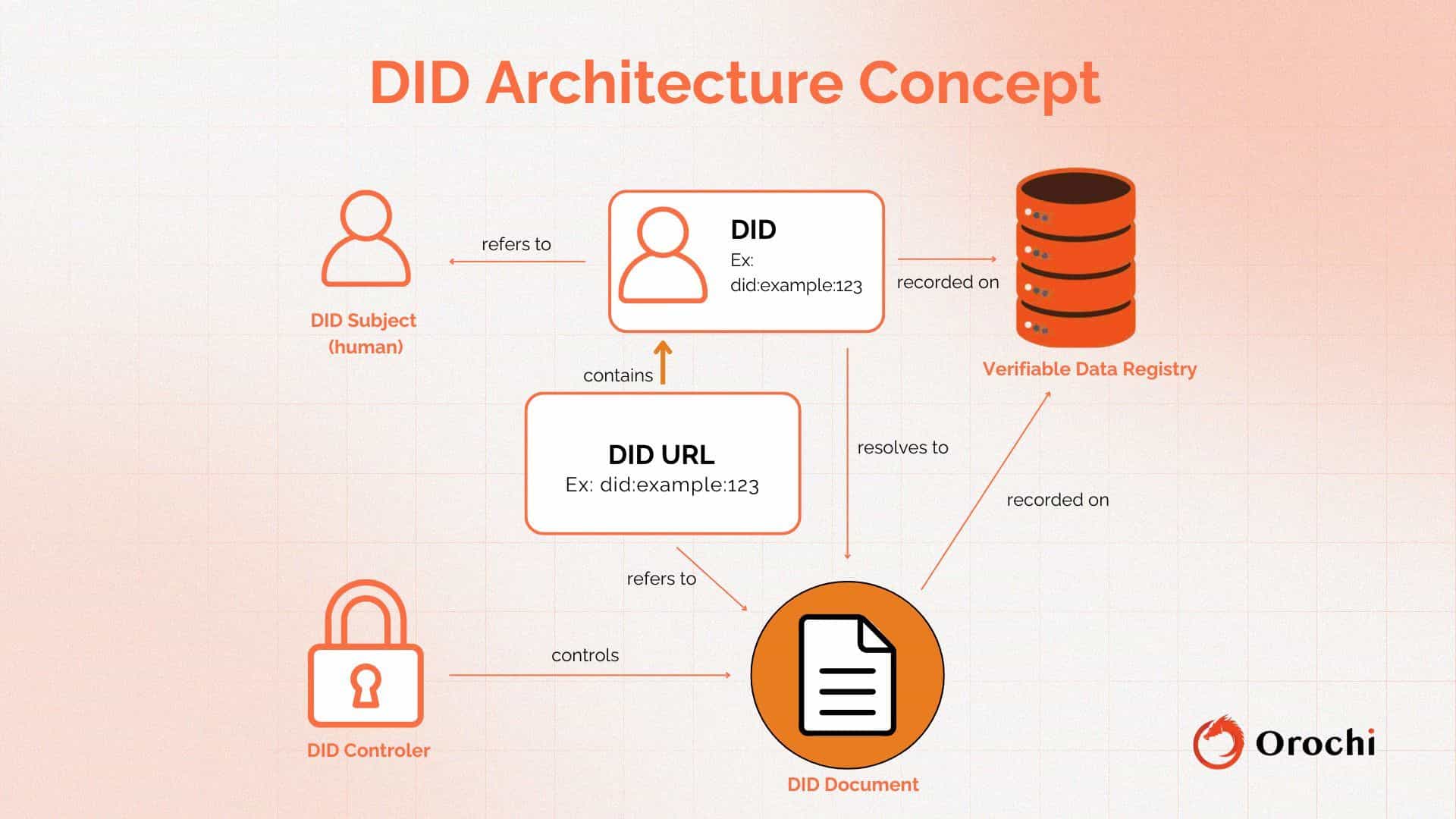
When a DID is later used, applications resolve it to retrieve verification information and confirm ownership using cryptography. This enables decentralized identity verification, where trust comes from math and keys rather than centralized identity providers.
What is a DID Document and what information does it contain?
- Public keys for authentication
- Verification methods and key rotation
- Optional service endpoints
- No personal or sensitive data stored directly
A DID Document is a machine-readable document that describes how a Decentralized Identifier (DID) can be authenticated and interacted with. When someone asks what is a DID in decentralized identity, the DID Document is a core part of the answer.
A DID Document typically contains:
- Public keys for authentication, allowing others to verify that the DID is controlled by its rightful owner
- Verification methods, including support for key rotation to maintain long-term security
- Optional service endpoints, which can point to messaging services, credential issuers, or other identity-related services
- No personal or sensitive data, ensuring privacy by design
Because a DID Document only includes cryptographic material and metadata, it supports Self-Sovereign Identity (SSI) principles. Users remain in full control of their identity, often through a digital identity wallet, while relying parties can perform decentralized identity verification without accessing private information.
Are Decentralized Identifiers Stored on the Blockchain?
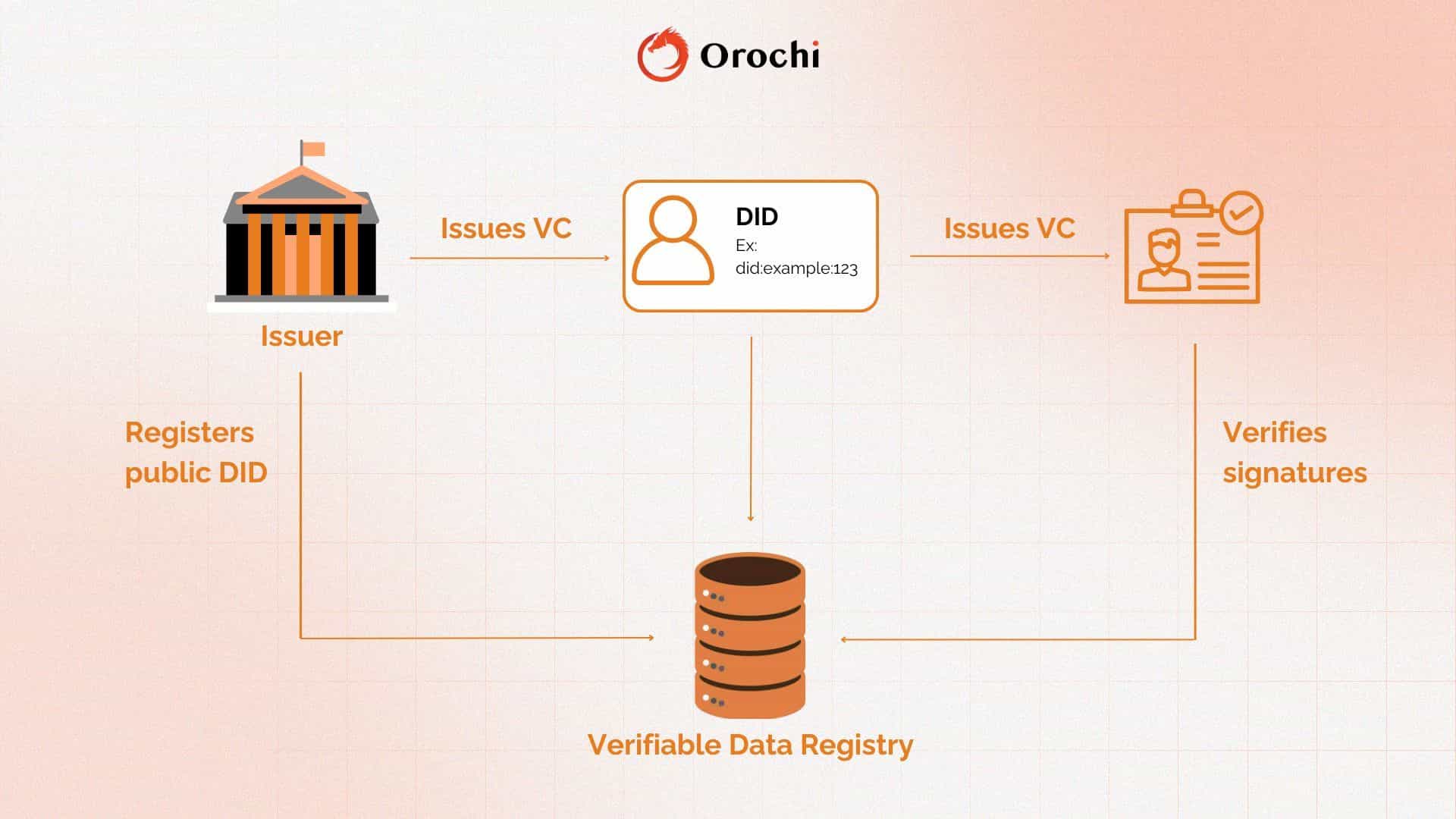
A common question when learning how does a Decentralized Identifier work is whether DIDs store identity data on the blockchain. The answer is no. In most implementations, the blockchain acts as a resolver or registry, not as a data store.
Only the minimal information required to resolve a Decentralized Identifier (DID) is anchored on-chain. Identity data, credentials, and personal information remain off-chain and wallet-controlled by the user. This design ensures privacy while still benefiting from blockchain properties such as immutability and global verifiability.
By separating identity data from the ledger, DIDs enable privacy-preserving digital identity with DID architectures. This model supports secure authentication, integration with Verifiable Credentials (VCs), and enterprise-grade trust—without turning blockchains into centralized identity databases.
How Do Decentralized Identifiers Work with Verifiable Credentials (VCs)?
Decentralized Identifiers (DIDs) act as the identity anchor in decentralized identity systems, while Verifiable Credentials (VCs) carry the actual claims about that identity, such as government IDs, diplomas, licenses, or employment records.
Verifiable Credentials allow individuals to prove qualifications, age, KYC status, or professional licenses using cryptographic signatures—without sharing raw personal data and without relying on centralized identity systems.
In simple terms, a DID answers “who controls this identity?”, while Verifiable Credentials answer “what can be proven about this identity?”. Together, they enable privacy-preserving identity verification without relying on centralized databases or repeated data disclosure.
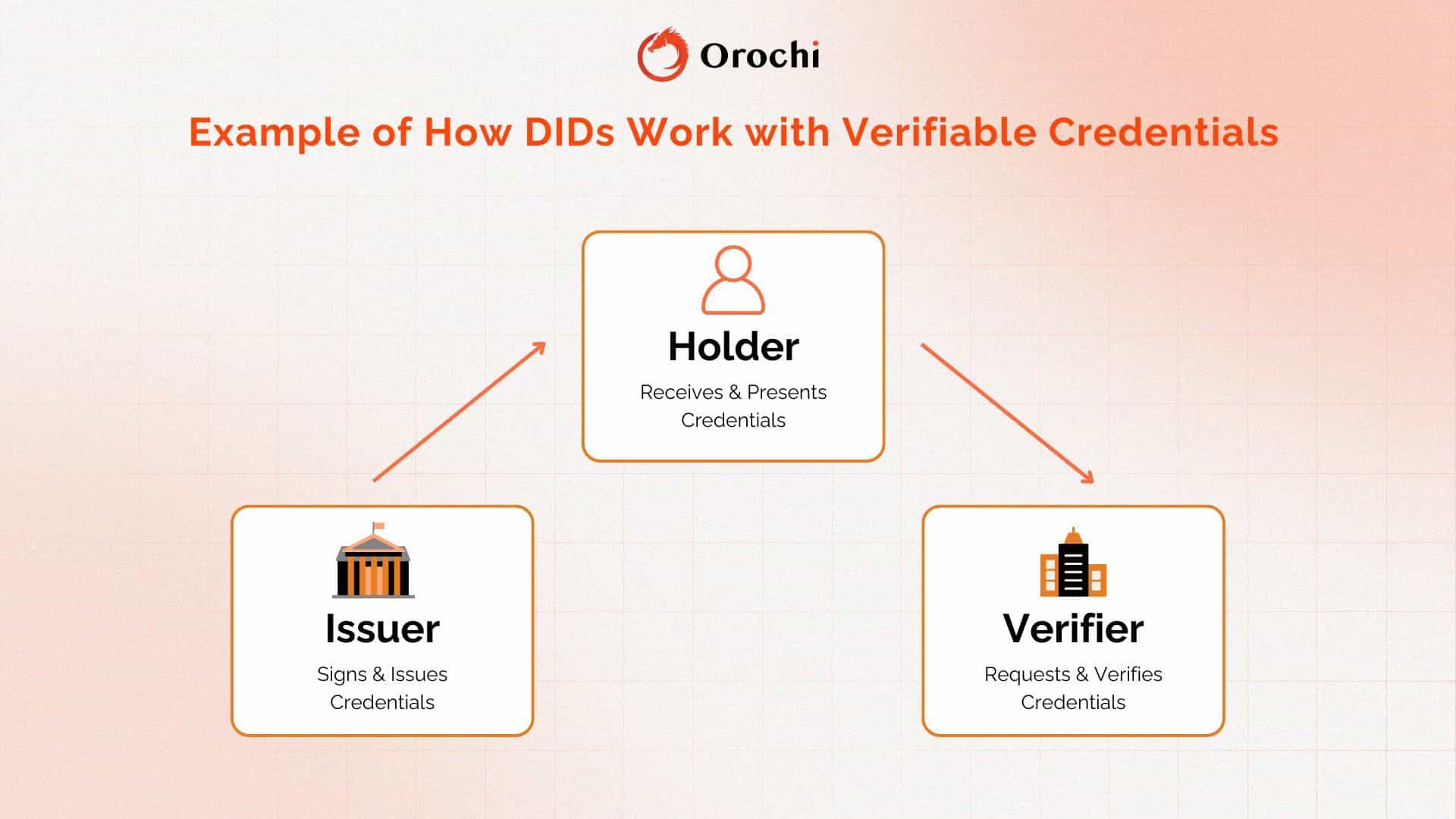
What is the Issuer–Holder–Verifier Model in Decentralized Identity?
Decentralized identity systems using DIDs and Verifiable Credentials follow a simple but powerful issuer–holder–verifier model:
Issuer
The issuer is an entity that creates and signs a Verifiable Credential using its DID.
Examples include governments issuing digital IDs, universities issuing diplomas, or companies issuing employment credentials.
- Signs credentials cryptographically with its DID
- Does not control how credentials are later used
Holder
The holder is the individual or organization that receives and stores the credentials in a digital identity wallet.
- Fully controls their credentials
- Chooses when and how to present them
- Can selectively disclose only required information
Verifier
The verifier is the party that needs to check a claim—for example, an employer, service provider, or regulator.
- Verifies authenticity using the issuer’s DID
- Does not need to contact the issuer
- Receives cryptographic proof, not raw personal data
Why This Model Matters
This DID–VC architecture removes several limitations of traditional identity systems:
- No central database: Identity data is not stored in a single platform
- Privacy by design: Users share proofs, not full documents
- Offline verification: Credentials can be verified without real-time issuer access
- Cross-platform trust: Verification works across ecosystems and jurisdictions
For example, a user can prove they are over 18, licensed, or qualified without revealing their name, address, or document number, something that is not possible with centralized identity systems.
How Is Decentralized Identity Different from Centralized Identity?
Traditional digital identity systems are built around centralized logins, accounts issued, stored, and controlled by platforms or institutions. In contrast, decentralized identity shifts control to users by relying on Decentralized Identifiers (DIDs) and cryptographic verification rather than centralized databases.
At a high level, the difference comes down to who owns the identity, how trust is established, and how much data must be exposed to prove something about a user.
| Dimension | Centralized Identity (Web2) | Decentralized Identity (DID) |
|---|---|---|
| Ownership | Platform owns and controls the account | User controls the DID and keys |
| Revocation Risk | Absolute — access can be revoked unilaterally | Minimal — user retains control via cryptographic keys |
| Privacy | Full data sharing is common | Selective disclosure by default |
| Trust Model | Institutional trust in the provider | Cryptographic proof and verification |
What is Self-Sovereign Identity (SSI) and How Do DIDs Enable It?
Self-Sovereign Identity (SSI) is a digital identity model where individuals and organizations fully own and control their identities, instead of relying on centralized platforms such as governments, social networks, or service providers.
In an SSI system, users decide when, how, and with whom their identity information is shared. Decentralized Identifiers (DIDs) provide the technical foundation that makes this possible by enabling identity ownership and verification without a central authority.
In simple terms:
- SSI defines the principle: user-owned digital identity
- DIDs implement the mechanism: cryptographic control and verification
Without DIDs, SSI would remain a concept rather than a practical, interoperable system.
Why Are DIDs Considered a Core Pillar of Self-Sovereign Identity?
DIDs are fundamental to SSI because they remove the structural dependencies that exist in traditional identity systems.
User-Generated Identifiers
DIDs can be created directly by users, organizations, or systems—without registering with a central authority. This ensures identity creation is permissionless and independent of any platform.
No Permission Required to Create or Use
Unlike usernames or accounts issued by service providers, DIDs do not require approval, registration, or ongoing control by a third party. As long as the controller holds the cryptographic keys, the identity remains valid and usable.
Interoperable Across Systems and Services
DIDs are designed to work across different networks, applications, and ecosystems. The same DID can be used to authenticate, receive Verifiable Credentials, and prove claims across multiple services—without creating new accounts each time.
What is a Digital Identity Wallet and Why Is It Important?
A digital identity wallet is the control layer of decentralized identity systems. It is where users store their Decentralized Identifiers (DIDs) and Verifiable Credentials (VCs), and where they manage consent, sharing, and verification of their identity data.
Unlike Web2 identity systems, where platforms store and control user accounts, a digital identity wallet puts users in charge. The wallet allows individuals to decide what information to share, with whom, and for what purpose, without handing over full documents or raw personal data.
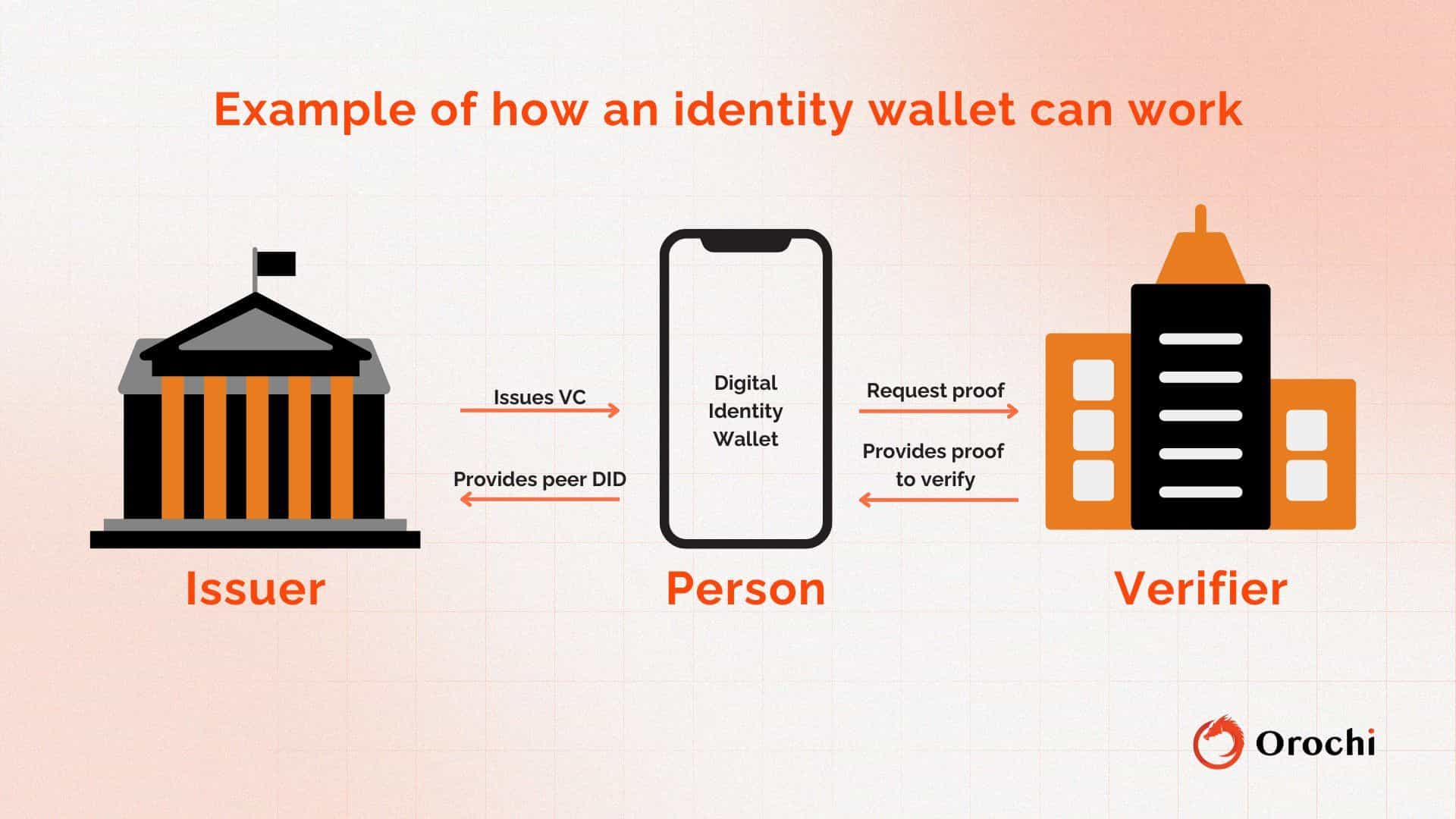
How does selective disclosure protect user privacy?
Selective disclosure allows users to share only the minimum information required for a specific verification and it's nothing more.
Instead of revealing full credentials, the wallet can generate cryptographic proofs that answer a verifier’s question without exposing raw data.
Share Only Required Attributes
For example, a service may only need to know whether a user is over 18—not their name, date of birth, or ID number. The wallet discloses only the required attribute.
Prove Statements Without Revealing Raw Data
Users can prove statements such as:
- “I am over 18”
- “I hold a valid license”
- “I passed KYC checks”
All without sharing the original documents or credentials.
Reduce Data Leakage and Tracking Risk
Because users do not repeatedly submit full identity documents:
- Sensitive data is not copied across platforms
- Verifiers cannot track users across services
- The risk of data breaches and misuse is significantly reduced
Are Decentralized Identifiers Secure and Privacy-Preserving?
A key reason what is a Decentralized Identifier (DID) matters today is its strong security and privacy model based on cryptography.
Decentralized Identifiers (DIDs) are designed to be secure by cryptography and private by architecture. Instead of relying on centralized databases or identity providers, DIDs use cryptographic verification to prove control and authenticity.
This means trust does not come from an institution or platform, but from mathematical proof. As a result, DIDs significantly reduce common risks found in traditional identity systems, such as data breaches, identity theft, and unauthorized tracking.
Most importantly, DIDs do not store personal or sensitive data on-chain. They only enable verification of control and validity, keeping identity data under the user’s control.
How do cryptographic proofs secure decentralized identifiers?
DIDs rely on well-established cryptographic mechanisms to ensure both security and privacy.
Public–Private Key Pairs
Each DID is controlled through a cryptographic key pair:
- The private key is held securely by the DID controller (usually in a digital identity wallet)
- The public key is published in the DID Document
Only the entity holding the private key can prove control of the DID, making impersonation extremely difficult.
Digital Signatures for Authenticity
When a DID is used—for authentication or verification, the controller signs a message with their private key.
Verifiers can independently check this signature using the public key from the DID Document.
This ensures:
- The identity is authentic
- The message has not been altered
- No central authority is required
No Sensitive Data Written On-Chain
Blockchains or verifiable data registries are used only to:
- Anchor the DID
- Enable resolution to the DID Document
They do not store names, IDs, credentials, or personal attributes. All sensitive data remains off-chain, wallet-controlled, and shared only when the user explicitly consents.
What Are the Current Limitations and Challenges of DIDs?
While Decentralized Identifiers (DIDs) provide a strong foundation for secure and privacy-preserving digital identity, their adoption still faces several practical and ecosystem-level challenges. These limitations are not fundamental flaws, but rather maturity and coordination issues common to emerging infrastructure technologies.
Understanding these challenges helps organizations and developers adopt DIDs realistically and responsibly.
Wallet UX and key management
Limitation:
Decentralized identity shifts key ownership to users. Unlike Web2 accounts, there is no centralized password reset or account recovery by default.
Challenge:
Managing private keys can be difficult for non-technical users. Poor wallet UX, unclear recovery flows, and fear of key loss remain major barriers. While solutions like key rotation, social recovery, and custodial-assisted wallets are emerging, balancing usability with strong security is still an ongoing challenge.
Interoperability across ecosystems
Limitation:
Although DIDs are designed to be interoperable, multiple DID methods exist, each with different resolution and implementation approaches.
Challenge:
Not all wallets, registries, and platforms support the same standards consistently. Cross-ecosystem verification, especially across blockchains, enterprises, and jurisdictions—often requires additional integration work. While the W3C DID Core standard provides a shared foundation, ecosystem-level alignment is still evolving.
Regulatory and institutional readiness
Limitation:
DID technology is advancing faster than regulatory frameworks and institutional adoption.
Challenge:
Legal recognition of decentralized identifiers and Verifiable Credentials varies across regions. Many enterprises and governments remain cautious about identity models they do not directly control. However, active pilots in KYC, digital credentials, and cross-border identity indicate growing institutional readiness over time.
How Can zkDatabase Strengthen Decentralized Identity Systems?
Decentralized identity systems depend on more than just identifiers, they depend on verifiable data. While Decentralized Identifiers (DIDs) establish who controls an identity, trust at scale requires strong guarantees that identity-related data remains correct, untampered, and auditable over time. This is where Orochi Network and zkDatabase play a critical role.
Find out more about zkDatabase: What is zkDatabase 101 | Full Guide For Beginners
How zkDatabase Supports Verifiable Identity Data ?
-
Proves integrity of off-chain identity data: Identity-related records (e.g., KYC status, credential validity, revocation states) are stored off-chain and continuously verified using cryptographic proofs, ensuring data has not been altered.
-
Enables audit-ready verification workflows: zkDatabase produces succinct proofs that verification steps were executed correctly, allowing auditors and regulators to validate identity processes without accessing raw personal data.
-
Preserves privacy while ensuring correctness: By leveraging zero-knowledge proofs, zkDatabase allows identity systems to prove correctness—such as eligibility or compliance—without revealing underlying identity attributes.
Conclusion
What is a Decentralized Identifier (DID) is more than a new identity format. It represents a shift toward user-owned, cryptographically verifiable digital identity. By replacing centralized logins with decentralized identifiers, DIDs enable secure authentication and privacy-preserving verification without relying on institutional trust.
As decentralized identity expands into enterprise and regulated environments, trust must be provable, not assumed. Orochi Network strengthens this foundation through zkDatabase, enabling identity-related data to be verified, auditable, and tamper-resistant while preserving privacy. Together, DIDs, Verifiable Credentials, and verifiable data infrastructure form the basis of a more secure, interoperable future for digital identity.
FAQs
What is a Decentralized Identifier (DID)?
A Decentralized Identifier (DID) is a user-controlled digital identifier that enables cryptographic verification of identity without relying on a centralized authority. A DID is created and managed by its controller and resolves to a DID Document containing public keys and verification methods—without storing personal data.
How does a DID work in decentralized identity systems?
A DID works by linking an identifier to cryptographic keys published in a DID Document. When authentication or verification is needed, the DID controller proves control by signing messages with a private key, which can be independently verified using the corresponding public key.
Why does decentralized identity (DID) matter?
Because today’s digital identity is fragile, invasive, and centralized and it doesn’t scale to a world that needs privacy, interoperability, and verifiable trust.
Read More:
- Read more about Crypto Payment: Report Crypto Payment (Part 1)


