AI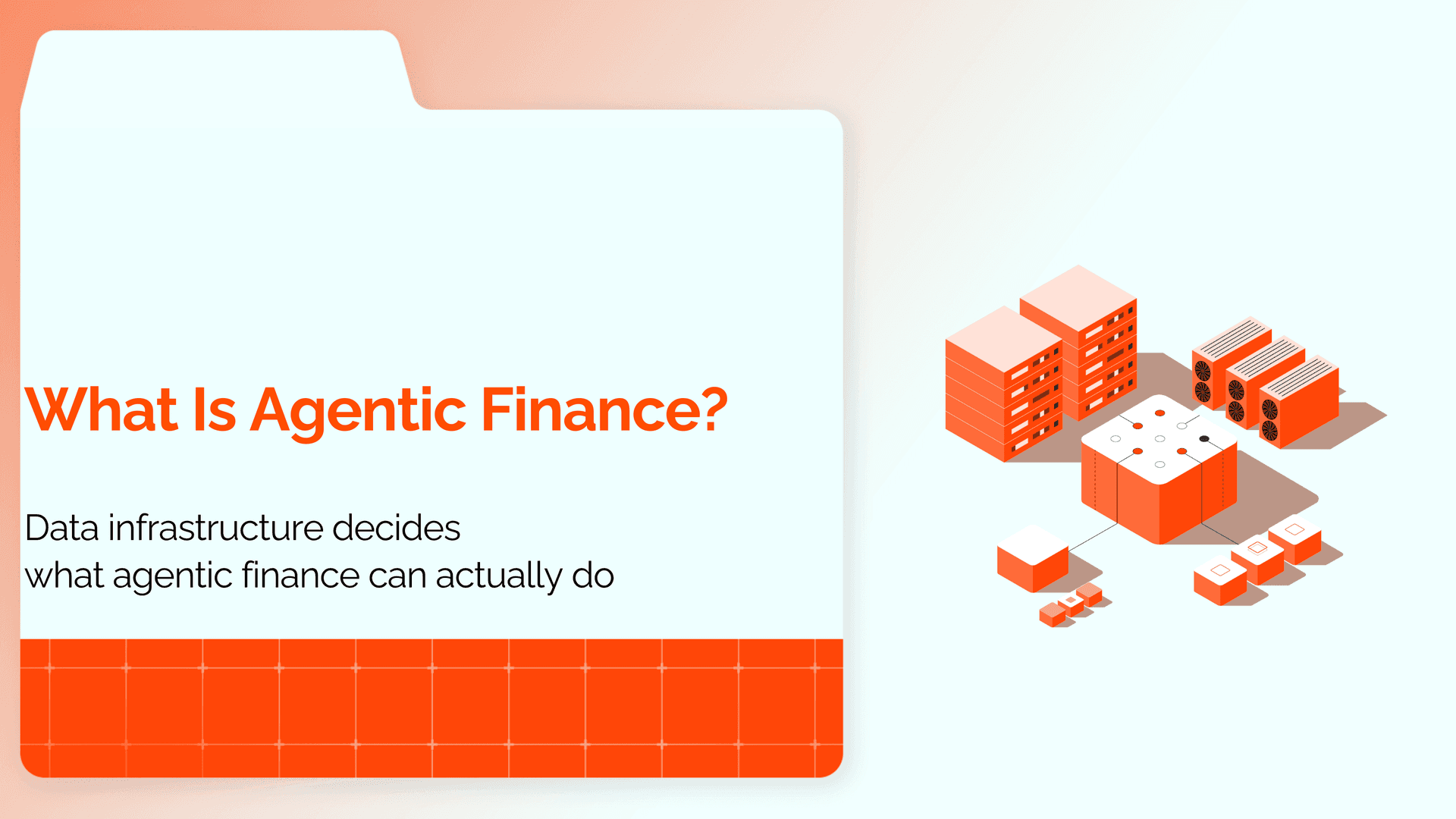
What Is Agentic Finance? Why Data Infrastructure Defines What Agents Can Do
July 28, 2026
13 mins read
Agentic finance is moving from AI-assisted workflows into agentic payments, stablecoin rails, DeFi copilots, and tokenized asset markets. Here is why the category is becoming important now.


TL;DR: Agentic finance is the shift from AI tools that advise on financial decisions to AI agents that can observe data, reason over constraints, and act within approved limits. The category is becoming important now because payments, stablecoins, agent wallets, DeFi copilots, and tokenized assets are giving agents the rails to transact.
The first real use was agentic payments, but the direction is broader: agents that pay for services, monitor portfolios, route capital, prepare compliance workflows, and eventually operate across tokenized financial markets. That trajectory is what makes agentic finance consequential. The key question is no longer whether agents can talk about finance, but whether they can safely participate in financial action.
Key Takeaways:
- Agentic finance is moving from a narrative into an infrastructure category as payment networks, cloud providers, stablecoin companies, banks, and crypto protocols build agent-ready rails.
- Agentic payments are the first practical wedge because the action boundary is narrow: authorize, pay, settle, reconcile.
- The market is expanding into x402-style machine payments, agent wallets, stablecoin settlement, DeFi copilots, yield agents, and traditional finance copilots.
- RWA and institutional DeFi are likely to become the next frontier because tokenized assets make financial state more programmable.
- The category will not scale on model intelligence alone. It will need reliable data, permissioning, policy controls, auditability, and Verifiable Data Infrastructure.
What is agentic finance?
Agentic finance is the use of AI agents in financial workflows where software can observe financial state, reason over objectives, and take bounded actions through connected tools. In simple terms, it is finance where an agent can do more than answer a question. It can help move through a workflow.
That workflow may be small. An agent might pay for an API call, purchase a service, or renew a subscription within a budget. It may also be complex. An agent might monitor a treasury portfolio, compare stablecoin liquidity venues, flag collateral risk, prepare a KYC review, or recommend a rebalance under an investment mandate.
The useful distinction is between financial advice and financial action. A chatbot that summarizes market news is not enough to define agentic finance. A system that can connect to data, permissions, wallets, payment credentials, policy rules, and execution venues is closer to the category.
It also helps to separate intelligence from autonomy. Some financial agents are LLM-heavy copilots that research, summarize, and suggest next steps. Others are deterministic agents that execute rule-based strategies, such as payment settlement, yield routing, or rebalancing. The more capital an agent can influence, the more the system becomes an infrastructure problem: data quality, authority, limits, and evidence.
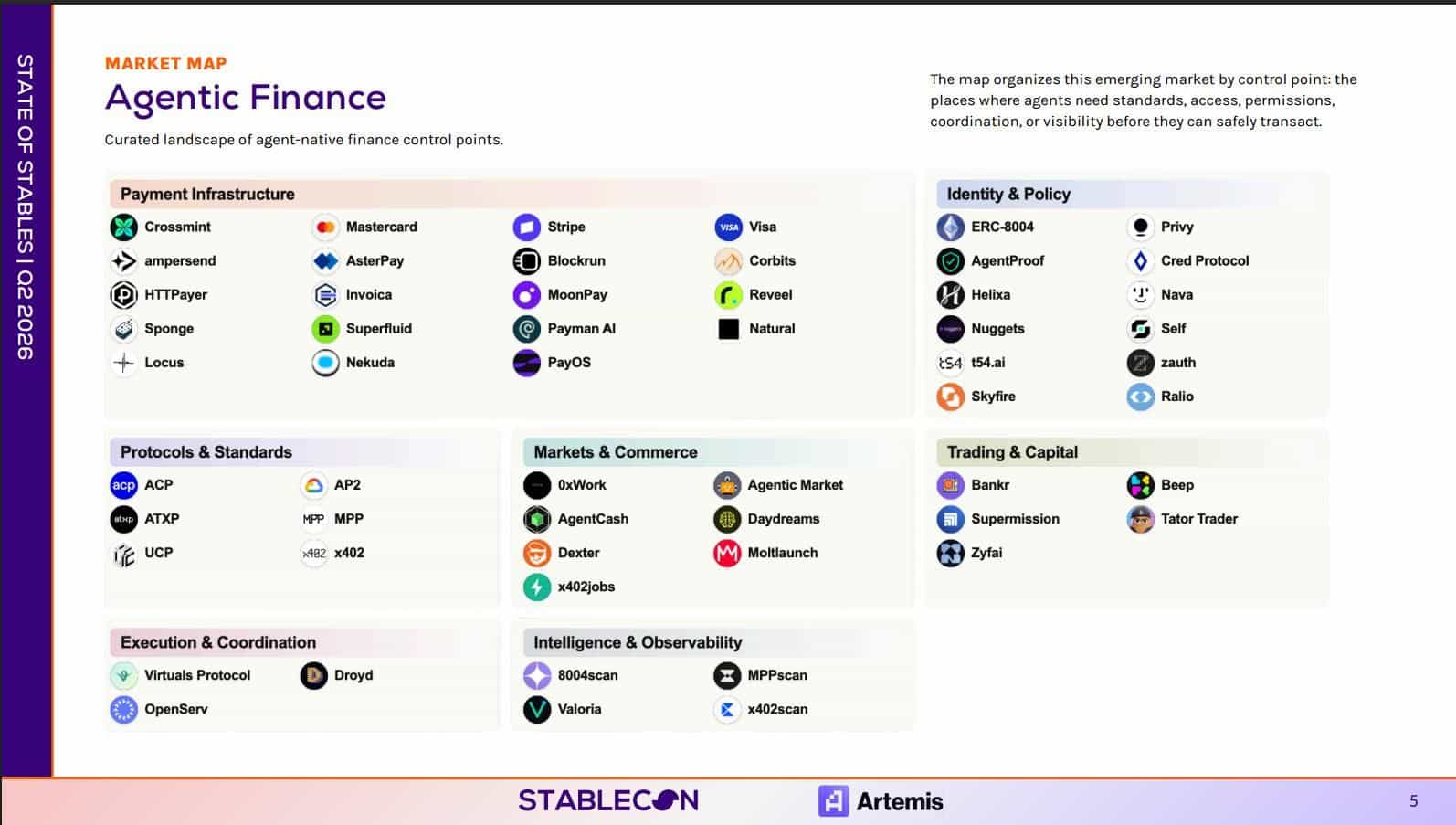
Agentic finance is emerging as a market of control points across payment infrastructure, protocols, identity, execution, observability, and trading. Source: Stablecon x Artemis, The State of Stables Q2 2026.
Why is agentic finance becoming important now?
Agentic finance is becoming important now because several parts of the financial stack are becoming agent-ready at the same time. Payment networks are preparing for agent-initiated transactions. Cloud platforms are building agent payment infrastructure. Stablecoin companies are creating agent wallets and programmable payment flows. Crypto protocols are building machine-payment standards. Tokenized asset platforms are making more financial instruments programmable.
The first signal is agentic payments. In September 2025, Google Cloud announced the Agent Payments Protocol (AP2), developed with more than 60 organizations including Adyen, American Express, Coinbase, JCB, Mastercard, PayPal, Revolut, Salesforce, ServiceNow, UnionPay International, and Worldpay. AP2 focused on a basic problem: if an agent initiates a payment, the system needs proof of authorization, authenticity, and accountability.
Payment networks then moved in the same direction. Visa announced secure agent-initiated transactions and framed agent-driven purchases as part of mainstream commerce in 2026. Mastercard expanded Agent Pay and described agentic transactions as a new commerce model where agents become visible, governed participants in the payment flow. Stripe expanded Shared Payment Tokens so agents can initiate payments with permission without exposing the user's underlying credentials.
The second signal is cloud and crypto infrastructure convergence. AWS introduced Amazon Bedrock AgentCore Payments in preview, built with Coinbase and Stripe, to let autonomous agents handle wallet authentication, stablecoin payment execution, spending governance, and observability when accessing paid resources. Coinbase and Cloudflare contributed to the Linux Foundation as the x402 Foundation to develop an open standard for AI-driven payments over HTTP.
The third signal is stablecoin and wallet infrastructure. Circle introduced Agent Stack for agents that need wallets, USDC payments, service discovery, and command-line financial actions. Fireblocks' Agentic Payments Suite focuses on agent-initiated stablecoin payments with policy controls, KYT, Travel Rule checks, reporting, and reconciliation. Tempo and Stripe's Machine Payments Protocol points in the same direction: payments are becoming lifecycle infrastructure for machines, not only checkout for humans.
The fourth signal is enterprise and banking activity. J.P. Morgan Payments announced work with Mirakl Nexus to support AI agent checkout for merchants, with payment processing, tokenization, and fraud protection as the underlying rails. McKinsey has covered agentic AI in banking KYC and AML workflows, where agents gather, validate, screen, escalate, and produce an audit trail for human review.
The fifth signal is tokenized markets. Ondo Finance's June 2026 roadmap points toward trading, prime brokerage, and asset management layers that can support investors or agents acting on their behalf. That matters because tokenized assets turn financial instruments into programmable objects. Once assets, settlement, collateral, and policy controls become machine-readable, agents can do more than complete checkout.
How did agentic payments become the first practical use case?
Agentic payments became the first practical use case because payments are narrow enough to govern and valuable enough to standardize. A payment agent can be given a clear mandate: spend up to a limit, with an approved merchant, for an approved purpose, using an approved credential or wallet.
That shape makes the problem easier to define. The system can ask whether the user authorized the agent, whether the merchant received the correct intent, whether the credential was scoped, whether fraud checks passed, and whether the transaction can be disputed or reversed under existing rules.
Payments also expose the central issue for all agentic finance: autonomy must be visible. A merchant, issuer, payment network, auditor, or user needs to answer what the agent did, what authority it had, what data it used, and why the transaction was allowed.
This is why agentic payments are the proving ground. If a system cannot make a small purchase auditable, it cannot safely make portfolio actions auditable. Payments are the narrow edge of a much larger financial automation category.
What does the agentic finance landscape include?
The early agentic finance landscape is broader than payments. Stablecon and Artemis's Q2 2026 market map organizes the category by control points: payment infrastructure, protocols and standards, identity and policy, markets and commerce, execution and coordination, intelligence and observability, and trading and capital. That framing is useful because agents do not need only a wallet. They need standards, access, permissions, coordination, and visibility before they can safely transact.
The useful takeaway is not that every listed product will become institutional infrastructure. It is that the category is already branching into different product types.
A useful way to read the agentic finance landscape is by control point, not only by product category:
| Layer | What it does | Why it matters |
|---|---|---|
| Payment infrastructure | Lets agents initiate and settle payments | Turns agents from advisors into economic actors |
| Protocols and standards | Defines how agents request, authorize, and prove transactions | Makes agent activity interoperable across apps and networks |
| Identity and policy | Controls who the agent represents and what it can do | Prevents open-ended financial authority |
| Execution and coordination | Connects agents to tools, wallets, and workflows | Helps agents complete multi-step financial tasks |
| Intelligence and observability | Tracks data, market state, and agent behavior | Makes financial decisions easier to monitor and review |
| Trading and capital | Supports allocation, routing, and strategy execution | Expands agentic finance beyond payments |
DeFi copilots help users research, trade, bridge, swap, and interact with protocols through a specialized interface. These products usually keep humans in the loop, but they reduce the friction of moving through complex DeFi actions.
Yield agents try to automate capital allocation across lending markets, vaults, liquidity pools, and other yield venues. Many of these systems rely more heavily on deterministic rules because capital allocation needs repeatability, constraints, and auditability.
Informational agents focus on market intelligence, sentiment, wallet tracking, risk signals, and data retrieval. They may not execute directly, but they shape the decisions that humans or other agents make.
Traditional finance copilots bring similar workflows to brokerage, portfolio, and research environments. They show that the agentic finance pattern is not limited to crypto, even if crypto rails make agent-to-agent payments and programmable settlement easier to test.
The landscape is still early, but it is no longer empty. The category now includes payment protocols, wallet tools, agent checkout, stablecoin settlement, DeFi execution, data agents, and supervised capital allocation.
Why are RWA platforms the next frontier?
RWA platforms are a natural next frontier because tokenized assets make financial instruments more machine-readable. Stablecoins, tokenized Treasuries, tokenized funds, private credit, commodities, and tokenized equities can become inputs for agents that monitor conditions and act under rules.
The opportunity is clear. Agents could help treasury teams monitor reserve signals, liquidity venues, redemption windows, and counterparty exposure. They could help lending protocols check collateral state. They could help funds compare NAV inputs, custody data, and onchain positions. They could help compliance teams prepare eligibility checks and audit packages.
The challenge is that RWA workflows are more complex than payments. A payment agent may need a user mandate and a merchant credential. An RWA agent may need NAV data, reserve composition, collateral status, investor eligibility, custody data, redemption windows, liquidity depth, jurisdictional restrictions, and execution constraints.
That complexity is why institutional agentic finance will likely start with bounded, supervised workflows. The near-term version is not a fully autonomous asset manager. It is a set of agents that monitor, check, recommend, prepare, and execute only inside approved limits.
What infrastructure does agentic finance need?
Agentic finance needs infrastructure that makes financial state observable, permissions enforceable, actions bounded, and outcomes auditable. The model is only one part of the system. The surrounding rails determine whether the agent can be trusted with financial workflows.
The required stack includes:
- Fresh data: Is the financial state current enough for the action?
- Provenance: Where did the data come from?
- Lineage: How was the data transformed?
- Permissioning: What can the agent access?
- Policy controls: What is the agent allowed to do?
- Execution controls: How can the agent act?
- Audit trail: Can a reviewer reconstruct what happened?
- Verifiability: Can critical data states or computations be independently checked?
Chaos Labs frames a related issue in financial AI: markets are not static documents, they are continuously changing state machines. Web search can retrieve narratives about what happened, but it cannot reliably observe live portfolio state, order books, liquidity, redemptions, or collateral conditions.
Enterprise AI research points in the same direction. Fivetran's 2026 Agentic AI Readiness Index found that data quality and lineage, regulatory compliance, and security/privacy were among the top blockers for production agentic AI. Deloitte's agentic AI architecture work similarly emphasizes governed APIs, trusted data, canonical models, semantics, lineage, and auditability.
The pattern is consistent: agentic finance scales only when the data layer, policy layer, and execution layer mature together.
What should builders watch next?
Builders should watch five areas.
First, payment standards. AP2, x402, machine-payment protocols, payment tokens, and agent checkout will shape how agents pay for services and prove authorization.
Second, agent wallets. Scoped wallets, spending limits, policy engines, and wallet observability will decide how much financial authority agents can receive.
Third, stablecoin settlement. Stablecoins are becoming a natural payment asset for agents because they are programmable, internet-native, and available across blockchain rails.
Fourth, RWA data. Tokenized assets will need reliable NAV, reserve, collateral, custody, redemption, and eligibility data before agents can act around them.
Fifth, verifiability. As agents move from recommendations into financial action, the industry will need stronger ways to prove data state, query correctness, and policy satisfaction without exposing sensitive data.
This is where the category connects to Verifiable Data Infrastructure. Agentic finance begins with agents that can pay. It becomes institutionally useful only when those agents can rely on financial data that is fresh, permissioned, auditable, and independently checkable.
What comes after agentic payments?
The next phase of agentic finance is not just more autonomous checkout. It is financial workflow automation across payments, treasury, collateral, compliance, portfolio monitoring, and tokenized asset markets.
That phase will require more than better models. It will need reliable data infrastructure, bounded authority, policy enforcement, audit trails, and cryptographic verification for sensitive financial workflows.
Orochi Network's zkDatabase fits into that future as part of the Verifiable Data Infrastructure layer. It is not an AI agent, risk engine, or execution system. It is the data layer that can help financial systems prove data state and query correctness through Zero-Knowledge Proofs without exposing sensitive data.
That is the deeper infrastructure question behind agentic finance: before agents can manage capital, can they trust the data they act on?
Continue Reading
Read the follow-up on institutional agentic finance and verifiable data.
FAQ
What is agentic finance?
Agentic finance is the use of AI agents in financial workflows where agents can observe data, reason over objectives, and act within approved constraints. It goes beyond chatbots because the agent is connected to tools, data sources, permissions, and financial systems.
What is the difference between agentic finance and agentic payments?
Agentic payments are the first practical use case within agentic finance. They focus on agents initiating or completing payments under user-approved rules. Agentic finance is broader and can include treasury monitoring, collateral checks, portfolio recommendations, compliance workflows, and bounded execution across financial systems.
Why are stablecoins important for agentic finance?
Stablecoins are important because they give agents programmable payment rails that can operate across internet-native financial systems. They can support micropayments, API payments, wallet-based transactions, and settlement workflows, but they still need permissioning, policy controls, and auditability.
Why do RWA markets matter for agentic finance?
RWA markets matter because tokenized assets make financial instruments more programmable. Agents could eventually monitor tokenized Treasuries, funds, private credit, collateral, reserves, and redemption conditions. The challenge is that much of the required data starts off-chain, so institutions need stronger ways to verify it.
What is the biggest bottleneck for agentic finance?
The biggest bottleneck is not only model intelligence. It is trusted infrastructure: fresh data, provenance, permissions, policy controls, audit trails, and verifiability. Without those layers, agents may look autonomous but remain hard to approve for serious financial workflows.
Related toAI