Real - World Assets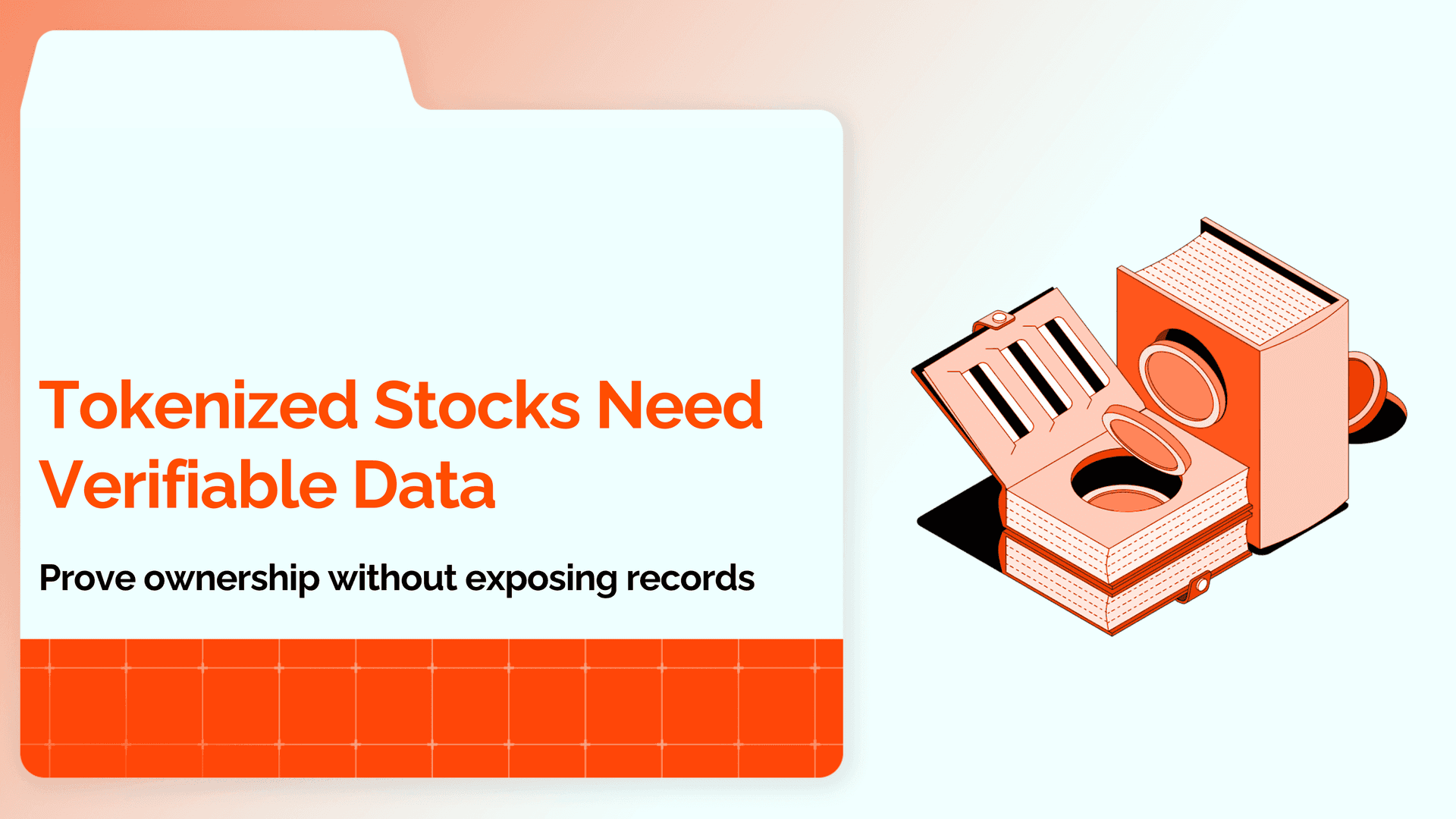
Why Tokenized Stock Infrastructure Needs a Verifiable Data Layer
July 14, 2026
11 mins read
Native tokenized stocks aren't wrapper tokens, the on-chain record IS the share. Why tokenized equities need a verifiable data layer.


TL;DR: A recent partnership between a leading tokenization platform and the world's largest transfer agent will allow 25,000+ companies to issue shares as native tokens. Unlike wrapper tokens, these Issuer-Sponsored Tokens ARE the share, the on-chain record IS the shareholder register. That shift makes tokenized equities data verification a structural requirement, not an optional feature.
Tokenized equities data verification is not a product category yet. It should be. This sits alongside the SEC's 2026 tokenized-securities guidance shaping how RWA protocols bring securities on-chain. The total addressable scope covers a market north of $30 trillion, per the same analysis. The infrastructure question this raises has received almost no attention: when the shareholder register lives on-chain, who proves it is correct?
Key Takeaways:
- Issuer-Sponsored Tokens are native tokenized shares, not economic exposure to a custodied share. The token IS the legal share.
- Moving the official shareholder register on-chain creates a data integrity requirement that trust-based transfer agent accountability cannot satisfy alone.
- Every ownership change, dividend record, and voting outcome becomes a data provenance question once the register is on-chain.
- Zero-Knowledge Proofs allow shareholder record updates to be verified cryptographically without exposing the full registry.
- zkDatabase's verifiable data architecture is well-suited to this model: continuous, cryptographic proof of committed data state across the full pipeline.
What Is the Difference Between a Wrapper Token and a Native Tokenized Share?
Most tokenized equities in existence today are wrapper tokens. Products like AAPLx or TSLAx give the holder economic exposure to a share held in custody by a third party. The token tracks the price. The actual share sits in a traditional brokerage account. The connection between wrapper and underlying is contractual: the custodian asserts the share is there.
This is indirect tokenization. Ownership of the wrapper is tracked on-chain. Ownership of the underlying share is tracked in a traditional ledger. The two systems are connected by trust, not by proof.
Native tokenized shares work differently. Under a direct tokenization model, the approach used by SEC-registered transfer agents operating under Section 17A of the Securities Exchange Act of 1934, the blockchain is integrated into the official shareholder register. The same shift is underway wherever regulated tokenized securities move on-chain, including at the settlement-infrastructure layer.. The token does not represent a share. The token is the share. Investors receive the same legal rights as traditional shareholders: voting rights, dividend entitlements, corporate action participation.
The distinction is not semantic. It determines the entire data architecture downstream.
Why Does the Verification Problem Differ Between These Two Models?
With wrapper tokens, the data verification question is relatively contained: does the custodian hold the underlying shares that back the tokens in circulation? This is a Proof of Reserves (PoR) problem. It is solvable, imperfectly today, but architecturally understood.
With native tokenized shares, the verification question is of a different order. The on-chain record is not a derivative of the official register. It is the official register. Every state change to that record carries legal weight. Ownership changes must be accurate and unalterable. Dividend calculations must correspond to verified ownership states at the record date. Voting outcomes must reflect the verified ownership distribution at the snapshot block.
When the shareholder register is a trusted off-chain database maintained by a regulated entity, accountability is institutional. Transfer agents are liable under federal securities law. Their processes are audited. Their records are assumed correct unless challenged through legal proceedings.
When the shareholder register is an on-chain database, that institutional accountability does not disappear. It becomes insufficient on its own. A database entry can be modified. A cryptographic proof of that entry cannot be retroactively falsified. The question shifts from "do we trust the transfer agent?" to "can anyone verify the register without trusting any single party?"
That is a different question. And it requires different infrastructure.
What Happens to Every Corporate Action When the Register Goes On-Chain?
Consider what a dividend payment requires in a native tokenized equity architecture. The issuer must:
- Capture the shareholder register at a specific record date
- Calculate entitlements based on verified ownership at that date
- Execute payments against those calculations
- Record the payment state in the register
In a traditional setup, each of these steps is a trusted internal operation. The transfer agent performs them. Regulators and auditors review them periodically. Shareholders trust the outcome.
In a native tokenized architecture, each of these steps produces a data state that exists on-chain. If that data state is not cryptographically provable, if anyone with database access can alter a record between step 1 and step 3, then the legal enforceability of the token's ownership rights rests on the same trust assumption as before. The blockchain becomes an expensive ledger with no verification advantage.
The same logic applies to voting. If the on-chain register reflects 1,000 shareholders at the record date, and the vote count reflects 1,200, something changed. In a trust-based model, you investigate. In a verified model, you prove, or you cannot prove, which is a different kind of answer and a far cleaner one for regulators.
RWA tokenization at this scale does not simply require blockchain rails. It requires cryptographic accountability at the data layer.
The visual below summarizes where verification fits once the shareholder register becomes part of tokenized stock infrastructure.
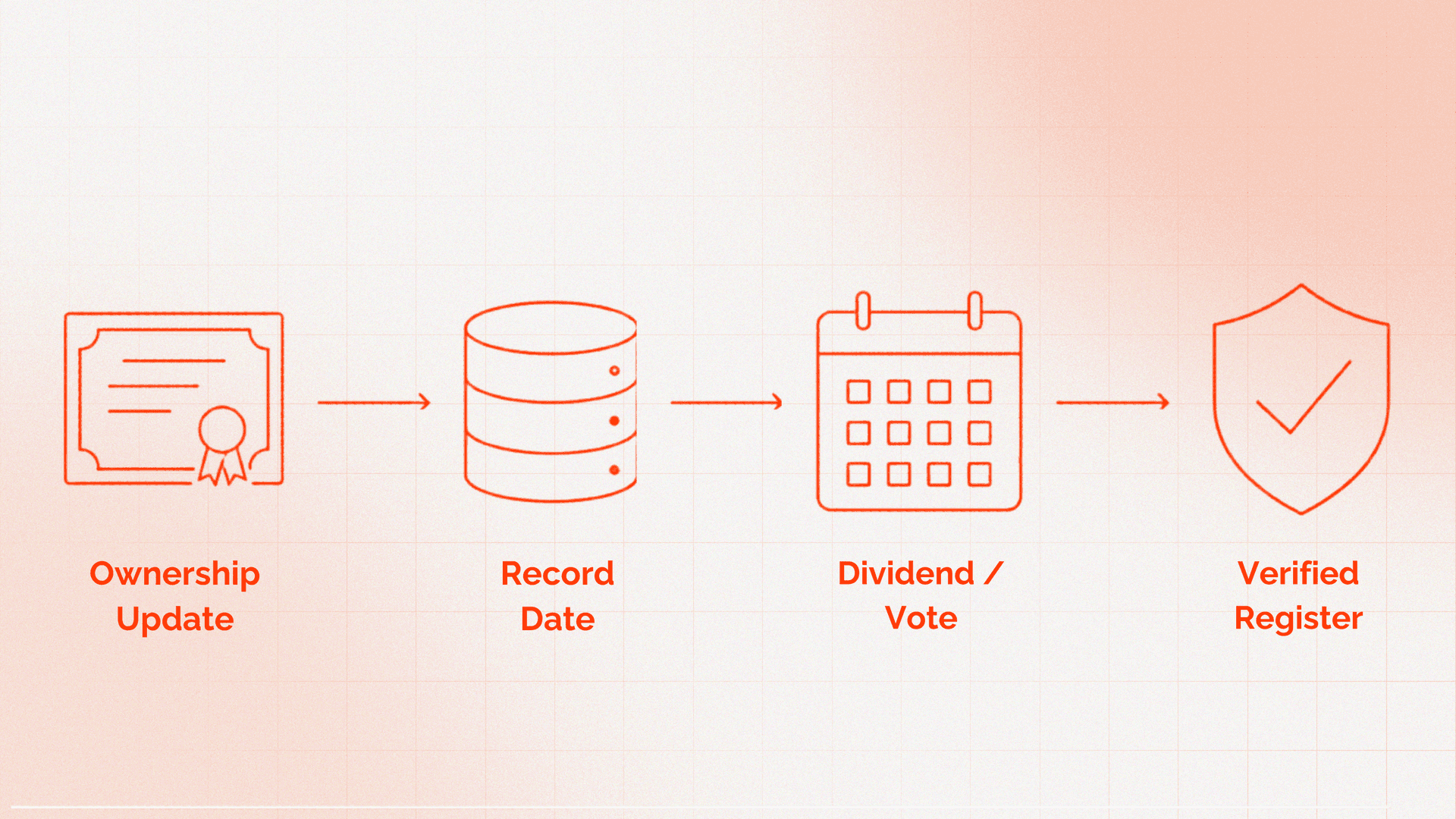
Native tokenized shares turn the shareholder register into live infrastructure. The missing layer is proof that ownership records, dividend snapshots, and voting data are correct before corporate actions execute.
Why Is Cryptographic Proof Different From Regulatory Accountability?
Transfer agents are regulated. They are accountable. They have professional liability, insurance, and legal exposure. For 50 years, that accountability has been the mechanism by which shareholder registers are trusted.
Cryptographic proof is not a replacement for regulatory accountability. It is an addition to it, one that changes what "trust" means in practice.
A regulated transfer agent can make a mistake, face a system error, or, in adversarial scenarios, face a bad actor with database access. Regulatory accountability addresses these failures after the fact: litigation, remediation, penalties. Cryptographic proof addresses them before the fact: any state change generates a proof, and any verification attempt that fails flags the inconsistency immediately.
For institutional buyers of native tokenized shares, including asset managers, pension funds, and sovereign wealth funds, the question is not whether the transfer agent is reputable. It is whether ownership position can be verified independently, without relying on the issuer's system producing the correct output on demand.
This is not a theoretical concern. It is the same question that drove institutional demand for verifiable data infrastructure in stablecoin reserves and tokenized fund NAV. The answer in those contexts was Zero-Knowledge Proofs. The answer for native tokenized equities is the same.
How Does Zero-Knowledge Proof Architecture Apply to the Shareholder Register?
The specific challenge with shareholder registers is privacy. A publicly listed company may have tens of thousands of shareholders. Exposing the full registry on-chain, ownership positions, transaction history, dividend entitlements, violates both investor privacy expectations and securities regulations in most jurisdictions.
Zero-Knowledge Proofs solve this directly. A Zero-Knowledge Proof can prove that a specific ownership record satisfies committed-state conditions, without revealing the underlying registry. An institutional shareholder can verify their position cryptographically without the issuer or transfer agent having to publish the full register.
In an appropriate integration, zkDatabase's verifiable data pipeline can generate a Zero-Knowledge Proof at each data state update. For a shareholder register, this means an ownership change can produce a compact Groth16 proof, verifiable on compatible EVM chains, showing that the registry was in a specific committed state at a specific moment. The proof does not expose the registry.
Corporate actions become verifiable the same way. A dividend payment proof demonstrates that the payment calculation was performed against the correct ownership snapshot, without revealing individual positions. A voting record proof demonstrates that the outcome matches the verified ownership distribution at the record block.
From off-chain to on-chain, the data pipeline maintains cryptographic continuity. Each verified step reduces the trust assumption that otherwise sits with the database operator. This is what audit-grade data integrity means in a native tokenized equity context.
What Does This Mean for Tokenization Platforms Building Native Equity Infrastructure?
For tokenization platforms evaluating whether to build native tokenized equity infrastructure, the data architecture question comes before the technology question.
The token standard matters. The custody model matters. The regulatory jurisdiction matters. But all of these decisions sit on top of a foundational requirement: the on-chain record must be cryptographically provable, not just technically correct.
A shareholder register that exists on-chain but lacks verifiable data infrastructure is a trust-based database with a blockchain front end. The value of the blockchain (immutability, programmable rights, 24/7 settlement) depends entirely on the integrity of the data it encodes. If that data can be altered without detection, the token's legal validity is only as strong as the institution that issued it.
Tokenized equities have the potential to expand market access, reduce settlement friction, and enable continuous trading in instruments that currently clear in T+1 or T+2 cycles. None of that potential is realized if the underlying data layer replicates the trust assumptions of the system it is replacing.
The deal announced in April 2026 puts 25,000+ companies within reach of native tokenized share issuance. The platforms that will win institutional adoption are the ones that treat tokenized equities data verification as a first-order infrastructure requirement, not an audit afterthought.
What Should Heads of Product and CTOs Be Evaluating Now?
If you are building native tokenized equity infrastructure, or evaluating a platform that does, the questions worth asking are operational:
At what point in the ownership transfer process is a cryptographic proof generated? If the answer is "at settlement" rather than "at every state change," the register has gaps. Corporate actions, dividend records, and voting snapshots occur between settlement events.
Can an institutional shareholder verify their position without requesting it from the issuer's system? If the answer is no, the token's claim to self-sovereign ownership is incomplete.
Can a regulator verify the dividend calculation was performed correctly, without access to the full registry? If the answer requires sharing the full dataset, MiCA's data minimization requirements and equivalent frameworks create compliance exposure.
These questions do not have clean answers today for most tokenized equity platforms. They are the questions that Verifiable Data Infrastructure is designed to answer.
zkDatabase's from off-chain to on-chain data provability model, ingestion, storage, query, and on-chain verification, each step cryptographically proven, provides the architecture that native tokenized equity infrastructure needs at the data layer. Transfer agents prove the record is correct with liability. zkDatabase proves the record is correct with math.
Both matter. Only one can be verified independently.
FAQ
What makes a native tokenized share different from a wrapped token in terms of data requirements?
A wrapper token tracks the price of a custodied share. Data verification means confirming the custodian holds the underlying shares. A native tokenized share is the legal share, and the on-chain record is the official shareholder register. Data verification in this context means proving every state change to that register is accurate, unaltered, and traceable. The scope of verifiable data requirements expands from reserve confirmation to continuous register integrity.
Can Zero-Knowledge Proofs protect shareholder privacy while still enabling on-chain verification?
Yes. Zero-Knowledge Proofs allow a system to prove that a specific data state is correct without revealing the underlying data. A shareholder can verify their own position cryptographically. A regulator can verify a dividend calculation was performed correctly. Neither operation requires exposing the full shareholder registry. This is the core technical mechanism that makes privacy-preserving on-chain verification possible for institutional equity infrastructure.
Why is regulatory accountability from a transfer agent insufficient for native tokenized equity verification?
Regulatory accountability operates after the fact, through audits, litigation, and remediation. It assumes the transfer agent's records are correct unless challenged. Cryptographic proof operates at the point of state change: every ownership update generates a proof that can be independently verified. For institutional buyers requiring continuous, independent confirmation of their position, without relying on the issuer's system, regulatory accountability alone does not satisfy the verification standard that institutional capital increasingly demands.
Related toReal - World Assets