Data Privacy
Data Privacy Compliance in 2026: Proof Stack for Crypto AI
July 28, 2026
14 mins read
Data privacy compliance in 2026 is moving from policy promises to verifiable evidence. Crypto teams, AI agent builders, and institutional finance operators need consent logs, minimal disclosure, access records, and Zero-Knowledge Proofs that show what happened without exposing sensitive data to counterparties, auditors, or public chains.


TL;DR: Data privacy compliance in 2026 is no longer about writing better policies. It is about proving restraint: what data was collected, who accessed it, why it was used, and whether sensitive inputs stayed private. Crypto and AI teams need verifiable logs, minimal disclosure, and Zero-Knowledge Proofs that auditors can verify.
Partners and regulators increasingly show up with proof requests rather than questionnaires: show consent, access, and data handling in production, not just policy documents. That shift is what data privacy compliance now turns on, and zkDatabase gives teams a way to prove data integrity and compliance-related states without exposing raw data.
What Are the Key Takeaways?
- Data privacy compliance in 2026 depends on auditable evidence, not policy language alone.
- AI agents make consent enforcement harder because data access happens continuously and automatically.
- Public blockchains create wallet linkability, transaction exposure, and metadata risk for institutional users.
- Zero-Knowledge Proofs allow teams to prove claims about data without revealing the underlying data.
- zkDatabase fits as a Verifiable Data Infrastructure layer for consent logs, access data, and compliance-state proofs.
Why Does Data Privacy Compliance in 2026 Require Proof Instead of Policy?
Data privacy compliance in 2026 requires proof because institutional partners need evidence that privacy rules were enforced in production. A privacy policy can describe intent; a verifiable record can show what the system actually did.
IBM's 2025 Cost of a Data Breach Report puts the global average breach cost at USD 4.44 million, down 9 percent from the prior year. Faster detection helps, but it does not answer the question that matters in institutional procurement: can the team prove what happened before, during, and after sensitive data was accessed?
That question matters for crypto teams because on-chain activity is persistent and linkable. It matters for AI teams because agents can retrieve, copy, and combine data at machine speed. It matters for RWA, stablecoin, and institutional DeFi teams because counterparties want auditability without unnecessary exposure.
The practical shift is simple. Compliance teams are moving from "we have controls" to "here is the evidence trail." The evidence trail needs to show consent state, access purpose, data minimization, and whether raw data stayed inside the approved environment.
zkDatabase supports that evidence model by turning off-chain data operations into Verifiable Data. A partner can verify a proof that a condition was met without seeing the underlying dataset.
Bottom line: Data privacy compliance now rewards teams that can prove restraint, not teams that merely promise it.
What Is the New Privacy Stack for Crypto and AI Agents?
The new privacy stack combines consent management, minimal disclosure, verifiable logging, Zero-Knowledge Proofs, and jurisdiction-aware data handling. Each layer answers a different question: who allowed access, what was exposed, what was proven, and where the data moved.
The old stack was built around banners, access policies, and after-the-fact audits. That model breaks down when AI agents request data repeatedly and blockchain applications expose metadata by default. A better stack looks like this:
| Layer | What it controls | Evidence it should produce |
|---|---|---|
| Consent management | Whether data can be used for a purpose | Machine-readable consent state |
| Minimal disclosure | How much data is revealed | Proof that only required fields were used |
| Access logging | Who accessed data and why | Tamper-evident access record |
| Zero-Knowledge Proofs | Whether a claim is true | Verifiable proof without raw data exposure |
| Sovereignty controls | Where data is processed or transferred | Region-specific audit trail |
For AI agents, this means every request should pass through a policy loop. The agent asks for data, the system checks consent and purpose, the system returns only the minimum required fields, and the access event is logged. For blockchain applications, the same logic applies to wallet eligibility, reserve checks, KYC status, and institutional reporting.
This is where selective disclosure in 2026 becomes more than a privacy feature. It becomes the operating model for regulated data use.
Bottom line: The new privacy stack is a proof stack: consent, access, and disclosure need to be machine-checkable.
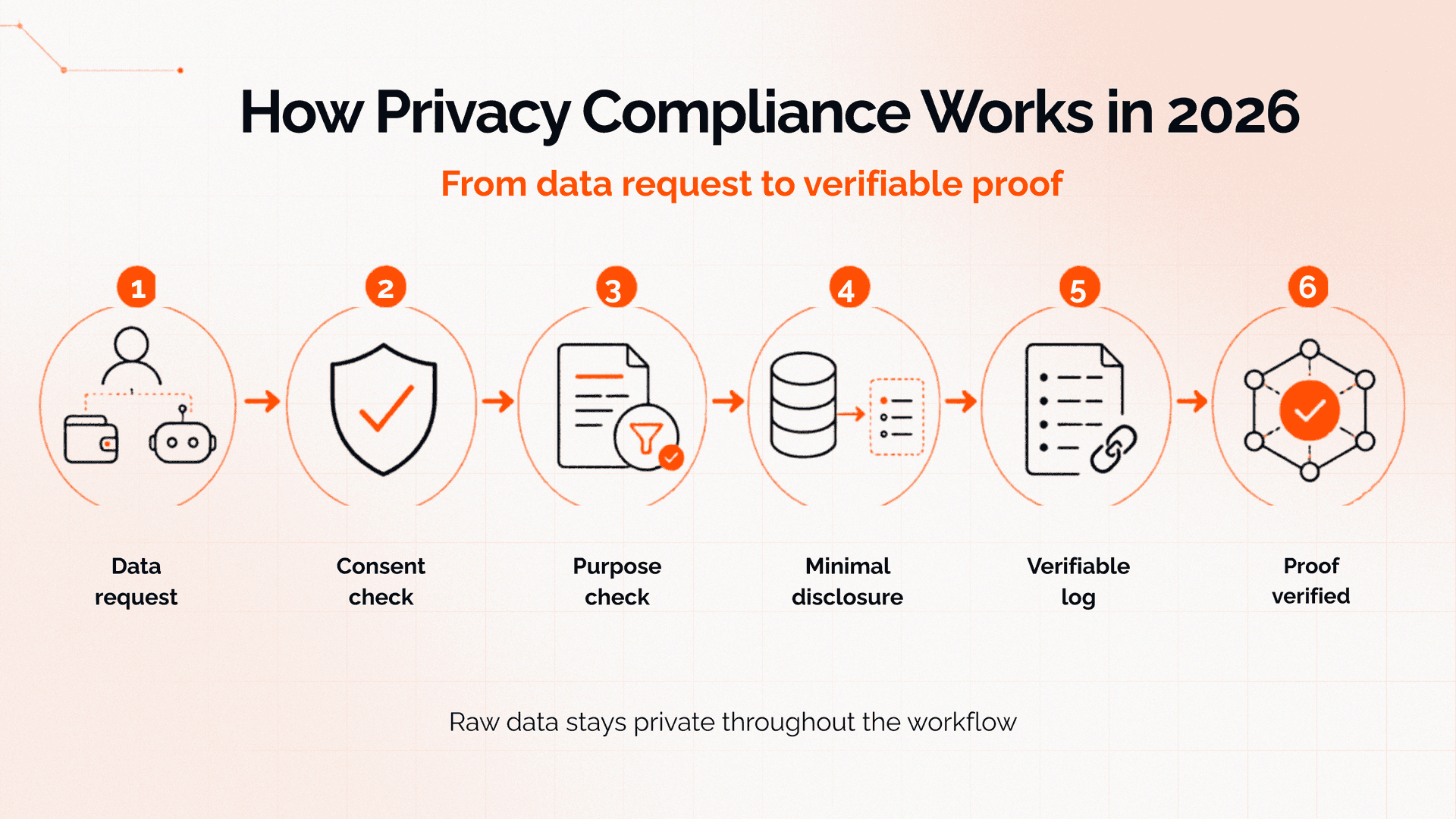
How privacy compliance shifts from a raw data request to verifiable proof while sensitive data stays private throughout the workflow.
Why Does Wallet Linkability Create a Data Privacy Compliance Risk?
Wallet linkability creates data privacy compliance risk because pseudonymous addresses behave like persistent identifiers. Once transaction timing, counterparties, and repeated interactions are clustered, a wallet can reveal identity signals and business relationships that were never meant to be public.
Public chains are useful because they are transparent. That same transparency is hard for institutions. Payroll, vendor payments, B2B settlement, treasury movement, and tokenized asset ownership all carry sensitive context. Publishing that context indefinitely can expose counterparties, commercial relationships, and operational patterns.
TRM Labs' 2026 research on on-chain privacy and financial compliance makes the institutional point directly: businesses cannot run payroll, vendor payments, or treasury operations on systems where competitors can observe every transaction. The issue is not secrecy for its own sake. The issue is protecting normal financial activity from becoming public metadata.
For RWA and institutional DeFi, the challenge is sharper. Regulators may need proof that an asset exists, a counterparty is eligible, or a transaction satisfies policy. They do not necessarily need a public feed of every sensitive input. The compliance goal is selective disclosure: reveal what a verifier needs, keep everything else private.
Orochi Network's Verifiable Data Infrastructure is designed around that distinction. Raw data can remain off-chain while a proof about the data becomes available for on-chain verification. That supports privacy-preserving compliance without forcing public disclosure of the full dataset.
Bottom line: Wallet linkability turns normal institutional activity into durable metadata unless teams separate proof from disclosure.
How Do AI Agents Change Consent and Data Governance?
AI agents change consent and data governance because they make data access continuous, automated, and difficult to supervise manually. A consent banner records a moment; an agent workflow needs request-time enforcement on every action.
The EU AI Act timeline makes this more urgent. The European Commission's AI Act Service Desk states that obligations for Annex III high-risk AI systems, Article 50 transparency requirements, and related innovation measures apply from August 2, 2026. General-purpose AI obligations already entered into application on August 2, 2025.
For crypto and financial applications, the operational problem is straightforward. A customer support agent should not retrieve a user's entire transaction history when it only needs invoice status. A risk agent should not copy raw KYC files when it only needs to know whether a check passed. A treasury agent should not expose counterparty data when a yes-or-no eligibility proof is enough.
The governance model should be request-based:
- The agent asks for a specific data attribute.
- The system checks purpose, consent, and role.
- The system returns the minimum required output.
- The access event is logged in a tamper-evident record.
- A verifier can later prove the rule was followed.
zkDatabase can support this model by proving access and data-state conditions over off-chain data. That gives compliance teams an evidence trail for agent behavior instead of relying on screenshots, policy documents, or manual audit sampling.
Bottom line: AI agent governance needs consent that is enforceable by systems, not consent that only humans can read.
Which Privacy-Enhancing Technologies Should Institutional Teams Prioritize?
Institutional teams should prioritize privacy-enhancing technologies based on the evidence they need to produce. Zero-Knowledge Proofs fit claims that must be verified without disclosure, MPC fits multi-party computation, differential privacy fits aggregate analytics, and TEEs fit isolated processing with hardware trust assumptions.
The right choice depends on what the verifier needs to know.
| Technology | Best fit | Main tradeoff |
|---|---|---|
| Zero-Knowledge Proofs | Prove eligibility, reserve sufficiency, KYC status, or data integrity without exposing raw data | Circuit design and proof-system complexity |
| MPC / SMPC | Compute across several parties without one party seeing all inputs | Coordination and latency |
| Differential privacy | Publish aggregate analytics while reducing individual exposure | Accuracy loss and statistical design |
| TEEs | Process sensitive data inside isolated hardware environments | Hardware trust assumptions |
Zero-Knowledge Proofs are especially relevant for data privacy compliance because they produce verifier-friendly evidence. A proof can show that a wallet is eligible, a reserve threshold was met, or a compliance-state record existed at a timestamp without exposing the underlying identity, balance sheet, or registry.
This is the same architectural direction described in how zkDatabase proves off-chain data authenticity: the data stays off-chain, while the proof becomes verifiable by systems that need assurance.
Bottom line: The best privacy-enhancing technology is the one that produces evidence your auditor, partner, or smart contract can verify.
What Does Post-Quantum Readiness Mean for Privacy Teams in 2026?
Post-quantum readiness means teams should begin cryptographic inventory, migration planning, and crypto-agility work now, while using finalized standards where appropriate. It does not mean every production system must switch overnight.
NIST finalized its first three post-quantum cryptography standards in August 2024: FIPS 203 for ML-KEM, FIPS 204 for ML-DSA, and FIPS 205 for SLH-DSA. NIST selected HQC in March 2025 as an additional backup algorithm for standardization, with finalization expected later.
For privacy teams, the larger lesson is not only key size. It is metadata resilience. Even when content is encrypted, metadata can reveal who interacted, when, how often, and in what pattern. In crypto and AI systems, metadata can be as sensitive as the content itself.
That is why data privacy compliance needs to cover both content protection and proof design. A system can keep raw data encrypted but still leak relationships through logs, wallet links, model prompts, or cross-border transfer data. Proof-based architectures reduce the need to move raw data in the first place.
Bottom line: Post-quantum planning should sit beside metadata minimization and proof-based disclosure, not replace them.
How Do Cross-Border Data Flows Affect Privacy Architecture?
Cross-border data flows affect privacy architecture because compliance requirements depend on where data is collected, processed, stored, and accessed. A single global privacy design often fails once a partner asks where sensitive processing actually happens.
The EU, Singapore, Hong Kong, the UAE, India, Vietnam, and the United States do not treat data transfers identically. Teams operating across these markets need architecture that can localize processing, reduce unnecessary movement, and produce transfer data when asked.
For institutional crypto and RWA teams, the best pattern is to keep sensitive data close to its source and move proofs instead of raw data. A reserve proof, identity eligibility proof, or compliance-state proof can cross system boundaries with less exposure than the underlying dataset.
That does not remove legal obligations. It gives legal, compliance, and engineering teams a better primitive to work with. Instead of negotiating raw-data access for every partner, teams can define which claims need to be proven and which data never need to leave the source environment.
Bottom line: Cross-border compliance becomes easier when systems export verifiable proofs instead of sensitive datasets.
What Happened to Third-Party Cookies and First-Party Data?
Third-party cookies were not removed from Chrome. Google announced in April 2025 that Chrome would maintain its current approach to third-party cookie choice and would not roll out a new standalone prompt for third-party cookies.
That matters because many "cookieless" migration plans were built around a forced Chrome deadline that did not arrive. But the strategic direction is still clear: first-party data, explicit consent, and auditable data use are more durable than tracking models built on weak user understanding.
For institutional crypto teams, the lesson is not about adtech. It is about trust. If a partner asks what user data was collected, why it was collected, and how consent was enforced, "the browser allowed it" is not a serious answer. The right answer is a first-party data model with consent data and verifiable access logs.
zkDatabase fits that direction because compliance teams can treat consent and access events as data states that can be proven. The system does not need to expose all user data to prove that a rule was enforced.
Bottom line: The cookie reversal did not weaken the first-party data case; it made evidence-based consent more important.
How Does zkDatabase Make Privacy Compliance Verifiable?
zkDatabase makes privacy compliance verifiable by turning off-chain data states and operations into cryptographic proofs. The verifier checks the proof; the raw data stays private.
In practice, zkDatabase can support three evidence patterns:
- Consent evidence: proof that a user or counterparty had the required consent state at a specific time.
- Access evidence: proof that a system checked role, purpose, or permission before allowing access.
- Integrity evidence: proof that a record, query, or transformation was not altered without detection.
This matters for RWA, stablecoin, and institutional DeFi teams because sensitive data often cannot be placed directly on-chain. Ownership documents, reserve composition, KYC data, borrower files, and counterparty details need privacy. Smart contracts and partners still need assurance.
zkDatabase's Groth16-based proof system is part of the technical foundation for that assurance. The broader category is Verifiable Data Infrastructure: data remains usable by institutions because its correctness can be proven without broad disclosure.
For a concrete RWA example, see how zkDatabase powers verifiable data for RWA protocols. The same pattern applies to privacy-preserving compliance: prove the claim, protect the input.
Bottom line: zkDatabase helps teams move from "trust our privacy policy" to "verify the proof."
What Does This Mean for Data Privacy Compliance?
Data privacy compliance in 2026 is becoming a measurable operating discipline. Crypto teams need to manage wallet linkability. AI agent teams need request-time consent enforcement. Institutional finance teams need cross-border privacy controls and audit-ready evidence. The common requirement is proof: evidence that sensitive data was accessed, processed, and disclosed only under the rules that applied at the time. Orochi Network's zkDatabase is built for that evidence layer, turning off-chain data into Verifiable Data that partners, auditors, and smart contracts can verify without seeing the raw inputs.
Bottom line: The winning privacy architecture minimizes exposure while making every sensitive data operation provable.
How Can Teams Evaluate zkDatabase?
Teams can evaluate zkDatabase by mapping one compliance workflow to a proof requirement: what must stay private, what must be verified, and who needs to verify it. The best first use cases are consent-state proofs, KYC eligibility proofs, reserve checks, and audit trails for off-chain data.
Book Technical Call
Discuss how zkDatabase can support privacy-preserving compliance workflows for RWA, stablecoin, and institutional DeFi systems.
View zkDatabase Docs
Review the proof architecture behind verifiable off-chain data and on-chain verification.
Bottom line: Start with one sensitive workflow where partners need proof but should not receive the raw data.
What Questions Do Teams Ask About Data Privacy Compliance?
The most common questions are about what data privacy compliance means, how Zero-Knowledge Proofs reduce disclosure, why AI agents change consent risk, and where zkDatabase fits in the architecture.
What is data privacy compliance in 2026?
Data privacy compliance in 2026 means proving how sensitive data was collected, accessed, processed, and disclosed. Policies remain necessary, but institutional teams increasingly need verifiable evidence: consent logs, access data, data minimization controls, and proofs that raw data stayed private. This is especially important for crypto systems, AI agents, and regulated financial workflows.
How do Zero-Knowledge Proofs support privacy-preserving compliance?
Zero-Knowledge Proofs support privacy-preserving compliance by proving that a statement is true without revealing the underlying data. A team can prove KYC eligibility, reserve sufficiency, consent state, or data integrity without exposing identity files, reserve composition, or transaction details. This helps institutions satisfy verification requirements while reducing unnecessary disclosure.
Why are AI agents a privacy compliance risk?
AI agents are a privacy compliance risk because they can access and combine data continuously without manual review for every request. If consent, purpose, and minimal disclosure are not enforced at request time, an agent can over-collect sensitive data. Compliance teams need machine-readable consent, scoped data access, and tamper-evident logs for agent workflows.
Where does zkDatabase fit in a privacy compliance architecture?
zkDatabase fits as a Verifiable Data Infrastructure layer for off-chain data states, access events, and compliance-related proofs. It can help teams prove that a record existed, a rule was checked, or a data operation was valid without exposing the underlying dataset. That makes it relevant for RWA, stablecoin, AI agent, and institutional DeFi workflows.
Bottom line: Privacy compliance becomes easier to verify when sensitive data operations produce proofs by default.
Related toData Privacy