Data Privacy
Selective Disclosure in 2026: Evidence-First Compliance for AI Agents and Cross-Chain Apps
February 10, 2026
14 mins read
Selective Disclosure in 2026: prove just enough with verifiable credentials and ZK proofs, plus an audit-grade reference architecture with zkDatabase.


Selective Disclosure lets a holder prove one claim without exposing the full identity record, enforcing Data Minimization and reducing regulated leakage in real verification flows. In 2026, this matters because KYC, age gating, access control, and RWA onboarding are increasingly automated by AI agents and routed across many verifiers, which turns “oversharing” into permanent data exhaust. Selective disclosure also gets confused with Zero Knowledge Proofs (ZKPs).
Selective disclosure limits what is revealed, while ZKPs prove constraints about what is revealed. For evidence-first compliance, zkDatabase can anchor disclosure events and policy versions as Audit Grade Evidence with Data Integrity, without warehousing raw PII.
What is Selective Disclosure, and what exactly does it reveal or hide?
Selective Disclosure is a cryptographic method that lets a user prove specific claims (attributes) without revealing the full underlying dataset. Instead of sharing an entire credential or identity record, the holder reveals only the minimum necessary fields or a proof about them, reducing privacy leakage and regulated exposure.
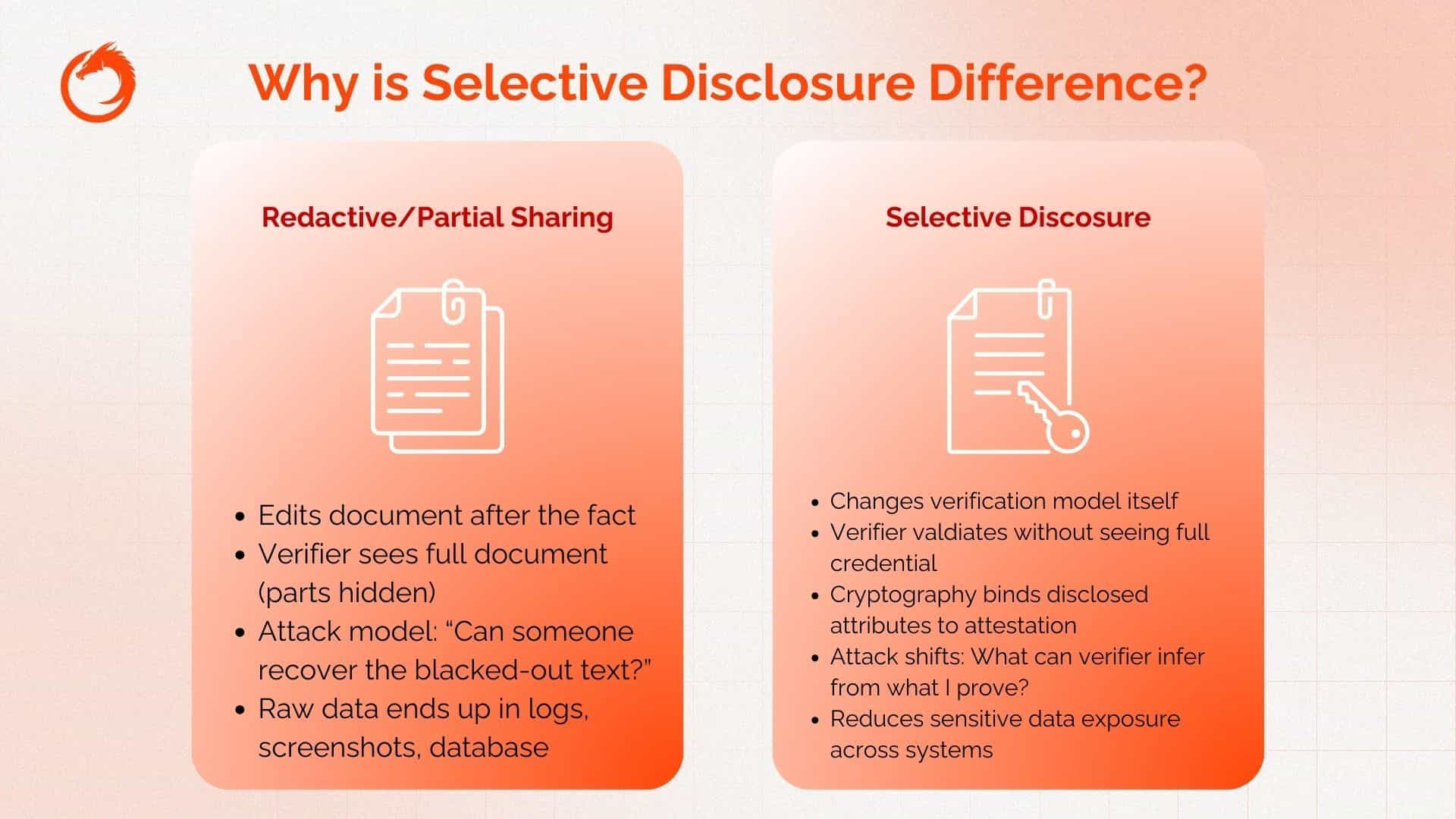
Why is selective disclosure different from “redaction” or “partial sharing”?
Redaction edits a document after the fact. Selective Disclosure changes the verification model itself. The verifier does not need the full credential to validate authenticity because the cryptography binds disclosed attributes to an issuer’s attestation.
That shifts the attacker model from “can someone recover the blacked-out text” to “what can the verifier learn or infer from what I chose to prove.” In practice, it reduces the number of places raw sensitive fields end up living: logs, screenshots, ticket threads, analytics payloads, and vendor databases.
What is the “minimum disclosure” principle in real verification workflows?
In production systems, the goal is not maximum privacy, it is minimum necessary disclosure while keeping verification reliable. The design question is always: what can the verifier accept as proof, and what must never leave the holder’s boundary?
- Prove “over 18” without date of birth.
- Prove residency without full address.
- Prove accreditation without revealing employer history.
- Prove uniqueness or membership without exposing identifier lists.
- Prove policy compliance without disclosing raw PII.
How does Selective Disclosure work with Verifiable Credentials in practice?
Most real deployments implement Selective Disclosure through Verifiable Credentials where an issuer signs claims, a holder presents only needed parts, and a verifier checks cryptographic validity. The core design work is defining trust boundaries, presentation formats, and anti-correlation safeguards.
What are the issuer holder verifier roles, and where do trust boundaries break?
The issuer attests, the holder controls disclosure, and the verifier validates. Sounds clean until you model incentives. Issuers want analytics and revocation control. Verifiers want deterministic risk reduction with minimal integration effort. Holders want privacy and low friction. Trust boundaries break where correlation becomes easy: issuer specific identifiers, stable presentation metadata, or verifiers demanding more fields “just in case.” Privacy Preserving Identity is not a slogan here. It means fewer shared identifiers, fewer linkable events, and fewer long lived artifacts that third parties can hoard.
A concrete case is the EU Digital Identity Wallet under the eIDAS 2.0 framework, where verifiable credentials and selective disclosure are used to let citizens prove only what is necessary.
- Users can disclose only the needed attributes (age, nationality, residency) without exposing the full personal profile.
- Age eligibility can be proven without sharing the full birthdate, which directly reduces unnecessary PII collection.
- Holder controlled disclosure minimizes shared identifiers and limits linkable events across verifiers, which makes correlation harder by design.
“When integrating selective disclosure with our digital wallet solution, we saw a marked reduction in unnecessary PII exposure. Verifiers only received what they absolutely needed, keeping our identity holders’ broader data off logs and analytic systems.”
This is why Credential Presentation is the real control plane. Issuance matters, but the privacy harm usually happens at presentation time, when a workflow turns a one time check into a reusable dossier.
What is a credential presentation, and what does verification actually check?
A credential presentation is the “proof package” the holder sends to a verifier, containing selectively revealed fields and the cryptographic material needed to validate authenticity. Verification is not only signature checking; it’s also validating constraints, freshness, and revocation status.
- Signature validity over disclosed attributes or derived proof.
- Schema integrity: claims map correctly to expected fields.
- Freshness and replay resistance (nonce, challenge, timestamp).
- Revocation status (if supported by the scheme).
- Optional policy checks (age threshold, jurisdiction, eligibility rules).
What cryptographic mechanisms enable Selective Disclosure, and what are the tradeoffs?
Selective Disclosure can be implemented using signature schemes (like attribute-disclosure signatures) or proof systems (like membership proofs and Zero-Knowledge Proofs (ZKPs)). The right mechanism depends on unlinkability needs, verifier cost, proof size, and how revocation or updates are handled.
How do BBS+ style signatures enable unlinkable attribute disclosure?
BBS+ style signatures exist because “sign a list of attributes” is easy, but “reveal only some attributes without letting verifiers correlate presentations” is hard. The scheme supports Attribute-Based Credentials where a holder can disclose a subset of claims while keeping the rest hidden, and can often do so in a way that reduces correlation between multiple presentations. That unlinkability matters in 2026 because the verifier set is not one party. It is many: exchanges, payment rails, apps, compliance vendors, and AI agents doing checks on your behalf.
The performance reality is not theoretical. If you ask a verifier to validate heavyweight proofs at 500 to 2,000 presentations per second, cost and latency will shape your architecture. Use BBS+ when unlinkability is worth that cost, and when wallet and library support is real, not aspirational.
How do Merkle proofs and membership proofs support selective disclosure patterns?
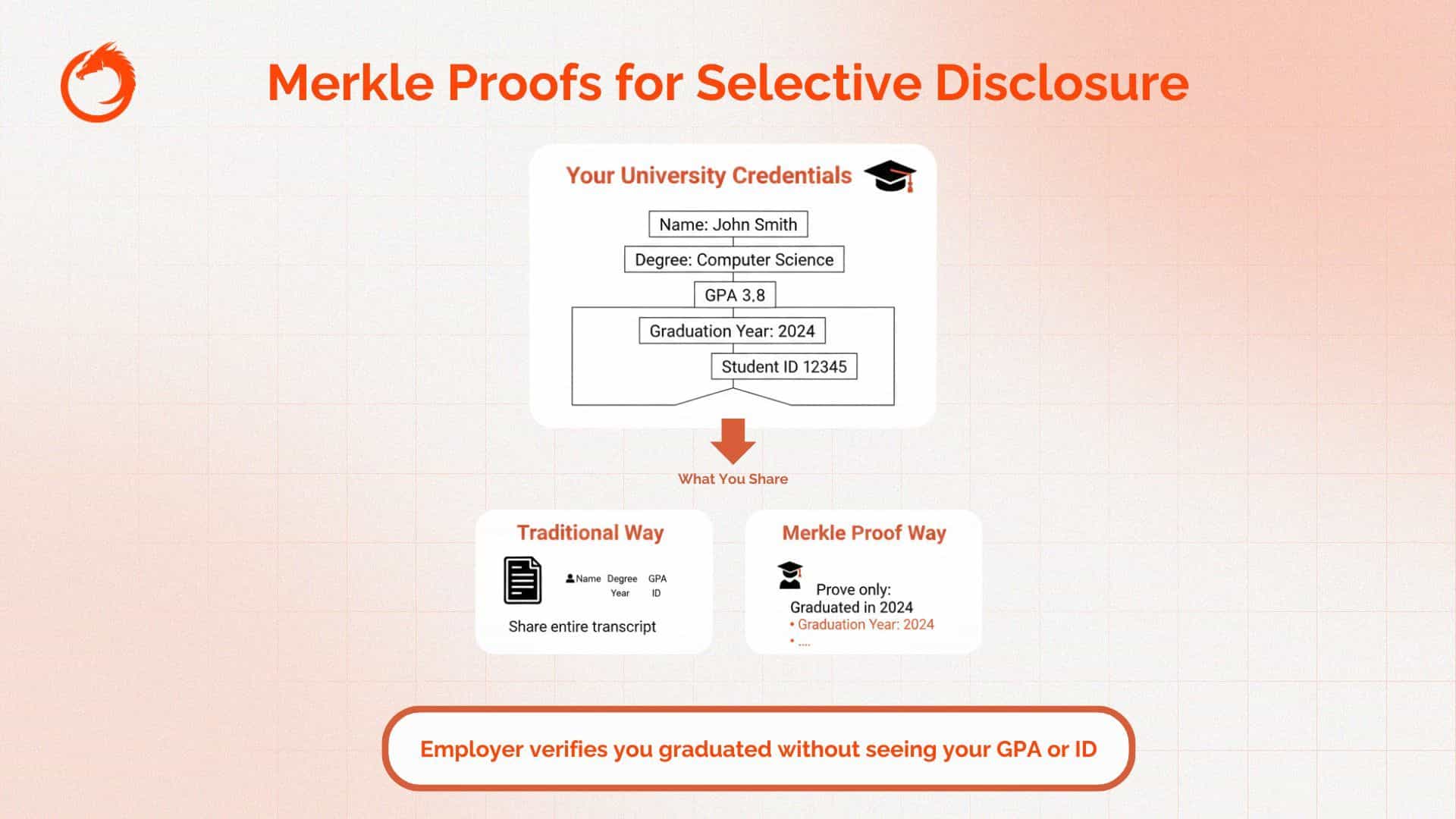
Merkle-based approaches take a different stance. Instead of proving “I have a signature over all these claims,” you prove “this claim is part of a committed set,” without revealing the entire set. That works well for allowlists, membership checks, and “is this credential in the set” patterns. It also gives you a clean audit story: commitments can be versioned, anchored, and referenced as a Provable Data Pipeline step.
The tradeoff is subtle leakage. Structure leaks. Update cadence leaks. If you rotate the tree weekly for revocation, that operational rhythm becomes metadata. Merkle proofs are great when your disclosure granularity maps to leaves cleanly and your revocation story fits the commitment model.
What are the practical tradeoffs: proof size, verifier cost, and revocation complexity?
No Selective Disclosure scheme is free. Teams typically underestimate correlation risk and overestimate how easy revocation is once proofs are in the wild. Treat these tradeoffs like protocol parameters, not product details.
- Proof size impacts mobile UX and latency.
- Verifier cost impacts scale and abuse resistance.
- Revocation introduces state: lists, accumulators, timestamps, or online checks.
- Linkability risk depends on presentation metadata, not just cryptography.
- Interop: ecosystem support can matter more than theoretical elegance.
Selective Disclosure vs Zero-Knowledge Proofs: what should you use, and when do you combine them?
Selective Disclosure is about revealing only the necessary claims, while Zero-Knowledge Proofs (ZKPs) are about proving a statement without revealing the underlying witness. In practice, you often combine them: Selective Disclosure for claim minimization, ZKPs for proving constraints about claims.
When should choose selective disclosure, ZK proofs, or both?
The choice is not ideological, it’s architectural. Decide based on what must be proven (facts vs constraints), what can be disclosed (attributes vs derived statements), and what the verifier can afford to compute.
- Use Selective Disclosure when the verifier can accept disclosed fields.
- Use Zero-Knowledge Proofs (ZKPs) when you must prove constraints (thresholds, ranges, policy logic) without revealing inputs.
- Combine them when you disclose some fields but prove others (for example, jurisdiction disclosed, income threshold proven).
- Prefer simpler schemes when correlation risk is low and verifier throughput is key.
- Prefer stronger privacy when the cost of inference is high (finance, identity, RWA, healthcare).
What correlation risks remain even when “only share just enough”?
Correlation sneaks in through the seams: timestamps, challenge reuse, device fingerprints, verifier identifiers, and even “helpful” debugging headers. Unlinkable cryptography can still become linkable at the system layer if you reuse a stable subject identifier or if your Disclosure Policy forces the same attribute bundle across verifiers. Mitigation is practical, not mystical: rotate identifiers, scope credentials per relying party, blind presentation where possible, and treat analytics as hostile until proven otherwise.
What are the highest-value use cases for Selective Disclosure in 2026?
In 2026, Selective Disclosure is most valuable where the verifier needs strong assurance but regulations and user expectations punish over-collection. The biggest wins show up in access control, compliance-heavy onboarding, and cross-domain identity checks where minimizing leaked attributes reduces both risk and friction.
Which workflows benefit most: age gating, KYC/AML, access control, and RWA compliance?
The best use cases are the ones where full disclosure is both unnecessary and expensive. Each workflow below has a clear verifier requirement and a clear privacy failure mode if implemented naively.
- Age verification without DOB.
- KYC and AML assertions without sharing full documents repeatedly.
- Credentialed access for apps, builders, and gated communities.
- RWA participant eligibility and jurisdiction checks with minimized PII.
- Partner-to-partner verification where sharing raw data creates vendor sprawl.
How do you implement Selective Disclosure end-to-end without breaking security?
A clean implementation starts with a threat model, then chooses a credential format and proof mechanism that matches the verifier’s needs and the holder’s constraints. The practical goal is a repeatable pipeline: issuance, storage, presentation, verification, revocation, and audit evidence.
What is the minimal architecture should ship first?
Start with the smallest architecture that still prevents replay and reduces correlation risk. Add advanced privacy only after the baseline verification loop is stable and measurable.
- Define claims schema plus Disclosure Policy per verifier.
- Issuance service with signing and key management.
- Holder wallet or storage boundary (device or secure enclave).
- Verifier endpoint with challenge-response.
- Logging strategy that avoids sensitive attribute leakage.
A concrete throughput target helps keep teams honest. For consumer flows, design for 50 to 200 verifications per second per verifier cluster during peak. For exchange or payment rails, plan for 500+ verifications per second with caching and rate limits, or you will learn about denial-of-wallet the hard way. These are illustrative numbers, but the pressure is real.
How do you design disclosure policies and consent flows that are actually enforceable?
Write policy as code. “Who can ask for what, and why” should be explicit, versioned, and testable. Avoid consent theater where the UI implies privacy but the system stores full attributes anyway. Record the disclosure event without storing raw sensitive values. Track policy versions, key rotations, issuer revocation events, and verifier allowlists as first-class configuration. If your Regulatory Compliance posture depends on tribal knowledge in someone’s head, you will fail under stress.
What are the testing and monitoring checks that catch privacy regressions early?
Most privacy failures are regressions introduced by analytics, logging, or partner integrations. Treat privacy checks like protocol invariants and test them continuously.
- Replay tests (challenge reuse, nonce handling).
- Correlation tests across repeated presentations.
- Log scanning for attribute leakage.
- Revocation correctness and latency checks.
- Verifier performance baselines (throughput and cost).
What will change for Selective Disclosure in 2026 as AI Agents and compliance become “evidence-first”?
In 2026, Selective Disclosure will collide with AI agents that request data autonomously and regulators that demand auditable proof trails. Systems that can generate disclosure receipts and verifiable evidence of policy compliance will outperform systems that rely on trust and screenshots.
What is one 2026 insight that improves “information gain” beyond the references?
Here’s the missing piece: disclosure receipts. Treat each disclosure like a signed, minimal audit artifact that states what was disclosed, under which Disclosure Policy, to which verifier, and under what challenge, without storing raw PII. That receipt becomes Audit-Grade Evidence you can replay in an audit, a dispute, or a partner review.
AI agents make this urgent. Agents will request credentials, assemble presentations, and route them across vendors. Once an agent touches data, you need enforcement and proof, not assumptions. Expect a shift toward proof-carrying access: access tokens bound to proofs, expiring quickly, replay-resistant, and verifiable across domains. That is Cross-Chain Verification in spirit even when it never hits a public chain.
How can Orochi Network and zkDatabase make Selective Disclosure deployments audit-grade and scalable?
Selective Disclosure solves “share just enough,” but production systems still need Data Integrity, verifiable logs, and reproducible evidence for audits and cross-system disputes. Orochi Network and zkDatabase can anchor selective disclosure flows in Verifiable Data Infrastructure so can prove what happened without exposing what should stay private.
How does zkDatabase support evidence-first selective disclosure beyond the credential layer?
zkDatabase elevates selective disclosure from simply revealing “just enough” identity attributes into a verifiable evidence infrastructure by embedding cryptographic proofs directly into the data layer. Instead of only proving that a credential is valid, zkDatabase generates auditable, tamper-evident logs and integrity proofs for every data event , such as issuance, query execution, and disclosure decisions, without ever revealing the raw sensitive values themselves.
This means regulators, auditors, and partner systems can independently verify what was disclosed, when, and under which policy constraints, while the underlying data remains private, meeting both compliance and privacy mandates.
By treating selective disclosure events as provable data state transitions under zero-knowledge guarantees, zkDatabase turns selective disclosure from a cryptographic in identity protocols into a scalable, audit-grade evidence trail that supports automated compliance and reduces trust assumptions throughout complex verification workflows
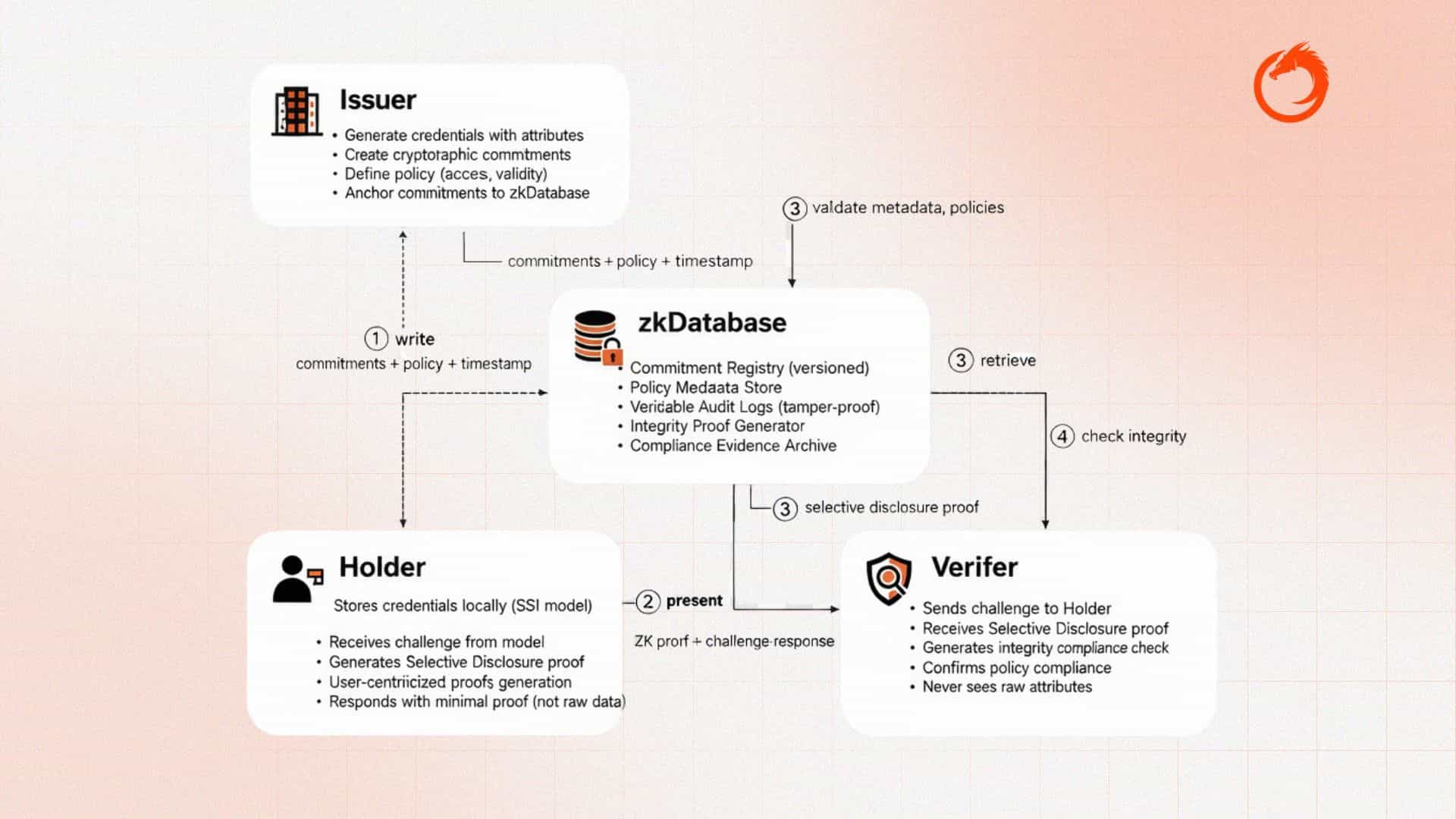
What does a reference architecture look like: credentials + zkDatabase + verifier workflows?
A workable architecture keeps raw attributes out of routine systems while preserving verifiability at every step. The goal is to make audits deterministic: the same inputs and policies yield the same verifiable outcomes.
- Issuer writes commitments and policy metadata into zkDatabase.
- Holder presents Selective Disclosure proof to verifier with challenge-response.
- Verifier checks proof and optionally validates integrity commitments.
- zkDatabase maintains verifiable logs for compliance evidence.
Conclusion
Selective Disclosure is not a niche identity trick. It is the pattern that makes privacy and verification compatible when AI agents scale requests and compliance teams demand evidence, not promises. Pair it with Verifiable Credentials for attestations, use Zero-Knowledge Proofs (ZKPs) for constraint proofs, and treat correlation, revocation, and logging as the real attack surface.
The future-facing move is simple: build for evidence-first compliance. Disclosure receipts, policy-as-code, and provable event trails will become normal expectations, not premium features. If you want Selective Disclosure that holds up under audits and partner scrutiny, anchor it in Verifiable Data Infrastructure with zkDatabase so your Data Integrity story is cryptographic, not rhetorical.
FAQs
Question 1: What is Selective Disclosure and why does it matter in 2026?
Selective Disclosure is a cryptographic method that lets you prove a specific attribute (like age eligibility or residency) without revealing your full identity record. It matters in 2026 because AI agents and cross-chain apps multiply the number of verifiers touching user data, so minimizing what gets shared is the fastest way to reduce PII exposure, breach impact, and compliance overhead.
Question 2: Selective Disclosure vs Zero Knowledge Proofs (ZKPs): what is the difference?
Selective Disclosure and Zero Knowledge Proofs (ZKPs) are often mixed up, but they answer two different questions: “What do you reveal?” versus “What can you prove without revealing?”
- Selective Disclosure: Reveals only the minimum required attributes from a credential (for example, prove age eligibility without exposing full birthdate).
- Zero Knowledge Proofs (ZKPs): Proves a statement about data without revealing the data itself (for example, prove you meet a threshold without sharing the underlying values).
Question 3: How do you prevent correlation and unnecessary PII exposure when deploying Selective Disclosure?
To prevent correlation, treat privacy as a full stack property, not just cryptography. Use holder controlled credential presentation, avoid stable identifiers and reusable metadata, enforce strict disclosure policies per verifier, and keep raw PII out of logs and analytics. For evidence first compliance, zkDatabase can anchor disclosure events and policy versions as audit grade evidence with data integrity, without warehousing raw PII across your systems.
Related toData Privacy