Real - World Assets
RWA Tokenization Audit: Chaining Proofs Across the Asset Lifecycle
July 28, 2026
14 mins read
An RWA tokenization audit usually checks four lifecycle transitions in isolation. zkDatabase generates a proof at each one, then chains them into a single continuous audit trail.


RWA Tokenization Audit: Chaining Proofs Across the Asset Lifecycle
Most verification work on tokenized assets happens at the boundaries: issuance, valuation, collateral, transfer. Each boundary is checked on its own schedule. The harder engineering problem is connecting those checks into one record that holds end to end.
TL;DR: An RWA tokenization audit requires proving four lifecycle transitions: issuance, NAV/valuation updates, collateral revaluation, and ownership/eligibility transfer. zkDatabase generates a Zero-Knowledge Proof at each transition over committed inputs, then Merkle-links those proofs into one continuous, time-stamped audit trail. This replaces point-in-time attestation with a verifiable state history a smart contract can check.
For a platform financing tokenized real-world assets, each lifecycle state can be checked in isolation, but the audit fails the moment those checks do not connect. An RWA tokenization audit stands or falls on that connection: unless issuance, valuation, collateral, and transfer link into one continuous history, verification resets to "trust the operator" between checkpoints. This piece walks a platform engineering team through where zkDatabase inserts a proof at each of the four lifecycle transitions, what each proof does and does not establish, and how the four proofs chain into a single audit trail.
Key Takeaways:
- An RWA tokenization audit has to cover four lifecycle transitions (issuance, NAV/valuation, collateral revaluation, and ownership/eligibility transfer), not a single snapshot.
- zkDatabase generates a Groth16 Zero-Knowledge Proof at each transition over committed inputs, which a supported smart contract can verify independently.
- These proofs prove computation correctness over committed inputs, not source-data accuracy, custody, or legal title, which remain the issuer's responsibility.
- The differentiator is chaining: the four per-transition proofs Merkle-link into one continuous, time-stamped state history instead of four disconnected attestations.
- This strengthens the evidence layer for MiCA- and GENIUS-style reporting, but legal compliance still requires issuer controls, auditor review, and jurisdiction-specific assessment.
Why Does an RWA Tokenization Audit Have to Cover the Whole Lifecycle?
An RWA tokenization audit fails when it verifies states in isolation, because a tokenized asset's risk lives in the gaps between checkpoints, not at the checkpoints themselves. A token can be correctly issued, correctly valued at noon, and still trade against a stale valuation by midnight or transfer to an ineligible holder the next day.
The off-chain record of a tokenized asset changes constantly: issuance terms are set, NAV updates land, collateral gets revalued, ownership moves. For an asset tokenization platform, each of those is a state transition with its own source data and its own failure mode. Traditional verification treats them as separate reporting events: a NAV report here, an audit cycle there, a KYC check at onboarding. Between those events, the on-chain token carries no independent evidence that its current state is correct; it carries the operator's word.
This is the cadence mismatch that has already produced documented losses. In the USDR/Tangible collapse, where the token fell from $1.00 to $0.51, proof-of-reserves reports showed the token as backed days before the depeg, while reserve composition had already shifted to 79% illiquid tokenized real estate that could not be redeemed at par. The point-in-time report was accurate when issued and useless by the time it mattered. A lifecycle audit closes that window by attaching evidence to every transition, not to a reporting calendar.
The four transitions below are the spine. zkDatabase inserts a proof at each, and the proof at each step proves the same narrow, honest thing: that an approved computation was executed correctly over committed inputs. It does not vouch for whether those inputs reflect reality. Source-data accuracy, custody, and legal title stay with the issuer. That boundary is what makes the rest of the claim credible.
How Does zkDatabase Prove the Issuance Transition?
The issuance transition is where a tokenization audit either starts from verifiable ground or starts from an assumption. At issuance, the platform commits the asset's defining record (identifier, terms, initial valuation basis, eligibility rules), and zkDatabase generates a Groth16 Zero-Knowledge Proof that this committed record was written under the approved computation. A supported smart contract verifies that proof, so the token's genesis state is anchored to a cryptographic commitment rather than to a database row the operator can later edit silently.
This is the one transition in the lifecycle without a dedicated deep-dive elsewhere, so it is worth being concrete about what the proof binds. The proof commits the inputs that define the asset at birth: which asset, on what terms, under which eligibility and valuation policy. Every later transition (every NAV update, every collateral revaluation, every transfer check) is evaluated relative to this committed origin. If issuance is unproven, nothing downstream has a fixed reference point; each later proof would only show that some computation ran, not that it ran against the asset as originally defined.
Selective disclosure matters here from the start. The platform can prove that an issuance satisfies its policy, with eligibility constraints met and valuation basis within the approved method, without publishing the underlying terms, pricing logic, or counterparty details on-chain. The outcome is disclosed; the proprietary inputs are not.
The boundary still holds at issuance. The proof establishes that the committed record was processed correctly under the rules. It does not establish that the off-chain asset is real, that custody is sound, or that legal title is clean. Those are diligence and custody questions the issuer owns. zkDatabase makes the record tamper-evident and verifiable from genesis forward; it does not underwrite the asset.
How Does zkDatabase Prove the NAV and Valuation Transition?
The NAV transition is where most tokenized funds lose continuity, because valuation updates on a daily cycle while the token trades continuously. zkDatabase generates a proof for each NAV/valuation state transition over committed inputs, so a supported smart contract can verify that the new valuation was computed under the approved method. Selective disclosure lets the platform prove a threshold (for example, NAV within an approved band) without exposing positions or pricing strategy.
The structural cause of the gap (daily NAV cadence against 24/7 trading, and the stale-valuation windows it opens) is covered in depth in NAV lag in tokenized funds. What the proof-chaining view adds is continuity: the NAV proof does not stand alone, it references the committed state from issuance and feeds the next link in the chain, so a verifier can trace the valuation history rather than trust a single latest number.
As at every step, the proof attests to computation correctness over committed inputs. Whether the price feed or position data going in is itself accurate remains a source-data question the issuer controls.
How Does zkDatabase Prove the Collateral Revaluation Transition?
The collateral revaluation transition determines whether a tokenized position is still adequately backed, and it is the transition where stale or operator-controlled data causes the most direct financial damage. zkDatabase generates a proof at each collateral state change, and selective disclosure can prove a coverage threshold (for example, collateral coverage ≥ 110%: TRUE) to counterparties and lending protocols without revealing the underlying portfolio.
The full problem statement, covering why RWA used as DeFi collateral breaks when revaluation lags the market and the contagion risk that creates, appears in the RWA DeFi collateral data integrity problem. In the lifecycle chain, the collateral proof links to the valuation it depends on, so a verifier can confirm not just the current coverage outcome but that it was derived from a proven valuation state, not an unverified side input.
The boundary remains explicit: the proof shows the coverage computation was correct over committed inputs. It does not certify that the collateral exists, is unencumbered, or holds clean legal title; those stay with the issuer and its custodians.
How Does zkDatabase Prove the Ownership and Eligibility Transfer Transition?
The ownership and eligibility transition is where compliance evidence most often breaks, because eligibility is checked at onboarding but rarely re-verified when a token moves. zkDatabase can carry KYC/KYB eligibility proofs that are selectively disclosed and periodically refreshed, allowing a supported smart contract to verify current investor eligibility without exposing raw identity data, subject to issuer policy and integration design.
The mechanics of verifiable, privacy-preserving compliance for transfers are covered in the verifiable compliance framework for RWA. For the chaining view, the relevant point is that an eligibility proof at transfer can reference the eligibility policy committed at issuance, so the question "is this holder allowed to receive this asset under the rules it was issued with" stays answerable as the asset moves, rather than resetting to an onboarding record nobody re-checks.
Two hedges are load-bearing here. First, eligibility proofs reduce the compliance gap when assets move beyond issuance only to the extent the issuer's policy and integration design support it; they do not auto-travel by default. Second, these proofs are verifiable on EVM-compatible chains through native bn254 pairing precompiles (EIP-197); coverage across non-EVM networks depends on integration design and chain support. "Cross-chain" here means EVM-compatible chains, not a guarantee of universal multi-chain portability.
How Do the Four Proofs Chain Into One Audit Trail?
The four per-transition proofs become an RWA tokenization audit trail when zkDatabase Merkle-links them into a single, time-stamped, cryptographically connected state history. Each transition's proof is not a loose attestation; it is a node in a chain that references the committed state before it, so the issuance commitment, the valuation history, the collateral coverage record, and the eligibility checks resolve into one continuous record an auditor or smart contract can traverse on demand.
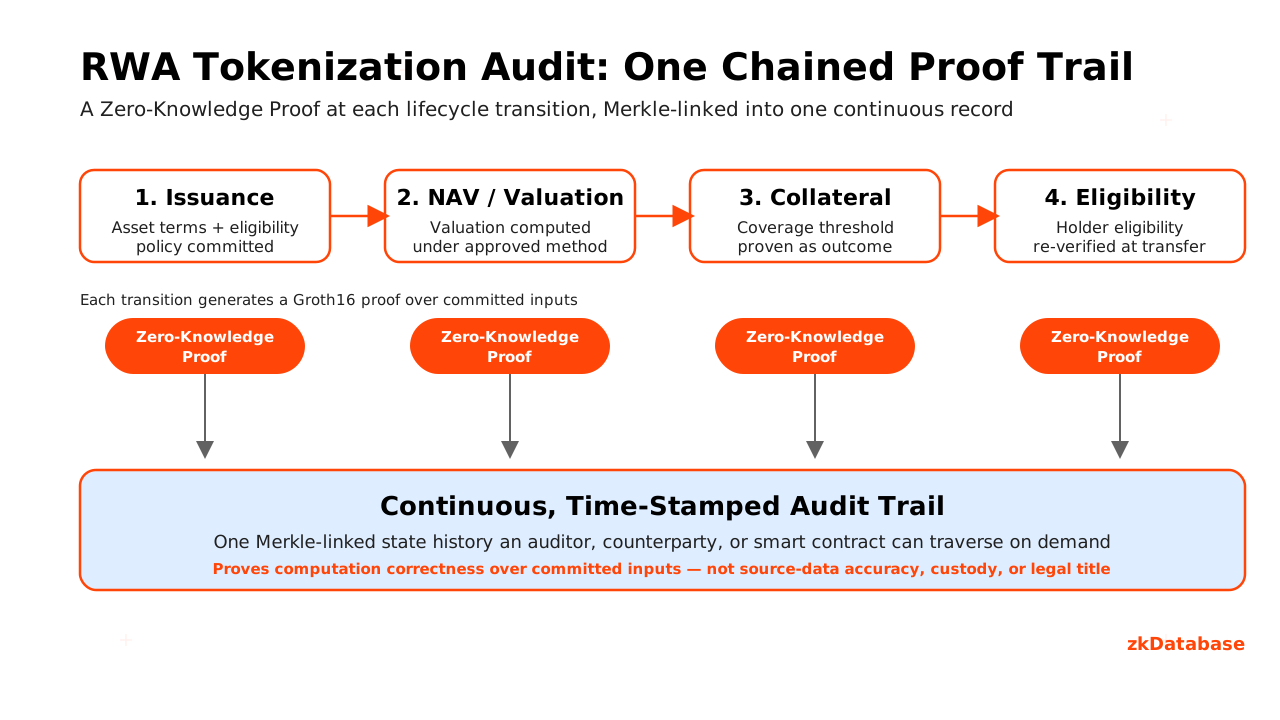 Each lifecycle transition generates a Zero-Knowledge Proof over committed inputs; zkDatabase Merkle-links them into one continuous, time-stamped audit trail.
This is the part no single-transition view delivers, and it is the reason the lifecycle has to be treated as one structure. A NAV proof on its own tells you a valuation was computed correctly. The same proof inside the chain tells you it was computed correctly against the asset as issued, and that the collateral coverage which followed was derived from it, and that the holder it transferred to was eligible under the original policy. The evidence value compounds because the links carry context forward. Remove the chaining and you are back to four disconnected reports with gaps between them, which is exactly the structure that let a point-in-time attestation read "backed" while the underlying state had already failed.
For a compliance or capital-markets reader, this is where the audit story becomes concrete. MiCA Article 36.9 requires asset-referenced token issuers to commission independent reserve audits every six months; the GENIUS Act requires monthly attestations for payment stablecoins and uses the word "attestation" without fixing a methodology. A continuous, on-demand evidence chain does not satisfy those obligations by itself, and it should not be sold as if it does. What it does is strengthen the evidence layer underneath them: instead of reconstructing state history manually at each reporting cycle, the platform can produce a cryptographically linked record of every transition between cycles. Legal compliance still requires issuer controls, auditor review, and jurisdiction-specific regulatory assessment. The chain makes the evidence better; it does not replace the audit or the auditor.
That distinction is the honest center of the whole design. The proofs reduce reliance on operator trust for computation correctness over committed inputs. They do not establish that the source data was accurate, that the assets exist and are unencumbered, or that legal title is clean. Those remain issuer and custodian responsibilities at every link in the chain. What changes is that the parts a platform can prove cryptographically now hold together as one record instead of resetting to trust between every checkpoint.
What Does an RWA Tokenization Audit Look Like Transition by Transition?
The table below maps each lifecycle transition to the proof zkDatabase generates and the boundary that proof does not cross. Read top to bottom and the proofs chain; read left to right and each row states what is proven and what still depends on the issuer.
| Lifecycle transition | State being committed | Proof generated | What the proof does not establish |
|---|---|---|---|
| 1. Issuance | Asset identifier, terms, valuation basis, eligibility policy | Zero-Knowledge Proof that the genesis record was committed under approved computation | That the off-chain asset exists, custody is sound, or legal title is clean |
| 2. NAV / valuation | Updated valuation under the approved method | Proof of correct valuation computation over committed inputs; threshold disclosed selectively | That the input price/position data is itself accurate |
| 3. Collateral revaluation | Updated collateral coverage state | Proof of correct coverage computation; coverage ≥ threshold disclosed as outcome only | That the collateral exists, is unencumbered, or has clean title |
| 4. Ownership / eligibility transfer | Current investor eligibility at transfer | Refreshable KYC/KYB eligibility proof, verified on EVM-compatible chains | Eligibility portability beyond issuer policy and integration; non-EVM coverage |
| Chaining (outcome) | Merkle-linked history of all four | One continuous, time-stamped, verifiable audit trail | A substitute for independent audit, auditor review, or regulatory sign-off |
Conclusion
An RWA tokenization audit is only as strong as the continuity between its checkpoints, and continuity is the part traditional attestation cannot provide. By generating a Zero-Knowledge Proof at issuance, at each NAV update, at every collateral revaluation, and at each eligibility transfer, then Merkle-linking those proofs into one time-stamped state history, zkDatabase turns four isolated checks into a single verifiable record an asset tokenization platform can hand to an auditor, a counterparty, or a smart contract on demand. The proofs are deliberately narrow: they establish computation correctness over committed inputs, not the accuracy of source data, custody, or legal title. Within that boundary, the chaining is what closes the gaps where stale, point-in-time reporting has historically failed, and it is the part no single-transition tool delivers.
Book a PoC → https://zkdatabase.org
See how zkDatabase generates per-state-transition proofs for your tokenization pipeline and chains them into one audit trail.
Talk to our team → https://orochi.network/partnership
Walk through where each lifecycle proof fits your existing data and custody stack.
FAQs
Q1: What does an RWA tokenization audit need to cover across the asset lifecycle?
An RWA tokenization audit needs to verify four lifecycle transitions (issuance, NAV/valuation updates, collateral revaluation, and ownership/eligibility transfer) rather than a single point-in-time snapshot. Each transition has its own source data and failure mode, and the risk in a tokenized asset usually lives in the gaps between checkpoints. zkDatabase generates a Zero-Knowledge Proof at each transition and chains them into one continuous record.
Q2: How does an asset tokenization platform prove data without exposing it?
An asset tokenization platform uses selective disclosure: zkDatabase proves a condition is true (reserves above a threshold, collateral coverage ≥ a required percentage, or an investor is eligible) without publishing the underlying positions, pricing logic, or identity data. The smart contract verifies the outcome of the proof, not the raw inputs. This lets a platform satisfy counterparties and regulators while keeping proprietary and sensitive data off-chain.
Q3: Does chaining proofs into an audit trail replace independent audits or guarantee compliance?
No. Chained Zero-Knowledge Proofs strengthen the evidence layer by producing a continuous, time-stamped state history, which can support MiCA- and GENIUS-style reporting workflows. They do not replace independent audits, auditor review, or regulatory sign-off, and they do not guarantee compliance. The proofs establish computation correctness over committed inputs; source-data accuracy, custody, and legal title remain the issuer's responsibility.
Q4: What does a per-transition proof actually establish, and what doesn't it?
A per-transition proof establishes that an approved computation was executed correctly over the inputs committed to zkDatabase at that state change. It does not establish that the off-chain asset exists, that custody is sound, or that legal title is clean; those stay with the issuer and its custodians. This boundary is deliberate: it keeps the cryptographic claim honest and is the reason the audit trail it builds is credible.
Related toReal - World Assets