Real - World Assets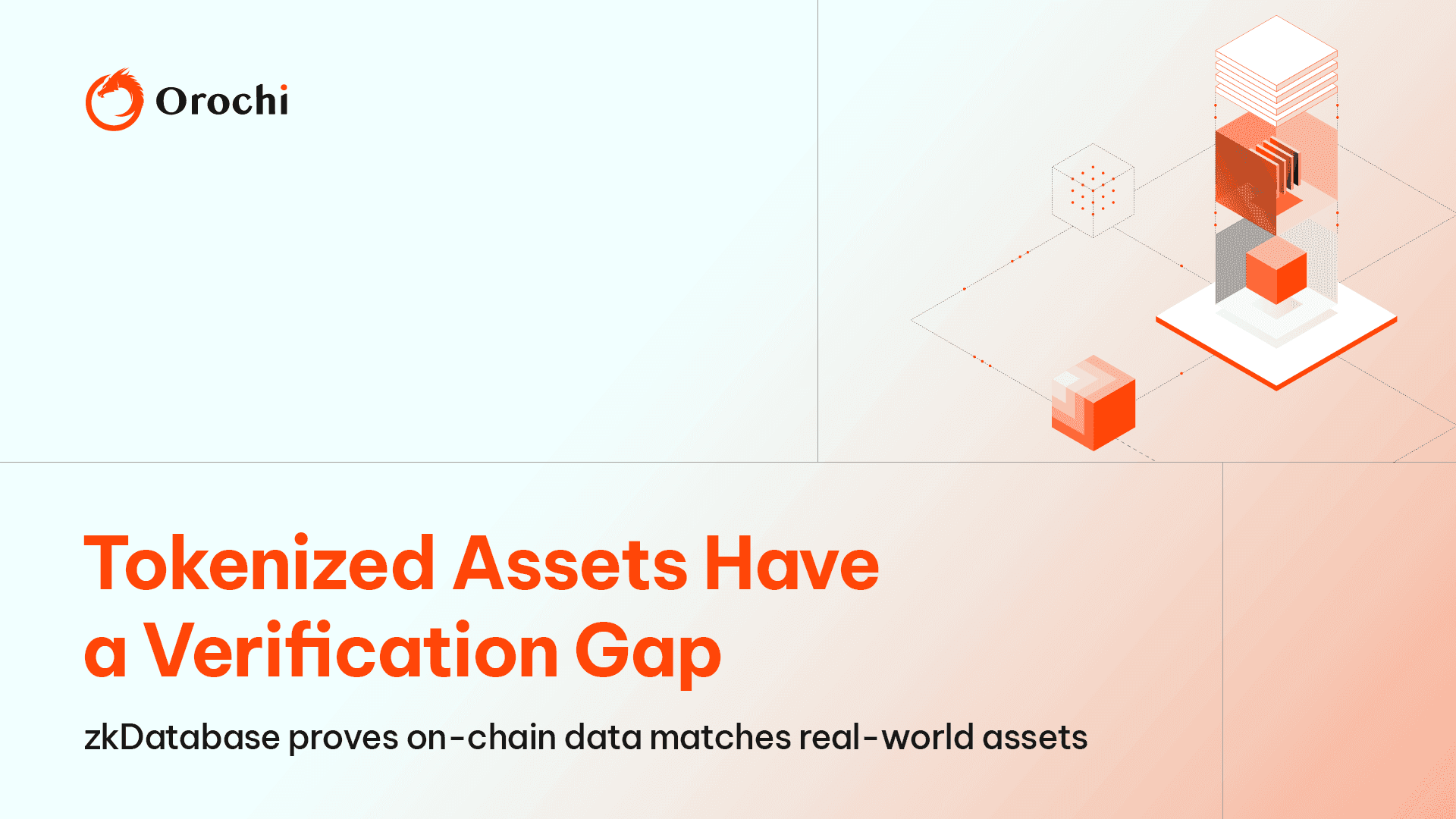
DTCC Tokenization: The Data Verification Gap Underneath
July 14, 2026
13 mins read
DTCC is moving tokenized securities onto blockchain rails. Settlement is solved; the data-verification layer between token and custody is not.


TL;DR DTCC's Tokenization Service brings tokenized securities from the world's largest securities depository onto blockchain rails. The settlement layer is advancing. The verification layer is not. For every tokenized security, on-chain smart contracts need cryptographic proof that token data matches underlying custodied assets, proof that current oracle infrastructure cannot provide.
DTCC processes custody and clearing for approximately $114 trillion in U.S. securities. Its DTC Tokenization Service validates the institutional RWA thesis more definitively than any startup pitch ever could. Backed by an SEC No-Action Letter and a 50-plus firm Industry Working Group that includes major banks, broker-dealers, and crypto-native platforms, DTCC is not running a thought experiment. It is moving tokenized securities into regulated market infrastructure.
The settlement layer is solved. The custody layer is solved. The problem the industry has not addressed, and that DTCC's announcement makes urgent, is the data verification layer. Every tokenized security creates a gap between what is recorded on-chain and what DTCC actually holds in custody, and on-chain smart contracts have no cryptographic way to confirm those two states match.
Key Takeaways
- DTCC's Tokenization Service moves tokenized securities into regulated market infrastructure, with production timing subject to DTCC's official rollout
- The service covers Russell 1000 equities, U.S. Treasuries, and major ETFs, securities already in DTC custody, representing tens of trillions in value
- Tokenized securities data verification requires cryptographic proof that on-chain token state matches off-chain custodied asset state in real time
- Current oracle infrastructure validates data plausibility through range-checking. It does not cryptographically prove data provenance
- zkDatabase provides the missing verification layer: end-to-end cryptographic proof from DTC custodied data to on-chain smart contract consumption
What is the DTCC's Tokenization Service and why does it matter?
DTCC's Tokenization Service is a regulated on-chain solution enabling tokenized representations of securities already held in DTC custody, including Russell 1000 equities, U.S. Treasuries, and major ETFs, with rollout timing subject to DTCC's official production schedule.
The service works within DTCC's existing custody structure. Tokens serve as alternative instructions for recording security entitlements on blockchain. They do not replace DTC's clearing and settlement functions, and they preserve all traditional investor rights and legal ownership. The December 2025 SEC No-Action Letter explicitly confirmed that tokens issued under the service are not themselves securities; they are a new form of record-keeping instruction layered on top of existing DTC custody.
What the service actually enables, and what it leaves open
The 50-plus firm Industry Working Group shaped the technical standards and interoperability requirements. Participants include Backpack, Ripple Prime, and Ondo Finance alongside major banks and broker-dealers, a combination of traditional market infrastructure and crypto-native platforms that reflects the cross-sector audience DTCC is building for. The service enables 24/7 trading and settlement, atomic transaction finality, and multi-chain access to securities that previously only moved during business hours through legacy settlement rails.
DTCC President and CEO Frank La Salla described it as "our vision coming to fruition: launching our tokenization service and successfully bridging TradFi and DeFi." That bridge between $114 trillion in custodied securities and the on-chain protocols that want to use them as collateral, settlement instruments, and liquidity assets is the infrastructure story of 2026.
What the service does not provide is a cryptographic proof layer. The token tells a smart contract that a specific security exists in DTC custody. It does not prove, mathematically, that the data the smart contract consumes (price, NAV, ownership status, collateral eligibility) accurately reflects the current state of the underlying asset.
DTCC's entry into tokenization validates the market and accelerates timelines for every participant in its working group. It also makes the data verification problem urgent rather than theoretical.
What is the data verification gap in tokenized securities?
Every tokenized security creates a verification gap: the on-chain token represents rights to an off-chain custodied asset, but on-chain smart contracts have no cryptographic way to confirm that the token's data, price, NAV, ownership status, collateral eligibility, accurately reflects the underlying asset's real-world state at any given moment.
This is not an edge case. It is the structural condition of every tokenized securities architecture in production today.
The diagram below shows where the verification gap appears: between the tokenized asset recorded on-chain and the smart contract that needs proof the data still matches the underlying custodied asset records.
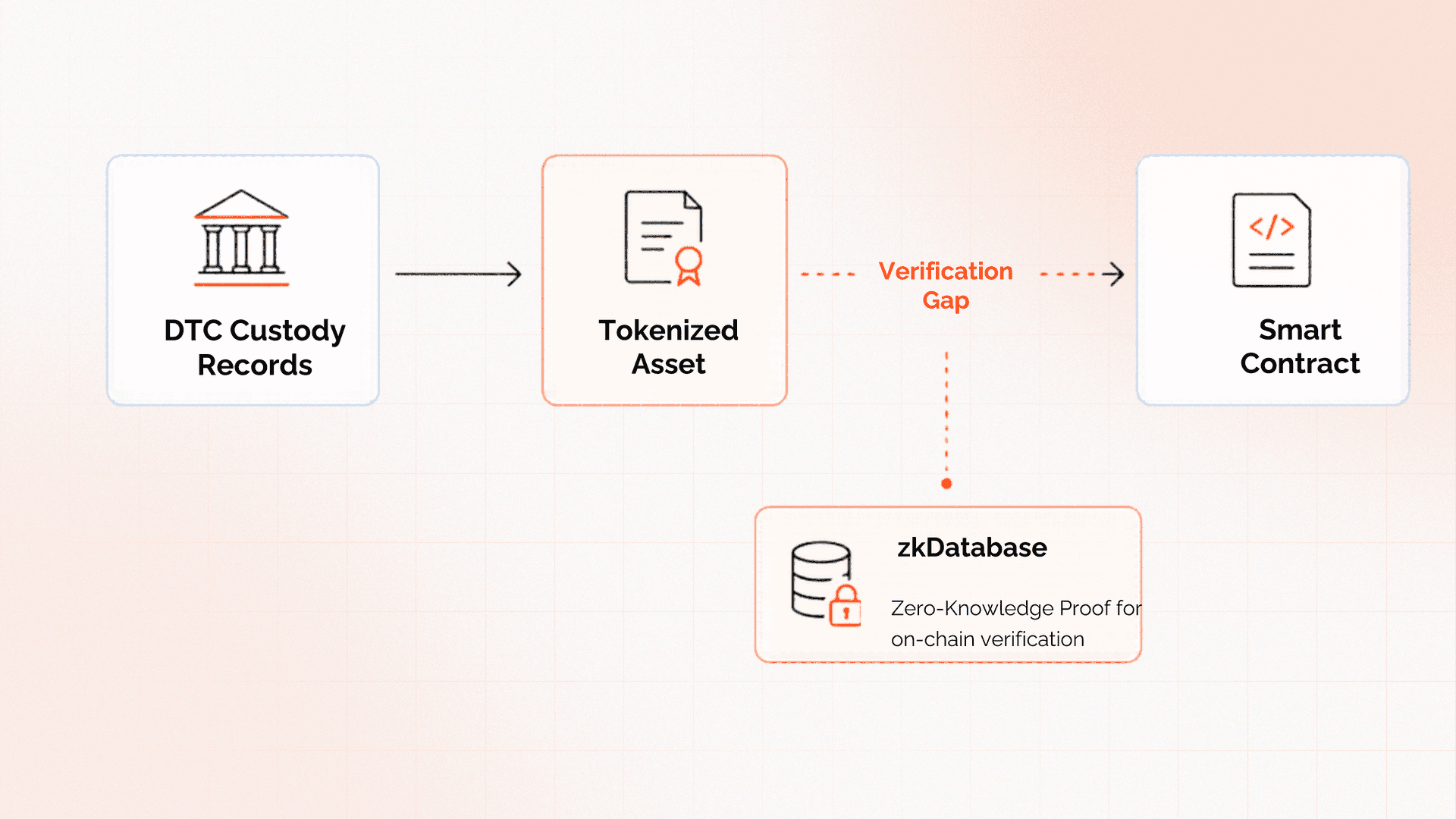
Figure: The verification gap sits between tokenized asset records and the smart contracts that rely on them. zkDatabase adds a cryptographic proof layer without exposing the underlying custodied data.
Why the token-custody gap is a design problem, not an implementation gap
Tokenized securities exist simultaneously in two states: on-chain token state, which the blockchain records, and off-chain custodial state, which DTC actually holds. Any discrepancy between these states (whether caused by data transmission delays, feed errors, or deliberate manipulation) becomes a counterparty risk that smart contracts cannot detect on their own.
The evidence that this risk materializes is not theoretical. Research across 50-plus incidents from January 2025 through April 2026 documents $2.5 billion-plus in losses attributable to oracle failures and data integrity failures in on-chain financial protocols. In one documented case, a circuit breaker froze an asset's price feed at a stale value while the market moved sharply in the opposite direction. The protocol's smart contracts consumed the frozen price as valid data and processed $11.2 million in incorrect liquidations before the discrepancy was caught. That incident involved a DeFi-native token with thin liquidity. Replicate the same architecture with Russell 1000 equities at institutional scale and the consequences are orders of magnitude larger.
The BIS made the point plainly in Bulletin No. 76: "risks associated with the oracle problem in DeFi may be worse than data reporting risks in traditional finance." That assessment predates DTCC's tokenization timeline. It applies directly to what DTCC is now building.
How current oracle infrastructure addresses this, and where it falls short
The dominant oracle model for institutional tokenized assets works by checking whether issuer-reported data falls within pre-defined upper and lower bounds. If the reported NAV is within range, the oracle publishes it. If it falls outside range, the oracle rejects the update. This model catches gross errors and manipulation attempts that move prices dramatically outside expected bands.
It does not cryptographically prove that the data is correct. It validates plausibility, not provenance. A value that has been systematically reported slightly wrong, close enough to pass the range check, but diverging meaningfully from the actual custodied asset state, passes every oracle validation step and propagates to smart contracts as verified data. The trust assumption sits with the data reporter, not with the math.
DTCC's own Industry Working Group includes players whose infrastructure sits in exactly this category. The verification model the working group has built toward is custody-layer trust plus plausibility-checking, not cryptographic proof. That gap is what DTCC's tokenization push leaves open.
The tokenized securities data verification gap is not a data availability problem. DTC holds comprehensive, authoritative records of every custodied security. The gap is a data provenance problem: on-chain contracts need cryptographic proof that what they consume matches what DTC holds.
What does a tokenized securities data verification stack need to look like?
A production-grade verification stack for tokenized securities must prove three things cryptographically: that the underlying security is custodied as claimed, that the on-chain token data matches current custodied asset state, and that the data was generated by an authorized, authenticated source.
| Proof Layer | What It Proves | Current Solution | Gap |
|---|---|---|---|
| Custody proof | Security is held at DTC as claimed | DTC clearing records | Not cryptographically accessible to smart contracts |
| Integrity proof | Token data matches custodied asset state in real time | Oracle data feeds (range-checked) | Plausibility validation, not cryptographic proof |
| Provenance proof | Data originated from authenticated DTC source | Periodic auditor attestation | Not continuous; not verifiable on-chain |
Each layer is necessary. None is sufficient alone. A custody proof that lacks integrity verification leaves smart contracts trusting that on-chain token data hasn't drifted from the underlying asset. An integrity proof that lacks provenance verification leaves smart contracts unable to confirm that the data pipeline from DTC was not compromised at some point in transit.
Where zkDatabase fits in the DTCC verification architecture
zkDatabase's Verifiable Data Pipeline sits between DTC custodied data and on-chain smart contract consumption. Data enters the pipeline from DTC feeds and custodian records. At every step (ingestion, storage, query, and proof generation), the pipeline can produce cryptographic proofs using the Groth16 proof system. Product benchmarks point to compact proofs and sub-0.5-second proving times for supported circuits, while on-chain verification cost depends on verifier design and deployment environment. Those specs make zkDatabase a candidate verification layer for high-frequency institutional data workflows, subject to integration validation.
Privacy-Preserving Proofs allow institutions to prove that NAV satisfies a threshold, that collateral eligibility criteria are met, or that ownership has not changed, without exposing the underlying position data. A custodian proves that a fund holds sufficient qualifying assets for a loan without revealing the full portfolio composition. A settlement counterparty proves delivery without revealing the counterparty's book.
zkDatabase is blockchain-agnostic, which matters for DTCC's multi-chain mandate. The working group members operate across different networks. The proof that a tokenized Treasury held in DTC custody matches its on-chain representation needs to verify on any compatible chain the working group supports, not only on Ethereum mainnet.
The Verifiable Data Pipeline does not replace DTCC's role or the existing settlement infrastructure. It adds the verification layer that current infrastructure assumes but does not provide: the cryptographic bridge between what DTC holds and what on-chain contracts can trust.
What does DTCC tokenization mean for institutional data verification timelines?
As DTCC's tokenization roadmap advances, institutional participants in its tokenization working group need to determine how they will handle data verification, a decision that can take 12 to 24 months to implement from scratch when built internally.
The working group's verification problem, by participant type
Ondo Finance's tokenized treasury products already exceed $1.8 billion in total value locked and rely on oracle infrastructure for NAV delivery. Adding DTCC-custodied securities to that architecture introduces new provenance requirements that the existing oracle model, which uses an SHV ETF price constraint as a plausibility check, was not designed to satisfy. The question Ondo and similar participants face is whether their existing oracle setup satisfies the verification standard DTCC's institutional counterparties will eventually require, or whether they are building a compliance gap into the foundation of a multi-billion-dollar product.
For banks and broker-dealers in the working group, the question is different. Their existing regulatory frameworks (Basel capital requirements, settlement finality standards, counterparty risk management) are built around the assumption that data is correct because a regulated custodian says it is. Cryptographic proof is not yet a regulatory requirement for tokenized securities in the U.S. But the GENIUS Act introduced PCAOB-examined disclosure for stablecoins, the CLARITY Act is advancing with progressively more specific data standards, and the BIS has explicitly called for data integrity infrastructure as an institutional adoption prerequisite. The direction of travel is toward proof, not away from it.
Build vs. buy for verification infrastructure
Building ZK verification from scratch requires $3 million to $7.5 million in year-one investment, 8 to 15 specialized engineers with ZK expertise, and 12 to 24 months to reach production, in a global talent pool of fewer than 1,000 engineers who can write production ZK circuits. Research across RWA and stablecoin protocols shows 80% outsource this layer entirely. The protocols that have built in-house, and succeeded, share three traits: extreme scale, unique technical requirements no vendor addresses, and a strategic intent to commercialize the infrastructure itself. None of those conditions describe the typical DTCC working group participant.
The alternative is integration with zkDatabase. A PoC can be scoped incrementally using a NoSQL SDK that maps onto existing developer workflows without requiring a ZK engineering team in-house. Production deployment still depends on data-source access, verifier deployment, audit requirements, and the institution's integration process, but it avoids starting the ZK verification layer from zero.
DTCC's tokenization roadmap is not only a future planning event. It is an infrastructure decision with real consequences for every working group participant who has not yet determined how they will close the data verification gap.
Conclusion
Tokenized securities data verification is the problem that DTCC's Tokenization Service makes unavoidable. The settlement layer is advancing. The custody layer is institutional. The verification gap, meaning cryptographic proof that what is recorded on-chain matches what DTC holds in custody, remains open. As DTCC moves tokenization deeper into regulated infrastructure, institutions building around that infrastructure need more than oracle data feeds. They need verifiable data. zkDatabase can provide end-to-end cryptographic proof across the full data pipeline, from DTC custodied asset to on-chain smart contract, subject to integration with authenticated DTC and custodian data sources.
The institutions that solve the verification layer first will set the standard for how tokenized securities infrastructure is built. See how zkDatabase closes the data integrity gap. Book a Demo
FAQ
What is tokenized securities data verification and why does it matter for DTCC's service?
Tokenized securities data verification is the process of cryptographically proving that on-chain token data (price, NAV, ownership status, collateral eligibility) accurately reflects the state of the underlying security held in custody at any given moment. For DTCC's Tokenization Service, this matters because on-chain smart contracts cannot inherently trust data from off-chain sources. They need cryptographic proof that what they consume is correct, current, and sourced from an authenticated DTC custodian record, not just a plausibility check that the value falls within expected bounds.
How does the DTCC's Tokenization Service differ from existing tokenized RWA infrastructure?
The DTCC's Tokenization Service is backed by the world's largest securities depository, one that holds legal custody of approximately $114 trillion in U.S. securities. Unlike tokenization platforms that must establish custody, compliance, and on-chain representation simultaneously, DTCC already holds the underlying assets under full regulatory oversight. Its tokenization service creates on-chain representations of already-custodied securities, dramatically reducing counterparty and custody risk. What it does not automatically solve is the data verification challenge: on-chain smart contracts still need cryptographic proof that token data matches custodied asset state in real time.
When will DTCC's tokenization service be fully operational?
DTCC's official production schedule should be checked against its latest public materials. The SEC No-Action Letter provides regulatory context for the service. The 50-plus firm Industry Working Group, which includes crypto-native and traditional finance participants, shaped the technical standards and interoperability requirements. Full production availability, supported assets, and compatible chains should be described using DTCC's current official rollout language.
Related toReal - World Assets