Institutional DeFi
Insituation DeFi in 2026: What Institutions Actually Deploy
May 5, 2026
17 mins read
Insituation DeFi in 2026: what institutions deploy, and how zkDatabase adds audit-grade proofs for custody, reserves, and compliance.


Insituation DeFi in 2026 is not about copying retail DeFi, it is about deploying permissioned market structures where compliance and control are measurable. Institutions run at off-chain performance, but they still must answer on-chain questions about data integrity, freshness, and audit trails.
Smart contracts settle deterministically, yet the inputs that matter most (KYC status, reserves, valuations, loan states) arrive from off-chain systems that are fast, messy, and rarely provable. This article maps what institutions actually deploy (permissioned pools, policy controls, custody, governance), then explains why data integrity becomes the bottleneck and why zkDatabase acts as the specialized verifiable infrastructure.
What does “Insituation DeFi in 2026” mean in production?
Insituation DeFi in 2026 describes institutional adoption of DeFi structures inside regulatory constraints, using permissioned participation, controlled visibility, and institution-grade operations. Pick a network model, participation controls, and token design that match compliance, risk, and settlement requirements, not maximal openness.
How does permissioned DeFi remove the anonymous counterparty problem?
Permissioned DeFi keeps the core DeFi mechanics but wraps them in a gated participation model, so compliance teams can tolerate interaction risk. Fireblocks explains this through the “whitelister” role that performs KYC checks before participants can enter a pool. (Fireblocks)
- Permissionless DeFi allows anyone to join, while permissioned pools rely on a whitelister that runs KYC to gate access.
- Regulated participants may not learn the counterparty’s identity, but they can know the counterparty was vetted for KYC and AML requirements.
- Aave Arc is a clean mental model: a separate, KYC’d liquidity pool where institutions participate under a whitelister and AML design constraints.
What design choices determine whether Institutional DeFi succeeds or fails?
Institutional DeFi succeeds when the design turns “trust” into enforceable controls. The practical frame is three axes: blockchain choice, participation controls, and token design. Each axis sets a different boundary for interoperability, privacy, and enforceable restrictions.
Visibility is not binary. Institutional deployments sit on a spectrum where some actors need transparency for operations, others need selective visibility for privacy, and auditors need replayable evidence for decision points. The Oliver Wyman Forum report explicitly frames transparency choices along a spectrum, from fully transparent transaction data to restricted access where participants see only their own transactions.
What components show up repeatedly in real institutional deployments?
This is the bill of materials. Keep it concrete.
- Custody and key security are foundational, plus procedures like approvals, limits, and segregation of duties.
- Permissioned access patterns show up everywhere: allowlists, role-based controls, and qualified participant gating.
- Transaction logging and audit tooling are first-class requirements, not add-ons, because every workflow becomes reviewable under institutional controls.
Where does data integrity break when Insituation DeFi touches off-chain systems?
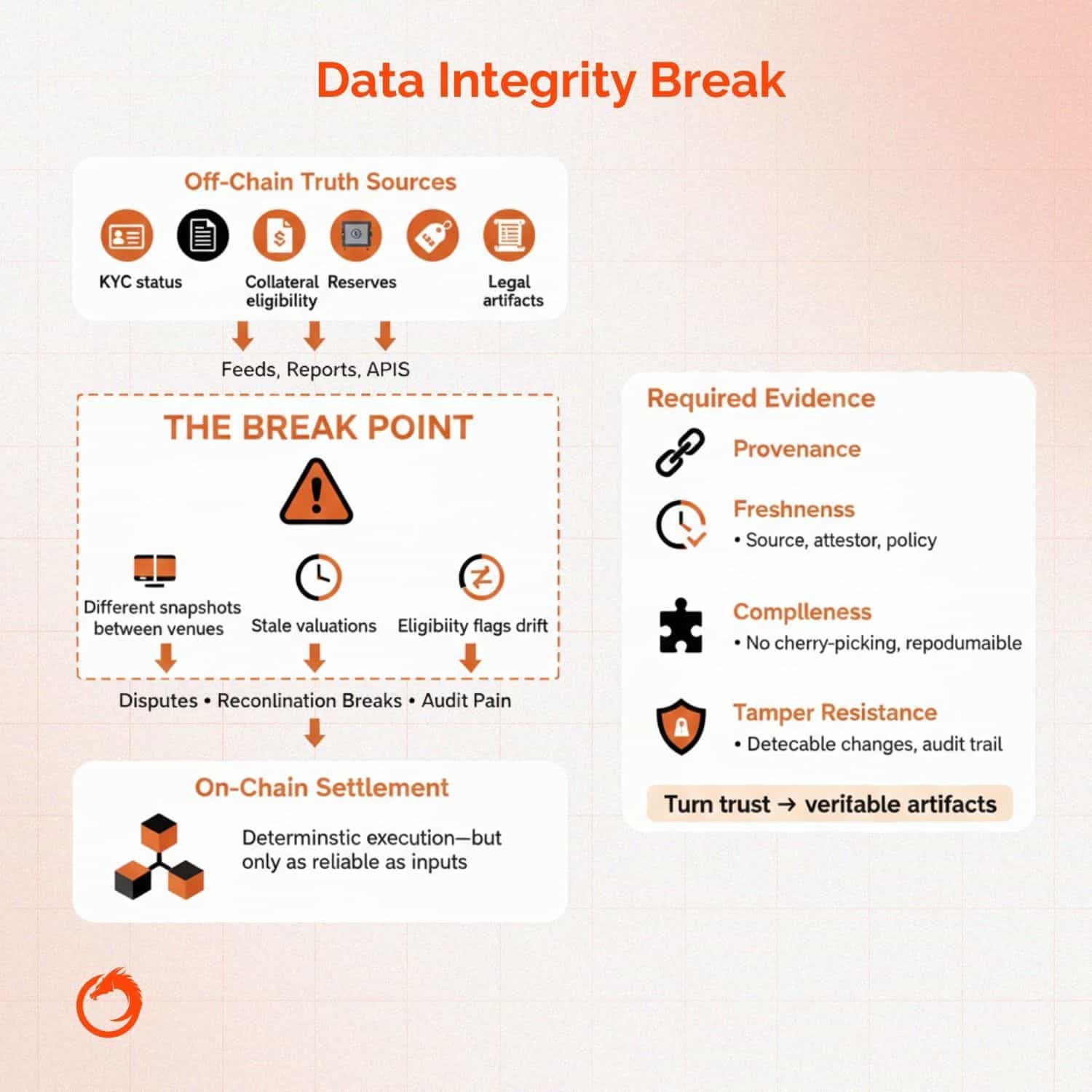
Institutional DeFi depends on off-chain truth: KYC status, collateral eligibility, reserves, valuations, and legal artifacts do not live natively on-chain. The integrity failure mode is simple: the chain can only be as reliable as its inputs, and institutions require evidence that inputs were correct, fresh, and policy-compliant.
Why does on-chain settlement still depend on off-chain data that is hard to prove?
The hardest truth about Insituation DeFi is that the “deterministic” part starts late. Custodians, administrators, banks, pricing agents, credit servicers, and compliance vendors generate the facts that contracts consume, and those facts typically arrive as feeds, reports, or APIs.
That last mile is where risk concentrates. If two venues read different snapshots, if a valuation is stale, or if eligibility flags drift between systems, you get disputes, reconciliation breaks, and audit pain. The DB and Northern Trust paper frames institutional DeFi as a regulatory balancing act where governance and trust demands reshape the “pure DeFi” model.
What evidence do compliance and audit teams require before they trust a DeFi workflow?
Turn “trust” into verifiable artifacts.
- Provenance: where the data came from, who attested it, and what policy governed it.
- Freshness: when it was observed, updated, and consumed by on-chain logic.
- Completeness: the dataset is not cherry-picked, and the query logic is reproducible.
- Tamper resistance: changes are detectable, and updates leave a durable trail.
How does zkDatabase act as a verifiable off-chain storage layer for Insituation DeFi?
zkDatabase is best framed as a specialized verifiable layer that keeps off-chain performance while producing cryptographic evidence about storage and query results. Instead of pushing raw institutional data on-chain, it makes integrity and auditability portable through proofs that counterparties, auditors, and smart contracts can verify.
How does verifiable off-chain storage scale without losing trust?
At a high level, zkDatabase anchors the database state to a state commitment, typically a Merkle tree or a cryptographic accumulator. Each write updates the commitment, and each read can return an authenticated proof tied to that commitment. That structure keeps throughput off-chain while shifting trust from operators to verification.
“Scale” here means continuous updates, large datasets, and many consumers. The trick is that consumers do not need the raw rows to trust a result, they need a proof that the result came from the committed state and that the state evolved through valid transitions. That aligns with the institutional need to balance transparency and confidentiality without giving up verifiability.
What does “audit-grade evidence” look like in day-to-day operations?
Use “what an auditor can replay” as the anchor.
- A proof-bound query result that an independent verifier can check against a known state commitment.
- A verifiable update trail describing who changed what, when, and under which policy boundary.
- A reproducible evidence packet for audits, incident response, and regulator questions.
How do CRUD proofs in zkDatabase work for Insert, Update, and Query operations?
CRUD proofs are the mechanical heart of zkDatabase: they let you prove that data was inserted correctly, updated according to rules, and queried without tampering. For institutions, this converts database operations into verifiable events that can be audited and consumed across systems.
How do Insert proofs guarantee correct state commits without generic ZK theory?
Insert proofs should be explained as a verifiable state transition, not as “ZK magic.” The claim is simple: a new record satisfies the schema and constraints, and the database updates the state commitment correctly. The verifier does not trust the database operator, it trusts the proof tied to public inputs like the previous and next commitment roots. This framing stays concrete and audit-friendly, which is exactly what institutional workflows need.
-
Define the exact claim: The inserted record matches the required schema, passes constraint checks, and is included in the new committed state.
-
Bind to a state commitment: The proof links the operation to a state commitment (commonly a Merkle root or cryptographic accumulator digest) so the insert becomes independently verifiable.
-
Prove a valid state transition: Public inputs include the previous root and new root; the proof shows the insert transforms state correctly from old to new without hidden edits.
-
Authenticate placement in the data structure: The proof demonstrates correct insertion into the underlying authenticated structure (for example, a Merkleized index), preserving ordering or key uniqueness rules.
-
Expose minimal, audit-relevant metadata: Include operation identifiers, timestamps or sequence numbers, and policy tags as public inputs when required, so audits can replay “what changed and when” without revealing sensitive values.
-
Support replayability: The same insert can be re-verified later using the proof and the commitment roots, enabling reproducible audits and dispute resolution.
What does an Update proof need to guarantee in regulated workflows?
An Update proof must prove more than “the bytes changed.” It must prove authorization and rule compliance: the updater had permission, the update followed policy constraints, and the new state commitment reflects the correct transition from the prior state.
Updates also need replayability. Auditors care about whether a record changed and whether the system can demonstrate the change did not rewrite history silently. In practice, you anchor an append-only integrity trail (logical or cryptographic) so multiple consumers can verify consistent history, especially when different chains read the same truth.
How do Query proofs prevent “selective truth” in institutional reporting?
A Query proof asserts that the result set is correct for the committed state, not an operator-crafted subset. This is where authenticated data structures matter: Merkleized indexes, Merkle-B-trees, or accumulators that support membership and range proofs.
Completeness is the core risk. If a Proof of Reserves report quietly omits an account bucket, or if collateral eligibility filters get “helpfully” tightened, you get compliance failure. Query proofs let you prove that a query was executed faithfully over the committed state, and that the result matches the query semantics, not the operator’s incentives.
How do lifecycle integrity and ZK transformations deliver end-to-end auditability?
Lifecycle integrity means you can trace a data point from source, through transformations, into on-chain consumption with a continuous evidence trail. ZK transformations add a second layer: you can prove computations and derived metrics without exposing sensitive raw inputs.
How do ZK-backed transformations prove computation without exposing sensitive data?
Most institutional facts are derived, not raw. Risk scoring, eligibility checks, reserve ratios, and exposure summaries all involve transformations. ZK-backed transformations prove that a computation was applied to committed inputs, producing a committed output, without revealing the private inputs.
This supports the institutional privacy spectrum: keep borrower or account details confidential, while still producing audit-grade evidence that the derived value is correct. The Oliver Wyman Forum report highlights that institutional solutions often require controlled transparency, not universal visibility.
What does an end-to-end chain-of-custody look like from data source to smart contract?
Model it as a pipeline an infra lead can diagram.
- A source attestation includes timestamp, issuer identity, and policy context.
- Verifiable storage commits state changes, with CRUD proofs for inserts and updates.
- Transformation proofs bind derived values to committed inputs.
- Publication exposes proofs via a verification endpoint or contract-facing interface.
- Verification happens on-chain or by counterparties, producing receipts for audits.
How does cross-chain verification consume zkDatabase proofs across networks?
Cross-chain verification makes the same evidence usable in multiple execution environments without re-trusting intermediaries. Institutions need this because workflows span chains, venues, and token standards, and data integrity must travel with the data.
How are proofs packaged and verified by smart contracts across different networks?
Keep this implementation-first.
- Proof artifacts include public inputs (state commitments, timestamps, query identifiers) and a verification key reference.
- The chain verifies what it must: correctness of the claim and binding to the committed state, while sensitive data stays off-chain.
- Proof reuse matters: the same claim should satisfy multiple verifiers if they share the public inputs and verification logic.
- Minimal receipts on-chain improve auditability: store hashes of proofs, roots, and verification outcomes for later replay.
What interoperability pitfalls appear specifically in institutional settings?
Interoperability is not only technical, it is legal, operational, and policy-bound. The DB and Northern Trust paper points directly at fragmentation and the need to connect different blockchains for settlement and reporting use cases.
Visibility requirements also diverge. Some participants need function-level privacy, others need broader transparency, and governance needs accountability. If you cannot align these constraints, bridging becomes a trust reintroduction, which defeats the point of verifiable workflows.
How does zkDatabase support RWA tokenization with ownership, valuation, custody, and compliance proofs?
RWA tokenization fails when ownership, valuation, and custody data cannot be proven consistently to issuers, investors, and regulators. zkDatabase acts as the evidence layer that turns off-chain claims into verifiable, replayable proofs that on-chain logic can safely rely on.
What must be proven for RWA tokenization to work at institutional scale?
RWA tokenization fails in the same places every time: ownership gets disputed, valuations go stale, custody evidence becomes ambiguous, and compliance gating turns into manual exception handling. Institutions do not need more dashboards. They need proof that the off-chain facts feeding on-chain settlement are correct, fresh, and traceable. Frame this section as a repeatable template: Problem → zkDatabase solution → data to be proven.
- Ownership disputes: zkDatabase returns proof-bound registry queries. Prove issuer registry state, beneficial owner mapping, and the full update history for ownership changes.
- Valuation drift: zkDatabase proves valuation inputs and ZK-backed transformations. Prove pricing sources, timestamps, market data snapshots, and the calculation rules used to produce the final valuation.
- Custody ambiguity: zkDatabase links custody events to verifiable updates across the lifecycle. Prove custody statements, movement logs, authorization trails, and reconciliation to the committed state at each handoff.
- Compliance gating: zkDatabase supports policy-bound eligibility proofs for distribution and transfers. Prove KYC status, restrictions, jurisdiction flags, and rule-consistent updates when eligibility changes.
How do you prevent stale or conflicting RWA metadata from breaking settlement?
Treat freshness as an invariant. Define freshness windows per asset class and enforce them at verification points, not as a reporting habit. If a consumer sees a proof outside the window, it rejects the action.
Lifecycle integrity is the operational fix. Every update produces a new state commitment and a verifiable trail, so counterparties can detect drift and reconcile disputes quickly. That turns “who is right” into “which proof matches the committed state”.
How does zkDatabase strengthen stablecoins with Proof of Reserves, freshness, and audit trails?
Stablecoins require continuous confidence that reserves exist, are sufficient, and match liabilities at meaningful time granularity. zkDatabase supports a provable data pipeline for Proof of Reserves style evidence, plus query integrity and freshness guarantees.
What should Proof of Reserves evidence look like at institutional scale?
Make this about verifiable reporting, not marketing attestations.
- Reserve composition proofs show assets, custodian accounts, and eligibility constraints tied to a committed state.
- Liability proofs bind supply and outstanding obligations to reproducible query semantics.
- Completeness proofs demonstrate no missing accounts and no excluded buckets in the reporting set.
- Audit-grade receipts make verification independent and archivable for reviews.
How do you prove data freshness and reconciliation without publishing sensitive account details?
Define a freshness SLA and encode it into the public inputs of the proof, so verifiers can reject stale reserve snapshots. Then prove reconciliation as a transformation: totals and ratios match committed sources, without exposing account-level rows.
This is where ZK transformations carry weight. You publish only what the market needs (aggregates, ratios, thresholds), while the proof binds those outputs to the private inputs. Consumers verify evidence, not dashboards.
How does zkDatabase make private credit usable on-chain with loan state proofs and granular access control?
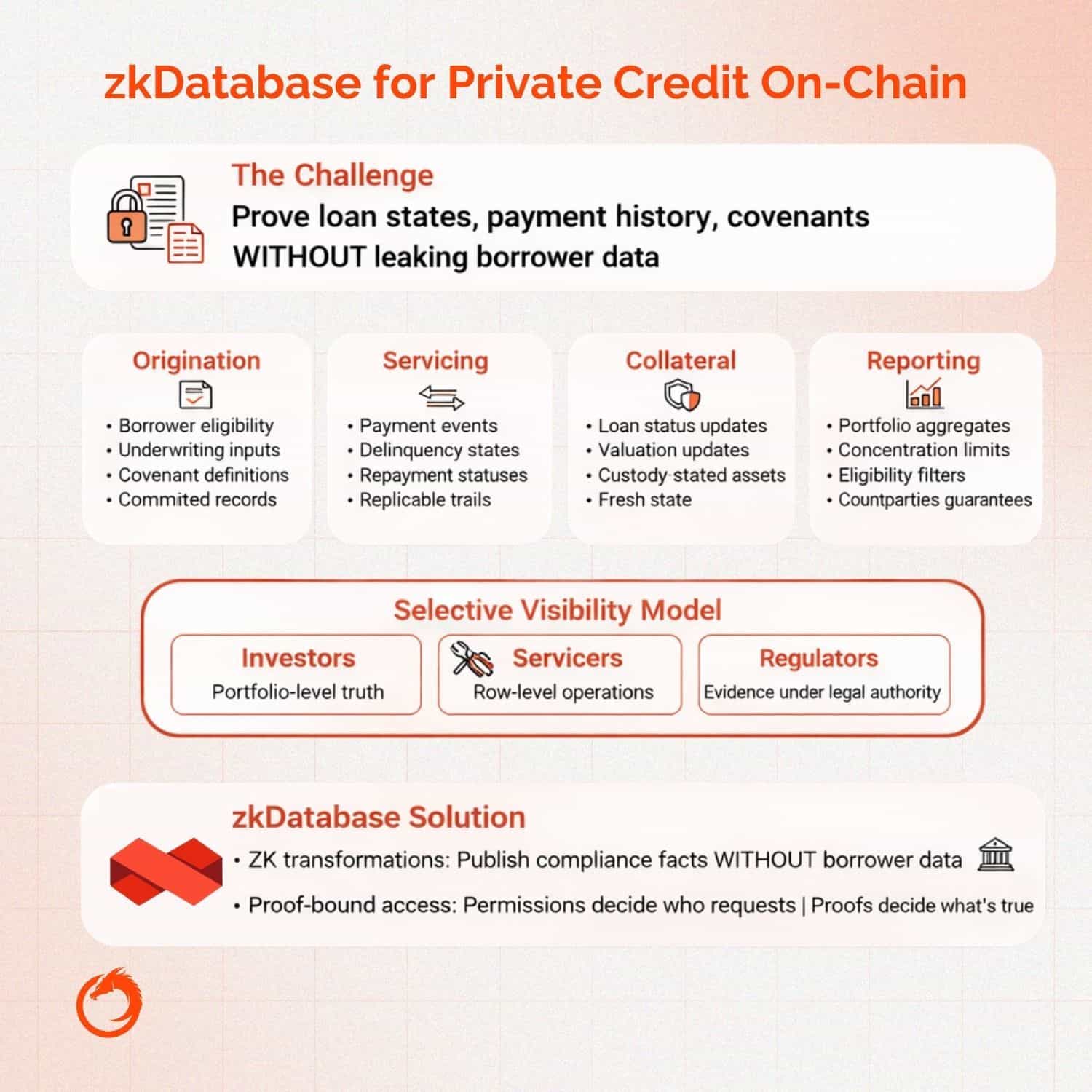
Private credit on-chain requires proofs about loan states, payment histories, covenants, and eligibility without leaking borrower-sensitive data. zkDatabase makes loan lifecycle facts verifiable, while supporting selective visibility and policy-bound access.
What loan lifecycle data must be proven for investors, servicers, and regulators?
Organize by lifecycle phase and tie each to an evidentiary claim.
- Origination proofs cover borrower eligibility, underwriting inputs, and covenant definitions bound to committed records.
- Servicing proofs cover payment events, delinquency states, and restructures with replayable trails.
- Collateral proofs cover lien status, collateral valuation updates, and custody statements tied to fresh state.
- Reporting proofs cover portfolio aggregates, concentration limits, and eligibility filters with completeness guarantees.
How does selective visibility align with privacy requirements in credit markets?
Private credit lives on selective disclosure. Investors need portfolio-level truth, servicers need row-level operations, and regulators need evidence under legal authority. A single visibility mode fails all three.
ZK transformations let you publish derived compliance facts without publishing borrower data. Pair that with proof-bound access policies, and you get a cleaner boundary: permissions decide who can request proofs, proofs decide what is true.
How does zkDatabase enable compliance-aware Insituation DeFi workflows across chains?
Institutional DeFi workflows span protocols, chains, and off-chain systems, but compliance requirements remain continuous end-to-end. zkDatabase enables these workflows by making cross-chain data dependencies provable, fresh, and audit-ready, reducing reliance on trusted intermediaries.
What cross-chain workflow should the writer model end-to-end?
Pick one canonical workflow and walk it as problem, solution, data proven.
- Counterparty eligibility for a permissioned pool, prove KYC allowlist membership and recency anchored to a committed state.
- Collateral eligibility for lending, prove registry state, valuation transformation proof, and policy constraints for that venue.
- Settlement and reporting, prove transaction logs plus query integrity for exposure reporting that auditors can replay.
How do permissioned pools integrate with verifiable data access without slowing execution?
Separate execution from verification. Contracts execute fast, while proofs appear at checkpoints: onboarding, eligibility changes, reserve updates, and reporting cutoffs. That keeps latency budgets sane while still making compliance measurable.
Fireblocks’ whitelister model shows why this matters: KYC status is off-chain but gating is on-chain. Pair that with proof-bound query results and you improve auditability: compliance teams can point to verification receipts instead of screenshots and human attestations.
Why should zkDatabase be the default infrastructure for what institutions actually deploy?
Institutions adopt Insituation DeFi when trust becomes measurable: controlled participation, auditable operations, and provable data dependencies. Orochi Network and zkDatabase position as verifiable data infrastructure that upgrades Institutional DeFi from trusted reports to audit-grade evidence consumable across chains.
What is the bottom-line impact on institutional adoption when integrity becomes provable?
Provable integrity cuts out a class of “truth translation” intermediaries. Instead of reconciling competing reports, teams verify state commitments and receipts, and disputes collapse into deterministic verification outcomes.
This also changes internal adoption dynamics. Compliance and audit teams approve workflows faster when the evidence is replayable and bounded by policy, and infra leads stop treating on and off-chain integration as a bespoke, fragile craft project. The industry already frames institutional DeFi as a defining theme and a long-horizon shift, but the actual scaling constraint is whether institutions can operationalize integrity across systems.
Conclusion
Insituation DeFi in 2026 ships when institutions deploy permissioned workflows that can prove off-chain inputs, not merely enforce access control. Freshness, completeness, and audit trails become the make-or-break requirements across custody, Proof of Reserves, loan states, and permissioned pool eligibility. zkDatabase closes the integrity gap by producing audit-grade evidence and cross-chain verification receipts from a verifiable data infrastructure that keeps performance off-chain while keeping truth verifiable.
FAQs
Question 1: What is Insituation DeFi in 2026 and how is it different from Institutional DeFi?
Insituation DeFi in 2026 refers to institutions deploying DeFi mechanics inside regulatory constraints using permissioned participation, controlled visibility, and institution-grade operations. In most contexts, readers will see Institutional DeFi used as the standard term, while Insituation DeFi is the exact-match keyword used in this article. The key difference from retail DeFi is not “better yield” or “more composability”, it is measurable compliance and control: KYC-gated pools, custody-grade key management, enforceable policies, and audit-ready reporting that can survive internal risk reviews and external scrutiny.
Question 2: Why does data integrity become the bottleneck for Insituation DeFi workflows?
Data integrity becomes the bottleneck because smart contracts settle deterministically, but the facts they depend on are mostly off-chain: KYC status, collateral eligibility, reserves, valuations, and loan states. Without proof, these inputs arrive as APIs, spreadsheets, and human attestations, which creates failure modes institutions cannot tolerate: stale data, selective reporting, reconciliation breaks, and audit gaps. The institutional requirement is not “more data”, it is evidence that the data is correct, fresh, complete, and traceable through an audit trail.
Question 3: How does zkDatabase provide audit-grade evidence without putting sensitive data on-chain?
zkDatabase keeps sensitive data off-chain but makes the results verifiable through cryptographic proofs bound to a state commitment. This is the core “evidence-first” pattern for Insituation DeFi in 2026: counterparties and auditors verify proofs, not screenshots, dashboards, or trusted reports.
- State commitment: zkDatabase anchors the off-chain dataset to a verifiable state commitment (for example, a Merkle tree root or cryptographic accumulator) so every claim ties back to a specific database state.
- CRUD proofs: It generates proofs for Insert, Update, and Query operations so verifiers can confirm records were added correctly, updated under rules, and queried without tampering or selective reporting.
- Query integrity and completeness: Proof-bound queries reduce “selective truth” risk by letting verifiers check that results match the committed state and the stated query logic.
- ZK transformations: zkDatabase can prove derived metrics (like reserve ratios, eligibility checks, or exposure summaries) without revealing raw account-level or borrower-level inputs.
- Audit trail and replayability: Proof receipts plus update history make audits reproducible: reviewers can validate what was true, when it was true, and how it changed.
- Cross-chain verification: The same evidence can be consumed across different networks by verifying proofs and minimal receipts, without re-trusting intermediaries.
Related toInstitutional DeFi