Stablecoin
Korea Won Stablecoin: What a Bank-Anchored Issuer Must Prove
October 23, 2026
8 mins read
Korea's Digital Asset Basic Act is taking shape around a debate over who can issue a won stablecoin, with the central bank pushing for bank-anchored issuance. That structure turns reserve and eligibility checks into a multi-party verification problem, where an issuer, a bank partner, and a regulator each need evidence without seeing each other's full books.


TL;DR: Korea's won stablecoin framework is forming under the Digital Asset Basic Act, with the central bank pushing for bank-anchored issuance and a proposed structure where banks hold at least 51% of issuing entities. That design makes reserve adequacy, redemption capacity, and issuer eligibility a multi-party verification problem rather than a single-issuer reporting task.
Three parties will have to agree on the same facts before a won stablecoin can launch under Korea's bank-anchored model: the issuer, its bank partner, and the regulator, each needing evidence of reserves and eligibility. Orochi Network's zkDatabase lets each of them prove the conditions that matter without exposing its full operating data.
Key Takeaways:
- A Korea won stablecoin will sit under the Digital Asset Basic Act, with proposed issuer requirements including a minimum capital around KRW 500 million and a registration statement covering reserves and redemption mechanisms.
- The central bank favors issuance anchored to licensed banks; a hybrid proposal would require banks to hold at least 51% of issuing entities.
- A bank-anchored structure splits reserve, custody, and eligibility data across multiple institutions that each need assurance without full disclosure.
- Foreign stablecoins would circulate only if their issuers establish a domestic presence and meet Korean supervision.
- Cryptographic proof lets each party verify reserve and eligibility conditions while keeping its data private.
What will a Korea won stablecoin framework require issuers to prove?
A Korea won stablecoin framework will require issuers to prove reserve backing, redemption capacity, and eligibility under the Digital Asset Basic Act, which is still being finalized. Reported proposals include a minimum capital figure around KRW 500 million, a refund or redemption reserve, a business and repayment plan, and a registration statement detailing technical infrastructure, issuance limits, and redemption mechanisms. The framework has not been enacted in final form, and the design is still under active debate.
What makes Korea distinct from frameworks already covered is the issuance structure itself. Where the Singapore MAS stablecoin framework sets requirements for a single licensed issuer, Korea is leaning toward issuance anchored to banks. That changes who holds the data behind each requirement, and therefore who has to prove what to whom.
The bank-versus-fintech debate is really a data-structure question
Korea's central bank wants won stablecoin issuance anchored to licensed commercial banks, while the financial regulator has favored admitting fintechs, and a hybrid proposal would require banks to hold at least 51% of any issuing entity. Beyond the politics, this is a decision about how reserve, custody, and compliance data is split across institutions.
A single fintech issuer keeps its reserve and customer data inside one perimeter. A bank-anchored structure spreads it. The bank may hold the reserve account and custody. The operating entity may run issuance and redemption. A compliance function may sit in a third place. Each participant needs assurance that the others are meeting their obligations, and none wants to expose its full book to the others. This is the same coordination pattern seen in Europe, where euro stablecoin bank consortiums had to reconcile shared issuance with private operating data.
A multi-party issuer turns reporting into a verification problem
When reserve, custody, and eligibility data lives across a bank, an operating entity, and a compliance function, periodic reports between them are slow and ask each party to trust the others. The harder requirement is letting each party verify a condition without seeing the full data behind it. A bank-anchored won stablecoin needs that capability built in, not bolted on after launch.
Consider redemption readiness. The operating entity promises holders can redeem on demand. That promise depends on reserve held at the bank partner, which the operating entity does not directly control. For the regulator and for holders, the live question is whether segregated reserve continuously matches outstanding issuance across both institutions. A monthly statement from each side, reconciled by hand, cannot answer that for any given moment.
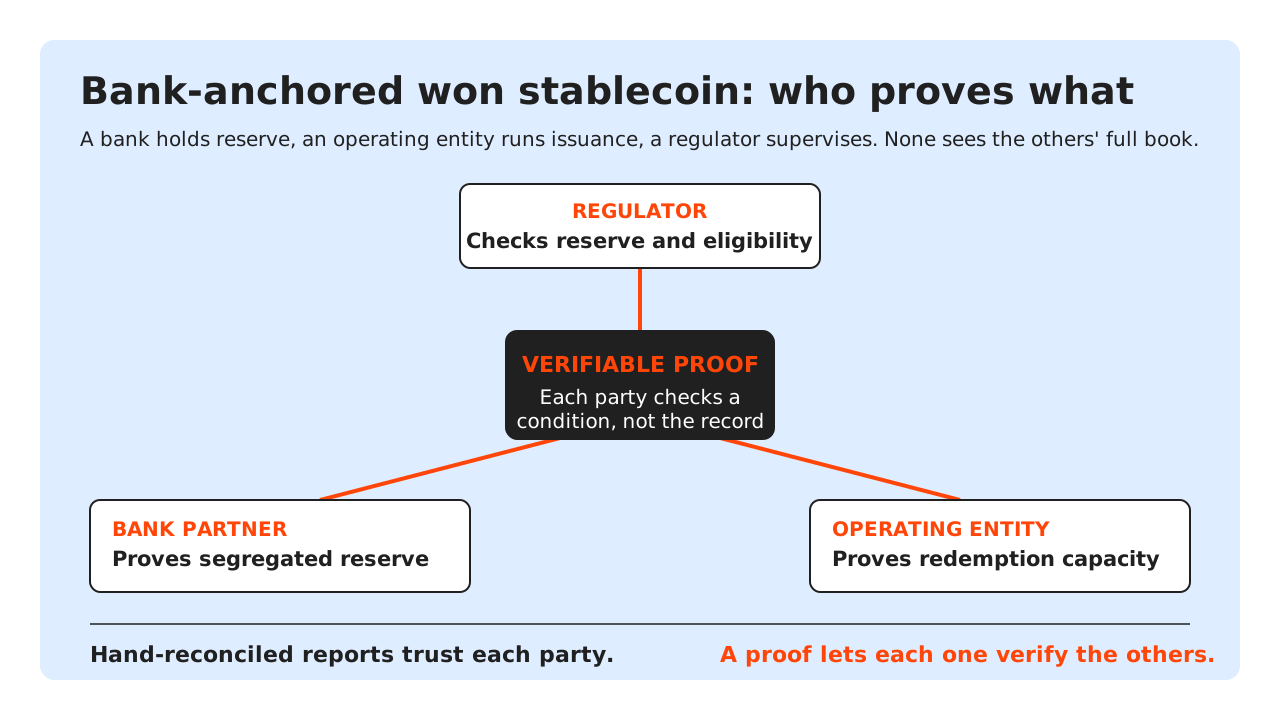 In a bank-anchored structure, reserve, issuance, and supervision sit in different hands; each party needs to verify a condition without seeing the others' full books.
The structure that Korea is debating is exactly the one where verifiable evidence between parties matters most.
Foreign stablecoins face a verification requirement too
Reported proposals would let foreign stablecoins such as major dollar tokens circulate in Korea only if their issuers establish a domestic presence and comply with Korean supervision. That turns a foreign issuer's compliance into something a Korean regulator has to be able to check locally, not take on the word of an overseas reporting regime.
A foreign issuer would need to demonstrate, to a Korean supervisor, that reserve and control conditions hold, while protecting data it is not obligated to publish. This is the cross-border version of the same problem the domestic structure faces. It echoes the jurisdictional fragmentation mapped in the US, EU, Hong Kong, and Singapore stablecoin comparison, now extending into Korea.
Where does verifiable data fit in a Korea won stablecoin?
Verifiable data lets each party in a won stablecoin structure prove a condition, such as reserve adequacy or eligibility, while keeping its underlying data private. The party that holds the data generates a cryptographic proof at the source, and a bank partner, regulator, or counterparty verifies the proof rather than trusting a report.
zkDatabase, the Verifiable Database built by Orochi Network, applies to this in a concrete way. A bank partner can prove that segregated reserve matches outstanding issuance, an operating entity can prove redemption capacity, and an issuer can prove it meets eligibility conditions, each without exposing the full account or customer data behind the claim. The live example already exists in the market: a won-backed token launched in September 2025, backed one-to-one by Korean won held in escrow at a domestic bank, which is precisely the bank-anchored model the framework is moving toward. The mechanism is selective disclosure, detailed in privacy-preserving compliance and applied to reserves in digital asset custody reserve verification.
One boundary is worth naming. zkDatabase does not grant a license, set the rules, or replace a Korean regulator's judgment. It gives each party in a multi-institution structure a way to prove the conditions the others depend on, which is what a bank-anchored design needs to function without constant manual reconciliation.
Conclusion
A Korea won stablecoin is being designed around a structure that splits reserve, issuance, and supervision across institutions, and the rules are still taking shape under the Digital Asset Basic Act. That structure makes verification between parties a core requirement rather than an afterthought. Verifiable Data Infrastructure does not decide who may issue or what the rules are. It gives a bank, an operating entity, and a regulator a way to prove the reserve and eligibility conditions each depends on, without any of them having to open its full book to the others.
Book an Advisory Call
Talk through where verifiable proof fits into a bank-anchored won stablecoin reserve and eligibility workflow.
FAQ
What is a Korea won stablecoin and how will it be regulated?
A Korea won stablecoin is a Korean-won-backed digital token being brought under the Digital Asset Basic Act, the country's forming digital-asset framework. Reported proposals include a minimum capital figure around KRW 500 million, redemption reserves, and a registration statement covering technical infrastructure and redemption mechanisms. The framework is not yet enacted in final form, and the issuance structure is still under debate.
Why does Korea favor bank-anchored stablecoin issuance?
Korea's central bank has pushed for won stablecoin issuance anchored to licensed commercial banks to keep it close to regulated balance sheets, while the financial regulator has favored admitting fintechs. A hybrid proposal would require banks to hold at least 51% of any issuing entity. The result spreads reserve, custody, and compliance data across multiple institutions that each need assurance.
How does a bank-anchored structure change verification?
A bank-anchored structure splits reserve, issuance, and compliance data across a bank, an operating entity, and a regulator. Each party needs to confirm the others are meeting obligations without exposing its full book. That turns periodic reporting between institutions into a verification problem, where the workable answer is proving a condition such as reserve adequacy without disclosing the underlying data.
Will foreign stablecoins need to verify compliance in Korea?
Reported proposals would let foreign stablecoins circulate in Korea only if their issuers establish a domestic presence and meet Korean supervision. That requires a foreign issuer to demonstrate reserve and control conditions to a Korean regulator locally, rather than relying on an overseas reporting regime, while protecting data it is not obligated to publish.
Related toStablecoin