Zero-Knowledge Proofs
Privacy-Preserving Compliance: Proving Conditions Without Exposing Raw Data
July 25, 2026
8 mins read
Privacy-preserving compliance lets institutions prove required conditions while reducing unnecessary exposure of sensitive data.


TL;DR: Privacy-preserving compliance uses cryptographic proofs, selective disclosure, and verifiable data systems to show that a required condition is satisfied without exposing the full dataset. For regulated financial workflows, it can support data minimization, auditability, and counterparty assurance, but it does not replace legal compliance programs.
A bank or stablecoin issuer routinely has to prove a specific fact to a regulator or counterparty, such as that reserves clear a threshold, without handing over the underlying customer and position data. That gap between what must be shown and what can stay private is where privacy-preserving compliance operates. zkDatabase provides the infrastructure for that proof layer.
Key Takeaways
- Privacy-preserving compliance focuses on proving a condition, not publishing raw data.
- Privacy-preserving compliance can support stablecoin, RWA, institutional DeFi, and capital markets workflows where data is sensitive.
- Selective disclosure is useful when the verifier needs the answer but not the underlying dataset.
- zkDatabase can create cryptographic evidence over compliance-state data, subject to application design and legal review.
- This approach can complement audit and compliance workflows, but it does not make a system regulator-approved by itself.
What does compliance based on Zero-Knowledge Proofs mean?
Compliance based on Zero-Knowledge Proofs means using cryptographic proofs to demonstrate that a compliance-relevant condition is true without revealing the raw data behind that condition. It turns a disclosure problem into a verification problem.
The simplest example is eligibility. A protocol may need to know that a user passed KYC, is not on a restricted list, or meets an investor qualification threshold. The protocol does not always need the user's passport, address, account history, or full identity record.
The same logic applies to stablecoin reserves and tokenized assets. A counterparty may need evidence that reserves meet a threshold, collateral coverage is sufficient, or a transfer rule was applied. It may not need to see every custodian account, every investor record, or every borrower document.
This is where privacy-preserving compliance becomes practical. The verifier receives a proof of the condition. The raw data stays in controlled systems.
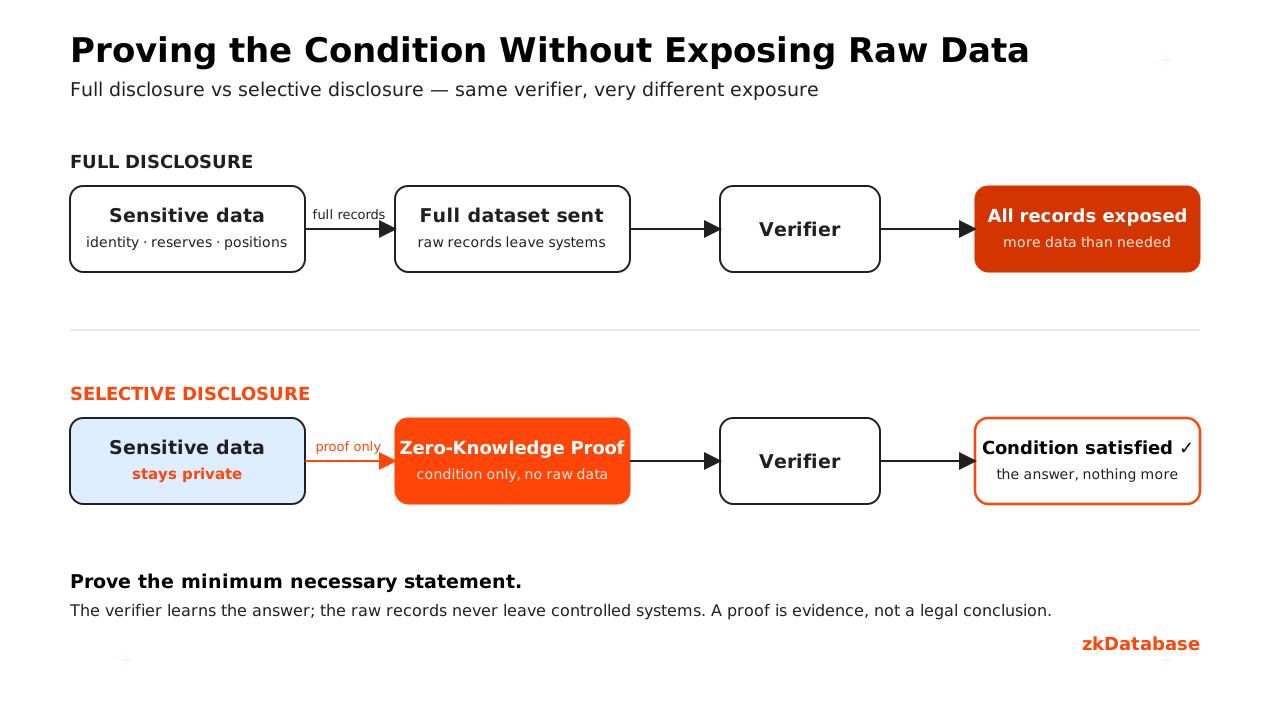 With selective disclosure, sensitive data stay in controlled systems while a Zero-Knowledge Proof shows the verifier only that the required condition was satisfied.
Orochi has covered adjacent privacy themes in data privacy compliance in 2026, but this article focuses on the mechanism: proving the condition without exposing the source data.
Why is privacy-preserving compliance hard for institutions?
Privacy-preserving compliance is hard because institutions face two duties that often pull in opposite directions: prove enough to satisfy stakeholders, while exposing as little sensitive data as possible.
Full transparency is not acceptable for many institutional workflows. Banks, asset managers, stablecoin issuers, and custody providers hold data that cannot be placed on a public blockchain: customer identity data, account balances, custodian relationships, trading positions, loan covenants, and internal risk signals.
Full opacity is also not acceptable. Regulators, auditors, counterparties, and smart contracts need evidence that required conditions were met. "Trust our internal system" is weaker than a verifiable record, especially when capital is moving across on-chain rails.
The design challenge is to prove the minimum necessary statement. For example:
- The wallet is in an approved set.
- The reserve ratio is above the required threshold.
- The borrower satisfies a covenant test.
- The transfer rule was checked against the current compliance state.
- The queried data was part of the committed database state at a specific time.
Privacy-preserving compliance succeeds when the proof is specific enough to be useful and narrow enough to avoid unnecessary disclosure.
How does selective disclosure work in compliance workflows?
Selective disclosure lets an institution reveal a proof of a fact while keeping unrelated data private. In compliance workflows, it can separate what a verifier needs to know from what the institution must protect.
A basic disclosure model asks for raw evidence. A more selective model asks for a statement about the evidence. For example, instead of sharing a full reserve file, an issuer may prove that eligible reserves exceed outstanding token supply under a defined calculation. Instead of exposing an investor file, a tokenized fund may prove that the investor satisfies a transfer restriction.
| Workflow | Raw-data approach | Selective disclosure approach |
|---|---|---|
| KYC eligibility | Share identity documents or registry data | Prove membership in an approved set |
| Stablecoin reserves | Share detailed custodian balances | Prove a threshold or composition condition |
| RWA collateral | Share full asset and valuation files | Prove collateral coverage against a committed dataset |
| AML screening | Share full screening history | Prove a required status at a timestamp |
The important boundary is that a proof is not a legal conclusion. It can show that a defined condition was checked against committed data. Whether that condition is sufficient for a specific compliance obligation remains a legal, governance, and regulatory question.
For a related stablecoin example, see Orochi's article on privacy-preserving Proof of Reserves.
Where can zkDatabase support privacy-preserving compliance?
zkDatabase can support privacy-preserving compliance by acting as a verifiable data layer for compliance-state data. It lets teams prove claims about committed data without forcing the verifier to inspect every underlying data point.
In a compliance-state workflow, zkDatabase can store or reference structured data such as eligibility status, reserve states, asset metadata, or approval flags. A verifier can then check a proof that a specific condition was satisfied at a defined time.
This can support several institutional use cases:
- Stablecoin issuers proving reserve or redemption-related conditions without exposing raw custodian data.
- RWA platforms proving asset lifecycle or investor eligibility conditions without exposing full asset files.
- Institutional DeFi protocols checking compliance states before execution.
- Capital markets systems proving data integrity for settlement, reporting, or audit trails.
The value is not that every compliance problem becomes a cryptography problem. The value is that compliance teams can reduce the amount of sensitive data that must move across systems, while still creating evidence that a condition was checked.
Orochi's broader product context for zkDatabase and RWA infrastructure shows where this evidence layer fits in institutional markets.
What should compliance teams verify before using this model?
Compliance teams should verify the rule, the data source, the proof circuit, the governance process, and the verifier's acceptance requirements before relying on privacy-preserving compliance workflows. Cryptographic proof is only as useful as the control environment around it.
A practical review should ask:
- What exact condition is being proven?
- Who controls the source data?
- How is the data committed, updated, and audited?
- Who can generate the proof?
- Who can verify the proof?
- What legal or regulatory requirement does the proof support?
- What data remains outside the proof model?
This avoids overclaiming. A Zero-Knowledge Proof can prove a statement about data. It cannot decide whether a regulator will accept that statement, whether the source data was legally collected, or whether the governance process is sufficient.
Bottom line: privacy-preserving compliance should be treated as an evidence layer, not a compliance shortcut.
What is the practical conclusion for privacy-preserving compliance?
Conclusion: privacy-preserving compliance gives institutions a way to prove necessary conditions while reducing unnecessary exposure of raw data. The institutional need is clear: private data must remain controlled, but claims about that data still need to be verified.
zkDatabase provides infrastructure for this middle ground. It can create cryptographic evidence over compliance-state data, reserve data, asset data, and eligibility data, while complementing the audits, controls, and legal frameworks institutions still need.
Explore zkDatabase
See how zkDatabase supports selective disclosure and privacy-preserving proof workflows.
See how zkDatabase supports selective disclosure and privacy-preserving proof workflows.
FAQ: What should compliance teams ask next?
What is privacy-preserving compliance?
Privacy-preserving compliance is the use of cryptographic proofs and selective disclosure to show that a compliance-relevant condition is true without exposing the full underlying dataset. It is most useful when a verifier needs assurance about a status, threshold, or rule check, but the raw data are sensitive. It can support compliance-adjacent evidence workflows, not replace legal obligations.
What is selective disclosure?
Selective disclosure is a method for revealing only the specific information needed for verification. In institutional finance, this can mean proving eligibility, reserve sufficiency, collateral coverage, or sanctions-screening status without exposing the complete identity file, custodian record, or portfolio dataset. The goal is controlled verification, not blanket transparency.
Can Zero-Knowledge Proofs replace audits?
Zero-Knowledge Proofs do not replace regulated audits or attestations by themselves. They can complement audit workflows by producing cryptographic evidence about data states and calculations between formal review cycles. Auditors, regulators, and legal teams still determine what evidence is acceptable for a specific obligation.
How does zkDatabase support privacy-preserving compliance?
zkDatabase can support privacy-preserving compliance by generating proofs over committed data states and query results. A verifier can check that a condition was satisfied without receiving every raw record. This is relevant for reserve checks, compliance registries, RWA asset states, and institutional DeFi workflows that require both privacy and verifiability.
Related toZero-Knowledge Proofs