Real - World Assets
The NAV Lag Problem: Tokenized Funds Update Once a Day in a Market That Trades 24/7
June 2, 2026
13 mins read
Tokenized fund tokens are priced on business-day NAV cycles — but they trade continuously and serve as collateral in 24/7 DeFi protocols. The result is a 12–36 hour window where lending platforms extend credit against stale valuations. NAV lag isn't an operational issue you can patch. It's a structural consequence of grafting traditional finance onto continuous on-chain markets.


TL;DR: Tokenized fund tokens are priced daily using NAV calculations from business-day-only asset valuations. But these tokens trade continuously on secondary markets and serve as collateral in 24/7 DeFi protocols. The result: lending platforms extend credit against asset values that may be 12 to 36 hours stale. NAV lag is a structural consequence of grafting business-day institutional finance onto continuous on-chain markets. Cryptographic verification of NAV at update time could fix the gap.
Key Takeaways
- NAV lag exposes lending protocols to stale collateral valuation. Most tokenized fund platforms update NAV once per business day, while DeFi protocols trade and liquidate continuously. The gap creates windows where credit extended against Friday's valuation rests on Wednesday's reality.
- Real-world cases show collateral NAV can drift by 3%+ between updates. Published NAV figures can lag behind actual asset values by multiple business days. When collateral is overvalued on-chain, borrowers can extract more value than underlying assets support.
- Current oracle solutions only relay data; they don't verify its source. Leading oracle networks confirm that data reached the chain correctly, but they don't cryptographically verify that the fund actually calculated the NAV as reported. This leaves a verification gap that no widely adopted production system currently addresses.
- The $27.6 billion RWA market depends on once-daily updates from controlled entities. As of April 2026, the total on-chain RWA market is $27.6B. U.S. Treasuries represent $13.5B+ of that. Most RWA oracle updates are controlled by single authorized entities, not decentralized networks.
- No widely adopted production system currently uses continuous cryptographic verification of NAV. Zero-Knowledge Proofs (ZKPs) could provide the most complete solution by anchoring trust in the source of the NAV calculation rather than the relay.
What is the structural mismatch in tokenized fund collateral?
Most tokenized fund platforms update NAV once per business day. DeFi protocols using them as collateral operate 24 hours a day, 7 days a week.
That gap creates a simple problem with serious consequences.
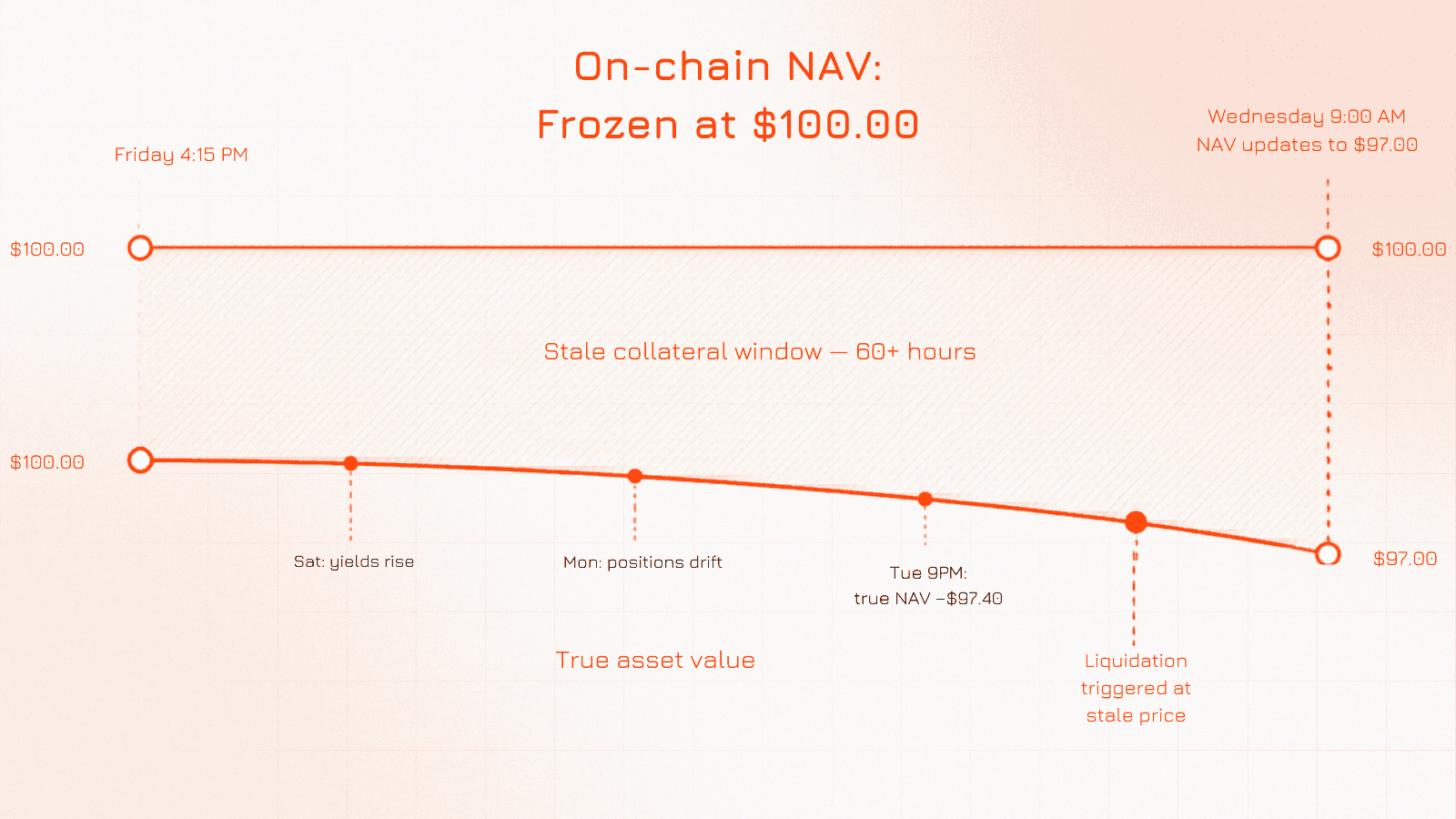
Imagine it's Friday at 4:15 PM ET. A fund completes its NAV calculation for the day and posts the value on-chain. A DeFi lending protocol accepts the fund tokens as collateral, extending $10 million in USDC loans against that valuation.
Over the weekend, and then Monday and Tuesday, the underlying assets move. Treasury prices shift. The real NAV drifts. But the on-chain price doesn't. On Wednesday morning, the NAV updates again and it's 3% lower than Friday's number. By then, the protocol has already extended credit that now exceeds safe collateral coverage.
The lending protocol extended the loan based on Friday's truth. It was operating within risk parameters at that moment. But the parameters were wrong for the next 60+ hours.
Why can't tokenized funds simply update NAV more frequently?
Traditional fund administration was designed for T+1 or T+2 settlement. NAV calculation happens once a day, after markets close, because that's when you have complete pricing data on all underlying holdings. You aggregate positions at 4 PM. You calculate NAV. You publish it. Investors trade the next day at that price.
This model works perfectly in traditional finance. It doesn't work when those same fund tokens live on blockchain.
On-chain, tokens trade whenever someone wants to trade them. There's no "settlement day." A borrower posts fund tokens as collateral at 11 PM on a Wednesday. A liquidation happens at 3 AM on Thursday. The protocol has no recourse to "we'll settle this tomorrow," because everything happens now, at the on-chain price.
The NAV is frozen until the next business day calculation. For 36+ hours, the on-chain price reflects a value calculated for a different market state.
What happens in that gap?
Collateral overvaluation scenario
Friday: Treasury fund NAV is $100.00. A lending protocol accepts $100M in fund tokens as collateral for $60M USDC loans. Over the weekend and Monday, U.S. Treasury yields rise slightly. The fund's underlying positions lose value. True NAV is now $98.50. Wednesday morning: NAV updates to $98.50. The protocol extended $60M against what it thought was $100M in collateral, but is actually $98.5M. The 3% margin is gone.
Liquidation timing mismatch scenario
Tuesday at 9 PM, a borrower's collateral ratio hits the liquidation threshold based on Friday's NAV. Wednesday at 2 AM, the liquidation executes, converting fund tokens to USDC. Wednesday at 4 PM, the NAV updates and is 2% lower than the liquidation price used. The protocol was forced to liquidate at a price that was artificially high. This harm flows to remaining borrowers and LPs through worse collateral recovery.
How NAV lag becomes leverage
When collateral prices go stale, borrowers and sophisticated traders extract value from the lag.
If you know a fund token's NAV will decrease, you can borrow heavily against Friday's price, knowing it will be worth less on Wednesday but the protocol won't adjust collateral requirements until the NAV updates. You have a 60+ hour window to extract value.
If you're a trader, you can spot the lag and trade the token on secondary markets before the NAV updates, capturing the spread between Friday's stale price and Wednesday's true value.
The protocol designed the system to be safe. It set a 40% collateral ratio requirement. But "safety" assumes collateral valuations are recent. When valuations are two days old, the math breaks.
NAV lag is not a risk that can be managed around. It is baked into the system as long as business-day settlement cadence drives on-chain collateral pricing.
Why is this a structural problem rather than an operational one?
You might assume the solution is simple: update NAV more frequently. Hourly. Every 30 minutes. On every block.
It's not. Here's why.
NAV calculation requires complete data. A fund's NAV is only accurate if you know the current price of every underlying holding. For a Treasury fund, that means current yields on every maturity. For a credit fund, it means current credit spreads on every loan in the portfolio. For a real estate fund, it means current appraisals.
In traditional finance, complete pricing data arrives once a day, after markets close. Treasury prices are final. The loan book isn't trading. Appraisers have delivered their valuations.
On-chain, you don't have that luxury. You could update NAV more frequently, but based on what? Mid-day Treasury yields? Live loan pricing? Appraisal estimates? Those are less reliable than end-of-day values. More frequent updates don't fix the trust problem. They just make it more visible.
The fund administrator also controls the oracle. Most RWA platforms run a centralized oracle where the fund administrator or a delegate computes NAV and pushes it on-chain. That's not decentralized consensus. That's one authorized entity saying "this is the NAV."
Token trading and settlement are genuinely 24/7. You can't fix this by moving to T+0 settlement on the token side. The tokens are already T+0. The gap is between the frequency of token trading (every block, continuously) and the frequency of NAV updates (once per business day).
You've placed an asset with business-day-only pricing into a market with continuous settlement and trading. No amount of operational tweaking fixes that. You need to change the verification model.
The path forward requires anchoring trust in the verification of NAV calculations, not just the frequency of publishing them.
Why don't current oracle solutions close the NAV verification gap?
Most RWA platforms use one of three approaches. None eliminates NAV lag.
Centralized oracle with periodic updates (most common)
The fund administrator calculates NAV at end of business day and pushes it on-chain. The protocol uses that value until the next update. This is the baseline approach used by most Treasury tokenization platforms. It doesn't address lag. It institutionalizes it. The protocol designer chose 24-hour intervals because that's how traditional finance works. It's the root of the problem.
Oracle network Proof of Reserve
An oracle network monitors the fund's off-chain reserve account and verifies the balance exists. Updates flow through the oracle network's decentralized node network. This approach is used by some platforms with reserve-backed tokens. Proof of Reserve confirms that reserves exist. It does not confirm that they're accurately valued. A fund could have all its cash in a reserve account (reserves pass PoR) while the fund's underlying assets have lost value (NAV should drop). PoR is a solvency check, not a valuation check. It doesn't solve NAV lag because it doesn't compute NAV. It only verifies one input, reserve balances, to the calculation.
Private oracle network with frequent feed integration
The fund administrator shares NAV calculation data with an oracle partner, which maintains a continuous pricing feed and pushes updates on-chain hourly or more frequently. Some institutional token platforms use this model. It reduces lag but doesn't eliminate it. If a fund calculates NAV at 4 PM and an oracle partner pushes an update at 5 PM, the on-chain value is still one hour old when traders and protocols use it the next morning. More critically, none of these systems cryptographically verify that the fund actually calculated NAV as reported. They verify that authorized entities published the data. They don't verify the data was real.
The gap that all three approaches share: trust in the relay, not verification of the source.
What would cryptographic verification of NAV actually do?
A ZKP-based system would anchor trust in the source of the NAV calculation, not the relay.
Current oracle systems answer one question: "An authorized entity published this data. The number reached the blockchain correctly."
ZKPs answer a different question: "The fund calculated this NAV from real, unmodified data. The calculation is cryptographically linked to the fund's records. The proof can be verified without seeing the underlying data."
Instead of the protocol trusting a fund administrator to publish the right number, and oracle networks to relay it faithfully, the protocol would verify a cryptographic proof that the NAV calculation happened correctly at the fund's source system.
That proof could be generated more frequently. Every time the fund updates its pricing data, not just at end of business day. Because the proof is cryptographic rather than trust-based, it doesn't matter if it comes from a system the protocol doesn't directly control.
Here's what that looks like in practice. At 10 AM on a Wednesday, the fund's internal pricing system recalculates NAV based on updated Treasury yields. It generates a Zero-Knowledge Proof: this NAV was calculated from real data, with this timestamp. You can verify the proof without seeing the underlying data. By 10:05 AM, that proof is posted on-chain. The protocol can now use a NAV that is hours old rather than days old, and it can verify the calculation happened, not just that someone reported a number.
The lag doesn't disappear entirely. Real-world asset valuations always have some staleness. But the lag becomes hours, not days. And the verification becomes cryptographic, not trust-based.
zkDatabase is built for this use case: generating ZKPs over financial data that protocols and institutions can verify without exposing underlying details. The Verifiable Data Pipeline covers the full chain from data ingestion to on-chain proof, using Groth16 proofs with 192-byte size and sub-0.5s proving time.
Cryptographic verification shifts the question from "do we trust this entity?" to "does this proof check out?"
Why does this matter for the $27.6 billion RWA collateral market?
The RWA market is $27.6 billion as of April 2026. U.S. Treasuries account for $13.5B+ of that. These tokens are being used as collateral in DeFi lending protocols, integrated into yield farming strategies, and held by institutional treasuries.
As the RWA market grows toward the projected $4 to $10 trillion by 2030, the NAV lag problem scales directly.
More collateral on platforms that don't verify NAV means more windows where credit extends against stale valuations. More borrowers stacking leverage on Friday's prices. More protocols absorbing losses when Wednesday's update arrives.
The current model works in a $27 billion market because the amounts are manageable and the participants are cautious. It will break at trillion-dollar scale.
Institutions won't move serious capital onto systems where collateral valuations can be two days old. Regulators won't allow it. U.S. stablecoin legislation moving through Congress in 2025 pushed toward monthly attestation requirements with executive accountability for accuracy. That direction is incompatible with weekly or multi-day NAV update cycles. Real-time cryptographic verification is the path to compliance at scale.
The NAV verification gap is manageable today. At the scale the RWA market is heading toward, it isn't.
Schedule a demo
zkDatabase generates ZKPs over financial data that protocols and institutions can verify without exposing underlying details. If you're building or operating an RWA protocol and NAV verification is on your roadmap, we can show you how cryptographic proofs eliminate the gap between traditional settlement cadence and continuous on-chain markets.
Schedule a demo to see how verifiable NAV updates work in practice.
FAQ
What exactly is NAV lag in tokenized funds?
NAV lag is the delay between the time a fund's real asset values change and the time the on-chain token price updates to reflect that change. Most tokenized fund platforms recalculate NAV once per business day, while tokens trade 24/7 on secondary markets. The result is a window, often 12 to 36 hours, where the on-chain price reflects a valuation from the past, not the present.
How does NAV lag affect DeFi protocols using tokenized funds as collateral?
When a lending protocol accepts tokenized fund tokens as collateral, it bases its risk model on the current on-chain NAV. If that NAV is 24+ hours old, the protocol's collateral coverage calculation is based on stale data. If the fund's underlying assets lose value during the lag window, the protocol becomes undercollateralized before the NAV updates and the protocol has any way to adjust. Borrowers can also exploit the lag by borrowing heavily against Friday's price, knowing it will be worth less on Wednesday but the protocol won't force liquidation until then.
Why don't fund platforms just update NAV more often, like every hour?
Because NAV calculation requires complete pricing data on all underlying holdings. In traditional finance, you get that data once a day, after markets close. If you try to calculate NAV hourly based on mid-day prices for Treasuries or estimates for private assets, you're computing a less reliable valuation. A cryptographic verification system could solve this by enabling the fund to generate proofs as soon as its pricing data updates, rather than waiting for a full manual calculation cycle.
Doesn't oracle Proof of Reserve already solve this problem?
No. Proof of Reserve confirms that a fund's reserves, the cash in its bank account, exist and are held by the right custodian. It doesn't compute or verify NAV. NAV depends on the values of the fund's underlying holdings, not just whether the fund has cash. A fund could pass Proof of Reserve while its underlying assets have lost value. PoR is a solvency check, not a valuation check.
Related toReal - World Assets