


Stablecoin
Proof of Reserves for Stablecoins: Oracle Feeds vs Cryptographic Proof
July 14, 2026
10 mins read
Proof of reserves for stablecoins compared: oracle reserve feeds vs cryptographic proof, where each fits, and what neither replaces yet.


TL;DR: Proof of reserves for stablecoins runs through two live mechanisms today: oracle reserve feeds that publish an aggregated backing number on-chain, and cryptographic proof (Merkle trees plus Zero-Knowledge Proofs) that verifies solvency privately and independently. Oracle feeds are the mature, adopted default; cryptographic proof is the supplementary layer adding privacy and independent re-verification on top.
Most live stablecoins publish their backing through the oracle model; cryptographic proof of reserves is newer and thinner in adoption but closes gaps the oracle model cannot. This article compares both mechanisms directly, grounds the comparison in which issuers actually use each today, and explains where cryptographic proof fits as a supplementary layer rather than a wholesale replacement.
Key Takeaways:
- Proof of reserves for stablecoins mainly runs through oracle feeds (Chainlink, RedStone, Chronicle) that publish an aggregated, public reserve number consumed directly by smart contracts.
- Oracle feeds prove assets exist and are mature and widely adopted, but they are public-by-design and prove assets only, not full liabilities.
- Cryptographic proof (Merkle trees plus Zero-Knowledge Proofs) adds privacy, independent re-verification, and tamper-evident history, at the cost of being newer and less adopted.
- The market pull behind stablecoin PoR is post-FTX holder trust and DeFi composability, not a specific regulatory mandate; regulation (GENIUS Act, MiCA) tightens the disclosure baseline around it, but neither model is a compliance substitute on its own.
What is proof of reserves for stablecoins?
Proof of reserves for stablecoins is the set of mechanisms an issuer uses to demonstrate, on-chain and often continuously, that circulating supply is backed by real reserves, most commonly through an oracle feed or a cryptographic proof. A stablecoin trades every second across dozens of venues; the reserve check behind it needs a way to keep pace, or at least stay close enough that a DeFi protocol accepting it as collateral has some confidence in the number.
The buyer behind this is not primarily a regulator. It is the holder and the DeFi protocol deciding whether to trust a token as collateral. After FTX, "we are fully backed" stopped being sufficient on its own; issuers that could show a re-checkable number won trust and unlocked composability, other protocols would accept their token, faster than issuers relying only on a monthly PDF.
Entities recurring through this space: Decentralized Oracle Network, Secure Mint, circuit breaker, Merkle tree, Groth16 proof, reserve composition, and independent re-verification. Each maps to a specific point in one of the two mechanisms this article compares.
How do oracle reserve feeds prove stablecoin backing?
An oracle reserve feed reads an issuer's on-chain wallets directly and pulls off-chain custody or bank data through a CPA or custodian source, aggregates that into a single value off-chain, and publishes the result on-chain, refreshed on a deviation threshold or a fixed heartbeat. Chainlink's Proof of Reserve, running through its Decentralized Oracle Networks, is the most widely adopted version of this model, and it consumes into two mechanisms: Secure Mint, which blocks a mint transaction if it would push total supply above the published reserve figure, and a circuit breaker, which halts minting or redemption if the feed shows a shortfall.
TrueUSD adopted Chainlink PoR in February 2023, becoming the first USD stablecoin to gate minting on it. OpenEden's USDO layers Chainlink PoR over its own real-time reserve monitoring. RedStone runs a related pull-oracle model, and its Trusted Single Source Oracle cryptographically chains each NAV update with a signature, timestamp, and reference to the prior record, so a reserve or NAV figure cannot be spoofed or silently replayed once published; Securitize uses this as its primary oracle for BlackRock's BUIDL fund. Chronicle's Verified Asset Oracle runs a continuous reconciliation loop between custodian data and on-chain balances, verified by named, reputation-staked validators rather than anonymous nodes, and sits alongside RedStone's NAV feed on BUIDL as a supplementary attestation layer.
How does cryptographic proof differ from an oracle reserve feed?
Cryptographic proof commits reserve and liability data into a Merkle structure and generates a Zero-Knowledge Proof, most commonly Groth16, that the committed dataset satisfies a stated backing condition, publishable on-chain so any party can re-run the verification themselves. This is the same construction Binance already runs in production for its own exchange proof of reserves, a Merkle tree of user balances checked against signed wallet holdings via a zk-SNARK, generalized here into a continuous database layer rather than a single-purpose snapshot circuit.
The mechanical difference from an oracle feed is what gets trusted. An oracle feed asks the reader to trust that the node network signed an honest aggregate. A cryptographic proof asks the reader to trust math they, or their own software, can check directly against the proof and a public verifier. That is independent re-verification (Merkle trees plus Zero-Knowledge Proofs) in practice, not just in name.
| Dimension | Oracle reserve feed | Cryptographic proof |
|---|---|---|
| What's published | Aggregated public reserve number | A proof that a committed dataset satisfies a backing condition |
| Data exposure | Public-by-design, the number is the point | Selective disclosure, proves the condition without exposing balances or custodians |
| What's proven | Assets exist, per the node network's signed report | The stated computation is correct over the exact committed data |
| Re-verification | Trust the node set's signature | Re-run the proof yourself, independent by construction |
| History | Point-in-time, refreshed on threshold or heartbeat | Tamper-evident proven history of every reserve-state change |
| Maturity | Mature, live across Chainlink, RedStone, Chronicle integrations | Newer, thin production adoption relative to oracle feeds |
| Consumes into | Secure Mint, circuit breakers | On-chain proof anyone with a verifier can check |
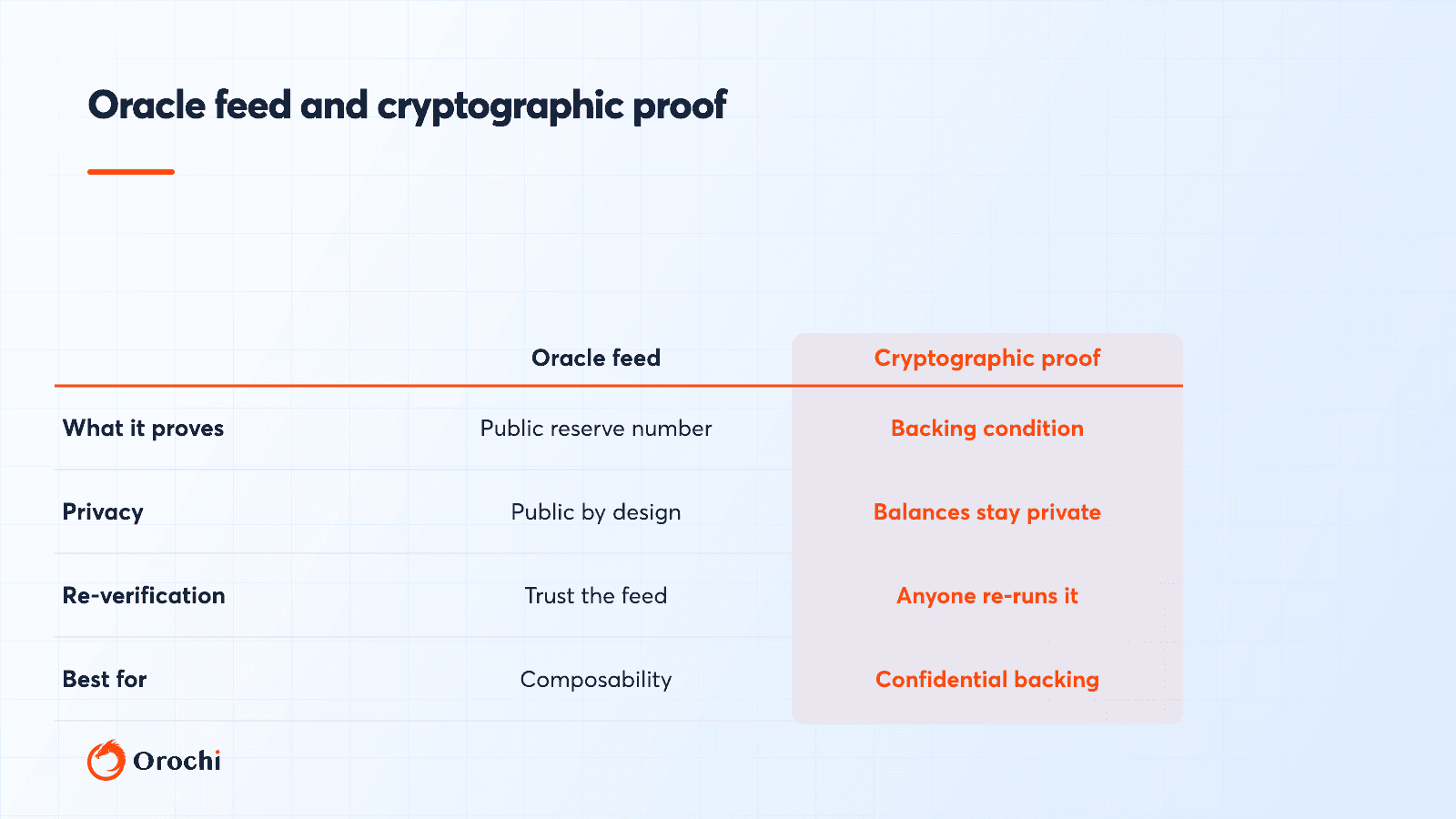
Oracle feeds publish a public reserve number for smart contracts to read; cryptographic proof lets anyone privately re-verify the same backing. Most issuers layer the second on top of the first.
Why isn't oracle-fed proof of reserves enough on its own?
Oracle feeds prove assets exist and are consumable by smart contracts, but they are public-by-design and typically prove only the asset side, not full liabilities, and only as fresh as the last threshold or heartbeat update. Publishing the reserve number openly is the entire point of the oracle model, which means an issuer that needs to keep loan-book composition, custodian identity, or position-level detail confidential cannot use the same feed to prove backing without exposing exactly the data it needs to protect.
That gap is not a flaw in the oracle model. It is a design tradeoff, transparency for composability, that fits most tokens well. It stops fitting once an issuer's backing structure includes information that cannot become fully public, a synthetic-dollar strategy, a private-credit loan book, or venue-level custody detail a competitor could exploit.
Where does cryptographic proof fit for stablecoin issuers today?
Cryptographic proof works best as a supplementary on-chain layer added where an oracle feed's public-by-design nature or point-in-time refresh leaves a gap, not as a wholesale replacement for the oracle model most stablecoins already run. BlackRock's BUIDL is the clearest live pattern for this today: PwC audits the fund, RedStone's TSSO carries the NAV feed, and Chronicle's Verified Asset Oracle sits alongside both as a supplementary attestation layer, not a replacement for any of them.
The same layering logic applies to cryptographic proof. An issuer already running a Chainlink or RedStone feed does not need to tear that out to add zkDatabase; it adds a re-runnable, privacy-preserving proof of reserves on top, most useful exactly where the oracle model's public disclosure or heartbeat-refresh cadence would otherwise expose more than the issuer wants, or leave a longer gap than a counterparty is comfortable with. Our companion piece on oracle feeds and reserve verification covers why stablecoins specifically feel this gap more than other tokenized assets do.
zkDatabase's role here is deliberately narrow: it does not replace an issuer's CPA attestation (a relationship covered in how Zero-Knowledge proof of reserves complements CPA attestation) or its existing oracle integration. It generates a proof over the same committed reserve data those relationships already produce, so a counterparty, auditor, or regulator can independently re-verify the backing claim on demand, without the issuer disclosing balances, custodians, or strategy detail it has legitimate reason to keep confidential. For the accounting side of this same layering question, see our piece on cryptographic proof versus periodic attestation.
Does regulation require cryptographic proof of reserves for stablecoins?
No regime today mandates on-chain cryptographic proof of reserves in a specific format; the GENIUS Act requires monthly reserve-composition disclosure examined by a registered accounting firm, a disclosure standard that sits underneath, not in place of, either the oracle or cryptographic model. The GENIUS Act (2025) obliges US payment-stablecoin issuers to hold 1:1 reserves in cash and short-term Treasuries and publish that monthly disclosure, with CEO/CFO certification, and PCAOB-standard annual audits above $50B in reserves.
Neither an oracle feed nor a cryptographic proof satisfies that disclosure requirement by itself; both are supplementary verification layers an issuer chooses to add on top of the attestation the regulation already requires. The buyer for either mechanism is still primarily the market, holders and DeFi protocols deciding whether to trust a token as collateral, with regulation tightening the baseline underneath that market pressure rather than driving the on-chain mechanism directly.
Bottom line
Proof of reserves for stablecoins is not a single technology choice. Oracle feeds are the mature, adopted default, turning "is it backed?" into a public, machine-readable number most DeFi protocols already trust. Cryptographic proof is the newer, thinner-adopted layer that adds privacy and independent re-verification exactly where a public feed's design tradeoffs stop fitting an issuer's confidentiality needs. Neither is a compliance substitute, and the strongest current pattern, BUIDL's PwC-plus-oracle-plus-Chronicle stack, treats them as layers, not competitors.
Explore zkDatabase
See how zkDatabase adds a re-runnable, privacy-preserving reserve proof alongside your existing oracle or attestation stack.
FAQ
What is proof of reserves for stablecoins?
Proof of reserves for stablecoins refers to the on-chain mechanisms, mainly oracle reserve feeds and cryptographic proof, that let an issuer demonstrate circulating supply is backed by real reserves. Oracle feeds publish an aggregated public number consumed directly by smart contracts; cryptographic proof verifies the same backing claim through Merkle trees and Zero-Knowledge Proofs, often without exposing underlying balances.
What is the difference between oracle-based and cryptographic proof of reserves?
An oracle-based proof of reserves has a node network read on-chain and off-chain data, agree on an aggregate value, and publish it openly on-chain, trusting the node set's signature. A cryptographic proof of reserves commits the same data into a Merkle structure and generates a Zero-Knowledge Proof that any party can independently re-verify themselves, without needing to trust who generated it or exposing the underlying balances.
Do stablecoin issuers need both an oracle feed and cryptographic proof?
Most issuers today run an oracle feed as their primary on-chain reserve mechanism, since it is mature and DeFi-composable by default. Cryptographic proof adds value as a supplementary layer specifically where privacy or independent re-verification matters, confidential loan-book composition, synthetic-dollar strategy detail, or a check a counterparty can re-run without waiting for the next feed refresh, rather than as a required addition for every issuer.
Can zkDatabase replace an oracle-fed proof of reserves system?
Not today, and that is not the intended role. zkDatabase generates a cryptographic proof over committed reserve data as a supplementary, privacy-preserving verification layer, alongside an issuer's existing oracle feed or CPA attestation, giving a counterparty an independently re-runnable check without requiring the issuer to expose balances, custodians, or strategy detail the oracle model would otherwise publish openly.
Related toStablecoin


