Zero-Knowledge Proofs
Why Zero-Knowledge Proof of Reserves Is Replacing CPA Attestation for Stablecoin Issuers
July 14, 2026
10 mins read
Stablecoin issuers rely on periodic CPA attestations to prove reserves. MiCA, HKMA, and the GENIUS Act now require what this model cannot deliver. Zero-Knowledge Proof of Reserves provides continuous cryptographic proof without exposing custodian data.


TL;DR: Stablecoin issuers prove reserve backing through periodic CPA attestations: monthly at best, quarterly at worst. MiCA, the GENIUS Act, HKMA, and MAS are increasing pressure for daily snapshots, random-date audits, and personally certified reserve reporting. Zero-Knowledge Proof of Reserves provides continuous, cryptographic proof of reserve adequacy and composition without exposing custodian identities or raw bank balance data.
Zero-Knowledge Proof of Reserves is a cryptographic mechanism that proves committed reserve data satisfies backing conditions without disclosing custodian names, bank account numbers, or reserve composition breakdowns. As MiCA enforcement tightens and the GENIUS Act binds personal liability to reserve certification, the point-in-time attestation model leaves a structural evidence gap between formal reporting cycles.
Key Takeaways:
- Zero-Knowledge Proof of Reserves proves reserve adequacy and composition conditions cryptographically, without exposing custodian identities or raw balance data
- Current CPA attestations are point-in-time snapshots, scheduled in advance, and structurally incompatible with random-date audit requirements
- MiCA, HKMA, the GENIUS Act, and MAS each expose a distinct operational failure in the scheduled attestation model
- Window-dressing, where issuers temporarily improve reserve composition before a known audit date, is eliminated by continuous unscheduled proof generation
- zkDatabase can prove reserve composition conditions and backing thresholds on demand, with fast verification under benchmark conditions
What Is Zero-Knowledge Proof of Reserves and How Does It Differ From CPA Attestation?
Zero-Knowledge Proof of Reserves is a cryptographic method that proves committed reserve data satisfies a condition such as reserves equal to or greater than outstanding token supply, without revealing custodian names, raw bank balances, or reserve composition details to any external party.
A CPA attestation works differently. An accounting firm is engaged on a scheduled basis, receives raw access to custodian accounts and bank statements, reviews data against a reference date, and publishes a report confirming reserves met a threshold on that specific day. The reserve composition could change the next morning. The attestation would not reflect that.
The mechanics are uniform across the three largest issuers. Circle engages Deloitte monthly under AICPA examination standards. Paxos uses KPMG on the same monthly cadence. Tether relies on BDO Italia quarterly, a lower assurance standard, and received S&P Global's weakest stablecoin rating in November 2025 partly because of non-disclosure of custodian identities. None of these issuers runs an on-chain cryptographic Proof of Reserves.
Understanding the Zero-Knowledge Proof architecture behind this capability makes the distinction concrete: instead of sending data to a reviewer who confirms what they saw, the issuer generates a proof that the data satisfies specified conditions, and any party can verify that proof on-chain without seeing the underlying data.
| Dimension | CPA Attestation | Zero-Knowledge Proof of Reserves |
|---|---|---|
| Verification method | Accounting firm reviews raw account data | Cryptographic proof over committed inputs |
| Frequency | Monthly or quarterly, scheduled in advance | On demand or event-triggered, depending on integration |
| Data exposed to auditor | Full raw access: bank accounts, custodian names, balances | None. Sensitive data stays encrypted off-chain |
| On-chain verifiable | No | Yes, where verifier contracts are deployed |
| Window-dressing resistant | No. Audit schedule is known in advance | Stronger, because proofs can be generated outside scheduled audit dates |
| Random-date audit ready | No. Requires advance scheduling | Stronger operational fit, subject to data-source integration |
| Regulatory coverage | Recognized legal attestation process | Technical evidence layer that complements legal attestation |
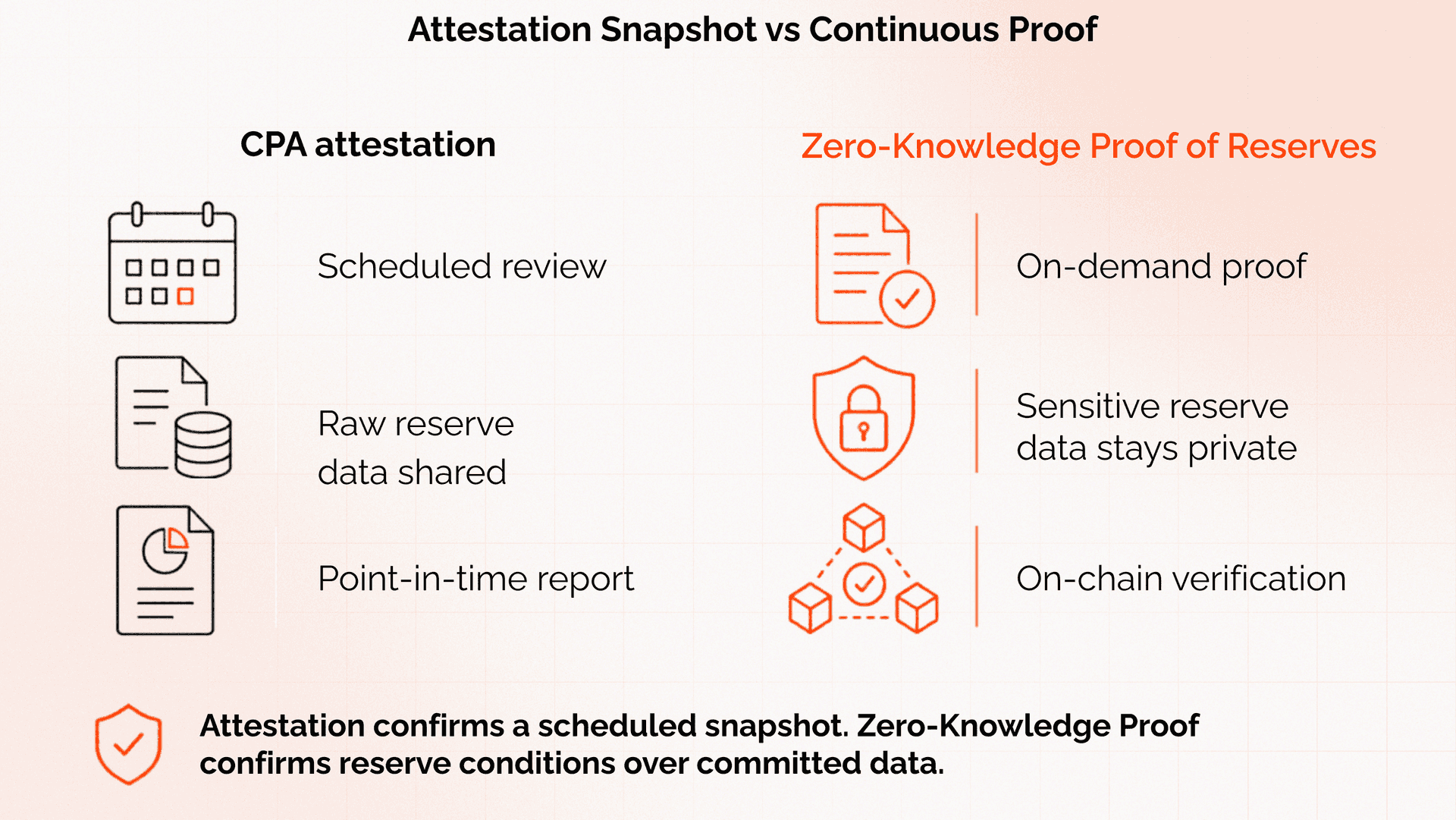 Zero-Knowledge Proof of Reserves complements CPA attestation by proving reserve conditions over committed data without exposing custodian identities or raw balance details.
Bottom line: Attestation confirms what a professional saw on one scheduled day. Zero-Knowledge Proof confirms reserve adequacy conditions over committed data, without the underlying data leaving the issuer's system.
Why Does the CPA Attestation Model Fail Four Regulatory Tests?
Four regulatory frameworks now require capabilities that the scheduled, point-in-time attestation model cannot deliver. Each exposes a different structural failure in how reserve backing is currently proven.
MiCA's daily reporting cadence. MiCA requires crypto-asset service providers to submit daily reserve snapshots in standardized iXBRL machine-readable format by 6:00 PM CET each day. Monthly attestation, published weeks after the reference date, does not satisfy a daily snapshot requirement. No manual process bridges this gap efficiently at scale.
HKMA's random-date audit. Hong Kong's Stablecoins Ordinance, which came into effect in August 2025, requires a qualified auditor to verify reserve assets on at least one randomly selected business day per reporting period, with no advance notice given to the issuer. Scheduled attestations are structurally incompatible with this requirement. A system that needs to prepare for an audit cannot satisfy a no-notice requirement.
GENIUS Act personal liability. The GENIUS Act, signed in July 2025, requires CEOs and CFOs of permitted payment stablecoin issuers to personally certify monthly reserve reports. That is 12 certification cycles per year, each carrying personal criminal liability for false statements. Manual reconciliation across multi-chain supply makes any inaccuracy a personal exposure event, not just a corporate one.
The window-dressing attack surface. Scheduled attestations create a structural incentive to temporarily improve reserve composition before the known audit date. S&P Global's stablecoin rating methodology explicitly flagged this practice. HKMA's random-date requirement targets it directly. A system that generates verifiable proof at any moment eliminates this attack surface, because no audit date can be anticipated or prepared for.
These four requirements converge in H2 2026 across the EU, Hong Kong, the United States, and Singapore simultaneously. The stablecoin regulatory expectations for that window are specific, binding, and not satisfiable by the current attestation model.
Bottom line: Each of the four frameworks targets a different weakness in the scheduled attestation model. Together, they make continuous cryptographic verification a serious compliance infrastructure advantage, not just a competitive feature.
How Does zkDatabase Solve the Stablecoin Reserve Verification Problem?
zkDatabase sits between a stablecoin issuer's authenticated custodian data feeds and the on-chain contracts that track outstanding token supply. Every reserve state change: a deposit, a withdrawal, a shift in asset composition, can generate a Zero-Knowledge Proof. That proof is timestamped, tamper-evident, and verifiable by smart contracts or counterparties where verifier access is deployed, without custodian data leaving the issuer's system.
Five specific capabilities address the gaps the attestation model leaves open.
Continuous proof generation. The proof can be generated on every data state change, not only on a schedule. HKMA's random-date audit becomes easier to support because the issuer can produce cryptographic evidence for the relevant committed reserve state.
Treating supply-integrity as part of reserve verification closes the gap where unauthorized minting can dilute backing before the next report.
Selective disclosure. The regulator receives a TRUE or FALSE result for each compliance condition. "Reserves at or above 100% of outstanding supply: TRUE." "Cash-equivalent share at or above 30%: TRUE." The underlying bank balances, custodian identities, and asset breakdown remain encrypted. Banking relationships stay private.
Sub-3ms verification speed. Proof verification completes in under 3ms under benchmark conditions. Daily iXBRL reporting and HKMA random-date audit responses shift from manual workflows to automated ones.
Multi-chain supply reconciliation. Zero-Knowledge Proofs can support verification across multiple chains where verifier contracts and integrations are deployed. For issuers managing outstanding supply across many chain deployments simultaneously, a unified proof architecture can cover total supply integrity without requiring public data extraction from each chain.
The shift this produces: instead of engaging an accounting firm to review raw data on a schedule, the issuer runs infrastructure that proves reserve adequacy is satisfied continuously. The auditor's role becomes reviewing a cryptographic record rather than requesting fresh raw data access at each cycle.
Bottom line: zkDatabase replaces the scheduled trust-based snapshot with continuous mathematical proof. The reserve is provably adequate at any moment. The underlying data never leaves the issuer.
Which Stablecoin Issuers Face the Most Immediate Compliance Pressure?
The issuers under the most immediate pressure are those operating under HKMA licensing review, MiCA's July 2026 grandfathering deadline, and the GENIUS Act's monthly certification requirement: three frameworks converging in H2 2026.
EU issuers under MiCA. The July 1, 2026 grandfathering expiry removes transitional protections for EMT issuers not yet fully MiCA-compliant. Daily CASP reporting in iXBRL format, 30 to 60 percent of reserves held in separate bank accounts, and semi-annual independent audits all become mandatory. Infrastructure decisions for Q3 compliance are in progress now.
Hong Kong HKMA license applicants. Zero stablecoin licenses had been issued as of early 2026 despite 36 formal applications. License candidates are selecting compliance stack components now, before architecture decisions lock. The random-date audit requirement maps directly to zkDatabase's capability: verifiable proof on any business day, at any time, with no preparation required.
US issuers under GENIUS Act. Monthly CEO/CFO-certified reserve reports become binding following final OCC/FDIC/Treasury rulemaking expected in H2 2026. Personal liability changes the risk calculus permanently. Issuers relying on manual reconciliation across multi-chain supply carry that exposure on every reporting cycle.
Singapore and MAS. MAS legislation expected mid-2026 will formalize the monthly attestation requirement and daily mark-to-market standard. For issuers already operating under voluntary attestation schedules, the shift to monthly cadence plus daily valuation makes automated proof generation a compliance infrastructure investment, not an optional upgrade.
The stablecoin market is projected at $1.9T base case by 2030, up from approximately $290B today. Reviewing data provenance requirements in tokenized markets makes clear that stablecoin reserve verification sits within a broader shift: institutional capital requires cryptographic proof, not organizational trust.
Zero-Knowledge Proof of Reserves closes the four operational gaps that CPA attestation cannot. It generates proof continuously rather than on a schedule. It satisfies random-date requirements by design. It eliminates the window-dressing attack surface. And it protects custodian identities through selective disclosure. The question for stablecoin issuers in H2 2026 is not whether to upgrade reserve verification infrastructure, but whether the compliance stack will be ready before the regulatory deadlines land.
Schedule Consultation
Discuss how zkDatabase maps to your MiCA, HKMA, and GENIUS Act reserve verification obligations.
Download Compliance Brief
Overview of zkDatabase's Zero-Knowledge Proof of Reserves architecture for stablecoin issuers.
Frequently Asked Questions
What is Zero-Knowledge Proof of Reserves for stablecoins?
Zero-Knowledge Proof of Reserves is a cryptographic mechanism that proves a stablecoin issuer holds reserves sufficient to cover outstanding token supply at any point in time, without disclosing custodian identities, bank account numbers, or reserve component balances. The proof is generated over encrypted inputs and is verifiable by any counterparty or smart contract on-chain, without the underlying data being shared with the verifier.
How does Zero-Knowledge Proof of Reserves differ from a CPA attestation?
A CPA attestation is a point-in-time report prepared by an accounting firm on a scheduled basis, confirming aggregate reserve balances on one reference date. A Zero-Knowledge Proof of Reserves is generated on every reserve state change, any day, on demand, and is verifiable on-chain by any party without raw data disclosure or a formal audit engagement. The attestation confirms what was true on one scheduled date; the Zero-Knowledge Proof confirms what is true at any moment.
Does zkDatabase's Zero-Knowledge Proof of Reserves satisfy MiCA and HKMA audit requirements?
Zero-Knowledge Proofs generated by zkDatabase are not currently recognized by MiCA, HKMA, or other regulatory frameworks as legal substitutes for traditional auditor attestations, which remain legally required. zkDatabase adds a continuous cryptographic evidence layer that strengthens the evidence base between formal audit cycles and makes each formal attestation more defensible. Regulatory audit and certification requirements must still be fulfilled by licensed professionals.
Related toZero-Knowledge Proofs