
Research
Why RWA Stablecoin Collateral Verification Fails, and How to Fix It
May 5, 2026
15 mins read
The pmUSD depeg didn't happen because the collateral was missing. It happened because no one could prove it was redeemable. This is the structural gap every RWA stablecoin running on periodic attestations carries, and what continuous cryptographic verification actually requires.


TL;DR
The May 2026 pmUSD depeg exposed a structural gap common to all hybrid RWA stablecoins: on-chain Proof of Reserves shows tokenized claims exist, not that they can be redeemed at face value under stress. When a low-cost analytics report raised questions about collateral quality, the protocol had no mechanism to respond. Liquidity drained and the peg broke. zkDatabase addresses this directly by generating continuous, cryptographic proofs over collateral data, so stablecoin issuers can prove backing in real time rather than asking holders to trust periodic attestations.
In May 2026, pmUSD lost more than 50% of its peg. Not because its on-chain data was wrong, but because no one could verify whether it was right. That distinction is the core problem with RWA stablecoin collateral verification today. This article explains what broke, why it keeps happening, and what a verifiable alternative looks like. For broader context on what a stablecoin is and how reserve models evolved, that primer is a useful starting point.
Key Takeaways:
- RWA stablecoin collateral verification fails when on-chain attestations cover tokenized claims, not verified, redeemable value
- The pmUSD depeg followed the same structural pattern seen in at least six major stablecoin incidents since January 2025
- A Peg Stability Module with 0.1% of supply capacity cannot absorb confidence shocks. Liquidity is not a substitute for proof
- Continuous cryptographic verification, not quarterly attestations, is the only mechanism that survives a market confidence event
- zkDatabase generates Zero-Knowledge Proofs (ZKPs) over collateral data continuously, replacing "trust us" with on-demand verifiability
What caused the pmUSD depeg in May 2026?
pmUSD depegged to approximately $0.42 in early May 2026 after an analytics platform assigned it a near-failing safety grade, triggering panic selling and Curve pool imbalances that its Peg Stability Module (sized at roughly 0.1% of total supply) could not absorb. The stablecoin, issued by the RAAC protocol and partially collateralized by tokenized precious metals via I-ON Digital's ION.au tokens, had claimed collateral health ratios above 119%. The on-chain data showed no immediate problem. The market did not believe it.
Four failure vectors converged simultaneously. The Peg Stability Module allowed 1:1 redemptions of pmUSD into sUSDS, but held only $47,000–$70,000 in capacity against a $100M+ supply. Adequate for routine activity, not for a confidence event. The PSM was also one-directional: users could exit, but arbitrageurs could not restore the peg at scale. Second, the collateral itself was off-chain mineral rights and mining claims in Yukon, Canada. These are assets whose market value can be attested on-chain but whose redeemability under stress cannot be cryptographically proven. Third, liquidity was concentrated in Curve pools, which imbalanced rapidly once selling started. Fourth, when the analytics report was published, RAAC's only response was a statement that collateral remained intact. The existing PoR mechanism could prove the collateral existed, but it could not prove the collateral was redeemable at face value under adversarial conditions.
What role did the Peg Stability Module play?
The PSM's theoretical function is to create a hard floor: any holder can swap pmUSD for a stable counterpart at $1, removing the incentive to panic sell. But a PSM sized at 0.1% of supply holds that floor only in normal conditions. Under a confidence event, where dozens of large holders attempt to exit simultaneously, $47,000–$70,000 of exit liquidity is effectively zero. The asymmetry is structural: exit is easy once one seller moves the price, and each exit makes the next one harder.
One-directional redemptions compound this. If the PSM only allows pmUSD to sUSDS and not the reverse, arbitrageurs cannot buy discounted pmUSD and redeem at $1. The stabilization mechanism is absent precisely when it is needed most.
Why did on-chain Proof of Reserves not prevent the depeg?
RAAC ran real-time Proof of Reserves (PoR) feeds through infrastructure providers. On-chain data confirmed that tokenized mining claim assets existed in the system. What it could not confirm was whether those assets were redeemable at the stated value under adversarial conditions. On-chain PoR answers the question "do these tokenized claims exist?" not "can we liquidate them for $X today if holders want out?"
That gap between asset existence and redeemable value is the structural flaw. An on-chain attestation that says "mining rights worth $119M are pledged" provides no information about liquidity, counterparty concentration, lien exposure, or exit path. A Zero-Knowledge Proof over collateral data can prove overcollateralization ratios, asset composition ranges, and counterparty exposure bands without revealing sensitive details. And it can do this continuously, not on a reporting schedule. This is what moving data from off-chain to on-chain with cryptographic proof actually requires at the infrastructure level.
The pmUSD depeg was not an oracle failure or a hack. It was a confidence failure. Confidence failures happen when "trust us" is the only answer holders can get.
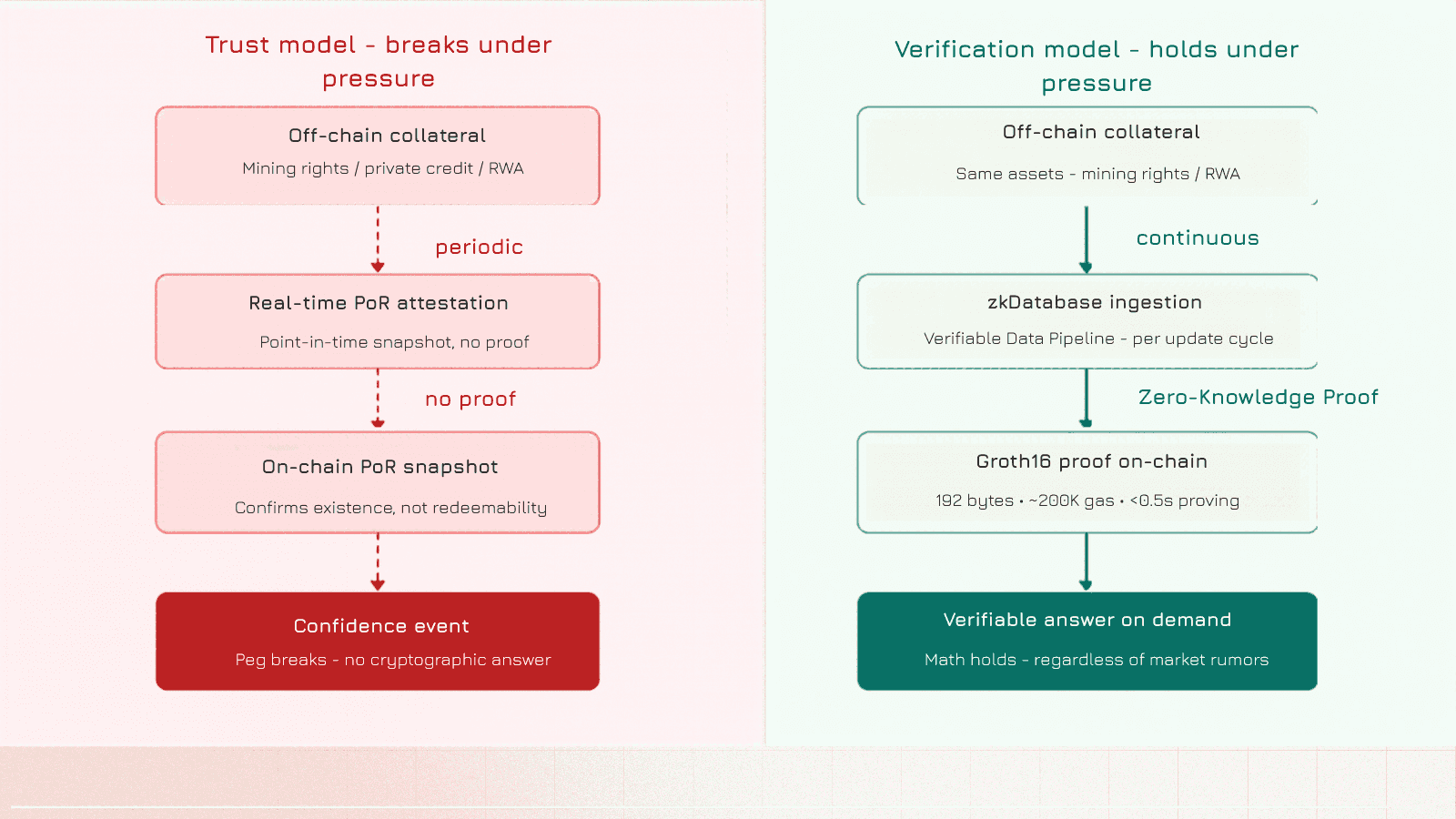
Real-time PoR attestation proves collateral exists, not that it can be redeemed. zkDatabase closes that gap with continuous Zero-Knowledge Proofs.
Is the pmUSD pattern unique, or a recurring structural gap in RWA stablecoin collateral verification?
The pmUSD depeg follows the same structural pattern as at least six prior RWA-backed or hybrid stablecoin failures since early 2025. Off-chain collateral claims without continuous verification. Thin redemption mechanisms. A single negative report triggering a confidence collapse that liquidity cannot contain. The pattern is documented across the 15-month incident record below.
What do recurring stablecoin incidents share in common?
Each incident traces back to the same root: a protocol claimed something about its collateral, holders had to trust the claim, and when trust broke, the mechanism had no cryptographic fallback.
| Incident | Depeg depth | Root verification gap |
|---|---|---|
| USD0++ (Jan 2025) | -11% | Hardcoded $1 oracle; no real-time NAV proof; governance change announced after insider reallocation |
| FDUSD (Apr 2025) | -13% | Monthly attestation model; no continuous reserve proof; issuer cross-contamination with TUSD |
| xUSD (Nov 2025) | -77% | Opaque off-chain fund management; oracle hardcoded at $1.00 regardless of market conditions; $93M fraud undetected |
| pmUSD (May 2026) | -53%+ | Tokenized mining claims not equal to verified redeemable value; PSM 0.1% of supply; no continuous proof mechanism |
In every case, the protocol had some form of on-chain data: price feeds, attestations, or PoR checks. None had continuous cryptographic proof that off-chain collateral remained adequate and redeemable. The difference is not technical sophistication. It is the trust model.
Why do RWA-backed stablecoins have higher verification risk than fiat-backed ones?
Fiat-backed stablecoins (those collateralized by cash and short-dated T-bills) operate in a world where redemption mechanisms are legally enforceable and assets are highly liquid. The verification problem is still real, but the exit path is well-defined: a holder can redeem for USD through a regulated counterparty on a predictable timeline.
RWA-backed stablecoins introduce a different category of risk. Mineral rights, private credit positions, tokenized real estate, and emerging market debt are all assets where "fully backed" and "fully redeemable" are not the same statement. These assets have no continuous market price, often have contractual restrictions on transfer, and may require legal processes to liquidate. A quarterly audit that says "collateral exceeds liabilities" is accurate as of the audit date. It says nothing about what happens when 30% of supply tries to exit in 48 hours. The broader RWA tokenization infrastructure landscape explains why data verification is the missing layer across the entire asset class.
The further the collateral is from liquid, fungible assets, the more critical continuous cryptographic verification becomes. And the more dangerous a periodic attestation model is.
The pattern is structural, not incidental. Every protocol that separates collateral verification from on-chain smart contract consumption has the same latent risk.
What does verifiable RWA stablecoin collateral actually require?
Verifiable RWA stablecoin collateral requires three things that current approaches do not provide: continuous proof generation, privacy-preserving disclosure, and on-chain-readable verification that smart contracts can consume directly. Periodic attestations, on-chain PoR snapshots, and PSM liquidity buffers cover none of these.
Why periodic attestations fail under market stress
Attestation timing creates a structural gap. A clean quarterly attestation says the books balanced on the day the auditor checked. It does not say anything about the 89 days between checks. This is the exact window where undisclosed lien exposure, deteriorating asset quality, or collateral concentration risk can grow undetected.
MiCA's stablecoin rules require issuers to maintain sufficient, highly liquid reserves and provide ongoing transparency to regulators, not point-in-time snapshots. By July 2026, all stablecoin issuers operating in EU markets must demonstrate continuous reserve adequacy under MiCA's full enforcement window. Monthly PDF attestations do not satisfy this. The regulation expects a live, verifiable window into reserve composition. That is precisely what cryptographic proof infrastructure provides. The verifiable compliance framework for RWA covers how this maps to specific regulatory obligations across jurisdictions.
What would continuous cryptographic collateral proof look like?
The mechanism is straightforward in architecture. Collateral data (asset values, composition ratios, counterparty exposure, overcollateralization percentage) is ingested continuously into a Verifiable Data Pipeline. At each update cycle, a Zero-Knowledge Proof is generated over this dataset. The proof answers specific questions ("is the collateral ratio above 110%?", "does any single asset exceed 30% of total backing?") without revealing the underlying asset identities, counterparty names, or exact positions. The proof is published on-chain. Any holder, smart contract, or regulator can verify the answer without accessing the underlying data.
This is not transparency in the traditional sense. It is mathematical proof. The stablecoin issuer's sensitive business information stays private. The verification result is public and cryptographically unforgeable.
| Periodic Attestation | On-Chain PoR Snapshot | Continuous Cryptographic Proof | |
|---|---|---|---|
| Frequency | Monthly / quarterly | When manually updated | Continuous / on-demand |
| Privacy | Auditor sees full data | Full data visible on-chain | Zero-knowledge: prove without exposing |
| Smart contract readable | No | Partially | Yes, native on-chain |
| Confidence under stress | Breaks when challenged | Breaks if asset does not match claim | Holds. Math does not have "off days" |
| MiCA alignment | Partial | Partial | Full |
Attestation is a trust model. Cryptographic proof is a verification model. For RWA stablecoins with illiquid off-chain collateral, only the verification model survives a market confidence event.
How does zkDatabase enable continuous RWA stablecoin collateral verification?
zkDatabase generates ZKPs over collateral data continuously, turning static off-chain claims into on-chain-verifiable state that smart contracts and holders can check at any time, without the issuer exposing sensitive asset details.
What is the Verifiable Data Pipeline for stablecoin reserves?
The pipeline has four stages. Off-chain collateral data (valuations, asset composition, counterparty positions) is ingested into zkDatabase at each update cycle. zkDatabase generates a Groth16 proof over this dataset: a 192-byte cryptographic proof computed in under 0.5 seconds, verified on-chain at approximately 200,000 gas. The proof is published on Ethereum or any EVM-compatible chain. On-chain smart contracts, including PSM logic, liquidation triggers, and third-party integrations, can read the proof and act on verified reserve state rather than trusted reported state.
The privacy architecture is critical here. zkDatabase proves facts about data without revealing the data itself. An issuer can prove "collateral ratio is above 115%" without disclosing the exact asset composition, counterparty identities, or position sizes. This matters for RWA protocols that work with institutional asset managers, mining companies, or private credit funds, all of which have legitimate confidentiality requirements. The proof satisfies regulators and holders without requiring the issuer to expose commercially sensitive information. For a deeper look at why data integrity is the defining trust layer for RWA, that analysis covers the audit gap across the full asset lifecycle.
How does this differ from what pmUSD had in place?
RAAC ran PoR attestations through infrastructure providers, updated periodically, with a last major reference cited as January 2026. The pmUSD model had three gaps zkDatabase closes directly.
First, frequency: periodic PoR updates versus continuous proof generation. A PoR snapshot from January 2026 has no bearing on whether the collateral was intact in May 2026 when the depeg occurred. Continuous proof generation means any holder can verify reserve status at the moment of a confidence event, not four months prior.
Second, the proof type: an attestation that says "tokenized mining claims worth $X exist on-chain" is different from a Zero-Knowledge Proof that says "the collateral ratio is above the stated threshold as of this block." The first confirms asset existence. The second confirms a verifiable financial condition. For holders deciding whether to exit, the second answer is the relevant one.
Third, the redemption signal: a PSM sized at 0.1% of supply breaks because sellers have no verified information to act against. If the on-chain proof continuously confirms overcollateralization above 115%, rational holders have a cryptographic basis to hold through a rumor-driven event rather than exit on uncertainty.
zkDatabase does not eliminate off-chain risk. It makes the risk visible and verifiable continuously, so holders can evaluate it rather than react to rumors.
What should RWA stablecoin issuers build for today?
The practical lesson from pmUSD is not to avoid RWA collateral. Tokenized real-world assets represent a legitimate and growing institutional use case. The RWA market exceeded $30 billion on-chain by early 2026 and is projected to reach $16 trillion by 2030. The lesson is to build verification infrastructure that does not depend on quarterly reports, trusted intermediaries, or liquidity cushions sized for good-weather conditions only.
Five infrastructure requirements follow directly from the pmUSD failure pattern.
Move from attestation cycles to continuous collateral proof generation. A confidence event does not wait for the next reporting date. The verification infrastructure needs to generate proofs at the same cadence the market can react. Not monthly. Not quarterly.
Size the Peg Stability Module for adversarial conditions. A PSM capacity of 0.1% of supply is not a stabilization mechanism; it is a signal of confidence that breaks the moment it is tested. PSM design needs stress-test modeling, not fair-weather sizing.
Separate proof of asset existence from proof of redeemable value. On-chain PoR confirms tokenized claims are registered. It does not confirm those claims can be exited at stated value under adversarial conditions. Both proofs are required. They answer different questions.
Integrate on-chain-readable proofs that smart contracts can consume directly. A PDF attestation is not actionable by a smart contract. A Groth16 proof on-chain is. Protocol logic (liquidation triggers, borrowing caps, PSM thresholds) should run against verified reserve state, not trusted reported state.
Align with MiCA's ongoing reserve transparency standard now, before the July 2026 enforcement deadline. The regulation's direction is clear: continuous, verifiable reserve adequacy. Protocols that build toward this standard proactively will have a competitive advantage with institutional liquidity providers and EU-market participants. Protocols that wait will face the same confidence dynamic pmUSD faced, with a regulatory deadline attached.
Protocols built for good-weather conditions do not survive confidence events. The ones that survive are the ones where the math holds regardless of what anyone is saying on social media. The oracle manipulation patterns that enabled earlier DeFi failures follow a similar logic; the oracle manipulation incident analysis is worth reading alongside this one.
Conclusion
RWA stablecoin collateral verification requires continuous cryptographic proof, not periodic attestations, not on-chain PoR snapshots of tokenized claims, and not PSM liquidity sized for normal conditions. The pmUSD depeg did not reveal a flaw in tokenizing real-world assets. It revealed a flaw in how RWA stablecoin collateral is verified. And that flaw is systematic.
zkDatabase's Verifiable Data Pipeline generates Groth16 Zero-Knowledge Proofs over collateral data continuously, giving stablecoin issuers the infrastructure to prove reserve sufficiency on demand to holders, regulators, and on-chain smart contracts, without exposing the underlying asset composition. When a confidence event hits, the protocol has a mathematical answer ready. Not a press release.
If your protocol uses off-chain collateral claims to back a stablecoin or tokenized asset, zkDatabase can show you what continuous, cryptographic collateral verification looks like in production. Book a demo
Frequently Asked Questions
What is RWA stablecoin collateral verification and why does it matter?
RWA stablecoin collateral verification is the process of proving that the off-chain assets backing a stablecoin are sufficient, intact, and redeemable at any given time. It matters because RWA-backed stablecoins rely on illiquid assets (mineral rights, private credit, real estate) where periodic attestations cannot confirm real-time reserve adequacy. Without continuous verification, a single credible negative report can trigger a confidence collapse that redemption mechanisms cannot contain. The May 2026 pmUSD depeg, which lost over 50% of its peg value within days, is the most recent illustration of what this failure costs.
How is zkDatabase's approach to reserve proof different from Chainlink Proof of Reserves?
Proof of Reserves systems confirm that tokenized asset claims exist on-chain. They answer "is this collateral registered?" zkDatabase generates Zero-Knowledge Proofs over the financial conditions of that collateral, answering "is the collateral ratio above the required threshold right now?" The distinction is between asset existence and verified financial state. zkDatabase also operates continuously, generating new proofs at each data update cycle rather than on a manual or scheduled basis. And because zkDatabase uses ZKPs, issuers can prove reserve conditions without exposing sensitive counterparty details or exact asset compositions, a requirement for institutional asset managers working with private credit or commodity-backed assets.
Can Zero-Knowledge Proofs prove collateral sufficiency without revealing the underlying asset details?
Yes. Zero-Knowledge Proofs are designed specifically for this purpose: proving a statement is true without revealing the data that makes it true. zkDatabase can generate a proof that a stablecoin's collateral ratio exceeds 110%, that no single asset exceeds 30% of total backing, or that reserve composition meets a specific regulatory threshold, without disclosing the identity of the assets, the names of counterparties, or exact position sizes. This privacy-preserving property is essential for RWA protocols that work with institutional partners who have legitimate confidentiality requirements. The proof is on-chain and verifiable by anyone; the underlying data stays off-chain and private.
Related toResearch