
Research
Supply Chain Attack: Malicious Code Hides in Open Source
October 24, 2026
12 mins read
This article dives into a sophisticated attack campaign that exploits GitHub's infrastructure, luring users into unwittingly downloading malware disguised within seemingly innocuous repositories.


In the bustling world of open-source development, a recent wave of cyber attacks has shed light on the insidious methods utilized by threat actors to infiltrate unsuspecting users' systems. This article dives into a sophisticated attack campaign that exploits GitHub's infrastructure, luring users into unwittingly downloading malware disguised within seemingly innocuous repositories.
I. Overview of the Attack
In the vast landscape of digital innovation, the open-source community stands as a beacon of collaboration and creativity. However, amidst its boundless potential lies a lurking threat – the exploitation of trust and transparency for nefarious purposes. In a recent series of incidents, a complex and deceptive attack campaign has emerged, targeting the very heart of the open-source supply chain.
This insidious assault operates at the intersection of manipulation and concealment, leveraging the infrastructure of GitHub, a cornerstone of the open-source ecosystem. The attackers, wielding a combination of cunning tactics and sophisticated techniques, aim to ensnare unsuspecting developers and users in their web of deception.
GitHub Manipulation
At the forefront of this attack is a calculated manipulation of GitHub's search functionality. By strategically crafting repositories with familiar names and topics, the attackers ensure their malicious creations rise to prominence in search results. Through the deceptive use of automated updates and fabricated popularity metrics, such as fake stars, these repositories masquerade as legitimate projects, camouflaging their malicious intent beneath a veneer of trustworthiness.
Malware Concealment
Embedded within the very fabric of these repositories lies a hidden danger – malware cunningly concealed within project files. Utilizing the obscurity of Visual Studio project files, the attackers cloak their malicious scripts, rendering them virtually undetectable to the untrained eye. This clandestine insertion of malware serves as a silent sentinel, lying in wait to ensnare unsuspecting users who unwittingly download and execute the tainted code.
Evolution of the Threat
As the campaign unfolds, the attackers evolve their tactics, adapting to countermeasures and exploiting new vulnerabilities. With each iteration, the malware evolves, growing more elusive and insidious in its design. Through active campaigns and strategic updates, the attackers continue to refine their arsenal, ensuring their malicious endeavors remain one step ahead of detection and mitigation efforts.
Detection and Prevention
Despite the intricacies of the attackers' schemes, signs of their nefarious activities have surfaced, serving as a warning beacon for vigilant users. Reports of compromised systems and user complaints underscore the critical need for heightened awareness and proactive defense measures. By remaining vigilant and adopting rigorous scrutiny of repository properties, users can fortify their defenses against the looming threat of malicious GitHub repositories.
Recommendations for Defense
In the face of this evolving threat landscape, the onus falls upon the shoulders of developers and users to fortify their defenses and safeguard the integrity of the open-source ecosystem. Embracing a culture of scrutiny and collaboration, developers are encouraged to prioritize manual code reviews and leverage specialized tools for malware detection. By fostering a collective commitment to security and resilience, we can collectively thwart the advances of cyber adversaries and preserve the vitality of the open-source community for generations to come.
If you want to understand more others crypto scheme like phishing attacts. We recently have an article that intricate History of Increase Allowance and Its Abuse in Phishing Attacks.
II. GitHub Manipulation Techniques
Within the labyrinthine corridors of GitHub's repository infrastructure, attackers employ a myriad of manipulative tactics to propagate their malicious creations. This section delves into the intricate web of deception woven by cybercriminals as they exploit GitHub's search functionality to ensnare unsuspecting users.
Crafting Illusions of Legitimacy
At the heart of this manipulation lies the artful crafting of repositories designed to deceive. Drawing from a repository of popular names and topics, attackers meticulously construct their creations to mimic legitimate projects, obscuring their nefarious intent beneath a veil of familiarity. From gaming cheats to utility tools, these repositories span a spectrum of seemingly innocuous subjects, effectively camouflaging their true nature amidst the vast expanse of GitHub's offerings.
Automated Updates: A Symphony of Deception
To ensure maximum visibility, attackers orchestrate a symphony of deception through the automation of repository updates. Leveraging GitHub Actions, a powerful automation tool integrated into the platform, attackers perpetually tweak their repositories with minute modifications, often as inconspicuous as altering a single file timestamp or injecting random changes into code snippets. This relentless stream of updates serves as a siren song, drawing unsuspecting users into the web of deceit with promises of freshness and relevance.
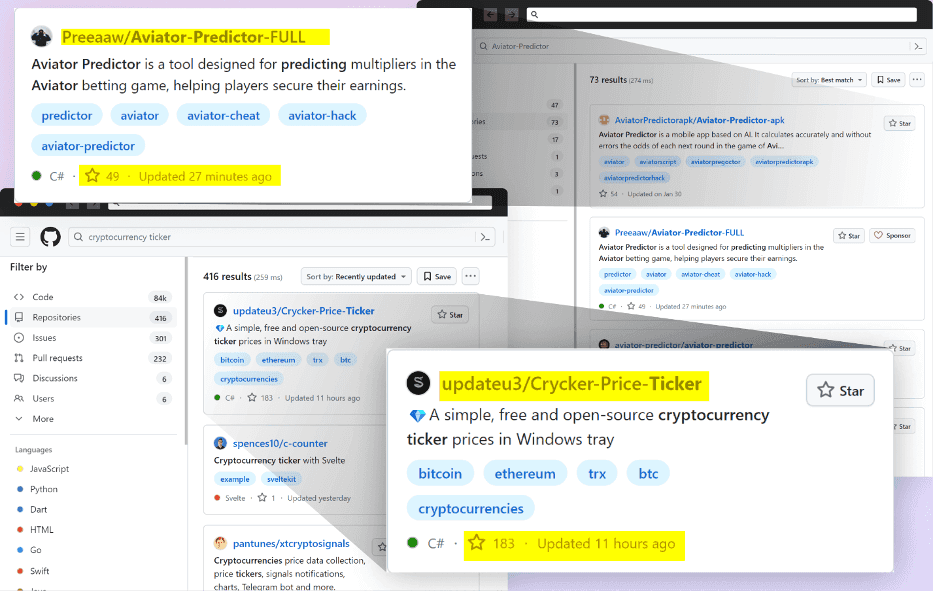
Source: checkmarx.com by Yehuda Gelb
Faking Popularity: The Illusion of Trust
In their quest to deceive, attackers harness the power of social validation to amplify the perceived legitimacy of their repositories. Through the creation of multiple fake accounts, they artificially inflate the number of stars bestowed upon their creations, creating an illusion of popularity and trustworthiness. Yet, beneath the veneer of acclaim lies a facade of deception, as these faux endorsements serve as nothing more than a smokescreen to ensnare unwitting users in their trap.
Unveiling the Deception
Despite the ingenuity of these manipulative tactics, signs of deception often linger beneath the surface, awaiting discovery by vigilant users. By scrutinizing repository properties for anomalies such as unusually high commit frequencies or stargazers with suspicious account creation dates, users can pierce through the veil of deception and safeguard themselves against the perils lurking within.
A Call to Vigilance
In the ever-evolving landscape of cyber threats, vigilance remains our greatest defense against deception and deceit. By arming ourselves with knowledge and adopting a critical eye towards the repositories we encounter, we can collectively thwart the advances of cyber adversaries and preserve the integrity of the open-source ecosystem for generations to come.
III. Malware Concealment: Unveiling the Hidden Threat
As the shadows of deception loom large within the open-source ecosystem, a sinister threat lies concealed within the very fabric of seemingly innocuous repositories. In this section, we peel back the layers of obfuscation to reveal the insidious techniques employed by attackers to cloak their malware within project files, evading detection and ensnaring unsuspecting users in their web of deceit.
Beneath the Surface: Concealed Malware
Embedded within the depths of project files, attackers deploy a variety of techniques to conceal their malicious payloads from prying eyes. One such method involves the manipulation of Visual Studio project files, such as .csproj or .vcxproj, where malicious scripts lie dormant, awaiting activation upon unsuspecting users' interactions. By leveraging the obscurity of these file formats, attackers create a veil of invisibility, rendering their malicious code virtually undetectable to casual inspection.
A Closer Look: Technical Analysis of Malicious Payloads
Peering beneath the surface, a detailed technical analysis unveils the intricacies of the common malicious payloads deployed by attackers. These payloads often consist of multi-layered scripts, comprising batch files, VBScript, and base64-encoded PowerShell scripts, orchestrated to execute a sequence of malicious actions upon invocation. From retrieving country codes to downloading encrypted files from remote servers, these payloads operate with surgical precision, evading detection while wreaking havoc on unsuspecting systems.
Evolution of the Threat: Active Campaigns and Tactical Evolution
As the campaign evolves, so too does the malware it propagates. Through strategic updates and targeted evolution, attackers adapt their tactics to evade detection and maximize impact. From the introduction of new URLs to the deployment of padded executables exceeding conventional size thresholds, the malware evolves with each iteration, growing more elusive and insidious in its design.
A Call to Action: Detection and Prevention
Despite the cloak of deception woven by attackers, signs of their nefarious activities often surface, serving as beacons of warning for vigilant users. Reports of compromised systems and user complaints underscore the critical need for heightened awareness and proactive defense measures. By remaining vigilant and adopting rigorous scrutiny of repository properties, users can fortify their defenses against the looming threat of concealed malware.
Fortifying Defenses in the Face of Deception
As we navigate the complex landscape of open-source development, the specter of concealed malware serves as a sobering reminder of the perils that lurk beneath the surface. By embracing a culture of vigilance and collaboration, we can collectively fortify our defenses against the machinations of cyber adversaries, preserving the integrity of the open-source ecosystem for generations to come.
IV. Detection and Prevention: Safeguarding Against Emerging Threats
In the ever-evolving realm of cybersecurity, proactive detection and prevention are paramount in safeguarding against emerging threats. This section delves into the critical importance of vigilance and proactive defense measures in identifying and mitigating the risks posed by malicious GitHub repositories.
Recognizing the Signs: Indicators of Successful Exploitation
Amidst the vast expanse of GitHub's repository ecosystem, signs of successful exploitation often manifest as red flags, signaling potential compromise and deception. Reports of compromised systems and user complaints serve as early warning signals, alerting vigilant users to the presence of malicious repositories within their midst. By remaining attuned to these indicators and responding swiftly to potential threats, users can mitigate the risk of falling victim to malicious activities.
Prevention Through Education: Empowering Users to Make Informed Decisions
Education serves as a cornerstone in the fight against cyber threats, empowering users to make informed decisions and adopt proactive defense measures. By familiarizing themselves with the telltale signs of deception, such as unusually high commit frequencies or suspicious repository properties, users can bolster their defenses and fortify their resilience against malicious actors. Through ongoing education and awareness campaigns, the open-source community can collectively strengthen its defenses and mitigate the risk of future attacks.
The Power of Collaboration: Building a Resilient Community
In the face of emerging threats, collaboration emerges as a powerful weapon in the arsenal of defense. By fostering a culture of information sharing and collaboration, developers and security professionals can collectively pool their resources and expertise to identify and mitigate emerging threats. Through platforms such as security advisories and threat intelligence sharing programs, the open-source community can unite in its efforts to safeguard the integrity of its ecosystem and protect against the machinations of cyber adversaries.
Embracing Proactive Defense Measures: Strengthening Resilience
As the threat landscape continues to evolve, the adoption of proactive defense measures becomes increasingly imperative in safeguarding against emerging threats. From conducting manual code reviews to leveraging specialized tools for malware detection, developers can fortify their defenses and mitigate the risk of falling victim to malicious activities. By embracing a proactive stance towards security, the open-source community can build resilience against the ever-present threat of cyber adversaries and preserve the integrity of its ecosystem for generations to come.
Empowering a Secure Future
The detection and prevention of malicious activities within the open-source ecosystem require a multifaceted approach that combines education, collaboration, and proactive defense measures. By remaining vigilant, fostering a culture of information sharing, and embracing proactive defense measures, developers and users can collectively fortify their defenses and safeguard the integrity of the open-source ecosystem against the ever-present threat of cyber adversaries. Through ongoing efforts and collaboration, we can empower a secure future for the open-source community and ensure its resilience in the face of emerging threats.
V. Recommendations: Fortifying Defenses in the Open-Source Realm
As the specter of malicious activities looms large within the open-source ecosystem, proactive measures are essential to fortify defenses and mitigate the risks posed by cyber adversaries. This section outlines a series of recommendations aimed at empowering users and developers to navigate the digital landscape with resilience and vigilance.
Heightened Awareness and Scrutiny
The first line of defense against malicious activities lies in heightened awareness and scrutiny of repository properties. Users are encouraged to remain vigilant and exercise caution when browsing and interacting with repositories on GitHub. Scrutinizing repository properties for anomalies such as unusually high commit frequencies or suspicious stargazers can serve as early warning signals of potential threats, enabling users to take proactive measures to safeguard their systems.
Prioritizing Manual Code Reviews
In an era of automation and rapid development cycles, the importance of manual code reviews cannot be overstated. Developers are urged to prioritize manual code reviews as part of their development process, meticulously inspecting code for signs of malicious intent or vulnerabilities. By adopting a critical eye toward the code they incorporate into their projects, developers can mitigate the risk of unwittingly introducing malicious code into their systems.
Leveraging Specialized Tools for Malware Detection
In addition to manual code reviews, developers can leverage specialized tools for malware detection to bolster their defenses against emerging threats. From static analysis tools to dynamic scanning solutions, a myriad of tools and technologies are available to aid developers in identifying and mitigating potential threats. By integrating these tools into their development workflows, developers can automate the detection of malicious code and strengthen their resilience against cyber adversaries.
Fostering a Culture of Collaboration
Collaboration emerges as a powerful weapon in the fight against malicious activities, as developers and security professionals unite to share knowledge, insights, and best practices. Through platforms such as security advisories and threat intelligence sharing programs, the open-source community can collectively pool its resources and expertise to identify and mitigate emerging threats. By fostering a culture of collaboration and information sharing, developers can strengthen their defenses and fortify their resilience against cyber adversaries.
Embracing Continuous Learning and Adaptation
In the ever-evolving landscape of cybersecurity, continuous learning and adaptation are essential to staying ahead of emerging threats. Developers and users alike are encouraged to remain abreast of the latest developments in cybersecurity, attending workshops, webinars, and training sessions to hone their skills and deepen their understanding of emerging threats. By embracing a culture of continuous learning and adaptation, developers can stay one step ahead of cyber adversaries and fortify their defenses against evolving threats.
Conclusion
The emergence of this sophisticated supply chain attack underscores the imperative for heightened awareness and proactive defense measures within the open-source community. By remaining vigilant and embracing a collaborative approach to security, we can collectively safeguard the integrity of the open-source ecosystem against evolving threats.
Related toResearch