


Research
The Oracle Problem for Enterprise DeFi: Legal, Financial, and Technical Risks
July 14, 2026
16 mins read
Oracle manipulation in DeFi cost institutions $8.8B in 2025, for enterprises, it is legal liability. Learn how zkDatabase closes the gap at the data layer.


Introduction
Every oracle manipulation DeFi attack starts the same way: a smart contract receives data it has no way to verify. The protocol trusts the feed. The attacker has already corrupted it. For retail protocols, that sequence ends in a post-mortem and a patch. For enterprise institutions, it ends in fiduciary exposure, audit failure, and regulatory liability that no amount of monitoring can fix after the fact.
$8.8 billion left DeFi protocols in 2025 through oracle-related exploits. That is not an edge case number. Oracle manipulation now sits at second place in the OWASP Smart Contract Top 10 2025, behind only access control failures. At that frequency and at that scale, the problem is structural, and structural problems do not get resolved by making the relay faster or more redundant.
The actual fix is a layer change. zkDatabase generates cryptographic proofs at the moment data is written, before any oracle relay happens. The on-chain contract verifies the proof, not the feed. What follows breaks down where oracle risk concentrates for institutions, what legal and financial liability it carries, and how Verifiable Data Infrastructure addresses it at the layer where the failure actually originates.
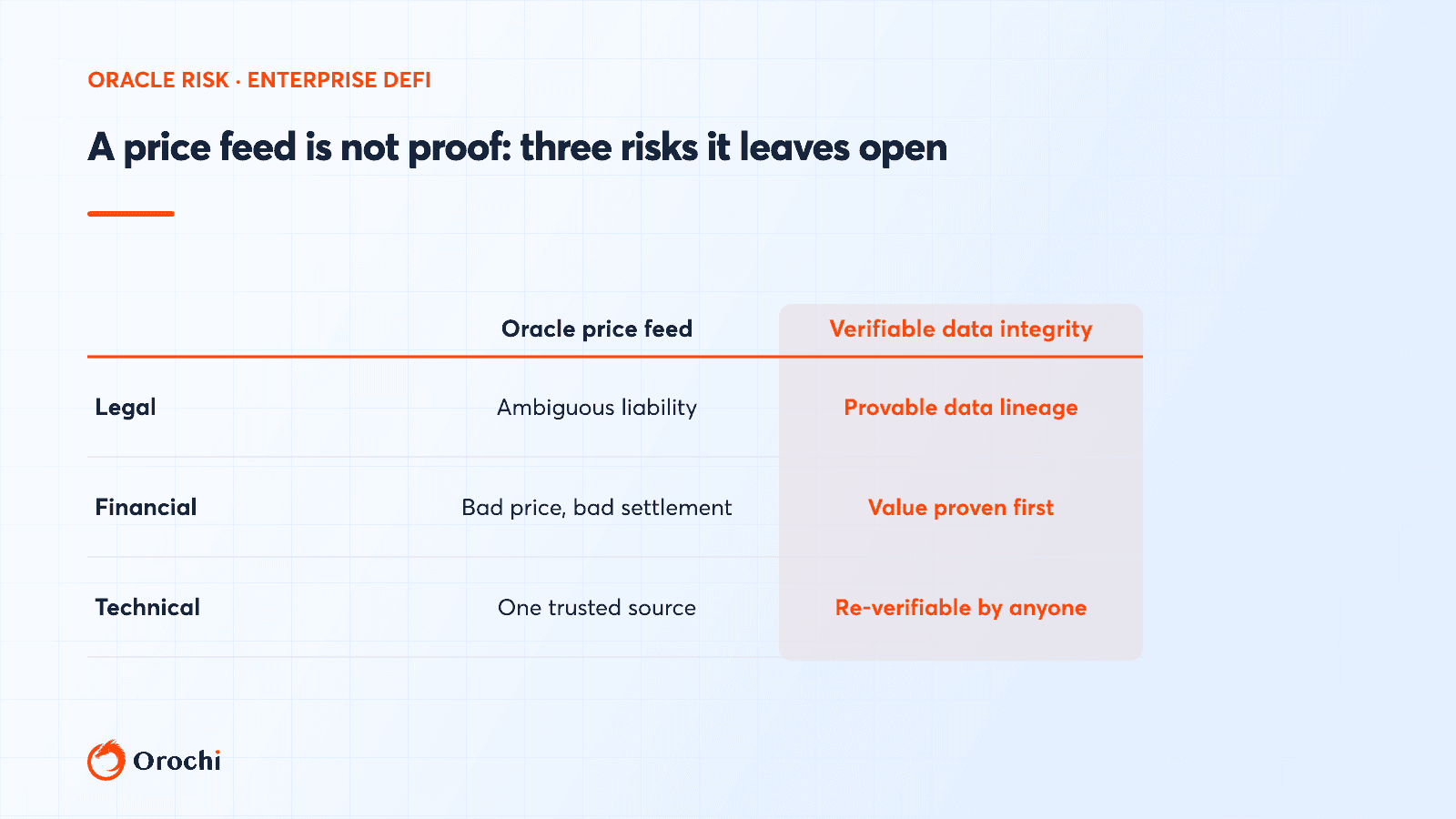
A price feed relays a value; verifiable data integrity proves the input itself, closing the legal, financial, and technical gaps.
What Is Oracle Manipulation in DeFi?
Oracle manipulation in DeFi is an attack in which a bad actor corrupts the external data input to a smart contract, causing the contract to execute on false state. The oracle supplies price data, asset valuations, or reserve figures. The contract trusts that input. When the input is false, every downstream calculation inherits that falsity: collateral ratios, NAV figures, liquidation thresholds, yield accruals.
The structural failure is not the oracle itself. It is the trust assumption embedded in every contract that consumes oracle data. Oracles operate at the transport layer: they relay data from a source to a contract. They do not generate cryptographic proof that the data was accurate at the source. The contract receives a number, not a proof.
The oracle problem is not a reliability problem. It is a verifiability problem.
Read more: Oracle Manipulation in Polymarket 2025
Smart Contract Data Dependency as a Structural Attack Surface
Smart contracts cannot fetch external data. They receive it. That single architectural constraint is the root of the oracle attack surface, and it does not get resolved by making the relay more reliable.
When a DeFi protocol consumes a price feed, it accepts a number from an external source and treats that number as fact. The contract has no internal mechanism to verify whether the number reflects the actual market state, whether it was manipulated in transit, or whether the source itself was compromised before the feed was generated. The execution logic assumes the input is correct. If the input is not correct, every calculation built on top of it is wrong.
OWASP classifies oracle dependency as the second most critical smart contract vulnerability class, behind only access control failures. That classification reflects a specific technical reality: there are three distinct input points an attacker can corrupt before a contract ever executes. The first is the data source itself, where a spot price or reserve figure can be distorted through market manipulation or direct compromise.
The second is the feed transport layer, where data in transit between source and on-chain contract can be intercepted or altered. The third is the data write into the contract's state, where the final input value can be manipulated before settlement. Any one of these three points is sufficient to produce a corrupted execution outcome. Protocols that rely on oracles are exposed at all three simultaneously, with no cryptographic proof at any stage to confirm the data's accuracy.
The structural vulnerability is not that oracles are unreliable. It is that they are unverifiable by design.
How Flash Loans Amplify Oracle Manipulation at Scale
Flash loans do not create the oracle vulnerability. They industrialize it. Without flash loans, distorting a price oracle requires capital held long enough to move a market, which introduces cost, risk, and detection exposure. Flash loans eliminate all three constraints.
The attack sequence executes within a single transaction block. An attacker borrows a large capital position with no collateral requirement, uses that position to distort a spot price or vault exchange rate, triggers a contract that consumes the manipulated oracle value, extracts value from the mispriced execution, and repays the flash loan, all before the block closes. The entire sequence is atomic. No partial state exists between steps. The manipulation, the exploit, and the repayment settle together or not at all.
This matters for enterprise institutions for a specific operational reason: the attack is complete before any monitoring system can register it. Post-transaction alerting, anomaly detection, and circuit breakers all operate on confirmed state. By the time a monitoring tool identifies that a price oracle was distorted, the funds have already moved and the transaction is final. The KiloEx exploit in April 2025, which produced a $7 million loss, followed exactly this pattern: flash loan capital distorted the perpetual futures price oracle, the mispriced contract executed, the loan was repaid, and the attacker exited within a single block. The window for intervention was zero. For institutions with real-time risk management obligations, a vulnerability class that produces irreversible losses faster than any detection system can respond is not a monitoring problem. It is an infrastructure problem.
Why Did Three Oracle Attacks in 2025-2026 Cost Institutions $13.5M?
Three incidents in a twelve-month window demonstrate that oracle manipulation is not an edge case. It is a repeating pattern with identifiable technical signatures.
$13.5M across three incidents, two of which exploited the same ERC-4626 vulnerability class within six weeks of each other.
Three Oracle Attacks, One Structural Pattern
Each incident followed the same technical sequence: unverified external price data consumed by a contract with no mechanism to independently validate the input. The attacker did not need to break cryptography. They only needed to feed false data into a system that was designed to trust it.
- KiloEx (April 2025, $7M loss): A flash loan was used to distort the spot price oracle feeding KiloEx's perpetual futures pricing engine. The contract calculated position values against the manipulated price, allowing the attacker to extract $7 million before the loan was repaid within the same block.
- Loopscale (April 2025, $5.8M loss): The protocol consumed ERC-4626 vault share prices via oracle to calculate yield-bearing token collateral values. The attacker manipulated the reported exchange rate, causing Loopscale to accept undervalued collateral as sufficient for an outsized loan position. $5.8 million was extracted through the mispriced collateral calculation.
- Venus Protocol / wUSDM (February 2026, $717K loss): The same ERC-4626 exchange rate manipulation vector was applied on ZKsync L2, where Venus Protocol consumed wUSDM vault data through an oracle bridge. The cross-chain relay introduced an additional unverified data handoff, compounding the attack surface. Two of the three incidents exploited the same ERC-4626 vulnerability class within a six-week window, confirming that unpatched oracle trust assumptions replicate across protocols sharing the same token standard. Read more: Defi Hacks 2026 | Top DeFi Hacks of February 2026 ERC-4626 - A Concentrated Oracle Vulnerability in Institutional Portfolios ERC-4626 standardizes the interface for yield-bearing vault tokens. Any protocol consuming ERC-4626 share prices via oracle relies on a reported exchange rate with no cryptographic guarantee of accuracy. Two separate protocols were exploited through this surface within six weeks. Institutions holding ERC-4626 positions in treasury management, collateral books, or fund strategies carry this exposure structurally, across every protocol that consumes rather than proves vault share valuations. What Legal and Audit Liability Does Oracle Risk Create for Enterprise Institutions? CertiK, Halborn, and incident-reporting outlets cover oracle attacks as technical events. They do not frame the consequence for institutions operating under fiduciary duty, regulatory data standards, or external audit requirements. That framing gap is where enterprise risk concentrates.
NAV Mispricing as a Financial Reporting Failure
Oracle manipulation does not only produce exploits. It produces mispricing, and mispricing propagates silently through every downstream calculation an institutional fund depends on.
A corrupted price feed does not stay contained at the point of entry. It moves through the entire calculation stack:
- Net Asset Value: Fund NAV calculated against a manipulated price input is a false NAV. Every investor statement, every redemption calculation, and every performance report built on that figure inherits the error.
- Loan-to-Value ratios: Collateral positions valued against a distorted oracle produce LTV figures that do not reflect actual exposure. A fund that believes it is within covenant thresholds may be materially undercollateralized.
- Yield accrual: Yield calculations tied to vault share prices or reserve figures carry the mispricing forward into income reporting. The reported yield is not the actual yield.
- Margin call thresholds: Risk management systems that trigger margin calls based on oracle-fed position values will either fail to trigger when they should, or trigger incorrectly, based on a price input that was never verified. For an institutional fund, each of these is not a technical incident to be patched. It is a financial statement integrity failure. The fund's reported state does not match its actual state. When an oracle input is unverifiable, every figure that depends on it carries an unquantifiable error that no post-hoc reconciliation can fully resolve. Three Regulatory Frameworks That Make Unverified Oracle Data a Legal Problem Three regulatory frameworks create direct legal exposure for institutions relying on unverified oracle data:
- Fiduciary duty: An institution that makes investment or collateral decisions on unverified data cannot demonstrate that it met its duty of care to counterparties or beneficiaries. "The oracle said so" is not a defense.
- MiCA Article 30: Crypto-asset service providers operating under MiCA carry explicit data quality obligations. Consuming unauditable oracle feeds for pricing or reserve data creates a compliance gap under the regulation's disclosure standards.
- SEC oversight: Tokenized securities require verifiable data trails. An oracle feed with no proof of accuracy at the source does not satisfy the evidentiary standard that SEC oversight of tokenized asset data implies. An institution that cannot prove its data was accurate at the time of execution cannot satisfy regulatory disclosure requirements post-incident. The Audit Trail Gap That Oracle Feeds Cannot Close An external auditor verifying a fund's positions six months after a reporting period cannot reconstruct whether an oracle feed was accurate at the time of a specific transaction. There is no proof to inspect. There is a log of what was reported, but no cryptographic evidence that the report reflected accurate source data. Attestation-based systems offer a snapshot. Verifiable Data Infrastructure offers a proof chain. The distinction matters when an auditor needs to confirm not just what was recorded, but whether the recording accurately reflected reality. Where Does Oracle Manipulation Concentrate Across Enterprise Use Cases? Oracle attacks do not distribute evenly across DeFi. They concentrate where data is most complex, most private, and most consequential. Private credit and institutional DeFi represent two of the highest-exposure categories for enterprise institutions, not because they are technically weaker than other protocols, but because the data they depend on is structurally impossible for oracle systems to verify without violating the privacy constraints that make those use cases viable in the first place. The oracle trust assumption does not just create exploit risk in these contexts. It creates a category incompatibility between how the data must be handled and what oracle systems are capable of proving. Private Credit On-Chain: Loan State Cannot Be Proven Through an Oracle Private credit is institutional-grade precisely because borrower records, repayment histories, and credit terms are not public. The data an on-chain counterparty needs to verify, including current loan state, repayment schedule adherence, and borrower access permissions, is confidential by design. No oracle can source that data without one of two outcomes: it either exposes the underlying borrower record to satisfy the data request, or it cannot access the data at all. The data structure and the oracle model are incompatible. There is no middle path where an oracle relays private credit state while preserving the counterparty confidentiality that institutional lenders require. The provable database addresses that incompatibility by storing loan state off-chain with ZKP-backed access control. Rather than relaying raw data, zkDatabase generates proofs across the loan lifecycle:
- A proof that the loan is currently in an active, performing state without disclosing the borrower's identity or credit terms
- A proof that scheduled repayments have been made on time and in the correct amounts without exposing the repayment ledger
- A proof that a specific counterparty holds valid access permissions without broadcasting the full access control list on-chain The on-chain consumer verifies the proof. It never receives the underlying borrower record. Confidentiality and verifiability are satisfied simultaneously, which is the structural condition that makes private credit on-chain viable for regulated institutions. Institutional DeFi: Cross-Chain Data Integrity Cannot Be Assumed Institutional DeFi operates across multiple chains. Counterparty eligibility must be confirmed at execution time, not at a prior attestation checkpoint. Position data must reflect current state, not a cached snapshot that may have drifted. Regulatory disclosures must be produced without exposing full portfolio state to public on-chain observers. Oracle bridges cannot satisfy any of these requirements with proof. They can only relay. Every cross-chain oracle handoff introduces a new trust assumption. Data originates on a source chain, crosses to a bridge, and arrives at the destination chain. Each transition is an unverified relay step. A compromised bridge, a manipulated feed at any intermediate point, or a timing gap between source state and destination consumption each produce the same outcome: the destination contract executes on data that cannot be proven to reflect actual source state at the time of execution. zkDatabase's cross-chain proof verification removes that assumption. The ZKP generated at data storage on the source system travels to any destination chain. The destination contract verifies the proof directly, with no intermediate trust assumption and no re-execution of the data retrieval:
- Counterparty eligibility checks are satisfied on-chain without exposing the underlying compliance record
- Position verifications reflect cryptographically committed source state, not a relayed snapshot
- Regulatory disclosures are produced from verified data commitments without broadcasting portfolio state to public observers The proof travels. The raw data does not. That distinction is what makes cross-chain institutional DeFi operationally viable under regulatory constraints. How Does zkDatabase Solve Oracle Manipulation at the Infrastructure Layer? The oracle problem is a transport-layer problem. Every solution that operates at the transport layer — redundant feeds, aggregation networks, reputation systems — addresses reliability, not verifiability. A more reliable oracle is still an unproven one. zkDatabase addresses on-chain data verification by operating at the storage layer. When data is written to zkDatabase, a Zero-Knowledge Proof is generated over that write operation. When an on-chain consumer queries that data, it receives a proof alongside the result. It verifies the proof. It does not trust the source. The audit trail is the proof chain. Every insert, every update, every query produces a cryptographic commitment that can be independently verified by any counterparty, auditor, or regulator, at any point after the fact.
Verifiable Storage vs. Transport-Layer Patching: Why the Layer Change Matters
Oracle solutions improve transport. zkDatabase changes the layer. A proof generated at write time is evidence that the data was accurate when it entered the system. No monitoring tool, no redundant feed, and no attestation service can produce that evidence retroactively. The proof either exists at write time or it does not exist at all. For institutions with audit requirements and regulatory obligations, retroactive evidence does not satisfy the standard.
End-to-End Data Lifecycle Integrity
zkDatabase generates cryptographic proofs across the full data lifecycle, each corresponding to a specific institutional failure mode:
- Insert proof: Proves the initial data record was written correctly. Relevant to loan origination, position opening, and RWA issuance events where the accuracy of the initial record determines every downstream state.
- Update proof: Proves a state change (price update, balance adjustment, repayment recording) was applied correctly. Relevant to NAV recalculations, collateral adjustments, and covenant monitoring.
- Query proof: Proves the query result is correct and that data was not altered between write time and query time. Relevant to compliance reporting and external audit verification. This is the capability gap that separates zkDatabase from oracle patches, monitoring dashboards, and attestation services. Those tools report. zkDatabase proves. Conclusion Oracle manipulation in DeFi attacks are not a monitoring problem that faster detection can solve. For enterprise institutions operating under MiCA Article 30, SEC data standards, and fiduciary duty obligations, unverified oracle data is a legal and financial liability that exists independent of whether an exploit occurs. The mispricing risk, the audit gap, and the regulatory exposure are structural, not incidental. zkDatabase addresses that structure by moving proof generation from the transport layer to the storage layer, producing a cryptographic audit trail that satisfies not just operational requirements, but compliance and evidentiary ones. zkDatabase provides the layer that enterprise DeFi requires before institutional capital can treat on-chain data as fact. Talk to our infrastructure team about your institution's data verification requirements.
Read more: What Does DeFi Look Like in 2025?
FAQs
Question 1: What Is Oracle Manipulation in a DeFi Attack?
Oracle manipulation in a DeFi attack is the process by which a bad actor corrupts the external data input to a smart contract, causing the contract to execute on false state. The attack path runs from data source corruption through feed manipulation to contract execution on the fraudulent input. OWASP classifies oracle dependency as the second most critical smart contract vulnerability class, behind only access control failures.
Question 2: Why Does Oracle Risk Create Legal Liability for Enterprise Institutions?
Legal liability arises because institutions have affirmative obligations to verify the accuracy of data used in investment and collateral decisions. MiCA Article 30 imposes data quality requirements on crypto-asset service providers. SEC oversight of tokenized securities implies evidentiary standards for data trails. An institution that cannot demonstrate its data was accurate at time of execution cannot satisfy fiduciary duty, regulatory disclosure requirements, or external audit standards when challenged post-incident.
Question 3: How Does zkDatabase Prevent Oracle Manipulation Without Replacing the Existing Data Stack?
zkDatabase addresses oracle manipulation by operating at the storage layer rather than the transport layer. It generates a cryptographic proof at the moment data is written, before any relay or oracle consumption occurs. On-chain consumers verify the proof, not the raw data feed. This functions as an infrastructure addition, not a replacement: existing data systems continue to operate while zkDatabase provides the verifiable commitment layer that produces a compliance-grade audit trail with no oracle dependency.
Related toResearch


