Real - World Assets
Tokenized Private Credit Loan Performance: How to Track and Verify On-Chain
May 4, 2026
10 mins read
Private credit tokenization blockchain protocols need continuous loan performance proof. Learn how zkDatabase generates Zero-Knowledge Proof-backed verification without exposing borrower data.


Private credit tokenization blockchain protocols have a verification problem that neither better reporting tools nor additional oracle nodes can solve. The loan data that determines token value — repayment status, collateral condition, covenant compliance — lives in the lender's internal system. The token contract that prices and settles against that data operates on-chain. Between those two systems, there is no cryptographic proof layer in most deployed protocols today.
That structural gap has a direct consequence at institutional scale. Secondary market participants cannot independently confirm whether a loan is performing. Covenant enforcement logic cannot trigger automatically when a breach occurs. Token pricing reflects what the lender chose to report, not what an independent verifier confirmed. For institutional capital allocators, compliance teams, and protocol architects evaluating tokenized private credit as a viable asset class, that is not an acceptable trust model.
This article covers what data must be tracked in a private credit tokenization blockchain protocol, why that data cannot be published to a public chain directly, and how zkDatabase generates verifiable on-chain loan performance proof without exposing borrower records at any step in the process.
What Is Private Credit Tokenization on Blockchain?
Private credit tokenization blockchain represents private loan agreements as tokens, where token value depends on the performing status, covenant compliance, and collateral condition of the underlying loan. All of those facts must be continuously tracked and verified, not reported once at issuance and forgotten.
Private credit is one of the fastest-growing segments in tokenized assets, with platforms like Maple Finance and Goldfinch already managing hundreds of millions in on-chain loan portfolios. The data integrity problem they face is not a product gap. It is structural: the loan data that determines token value lives off-chain, but the token contract operates on-chain.
Secondary market liquidity, token pricing accuracy, and covenant enforcement all depend on verified loan state. When lenders self-report their own performance data without a cryptographic anchor, secondary market investors have no independent way to confirm whether a loan is performing. That gap is where on-chain private credit protocols become vulnerable to mispriced risk.
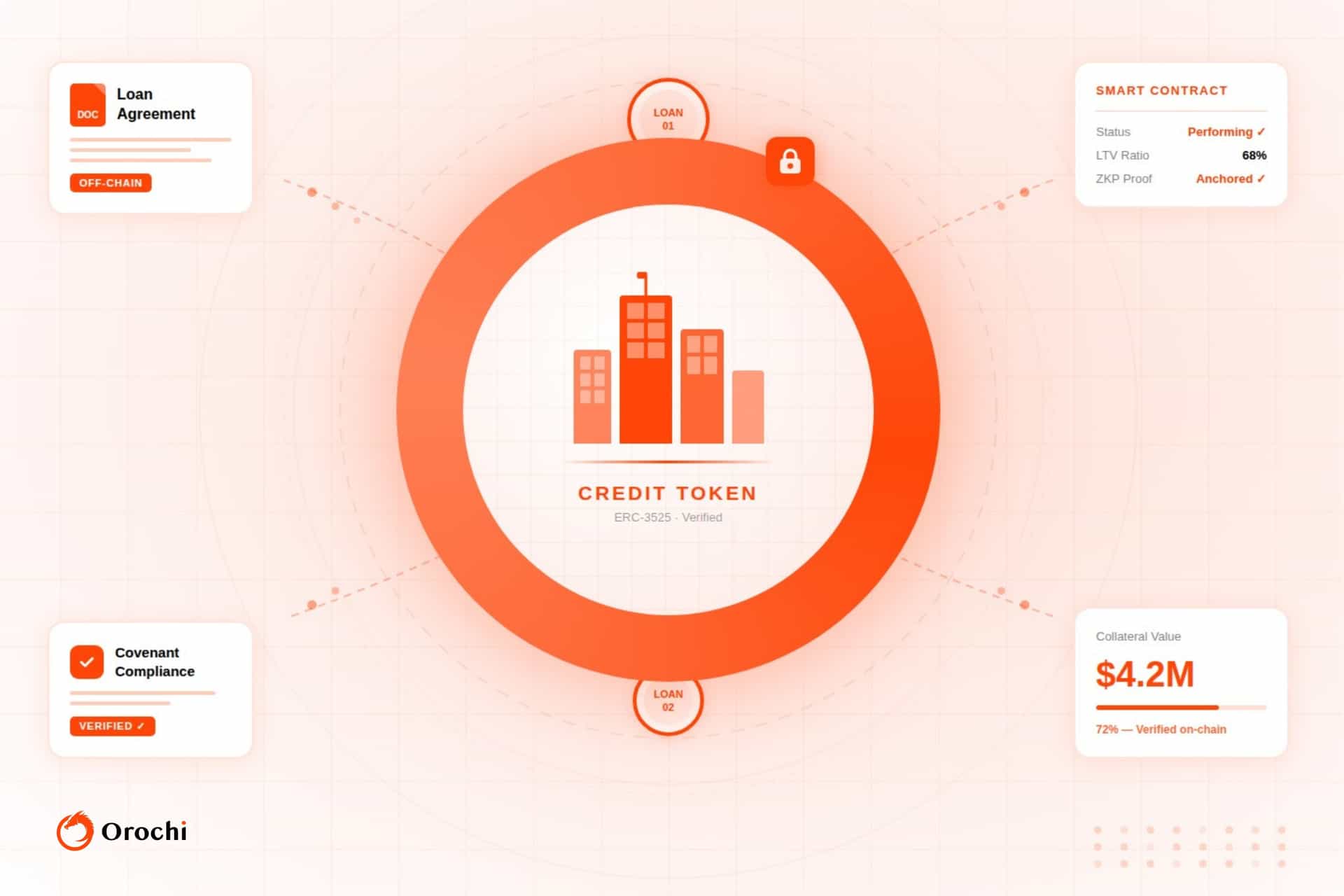
The specific gap zkDatabase addresses: there is no Zero-Knowledge Proof-anchored loan state layer between the lender's loan management system and the on-chain token contract. zkDatabase stores loan performance data off-chain and generates cryptographic proofs over every data state change, so protocols can publish verifiable commitments on-chain without exposing borrower records.
What Prerequisites Are Needed to Implement zkDatabase for Private Credit Verification?
Before integration begins, the protocol team needs four components in place.
- An off-chain loan management system (LMS) capable of pushing data updates on each state change. The LMS is the authoritative data source — zkDatabase receives event-driven writes every time loan state changes, not scheduled polling.
- Defined loan performance data fields, specifically: repayment status, outstanding principal, collateral value, covenant compliance flags, and days-past-due. These are the assertion inputs. Borrower PII is excluded from this set and is not required for proof generation at any step.
- A smart contract verifier deployment on the target chain. The verifier contract is what the token pricing logic queries to read proof status, and it must be live before proofs can be consumed on-chain.
- Access to the zkDatabase SDK. The SDK handles the connection between the LMS and the zkDatabase instance, including proof configuration and assertion condition setup.
How to Track Loan Performance On-Chain With zkDatabase
The core problem with on-chain private credit today is that loan performance data changes continuously, but on-chain proof of that performance does not. Lenders update their internal systems daily. Token contracts read static or manually updated values. zkDatabase closes that gap by running a proof generation layer between the LMS and the chain.
The six-step flow below is the complete implementation path.
- Define the verifiable data fields. The assertion inputs are: repayment status, outstanding principal, collateral value, covenant compliance flags, and days-past-due. Borrower PII is excluded from this set entirely. The proof asserts conditions over these fields, not the identity behind them.
- Connect the lender LMS to zkDatabase. The off-chain loan management system pushes updates to the zkDatabase instance on each data state change. This is event-driven, not polled. Every relevant change in loan state triggers a write to zkDatabase.
- Configure assertion conditions. Define the proof conditions for "loan performing": repayment current AND collateral value above the configured threshold AND no covenant breach. These conditions are configurable per protocol requirements. The proof does not hardcode a fixed definition of performance; the protocol architect sets the parameters.
- Generate proof on each update. zkDatabase generates a Zero-Knowledge Proof automatically on each data state change. Proof generation runs asynchronously, so it does not block the upstream LMS write operation.
- Publish proof on-chain. The proof commitment is posted to the on-chain smart contract verifier. The token contract reads proof status directly for pricing logic. No raw loan data travels to the chain at this step.
- Investor dashboard reads proof status. The secondary market interface reads the on-chain proof and displays "verified performing" or "covenant breach triggered." No raw loan data is exposed at any step in this flow.
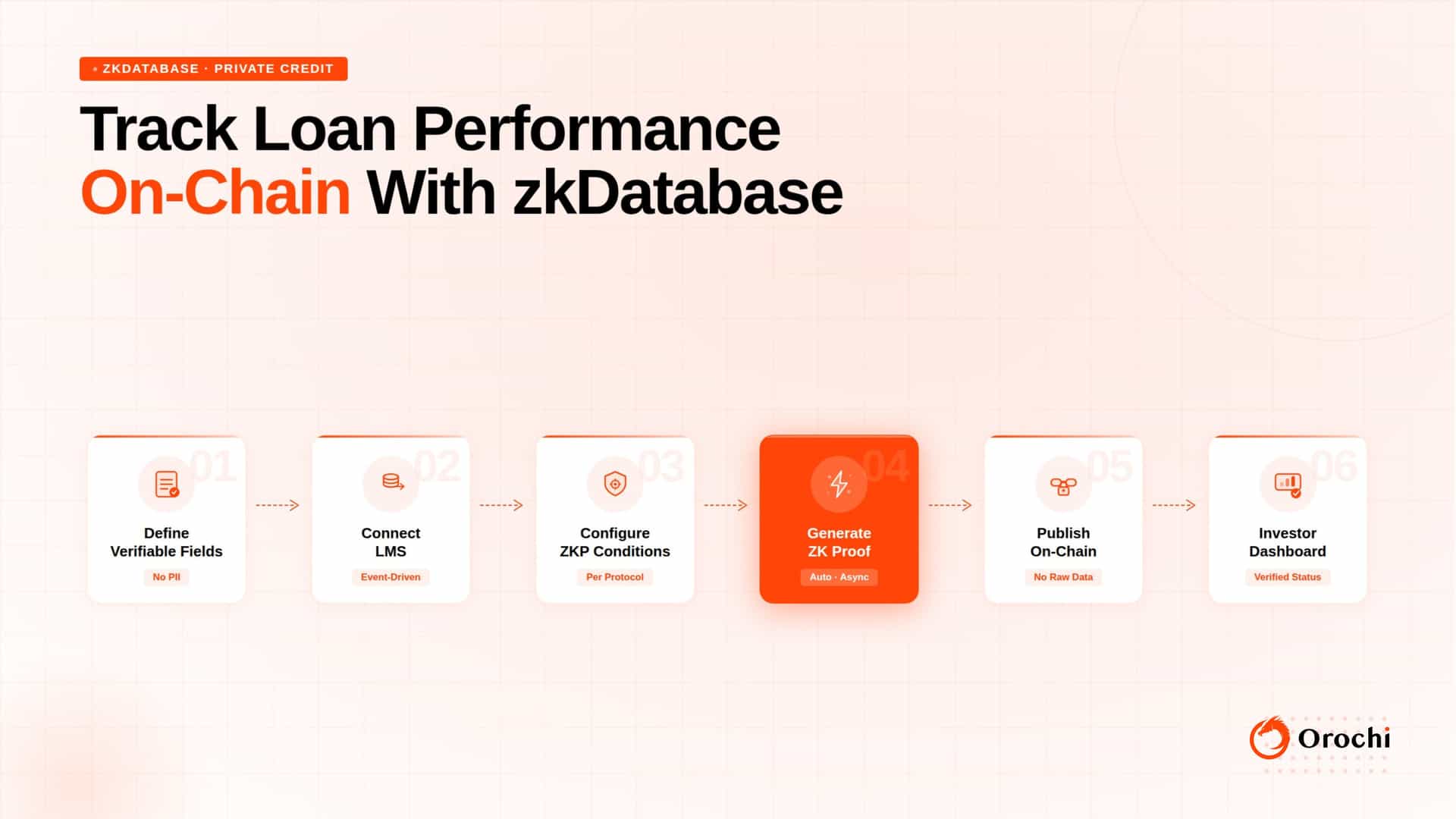
When an assertion condition fails, the proof signals non-performing status on-chain. The token contract triggers covenant logic automatically, such as halting distributions or initiating recovery procedures. Borrower identity and loan terms remain in off-chain storage throughout. This is how private credit verification becomes operationally viable at institutional scale: the chain knows the loan state without knowing the borrower.
zkDatabase automates verifiable loan performance proof at every data state change, without ever exposing the underlying borrower data to the chain.
How Does zkDatabase Handle Multiple Loan Updates Per Day?
Institutional lending protocols process multiple state changes per loan per day: repayment events, collateral revaluations, covenant flag updates. The proof generation layer must handle this volume without creating latency that blocks the upstream system.
zkDatabase generates proofs asynchronously per data state change. Proof latency does not block the upstream LMS write. On-chain consumers query the latest valid proof rather than waiting for a pending state. Proof availability is architecturally decoupled from proof generation latency.
How Are Default Events Proven Without Exposing Borrower Identity?
When a default event occurs, the assertion condition fails. The on-chain proof signals non-performing status. The proof does not include raw borrower data. It proves the fact — loan in default — without including the identity of the defaulting party.
Loan performance data linked to an identifiable natural person qualifies as personal data. Publishing that data on a public chain, even in summary form, creates regulatory exposure. The zkDatabase approach keeps borrower identity and loan terms in off-chain storage at all times. Only the proof commitment reaches the chain. Verifiability and privacy operate on different data layers. They are not in conflict.
What Is the Latency Between a Loan Status Change and On-Chain Proof?
From the protocol architect's perspective, the question is: what is the maximum acceptable lag between a loan entering default and the on-chain proof reflecting that status?
The proof pipeline has three latency components: LMS write, zkDatabase proof generation, and on-chain commitment post. Configurable freshness windows allow protocols to reject proofs older than N blocks. Staleness is machine-enforceable. A protocol can require that any proof consumed by the token contract was generated within the last X blocks, independently of the lender's reporting schedule.
What Are the Most Common Privacy Compliance Errors in Private Credit Tokenization?
Most compliance failures in on-chain private credit are not discovered at launch. They are baked into the data architecture before any code is written. The following four mistakes are the most consequential.
- Including borrower PII in assertion inputs. This violates GDPR Article 4 and is architecturally unnecessary. The proof condition requires no raw identity data. The proof asserts a condition over loan state fields, not over the borrower record.
- Using wallet address as borrower identifier on-chain. Wallet addresses are pseudonymous, not anonymous. In many compliance contexts, a wallet address is sufficient to link an on-chain position to an identifiable party, which de-anonymizes the loan relationship.
- Publishing full loan data to a public chain as "just metadata." Under GDPR, loan performance data linked to an identifiable party is personal data, regardless of how it is labeled by the protocol. The label "metadata" does not change the regulatory classification.
- Relying on lender self-reporting without cryptographic attestation. This eliminates the verifiability that secondary market liquidity requires. Self-reported loan performance is an assertion. It is not a proof. According to Halborn Security, unverified data feeds are one of the most persistent attack surfaces in DeFi protocols, covering both oracle manipulation and internal reporting failures.
Privacy compliance in private credit tokenization is not a post-launch concern. GDPR violations at the data architecture level cannot be patched after deployment.
zkDatabase vs. Manual Loan Reporting
The comparison below is framed from the institutional investor's perspective: what does each approach actually provide, and where does each fail structurally?
| Dimension | Manual Loan Reporting | zkDatabase Verification |
|---|---|---|
| Update frequency | Periodic (monthly / quarterly) | Continuous, proof per state change |
| Borrower privacy | Full data exposed to verifier | Off-chain only, proof verifies condition not data |
| Investor verifiability | Trust lender report | Query on-chain proof independently |
| Audit cost | Manual reconciliation per cycle | Proof chain is the audit trail, no manual step |
| Default response time | Discovered at next reporting cycle | Proof signals non-performing status immediately on assertion failure |
Manual audit cycles in tokenized credit structures create information gaps that institutional investors cannot accept at scale. The proof chain that zkDatabase generates is the audit trail. There is no separate reconciliation exercise.
Conclusion
Private credit tokenization blockchain protocols have reached the point where the data infrastructure, not the token mechanism, is the binding constraint on institutional adoption. Loan performance data that cannot be verified independently by secondary market participants is not a compliance inconvenience. It is the reason institutional capital stays out.
zkDatabase addresses that constraint by operating at the data layer, generating Zero-Knowledge Proof-backed verification on every loan state change, before any data reaches the chain. The result is a verifiable audit trail that runs automatically, respects borrower privacy, and satisfies the cryptographic standard that regulated counterparties require.
Orochi Network positions zkDatabase as the proof layer between off-chain lending operations and on-chain settlement. For protocols building toward institutional-grade secondary markets, that layer is not optional.
FAQs
Question 1: What Data Is Needed to Track Private Credit Loan Performance On-Chain?
Tracking private credit loan performance on-chain requires repayment status, outstanding principal, collateral value, covenant compliance flags, and days-past-due. All of this data is stored off-chain. zkDatabase generates a Zero-Knowledge Proof that verifies these facts are in a defined state — such as "loan performing" — without publishing the raw data to the chain.
Question 2: How Do Private Smart Contracts Verify Loan Data Without Revealing It?
Zero-Knowledge Proof-based smart contracts verify loan data by asserting a condition — for example "repayment is current AND collateral is above threshold" — without including the underlying loan data in the proof. zkDatabase stores the data off-chain and generates the proof over a configured assertion condition. The on-chain verifier confirms the assertion is valid without receiving the raw data.
Question 3: What Happens When a Loan Goes Into Default in a Tokenized Private Credit Protocol?
When a loan enters default, the assertion condition fails. zkDatabase generates a proof of non-performing status. The on-chain verifier contract reads this proof and the token contract triggers the configured covenant logic — for example halting distributions or initiating recovery procedures. Borrower identity and loan details remain in off-chain storage throughout the process.
Related toReal - World Assets