Data Privacy
Why Privacy Is The New Competitive Moat
January 29, 2026
11 mins read
As we enter 2026, the era of total transparency is ending. Discover why privacy has become the ultimate competitive moat in Web3, protecting proprietary business logic and sensitive data from being cloned in an open-source economy.


In an open-source economy where blockchain protocols can be forked and codebases replicated almost overnight, privacy has become the new competitive moat. While software can be copied, private state and private data cannot be easily cloned or migrated. This makes privacy one of the few truly defensible assets in Web3.
In an open-source Web3 economy where protocols can be forked overnight, privacy has become the true competitive moat. Code can be copied but private state and private data cannot.
As blockchain moves beyond experimentation into institutional and regulated use cases, privacy is no longer optional. It is core infrastructure. Systems must protect sensitive data while remaining verifiable and compliant.
Built on this principle, Orochi Network and its zkDatabase enable privacy by design, allowing data to remain confidential while proofs of correctness and compliance are verified on-chain.
The Current State: The "Glass House" Dilemma
For over a decade, "radical transparency" was the industry standard. While essential for trust in the early days, this total visibility has now created a strategic bottleneck. We are witnessing a shift where privacy vs transparency in blockchain is no longer a choice, but a survival requirement.
Why radical transparency is failing modern enterprises:
- Front-Running Risks: When order books and intents are visible mempools, MEV bots and competitors can exploit trades before they settle.
- Strategy Exposure: Hedge funds and institutions cannot deploy proprietary trading algorithms on-chain if every move is broadcast to the world.
- Copycat Vulnerability: Open code combined with open data allows competitors to fork not just the tech, but the business logic instantly.
Comparison: The Evolution to Privacy-First Infrastructure
To understand why privacy matters in crypto today, we must compare the limitations of legacy chains with the capabilities of modern privacy architectures.
| Feature | Legacy Transparent Chains | Privacy-First Infrastructure |
|---|---|---|
| Data Visibility | Public to everyone (Competitors & Users) | Selective Disclosure (Owner controls visibility) |
| Competitive Moat | Weak (Easily Forked/Copied) | Strong (Private State cannot be cloned) |
| Institutional Fit | Low (Compliance & Strategy risks) | High (Protects IP & User Data) |
| Primary Focus | Public Verification | User Privacy & Data Integrity |
The market is moving away from "public by default." To build a sustainable ecosystem, developers must adopt privacy-first infrastructure as the new standard. This is the only way to transform blockchain from a speculative casino into a secure global settlement layer.
Why Privacy Creates Long-Term Advantage ?
Privacy is no longer just a compliance requirement. It has become a strategic moat. As digital systems scale across Web3, AI, and regulated industries, platforms that can protect sensitive data while still enabling verification gain a clear competitive advantage.
- Privacy by default builds trust Users and enterprises increasingly choose systems that minimize data exposure instead of asking for blind trust.
- Better retention and adoption When users feel safe sharing data, they stay longer and engage more deeply.
- Enterprise readiness Institutions require privacy guarantees for compliance, audits, and risk management—without slowing innovation.
The Shift from Transparency to Selective Disclosure
Imagine living in a house made entirely of glass. While it proves you have nothing to hide, it also means everyone sees exactly what you are doing, 24/7. This is the problem with current blockchains: Full transparency is becoming a trap.
Why Being "Open" is No Longer Scalable
When every piece of data is public, we face three major problems that stop real businesses from joining crypto space:
- User Data Leakage: Right now, your wallet address reveals your entire financial history. It’s like posting your bank statement on social media for hackers to see.
- Surveillance Risks: Malicious bots monitor the network constantly. If they see you trying to buy a token, they can jump in front of you (front-running) to make you pay a higher price.
- Business Secrets: A company like Coca-Cola would never put its secret formula on a public blockchain. If competitors can see your suppliers, pricing, and customers, you lose your business edge.
The Solution: Prove It Without Showing It
We need to move from "showing everything" to selective disclosure. This means you can choose what to share and what to keep private.
This is the core of privacy-preserving systems. Instead of dumping all your data on-chain, we use a principle called data minimization.
- Old way: Reveal your passport to prove you are over 18 (exposing your address, name, ID number).
- New way: Cryptographically proves "I am over 18" without revealing any other personal details.
This shift allows us to verify facts without sacrificing secrets.
Why Privacy Is Critical for Web3, Assets Tokenization and Regulated Industries
The need for privacy is not a "nice-to-have" feature; it is the fundamental requirement to unlock the full potential of the next-generation internet. Let's look at how this impacts three key areas:
In Web3: Protecting Your Digital Footprint
- On-chain Data Permanence: Everything you do on a public blockchain stays there forever. It’s like having a permanent digital tattoo of every transaction. Without privacy in Web3, a mistake made years ago can haunt you indefinitely.
- Wallet Activity Exposure: Your wallet address is a public window into your financial life. If it gets linked to your real-world identity, everyone from marketers to malicious actors—knows your net worth and spending habits.
In Asset Tokenization: Safeguarding Sensitive Assets
When we move real-world assets (like real estate, bonds, or intellectual property) onto the blockchain, the stakes get higher.
- Asset Data Sensitivity: Tokenizing a valuable painting or a company’s equity requires putting sensitive valuation data on-chain. This data needs protection from competitors.
- Transaction Confidentiality: Large-scale asset transfers or private deals should not be broadcast to the public before they are finalized. Privacy ensures that these high-value movements remain confidential until the right moment.
In Regulated Industries: Meeting Compliance and Security Needs
For sectors like Finance, Healthcare, and Identity to adopt blockchain, privacy is non-negotiable.
- Enterprise Data Privacy: Banks cannot share customer data, and hospitals cannot reveal patient records publicly due to strict regulations (like GDPR or HIPAA).
- Real-World Assets (RWAs): To tokenize RWAs legally, you must comply with Know Your Customer (KYC) and Anti-Money Laundering (AML) rules. Privacy technology allows you to prove compliance without revealing the underlying personal data.
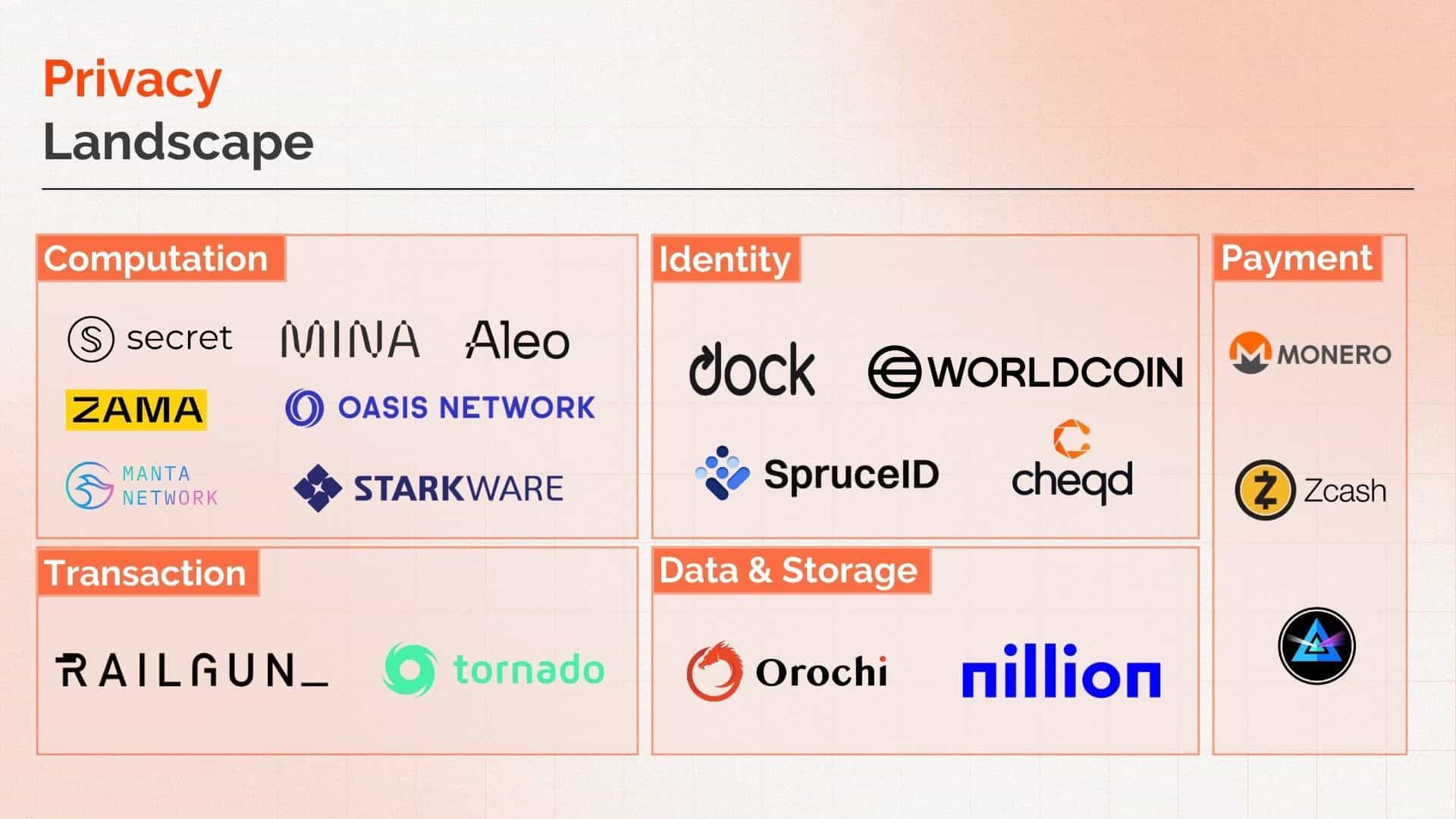
To visualize how the industry is addressing these challenges, the "Privacy Landscape" graphic below categorizes leading projects based on their core function, ranging from private computation and identity to secure data storage.
The Core Concept to Remember: Privacy ≠ Secrecy. Privacy is about controlled verifiability. It means you can prove something is true (e.g., "I am compliant") without having to show the raw data that proves it.
The Limitations of Traditional Privacy Models
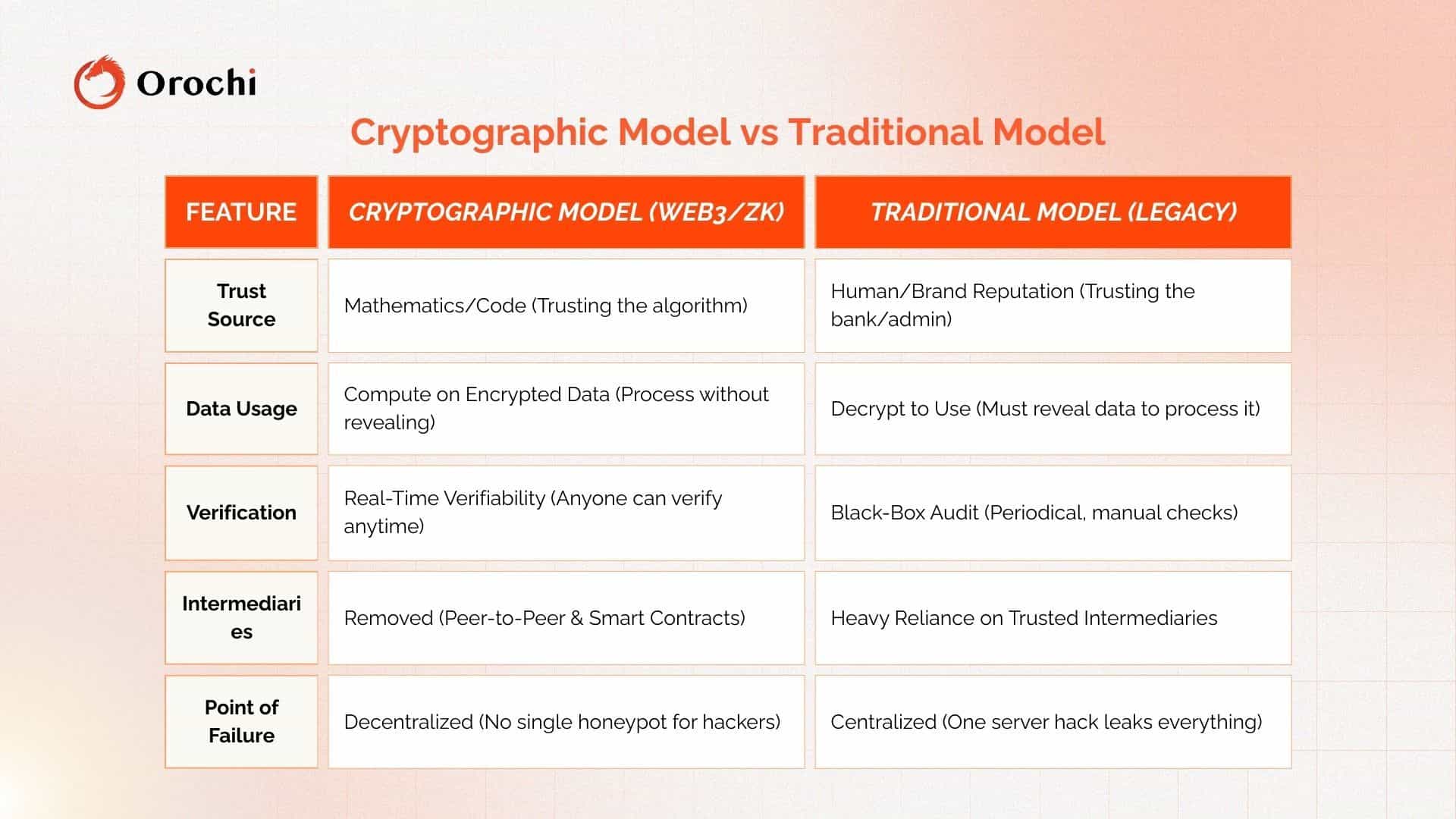
Before we can appreciate the new technology, we must understand why traditional data privacy is broken. For decades, "privacy" simply meant "trusting someone else to keep your secrets." In the digital age, this model is no longer sufficient.
Why Legacy Approaches Fail
The old way of doing things has three fatal flaws:
- Encryption Without Verifiability (The "Locked Safe" Problem): Traditionally, if you encrypt data, it becomes a useless block of static noise. To use the data (e.g., to check if you have enough money for a loan), you have to decrypt it first. The moment you decrypt it, privacy is lost.
- Reliance on Trusted Intermediaries: We rely on banks, notaries, and platforms to act as trusted intermediaries. We trust them not to peek at our data or get hacked. But history shows that even the biggest intermediaries suffer data breaches.
- Black-Box Audits: How do you know a company is handling your data correctly? Usually, they hire an auditor who issues a report. You can't check the data yourself; you just have to trust the auditor's word. This is a "black box". You see the result, but not the process.
Comparison: Trust vs. Truth
The table below highlights the critical privacy limitations of the legacy model versus the new cryptographic standard.
Verifiable Privacy and Proof-Based Data Systems
We are entering a new era where privacy is no longer about trusting a locked box, but about verifying the truth mathematically. We call this Verifiable Privacy.
The New Definition: Privacy + Proof
In the past, privacy meant secrecy, hiding data away and hoping no one finds it. Verifiable privacy changes the equation. It combines the security of keeping data hidden with the utility of proving facts about that data.
Simple formula:
'' Verifiable Privacy = Data remains hidden + Proof it is correct
How It Works: Cryptographic Proofs Simplified
At the heart of this system are cryptographic proofs, often using techniques like Zero-Knowledge Proofs (ZKPs).
Think of it as proving you have a key to a locked door without showing the key itself.
- The Old Way: You hand your key to the guard. He checks it, opens the door, and gives it back. (Risk: He could copy your key).
- The Verifiable Way: The guard stands outside. You unlock the door from the inside and walk through. The guard sees you exit, so he knows you have the key, but he never saw the key itself.
This is privacy-preserving verification. You prove the statement ("I have the key") is true, without revealing the secret ("The shape of the key").
The Breakthrough: Verification Without Revelation
This technology enables a powerful shift: Verifiable data.
- You can prove you are solvent without revealing your bank balance.
- You can prove you are a citizen without showing your passport number.
- You can prove a transaction is valid without showing who sent it or how much was sent.
By separating the fact (the proof) from the data (the secret), we eliminate the need for trust. We replace "Trust me, I checked it" with "Here is the proof, check it yourself."
Orochi Network and Privacy-First Verifiable Data Infrastructure
Orochi Network is building a privacy-first verifiable data infrastructure designed for systems where trust must be proven, not assumed. Rather than operating as an application layer, Orochi positions itself as foundational infrastructure that enables data to be verified cryptographically while remaining private by default.
At the core of this approach is zkDatabase, which transforms off-chain data into verifiable data that can be checked on-chain without exposing raw information. This allows organizations to maintain data confidentiality while still enabling audit-ready verification, regulatory compliance, and cross-system interoperability.
By combining privacy guarantees with proof-based verification, zkDatabase supports enterprise-grade workflows where correctness, integrity, and selective disclosure are essential. This model reflects a broader shift toward privacy-preserving data infrastructure, where systems scale not through transparency alone, but through controlled, verifiable trust.
Try zkDatabase Testnet with us.
Conclusion
As we look toward 2026, the era of "trust me, I'm transparent" is ending. The market has spoken: Privacy Is The New Competitive Moat. It is the only defensible asset that prevents competitors from cloning your business logic and ensures institutions can safely enter the Web3 space.
We are shifting from a paradigm of total exposure to selective disclosure, where verifiable data infrastructure becomes the backbone of the digital economy. Projects that adopt privacy-preserving verification today will build the trust and retention that legacy transparent chains cannot match.
Orochi Network stands at the forefront of this evolution. By providing the infrastructure layer for zkDatabase, we aren't just hiding data; we are empowering developers to prove facts, ensure compliance, and secure assets without compromise.
FAQs
What does privacy mean in modern digital systems?
Privacy no longer means secrecy or hiding illegal activity. In modern Web3, privacy means controlled verifiability. The ability to prove a statement (like solvency or identity) is true without revealing the underlying sensitive data.
Why is privacy becoming a competitive moat in Web3?
Because open-source code and public data make it easy for competitors to fork and clone projects. A "private state" cannot be copied, creating a strong network effect and business advantage that protects proprietary strategies and user data.
How can data be verified without being exposed?
We use cryptographic proofs, such as Zero-Knowledge Proofs (ZKPs). This technology allows a prover to demonstrate the truth of a statement (e.g., "I am over 18") to a verifier without ever showing the raw data (e.g., the birth date).
What role does verifiable data infrastructure play in privacy?
It acts as the foundation. Just as you need a strong foundation to build a house, you need verifiable data infrastructure like Orochi Network to manage, store, and compute data privately before it is used in smart contracts or dApps.
How does zkDatabase support privacy-preserving verification?
zkDatabase allows for the processing of data off-chain while generating a cryptographic proof of that processing. This ensures the data remains private, but its integrity and correctness are verified on-chain, making it perfect for enterprise and financial applications.
Related toData Privacy