Data Privacy
How Does Tokenization Protect Customer Data and Privacy in 2026?
February 2, 2026
16 mins read
How Does Tokenization Protect Customer Data and Privacy in 2026? Token vaults, FPE, PCI/GDPR scope cuts, and verifiable pipelines with zkDatabase now.


How does tokenization protect customer data and privacy in 2026? By cutting the number of places where raw PII and payment data ever exists, then forcing every path back to the original to pass through a hardened, audited choke point. That sounds simple. The hard part is making the system behave that way under pressure, at scale, with multiple teams, vendors, and data pipelines trying to “just ship.”
Most customer data privacy failures are blast-radius failures. Not one system gets hacked, but thirty systems quietly accumulate the same identifiers across logs, queues, analytics exports, and support tooling. Data tokenization is a containment strategy. It does not “solve privacy.” It changes the physics of exposure so a compromise yields useless artifacts instead of identity.
This article walks through tokenization in data security as it exists in real production flows: step by step implementation, vaulted vs vaultless tokenization tradeoffs, tokenization vs encryption and masking, compliance scope impacts like PCI DSS compliance and GDPR compliance, and the mistakes that quietly destroy privacy programs. Then we go one layer deeper: how zkDatabase turns tokenization from “trust us” security into a verifiable data infrastructure with Zero-Knowledge Proofs (ZKPs), so privacy controls become provable.
What is data tokenization in security, and what problem is it solving in 2026?
Data tokenization replaces sensitive data with unique tokens while the original value stays in a separate, secured system. In 2026, it matters because customer data moves through APIs, SaaS tools, analytics, and AI workflows where exposure risk comes from uncontrolled replication, not just database compromise.
How does tokenization actually transform customer data into tokens?
- Define sensitive value, token, and mapping: the token stands in for the original, and a controlled mapping mechanism allows authorized reversal.
- Simple flow: ingest → tokenize → store original in a token vault (or secure system of record) → propagate tokens across services.
- Tokens are safe in places where raw data is dangerous: logs, analytics tables, event streams, vendor payloads, and test environments.
- Deterministic vs random tokens: deterministic tokens preserve joins; random tokens maximize unlinkability. Choose deliberately.
Why does 2026 change the tokenization requirements for privacy programs?
In 2026, privacy breaks less often because someone “hacked the database” and more often because raw data quietly leaks across the organization. SaaS sprawl turns every integration into a new exfiltration path. AI and automation increase the number of systems that “want” full-fidelity data, which multiplies re-identification and accidental exposure risk. Operational surfaces like misrouted events, debug logs, and data exports become the dominant breach vectors. Tokenization therefore becomes a control plane problem: policy, access, auditability, and safe defaults matter more than the token format itself.
When is tokenization the right control compared to encrypting everything?
Encryption protects data at rest and in transit, but real systems routinely decrypt to process. Tokenization changes the game by removing sensitive fields from most systems entirely. It works best when paired with strict detokenization policy and durable audit trails. A simple heuristic holds: if a system does not truly need the original value, it should never receive it.
How does tokenization protect customer data and privacy in 2026 at a systems level?
Tokenization protects privacy by minimizing where sensitive customer data exists, shrinking breach blast radius and limiting compliance scope. Its real security value comes from controlling detokenization, not from the token format itself.
How does tokenization reduce breach blast radius and lateral movement?
- Tokens in downstream systems make stolen tables far less valuable to attackers because the monetizable data sits behind vault controls.
- It limits credential reuse impact: attackers can exfiltrate tokens, but cannot cash out without vault access.
- It prevents “secondary leaks” where raw PII ends up in logs, exports, analytics tables, and vendor systems.
- It simplifies incident response: fewer systems contain regulated data, so fewer systems require forensic validation and disclosure decisions.
Design note with realistic throughput targets: a mid-size consumer app can easily emit 10,000+ events per second at peak. If even 1% of those events contain raw PII, you get a privacy time bomb sitting in your data lake. Tokenize at ingestion, and the same pipeline stays useful without becoming toxic. Fortanix explicitly frames value in tokenizing early to reduce exposure before data moves across environments.
How does tokenization reduce PCI DSS and privacy compliance scope in practice?
- Scope reduction means fewer systems store or process PAN or regulated PII.
- Before vs after: payment service plus vault stay in scope, but analytics and most internal services can operate on tokens.
- Practical win: less audit surface, simpler controls, clearer data lineage and accountability.
- Condition: scope reduction fails if detokenization becomes a casual convenience feature.
What privacy guarantees does tokenization provide, and what does it not guarantee?
Tokenization is not anonymization. It is reversible by design under policy, which is exactly why it remains operationally useful. Privacy outcomes depend on governance: who can detokenize, when, and for what purpose. Tokenization does not guarantee data integrity or correctness; tamper detection and provenance require separate mechanisms. Tokenization reduces exposure risk, not all privacy risk: inference and linkage attacks still exist if you overuse deterministic tokens or leak auxiliary identifiers.
What are the main tokenization architectures (vaulted vs vaultless), and how do you choose?
Vaulted tokenization stores originals in a central vault and uses tokens elsewhere, while vaultless tokenization derives tokens cryptographically without a stored mapping table. Choose based on your dominant risk: vault compromise, operational complexity, performance, determinism requirements, and legacy format constraints.
What is a token vault, and what are its failure modes?
The token vault is the crown jewel. If an attacker gets broad vault access, they do not steal data, they regain the ability to detokenize at scale. Common failure modes look boring, which is why they hurt: over-broad network access, weak key management, poor segmentation between environments, and missing audit logs that would prove who did what. Reliability also becomes security. If your vault goes down, teams create “temporary” bypasses, and those bypasses outlive the incident. Treat the vault like a high-trust boundary, not like an ordinary database. Fortanix describes vaulted tokenization explicitly as a central secure map linking token back to original.
What is vaultless tokenization, and when is it a better fit?
Vaultless approaches reduce centralized mapping risk but shift pressure onto key management, determinism, and revocation patterns. They fit high-scale systems where you cannot tolerate vault lookups on hot paths, or where the original data already lives behind a different authoritative system and you mainly need safe surrogates. Governance changes too: key rotation, purpose scoping, and audit semantics differ from vaulted models. “Better” does not mean “more secure” by default; it means a different failure shape that may match your operational reality.
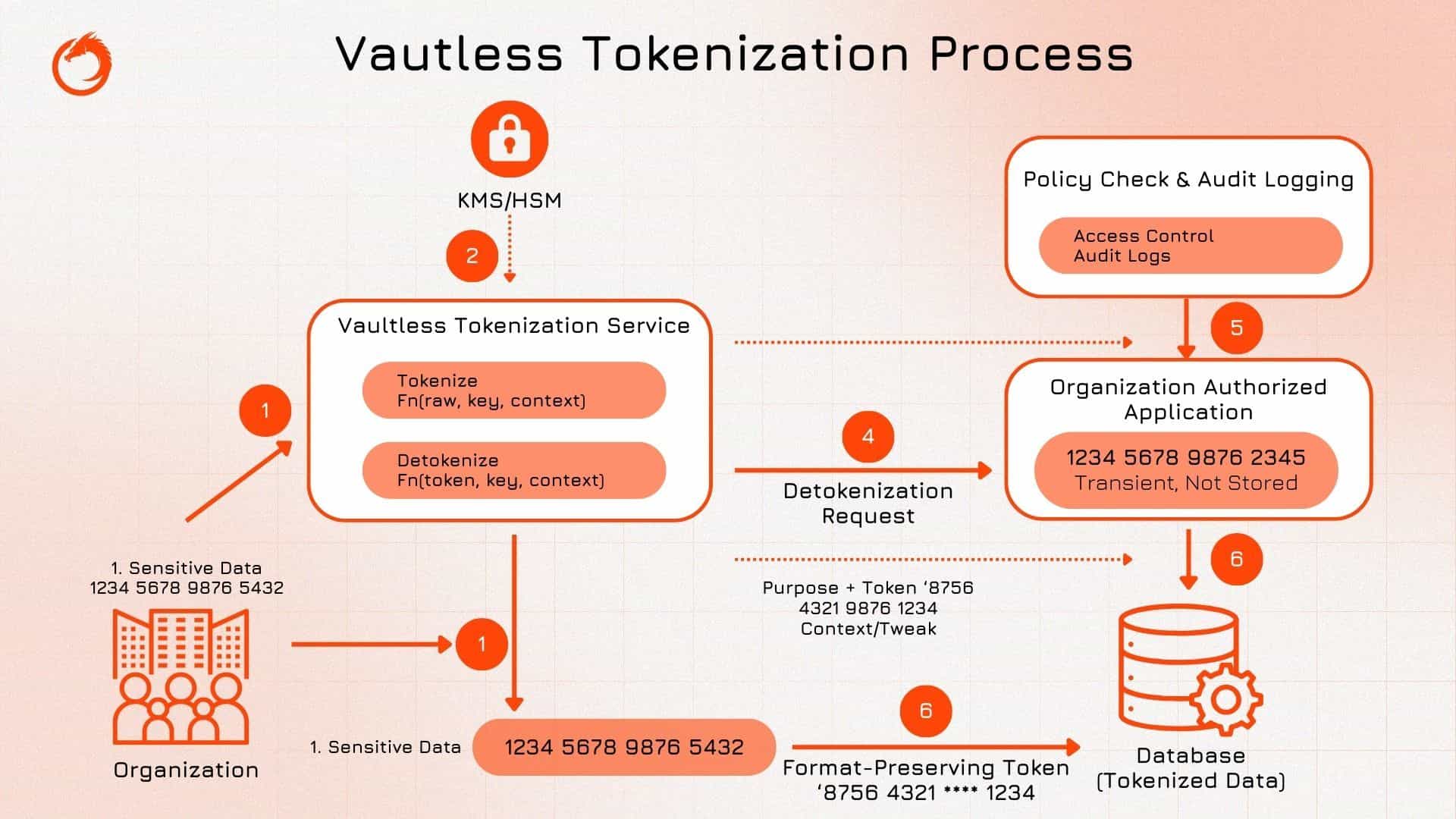
How does format-preserving encryption (FPE) fit tokenization for legacy systems?
- Legacy systems often need the “same shape” field: fixed length, charset constraints, validation rules.
- Format-preserving designs reduce migration friction because downstream systems accept tokens without schema change.
- Risk note: “format-preserving” does not mean “safe everywhere.” Policy still governs where values can travel.
- Set boundaries: decide which fields can be format-preserved and which must be fully tokenized with non-derivable tokens.
How does tokenization compare to encryption, hashing, masking, and anonymization for privacy outcomes?
Tokenization removes sensitive values from most systems while preserving utility through tokens. Encryption protects confidentiality but still requires decryption for use; masking reduces casual exposure; hashing supports one-way matching and integrity workflows; anonymization aims to prevent re-identification but rarely offers hard guarantees in rich datasets.
Which comparison framework helps teams pick the right control without false confidence?
- Use a decision table: reversibility, utility, scope reduction, operational burden, and failure mode.
- Avoid the privacy trap: confusing masking with tokenization, or tokenization with anonymization.
- Include processing needs: search, joins, analytics, customer support, dispute handling, fraud.
- Include abuse surface: insider access, vendor integrations, logging, observability, and “temporary” admin tools.
What is the cleanest way to explain “tokenization vs encryption” to execs and auditors?
| Tokenization | Encryption | |
|---|---|---|
| Core metaphor | Removes the sensitive object from most rooms by replacing it with a token. | Puts a lock on the same object. |
| Where sensitive data lives | Originals stay in a controlled system of record (often a token vault); most systems only see tokens. | Sensitive data remains in systems, protected by encryption at rest/in transit. |
| Processing reality | Most workflows run on tokens; detokenization should be rare and policy-gated. | Systems routinely decrypt to process, which increases exposure points. |
| Main security value | Data minimization by architecture: fewer places ever touch raw PII. | Confidentiality via cryptography, but depends on key handling and decrypt paths. |
| Auditor’s first question | “Where does raw PII exist?” Tokenization should shorten that list. | “Where can decryption happen?” That list is often larger than expected. |
| Real control choke point | Detokenization policy: who can reverse, when, and why. | Key management + access control: who can decrypt and where keys are used. |
| Compliance / scope impact | Can shrink regulated scope because sensitive values stay out of routine processing. | Often keeps more systems in scope if they store/process sensitive fields, even if encrypted. |
| Common failure mode | Over-permissioned detokenization or weak vault boundaries makes it cosmetic. | Key sprawl and leaks via logs/exports du |
How do detokenization controls determine whether tokenization actually protects privacy?
Detokenization is the choke point where privacy becomes enforceable policy instead of a data transformation. If too many systems can detokenize, tokenization becomes cosmetic and you lose both scope reduction and breach-reduction benefits.
What is detokenization, and why is it the highest-risk operation in the system?
Detokenization should be rare, explicit, and attributable to a specific human or service identity. It carries the highest risk because it reintroduces sensitive data into downstream contexts like logs, caches, UIs, and third-party payloads where leakage becomes easy and detection becomes hard. Attackers target detokenization paths because that is where tokens regain value: service accounts, debugging tools, support consoles, and batch exports. If most workloads operate on tokens, your exposure surface stays narrow. If detokenization becomes default, you rebuilt the same privacy problem with new labels.
How should RBAC and ABAC policies be designed for token services?
- Split roles: tokenize-only vs detokenize vs admin vs auditor.
- Enforce least privilege and time-bounded permissions for detokenization.
- Require purpose binding: ticket ID, consent artifact, fraud case, or legal basis for detokenize calls.
- Default-deny detokenization for analytics, telemetry, and batch export paths.
What audit logging proves tokenization is working during incidents and audits?
- Log every detokenization event with actor identity, reason, and data category.
- Detect anomalies: spikes, unusual geos, off-hours, bulk detokenization patterns.
- Keep immutable retention aligned to regulatory and incident response needs.
- Make logs queryable for “who saw what” investigations.
How can you implement tokenization step by step across APIs, databases, and analytics pipelines?
A safe rollout starts with data classification, then chooses architecture, then enforces detokenization policy before expanding coverage. Implementation succeeds when tokens become the default data type across services and originals stay confined to a narrow, audited perimeter.
What is the best step-by-step tokenization rollout plan for an enterprise?
- Inventory and classify customer data fields: PII, PAN, secrets, quasi-identifiers.
- Define boundaries: which systems keep originals vs tokens-only.
- Build the token service perimeter: authentication, authorization, key management, rate limits, monitoring.
- Migrate in phases: highest-risk flows first, including payments, support exports, logs, and data lake ingestion.
- Add continuous validation: scan downstream stores for raw PII leakage and block it in CI/CD.
Operational metric that matters: p99 latency and availability of the tokenization service. If your tokenization hop adds 100ms at p99, teams will bypass it. Realistic design targets look like single-digit milliseconds p50 and sub-20ms p99 at steady state for typical request sizes, with burst handling in the thousands of tokenizations per second for consumer workloads. Treat these as engineering guardrails, not universal truths.
How do you keep joins, search, and analytics useful after tokenization?
Deterministic tokens preserve join keys, but they also increase linkage risk, so scope their use carefully. Consider dual-token patterns: one token for operational workflows, another token for analytics with stricter detokenization and narrower join semantics. Tokenize before event emission and ETL ingestion so downstream systems never see raw PII. Avoid detokenization in data lakes; if you must allow it, create tightly controlled “lookup windows” with purpose binding and audit artifacts. This aligns with the core theme from references: organizations want systems to function as designed without exposing original data. (Fortanix)
Where should the mid-article functional CTA go to maximize conversion without sounding salesy?
- Place it right after the rollout plan, when the reader has intent and context.
- Make it functional: run a query, prove an operation, test a pipeline.
- Keep it short, declarative, and proof-oriented.
What are the biggest tokenization pitfalls that cause privacy failures even with “tokens everywhere”?
Tokenization fails when teams ignore operational reality: over-permissioned detokenization, insecure vault boundaries, poor logging, and uncontrolled copies in analytics and debugging. Most failures come from governance and integration drift, not from cryptography.
Which vault and key-management mistakes create catastrophic detokenization risk?
- Flat network access to the vault from too many environments.
- Weak key rotation and unmanaged secrets in CI/CD.
- Shared service accounts and missing per-call attribution.
- No disaster recovery testing for the vault, so availability incidents force unsafe bypasses.
How do insiders and third-party vendors bypass tokenization controls?
Insider risk usually starts as permission drift: support tools, exports, “temporary” admin access that becomes permanent. Third-party vendors bypass controls when you hand them detokenization through convenience integrations, webhooks, or privileged connectors. Fix it with enforceable policy: purpose binding, time-bound approvals, immutable logs, and contractual boundaries that map to technical boundaries. Private AI explicitly flags third-party data sharing as a core privacy risk area, which is exactly where tokenization must stay strict.
What is the 2026 frontier for tokenization: how do you make privacy controls provable, not assumed?
In 2026, the winning pattern is tokenization plus verifiable controls: you prove sensitive data stayed confined, detokenization followed policy, and outputs were computed correctly without leaking originals. This is where ZKPs and verifiable pipelines upgrade tokenization from a privacy technique into an audit-grade system.
What unique 2026 prediction can you add to increase information gain beyond standard tokenization guides?
Detokenization becomes the new API key. Teams will shift toward capability-based, purpose-bound access where every detokenization request carries cryptographic accountability, not just a log line. Privacy programs will be judged on provable enforcement, meaning machine-verifiable evidence that policy ran as written, not policy PDFs that no one can test. AI agents will pressure systems into broader data access, so the competitive moat becomes your ability to enforce and prove constraints under automation. Tokenization turns into governance substrate: the safest data is the data that never leaves its perimeter, and the most trusted system is the one that can prove it.
How can Zero-Knowledge Proofs (ZKPs) complement tokenization for compliance and auditability?
- Prove policy adherence: who accessed what category, under what rule, without revealing raw values.
- Prove query correctness over tokenized datasets: no tampering, no silent edits, no selective omission.
- Produce audit artifacts that third parties can verify independently.
- Reduce “trust me” surfaces in cross-org workflows where compliance depends on evidence.
How can zkDatabase turn tokenization into a verifiable, audit-grade data pipeline?
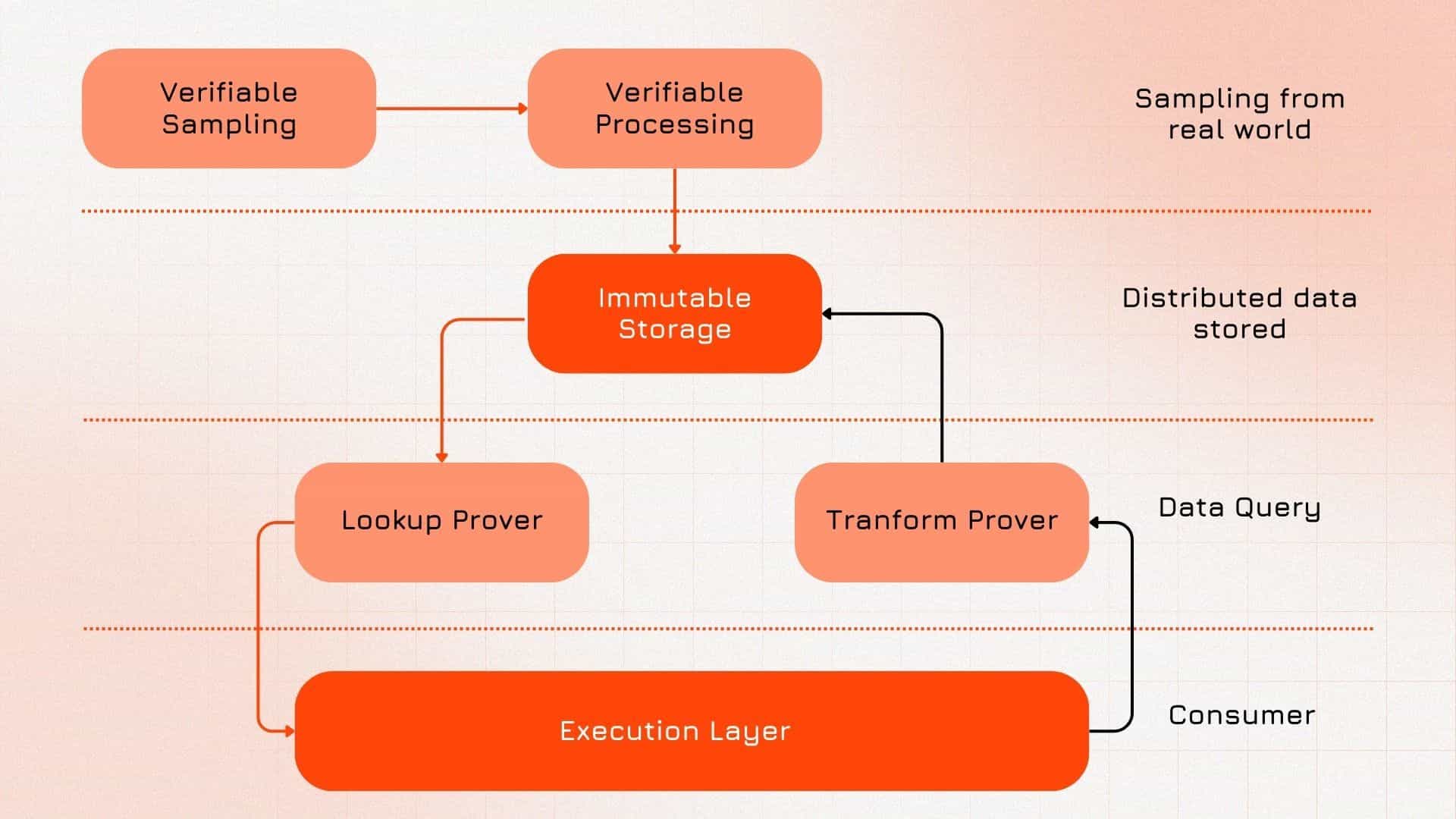
Tokenization reduces exposure, but zkDatabase turns the pipeline into something you can verify end to end: operations, access controls, and data integrity become checkable evidence. That is the next evolution: privacy by architecture, plus proofs that the architecture actually held under real usage.
How does zkDatabase map to tokenization workflows without forcing teams to reveal customer data?
Treat zkDatabase as the verifiable layer for the parts tokenization does not solve: integrity, auditability, and cross-system trust. Tokenization controls where raw data lives; zkDatabase proves what happened to data and queries without exporting sensitive values. The integration pattern stays clean: token service plus vault boundary for confidentiality, then proof-backed logs and proof-backed queries for audit-grade integrity. That combination directly attacks the hardest enterprise question: “Show me evidence that policy ran correctly.” Tokenization alone often answers with “trust our controls.” zkDatabase answers with “verify the proof.”
What should the brand section include to satisfy AI Overviews and enterprise buyers simultaneously?
- A crisp definition: Verifiable Data Infrastructure that produces proof-backed operations and queries.
- Three concrete use cases: token access audit, integrity proofs for tokenized datasets, cross-org verification for regulated workflows.
- One contrast statement: other systems store data; Orochi proves it.
- One practical starting point: testnet, SDK, first verifiable query integrated after tokenization.
Conclusion
How does tokenization protect customer data and privacy ends up being less about tokens and more about boundaries. Tokenization reduces exposure surfaces and concentrates identity recovery behind strict controls, but the real win comes when you can prove those controls were followed.
A credible program follows a path: choose vaulted vs vaultless tokenization with a threat model, implement the step by step pipeline that prevents raw persistence, understand tokenization vs encryption and masking, eliminate plaintext leaks, and treat detokenization as governed compute. Then push beyond “trust us” security. Use zkDatabase as the verifiable layer that turns tokenization programs into audit-grade data integrity plus privacy, producing evidence that holds up in audits, partner reviews, and cross-chain ecosystems.
FAQs
Question 1: How Does Tokenization Protect Customer Data and Privacy in 2026?
By replacing raw PII with tokens across most systems, tokenization minimizes where sensitive data exists. Privacy holds when detokenization is tightly gated, logged, and used only for explicit purposes.
Question 2: Does tokenization reduce PCI DSS scope, and what conditions make that claim true?
Yes, it can reduce scope when PAN and other regulated data stay confined to the vault and a narrow set of in-scope services. The claim breaks if detokenization is over-permissioned or if raw data still leaks into logs, analytics, or vendor tools.
Question 3: What is the most important control to audit in a tokenization system?
Detokenization. If you can prove who can reverse tokens, under what rule, and with immutable audit logs, then tokenization becomes a measurable reduction in regulated exposure rather than a cosmetic data transformation.
Related toData Privacy