Zero-Knowledge Proofs
Zero-Knowledge Proof Compliance for Financial Institutions
July 14, 2026
8 mins read
A practical evaluation guide to Zero-Knowledge Proof compliance for financial institutions. The five questions to ask before adopting it: what condition is proved, what data stays private, who verifies, what evidence is retained, and what legal and audit still decide.


TL;DR: Zero-Knowledge Proof compliance lets a financial institution prove a regulatory or contractual condition is satisfied without revealing the underlying data. This is a practical evaluation guide, not a primer. Assess any solution on five questions: what condition it proves, what data stays private, who verifies, what evidence is retained, and what legal and audit still decide.
For financial institutions evaluating Zero-Knowledge Proof compliance, the useful question is not what the technology is but how to assess and operationalize it. This guide gives the evaluation criteria and the boundaries. zkDatabase can provide this proof layer across reserves, eligibility, and reporting workflows.
Key Takeaways
- Zero-Knowledge Proof compliance means proving a regulatory condition is met without exposing the underlying data.
- Treat it as a buyer evaluation, not a cryptography lesson: assess what is proved, what stays private, and who verifies.
- The strongest practical use cases are reserve verification, holder eligibility, and continuous reporting evidence.
- A proof confirms a data condition; it does not certify legal compliance or remove auditors and regulators.
- zkDatabase can provide cryptographic infrastructure for these workflows, pairing Zero-Knowledge Proofs with verifiable data integrity at the source.
What Is Zero-Knowledge Proof Compliance, in One Paragraph?
Zero-Knowledge Proof compliance is using cryptographic proofs to show a compliance condition is satisfied without revealing the data that satisfies it. An institution can demonstrate that reserves meet a threshold, that a client passed eligibility checks, or that a transfer respected a rule, while keeping the figures and identities private. For the conceptual case and how this becomes a control layer for regulated on-chain finance, see Zero-Knowledge Proof compliance as a control layer.
This guide assumes that case and focuses on the practical side: where it fits, how to evaluate it, and what it does not do. The shorthand worth keeping is that a proof reveals nothing except that a specific statement is true, which is what lets it fit regulated workflows where institutions must demonstrate facts they are also obligated to keep confidential. The same reframe drives why institutions have a privacy problem, not a blockchain problem.
Where Does Zero-Knowledge Proof Compliance Apply for Financial Institutions?
It applies wherever an institution must prove a condition it also needs to keep private, which covers most of the regulated data surface. The clearest cases are reserve and backing verification, holder and counterparty eligibility, and ongoing regulatory reporting.
For reserve verification, an issuer can prove backing meets the required ratio and composition without exposing custodian holdings or account details. For eligibility, an institution can demonstrate that every holder cleared identity and sanctions screening without transmitting the personal data itself. For reporting, it can produce evidence of a condition between formal attestation cycles, rather than only on the audit date.
These map to existing research and architecture, not aspiration. They line up with how Zero-Knowledge compliance architecture handles AML and KYC without mass surveillance, and with the selective-disclosure model in evidence-first compliance. The common thread is privacy-preserving computation: prove the rule was followed, reveal nothing more.
How Should an Institution Evaluate a Zero-Knowledge Proof Compliance Solution?
An institution should evaluate any solution against five questions before adopting it. These cut through most of the marketing and surface where the real boundaries are.
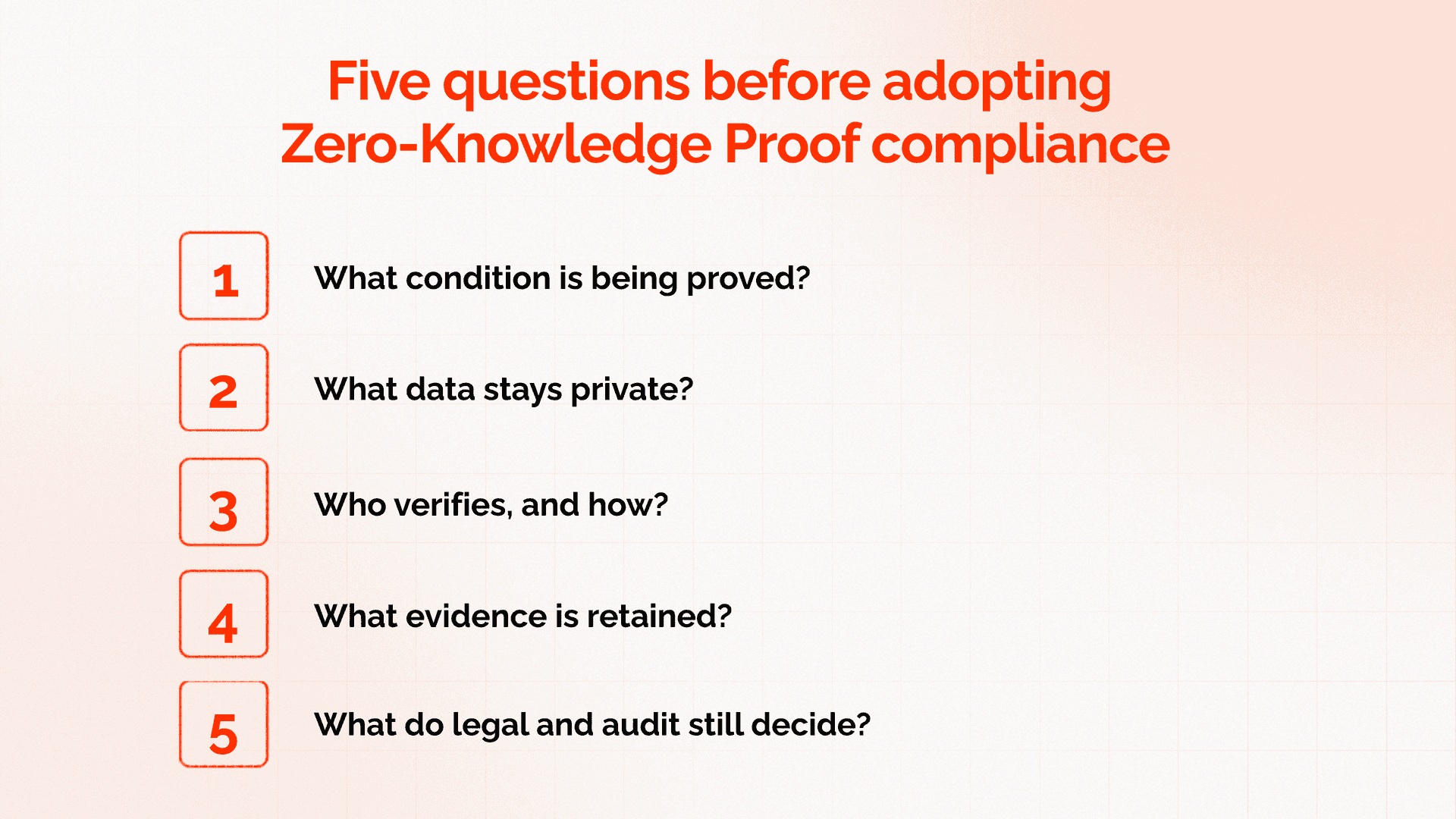 Five questions that separate real proof-based compliance from marketing.
- What condition is being proved? It should be a specific, named statement, such as "backing exceeds the required ratio," not a vague claim of "compliance."
- What data stays private? The boundary should be explicit, so the institution knows no sensitive record leaks during proof generation or verification.
- Who verifies, and how? There should be a concrete verification path. Authorized verifiers, auditors, counterparties, or regulators should be able to check the proof on-chain or through a defined interface where the workflow supports it, rather than trusting the institution's word.
- What evidence package is retained? The institution should know what proof artifacts are stored, for how long, and how they map to its existing audit and reporting obligations.
- What do legal and audit still decide? The proof is technical evidence. Legal interpretation, regulatory acceptance, and audit scope remain human decisions that the proof informs but does not replace.
Two more practical filters help. Ask whether the solution addresses data integrity at the source, not just proof generation, because a proof over bad data is still a faithful proof of a false premise. And ask about production maturity and integration effort, since a compliance workflow cannot depend on experimental infrastructure. These are the same evaluation instincts institutions already apply to data privacy compliance proof stacks.
What Can Zero-Knowledge Proof Compliance Not Do?
It cannot certify that an institution is compliant, and it does not remove the regulator, the auditor, or legal responsibility. A proof confirms a specific condition was true; it does not render a legal judgment about an institution's overall compliance posture.
This boundary is worth stating plainly because the technology is easy to oversell. A Zero-Knowledge Proof of reserve adequacy is strong evidence, but a regulator still interprets the rule, and an auditor may still be required. The proof improves what can be demonstrated and how often; it does not transfer accountability away from the institution.
It also depends on the inputs. A proof shows that the committed data satisfied a condition. If the data fed into the system was wrong at the source, the proof faithfully proves a false premise. That is why proof systems pair with verifiable data pipelines that establish data integrity from ingestion onward, the point made in a verifiable compliance framework for RWA.
Bottom line: Zero-Knowledge Proofs change the evidence, not the law. They let an institution prove more, more often, and more privately. They do not make the institution compliant by themselves, and they do not replace the people and bodies who decide what compliance means.
How Does zkDatabase Support Zero-Knowledge Proof Compliance?
zkDatabase supports it by generating cryptographic proofs across the data pipeline, so an institution can prove compliance conditions on-chain while the underlying data stays private. It pairs Zero-Knowledge Proofs with verifiable data integrity from ingestion through query, which addresses both halves of the evaluation: proving the condition, and trusting the inputs.
For a financial institution, the practical outcome is the ability to produce verifiable evidence of reserve conditions, eligibility, or reporting facts between formal attestation cycles, without exposing raw records. Authorized verifiers check the proof rather than trusting a reported value, where the workflow supports that path. The zkDatabase mainnet is live, and the product is built on Zero-Knowledge Proofs.
The boundary holds here too: zkDatabase can provide cryptographic infrastructure that supports compliance, audit, and reporting workflows. It does not guarantee compliance, replace auditors, or substitute for regulatory approval. It gives institutions a stronger, more private way to demonstrate the facts they are already responsible for.
Conclusion
Zero-Knowledge Proof compliance gives financial institutions a practical way to prove regulatory and contractual conditions without exposing the data behind them, across reserves, eligibility, and reporting. Evaluate it as evidence infrastructure, not a legal shortcut: ask what it proves, what stays private, who verifies, what is retained, and what legal and audit still decide. zkDatabase delivers this with Zero-Knowledge Proofs over a verifiable data pipeline, so institutions can let authorized verifiers check the proof instead of trusting the report.
Book a compliance advisory call → See how Zero-Knowledge Proofs can support your reserve, eligibility, and reporting workflows: https://orochi.network/partnership
FAQ
What is Zero-Knowledge Proof compliance for financial institutions?
Zero-Knowledge Proof compliance is the use of cryptographic proofs to demonstrate that a regulatory or contractual condition is met without revealing the underlying data. A financial institution can prove reserves meet a threshold, a client passed eligibility, or a transaction followed a rule, while keeping the figures and identities private. It produces verifiable evidence an authorized verifier can independently check.
How should a financial institution evaluate a Zero-Knowledge Proof compliance solution?
Evaluate it on five questions: what specific condition is proved, what data stays private, who verifies the proof and how, what evidence is retained for audit and reporting, and what legal and audit decisions remain. Then check two practical filters: whether the solution secures data integrity at the source, and whether it is production-mature enough to carry a compliance workflow.
Does Zero-Knowledge Proof compliance guarantee an institution is compliant?
No. It does not guarantee compliance or replace regulators and auditors. A proof confirms a specific condition was true; it does not render a legal judgment about overall compliance posture. The institution remains accountable, and formal audits or regulatory interpretation may still be required. It improves what can be proven and how often, not who decides what compliance means.
How is a Zero-Knowledge Proof different from encrypting compliance data?
A Zero-Knowledge Proof reveals only that a statement is true, while encryption hides data that someone with a key can later read in full. For compliance, this distinction matters: encryption still requires sharing the underlying data with whoever holds the key, whereas a proof lets an institution demonstrate a condition holds while disclosing nothing beyond that fact.
Related toZero-Knowledge Proofs