Reports
Report Crypto Payment (Part 2): Deep-in the Crypto Payment Products
May 12, 2026
13 mins read
Explore the current crypto payment landscape, analyzing crypto cards, gateways, on/off-ramps, and stablecoin neobanks through economics, UX, and regulatory realities.


Product Deep-Dives
2.1 Crypto Card Programs (Debit, Credit, Prepaid)
Crypto card programs represent the most visible bridge between cryptocurrency holdings and everyday spending. In 2025, these programs have evolved from marketing gimmicks into sophisticated financial products with complex economics and user incentives.
How They Actually Work
Despite being marketed as "crypto cards," most programs operate through a straightforward mechanism:
- User deposits crypto assets into a custodial wallet on the platform
- When a purchase is made, the platform instantly converts the required amount of crypto to fiat
- The fiat amount is pushed through traditional card networks (Visa/Mastercard)
- Merchants receive payment in their local currency with no crypto exposure.
Functionally, most crypto cards are fiat-settled payment cards with an embedded crypto liquidation step on the user side. They primarily drive crypto usage for cardholders rather than “true” crypto acceptance at the merchant level.
Funding Models and Liquidity Management
Funding models for crypto cards cluster into four patterns. Many rely on pre-funded pools where users convert crypto to fiat in advance, trading settlement safety for extra friction. Premium programs offer instant conversion at the point of sale, which shifts complexity into liquidity management and hedging. New credit-backed designs, like USDC-secured credit lines, let users spend against collateral rather than selling, while a newer wave of products experiments with stablecoin-native settlement in USDC on L2s where merchants accept on-chain payments.
Economic Structure and Fee Realities
The business model of crypto card programs usually combines card economics (interchange, FX spreads, fees) with token-based incentives:
- Rewards and rebates are often paid in a native token, with higher tiers gated behind sizeable token stakes.
- For example, reviews of the Crypto.com Visa card in 2025 indicate rewards tiers ranging from 1% to 8% CRO cashback, with the higher tiers (5% and 8%) requiring CRO stakes of roughly US$40,000 and US$400,000 respectively.
This means top-tier rewards are effectively financed by token utility and the opportunity cost of staking, while lower tiers resemble more conventional fintech debit cards with modest rewards and fee-driven economics.
Banking and Regulatory Dependencies
Card programs face outsized regulatory risk due to their reliance on traditional financial infrastructure:
- Issuing banks and processors: Most programs depend on one or a small set of issuing banks and processors in each region, so if a partner pulls out, card services can be suspended or shut down—as when Binance ended its EEA Visa card after Paysafe withdrew euro support.
- Card network compliance: Visa and Mastercard maintain strict requirements around reserve maintenance, fraud monitoring, and consumer protection.
- Money transmission licensing: Programs must navigate complex licensing requirements across jurisdictions, with significant compliance costs.
- De-banking risk: Even successful programs face sudden termination of banking relationships due to risk aversion at correspondent banks.
Taken together, crypto card programs are less about “pure crypto payments” and more about overlaying crypto funding and rewards on top of existing card and banking rails. Their long-term viability depends as much on banking partnerships, licensing, and risk infrastructure as on user demand for spending crypto.
Key Takeaways: Crypto Card Programs
- Most "crypto cards" are actually fiat cards with crypto funding mechanisms, not true crypto payment tools
- Token economics often disguise true costs, with premium features requiring substantial illiquid token commitments
- Banking relationships represent the critical vulnerability to sustainability and scale
- The most valuable card programs are evolving toward providing liquidity management rather than simple spending
- Competition is shifting from rewards rates to integrated experiences across trading, yield, and payments
2.2 Crypto Payment Gateways (Online & Offline / QR)
Crypto payment gateways serve as the critical infrastructure connecting merchants to the crypto economy. Unlike card programs that primarily serve consumers, gateways target business adoption with solutions designed for specific merchant needs and compliance requirements.
Gateway Architecture and Settlement Flows
Modern gateways employ sophisticated settlement architectures to address merchant concerns:
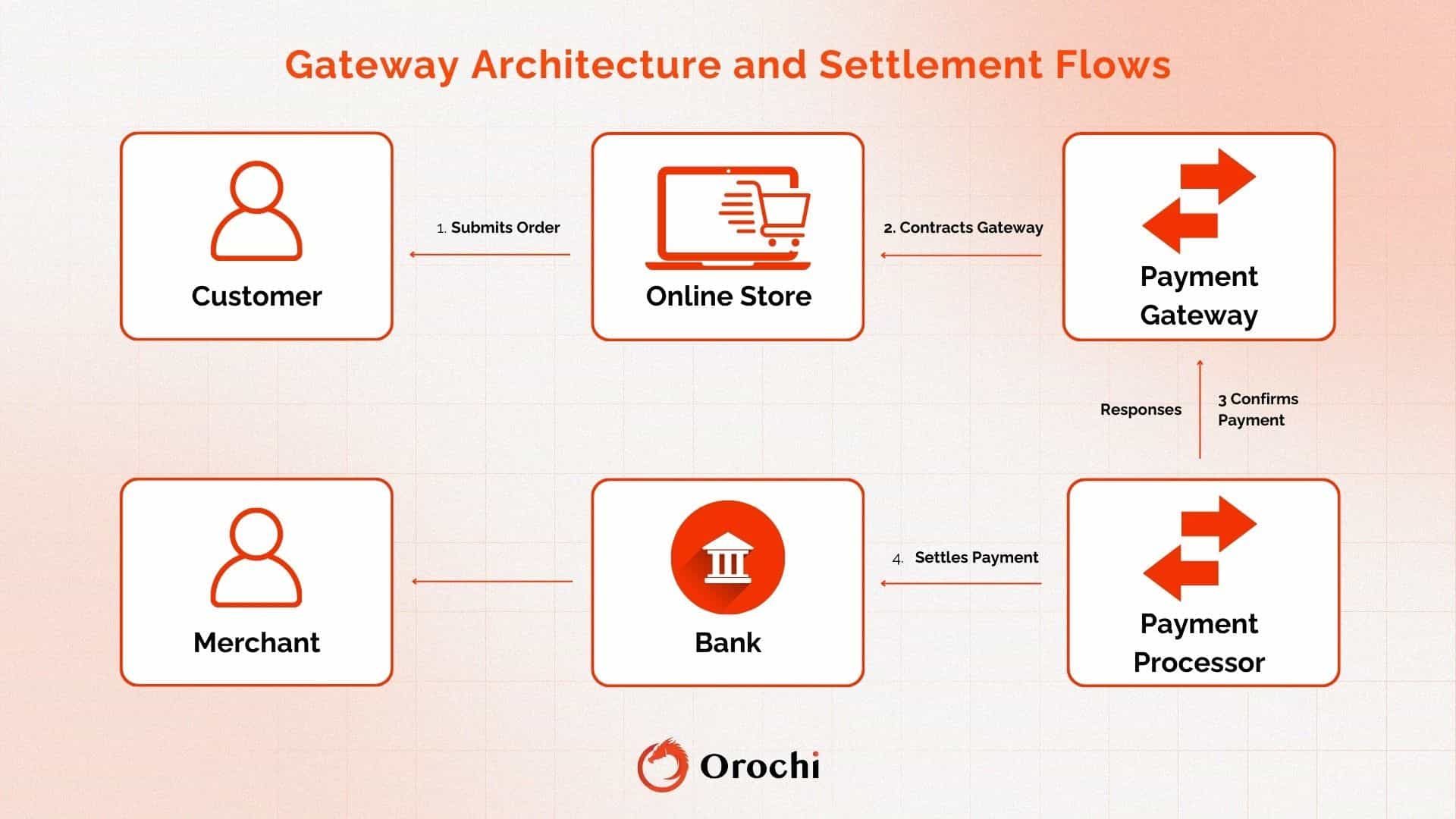
- Customer checkout: User selects crypto payment option during checkout
- Payment request: Gateway generates invoice in merchant's preferred currency (USD, EUR, etc.)
- Crypto selection: Customer chooses preferred cryptocurrency (typically BTC, ETH, or USDC)
- Conversion and routing: Gateway calculates equivalent crypto amount and provides payment address/QR code
- Settlement options:
- Instant fiat conversion: Crypto immediately converted to fiat and deposited to merchant's bank account (most common)
- Scheduled settlement: Crypto held and converted at predetermined intervals (daily/weekly)
- Crypto retention: Merchant receives and holds crypto assets (rare, typically only crypto-native businesses)
This flexibility allows merchants to benefit from crypto payments without exposure to volatility or complex accounting requirements.
Custodial vs. Non-Custodial Models
The custody approach fundamentally shapes gateway capabilities and risks:
Custodial Gateways (BitPay, Coinbase Commerce):
- Hold customer funds during payment processing.
- Offer guaranteed fiat settlement (e.g., USD/EUR/GBP) to remove price risk.
- Require comprehensive regulatory licensing (MSB/VASP).
- Provide consolidated dashboards, exports and tax/accounting tools.
Non-Custodial Gateways (BTCPay Server, NOWPayments non-custodial option):
- Never take possession of funds; act as a routing layer only.
- Lower regulatory burden and compliance costs but require the merchant to manage keys, wallets and treasury.
- Fee structures are often minimal (0–0.5% or just network fees for self-hosted software), compared with ~1% typical for commercial processors.
By 2025, large and enterprise merchants generally gravitate to custodial, regulated providers for reconciliation and compliance, while crypto-native or developer-led merchants increasingly deploy non-custodial/self-hosted stacks to retain control and minimize fees.
Merchant Economics: Why Businesses Adopt Crypto Payments
The merchant value proposition has shifted from ideology to measurable economics:
- Higher conversion rates: A 2025 Crypto.com / Absolute Labs study finds that “wallet-connected” crypto shoppers convert 3–5× higher and can add up to +11% incremental e-commerce revenue for some retailers.
- Increased average order value (AOV): CoinGate’s 2025 data shows the average Bitcoin cart size (~€132) is about 53% higher than the platform average, indicating larger baskets among crypto payers.
- Lower chargeback and fraud exposure: On-chain payments are irreversible once confirmed, so gateways and merchants effectively avoid card chargebacks, which are a major cost driver in traditional online payments.
- Access to new markets: Crypto payments enable sales to unbanked populations and regions with payment restrictions
- Lower processing fees: Multiple studies and provider reports place typical crypto gateway fees around ~1%, compared with roughly 1.5–3.5% for standard card processing.
These effects are strongest in verticals such as digital goods, gaming, high-value e-commerce, travel, B2B services and industries facing high card fraud or restricted access to traditional acquiring.
Key Takeaways: Payment Gateways
- Custodial gateways dominate enterprise adoption despite higher fees due to volatility protection and accounting simplicity
- Fee compression is accelerating, with Block's zero-fee Lightning integration pressuring traditional models
- Integration complexity remains the primary barrier to adoption for small merchants
- Value is shifting from payment processing to integrated treasury and accounting services
- Gateways with multi-chain capabilities and regulatory automation are gaining competitive advantages
From a systems perspective, gateways are really complex ledger & event-processing engines. Over time, regulators will care less about how you route crypto, and more about whether your internal books are provable and auditable. That’s exactly where a Verifiable Data Infrastructure like zkDatabase plugs in.
2.3 On-/Off-Ramps
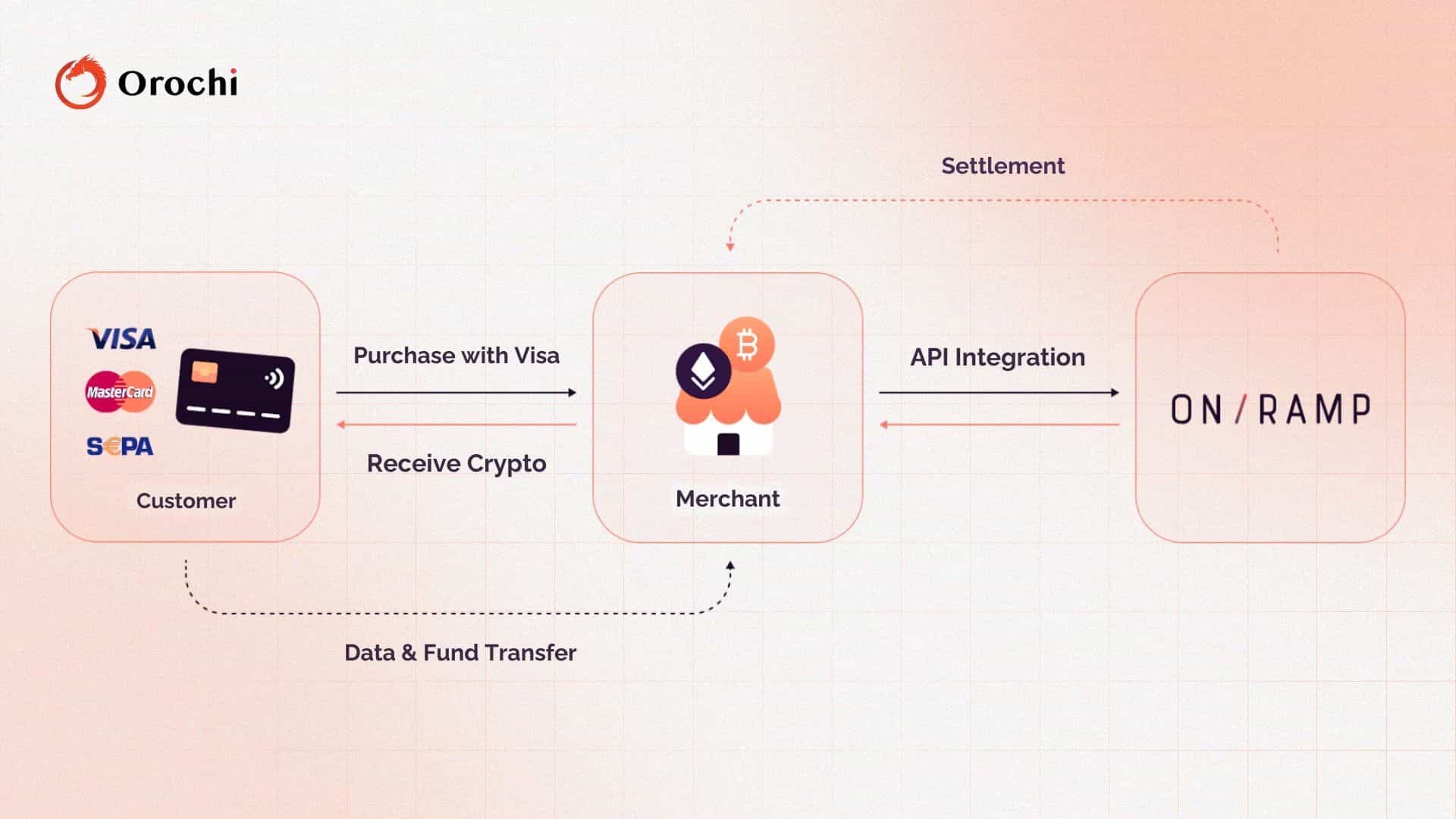
On/off ramps represent the critical infrastructure connecting traditional finance to the crypto ecosystem. These services enable users to convert between fiat currencies and digital assets, serving as the primary entry and exit points for most crypto users. In 2025, the ramp landscape has matured significantly but remains one of the most regulated and challenging segments of the crypto payment stack.
The Ramp Experience: User Journey and Pain Points
The typical user journey through an on/off ramp reveals significant friction points:
On-Ramp Flow (Fiat → Crypto)
In practice, an on-ramp is: KYC → link/pay with bank/card → wait for fiat to clear → buy crypto → wait for it to arrive in the wallet. End-to-end, this often stretches from minutes to days instead of feeling instant.
Off-Ramp Flow (Crypto → Fiat)
The off-ramp is: choose asset and amount → send to provider → compliance checks → bank payout. Again, funds move in stages, so “sell → cash in bank” typically spans hours to days, not a single real-time step.
Each extra step—KYC, redirects, waits—adds friction and drives users away. UX and KYC studies in crypto consistently identify heavy verification and payment flows as a key cause of onboarding and funding drop-off.
Fee Structures and Economics
While exact pricing varies by provider, region and method, 2024–2025 public schedules and reviews show consistent bands:
- Card payments: Most card-based crypto on-ramps price in the mid-single digits, with fees typically around 1.5–4.5% plus a small minimum per transaction.
- Bank transfers: Reviews and provider disclosures for MoonPay, Transak and others show bank transfer / wire on-ramp fees often around ~1% (sometimes 0.99–1.5%), positioned as cheaper but slower than cards.
- Alternative payment methods. In markets such as Africa, Yellow Card’s widget advertises 1% for bank transfers and 2% for mobile money, aligning with a ~1–3% band for local APMs.
- Network fees: Variable based on blockchain congestion (often subsidized for small transactions)
The most significant innovation has been the shift toward "invisible ramps" – services that abstract away the fiat/crypto boundary entirely. Platforms like Coinbase and Binance now offer seamless experiences where users can fund accounts via traditional methods but interact exclusively with crypto balances, never explicitly seeing the conversion process.
Key Takeaways: On/Off Ramps
- Banking access remains the primary bottleneck and competitive moat for ramp providers
- Fee compression has driven consolidation, with only well-capitalized players maintaining global coverage
- Regional specialization is increasingly important as regulatory requirements diverge
- The highest value is shifting toward embedded and invisible ramp experiences
- Identity and compliance infrastructure is becoming as valuable as payment processing capabilities
2.4 Stablecoin-First Neobanks & Fintechs
Stablecoin-first neobanks represent the emerging frontier of crypto-native financial services. Unlike traditional neobanks that digitize existing banking functions, these institutions build their core services around blockchain-native stablecoins while maintaining selective fiat integration points. In 2025, this category is rapidly evolving from experimental projects to legitimate financial infrastructure.
Core Architecture and Value Proposition
Stablecoin neobanks fundamentally reimagine the banking stack:
- Account structure: Primary accounts denominated in USDC or similar stablecoins rather than fiat currencies.
- Settlement rails: Transactions settle on blockchain networks (primarily Ethereum L2s) rather than traditional payment systems.
- Compliance layer: Regulatory requirements satisfied through on-chain analytics and selective fiat integration points.
- Product suite: Banking services (payments, payroll, invoicing) rebuilt with blockchain-native capabilities.
This architecture enables unique capabilities impossible in traditional banking:
- Continuous settlement: 24/7 transaction processing without batch delays
- Programmable money: Automated cash management rules, conditional payments, and embedded business logic
- Global by default: Immediate cross-border capability without correspondent banking networks
- Transparent reserves: On-chain verification of backing assets for stablecoins
Licensing Strategies and Regulatory Positioning
Stablecoin neobanks employ sophisticated regulatory strategies to navigate the complex landscape:
Table 6: Stablecoin Neobank Regulatory Approaches (2025)
| Regulatory Strategy | Primary Jurisdictions | Key Advantages | Key Limitations | Example Projects |
|---|---|---|---|---|
| Full banking license + stablecoin issuance | Switzerland, Singapore | Complete regulatory cover, direct fiat access | 1-2 year licensing process, high capital requirements | Sygnum Bank, AMINA (ex-SEBA) Bank |
| EMI/PI license + partner stablecoins | UK, EU (under MiCA) | Faster time to market (6-12 months), broader product set | Limited to regulated stablecoins, cannot issue own stablecoins | Revolut, Wirex, Plasma One, Tria, Gnosis Pay / ether.fi Cash |
| Specialized payments license | UAE, Puerto Rico | Focused scope, lighter requirements | Limited product capabilities, jurisdiction constraints | AE Coin + Mbank, FV Bank |
| Offshore structure + selective compliance | Cayman Islands, BVI | Global access, tax-neutral, full requirements | Banking access challenges, institutional adoption barriers | Early-stage projects |
The most successful approaches combine regulatory clarity in specific jurisdictions with technical architecture that can adapt to changing requirements. For example, M^0’s strategy is to build infrastructure that can plug into EMI/bank-licensed issuers in the EU, while being compatible with MiCA-compliant stablecoin frameworks.
Emerging Capabilities:
- Credit facilities: Undercollateralized lending based on on-chain cash flow analysis
- B2B payments: Automated cross-border supplier payments with invoice matching
- Tax management: Real-time tax calculation and withholding for global operations
- Compliance automation: Built-in regulatory reporting for anti-money laundering and sanctions screening
The most sophisticated platforms are developing "compliance-aware" smart contracts that automatically enforce regulatory constraints while maintaining the efficiency benefits of blockchain settlement.
Banking and Liquidity Infrastructure
Despite their blockchain-native positioning, stablecoin neobanks maintain critical fiat touchpoints:
- Reserve banking: Partner banks holding fiat reserves backing stablecoins and operational accounts
- Liquidity management: Sophisticated systems balancing on-chain and off-chain liquidity needs
- FX operations: Automated conversion between stablecoins and local currencies for global operations
- Settlement finality: Bridging mechanisms ensuring blockchain transactions achieve legal finality
These relationships remain the most challenging aspect of operations, with traditional banks often imposing restrictive terms on crypto-adjacent businesses. The most resilient neobanks maintain multiple banking relationships across jurisdictions and are increasingly pursuing direct regulatory licenses to reduce dependency.
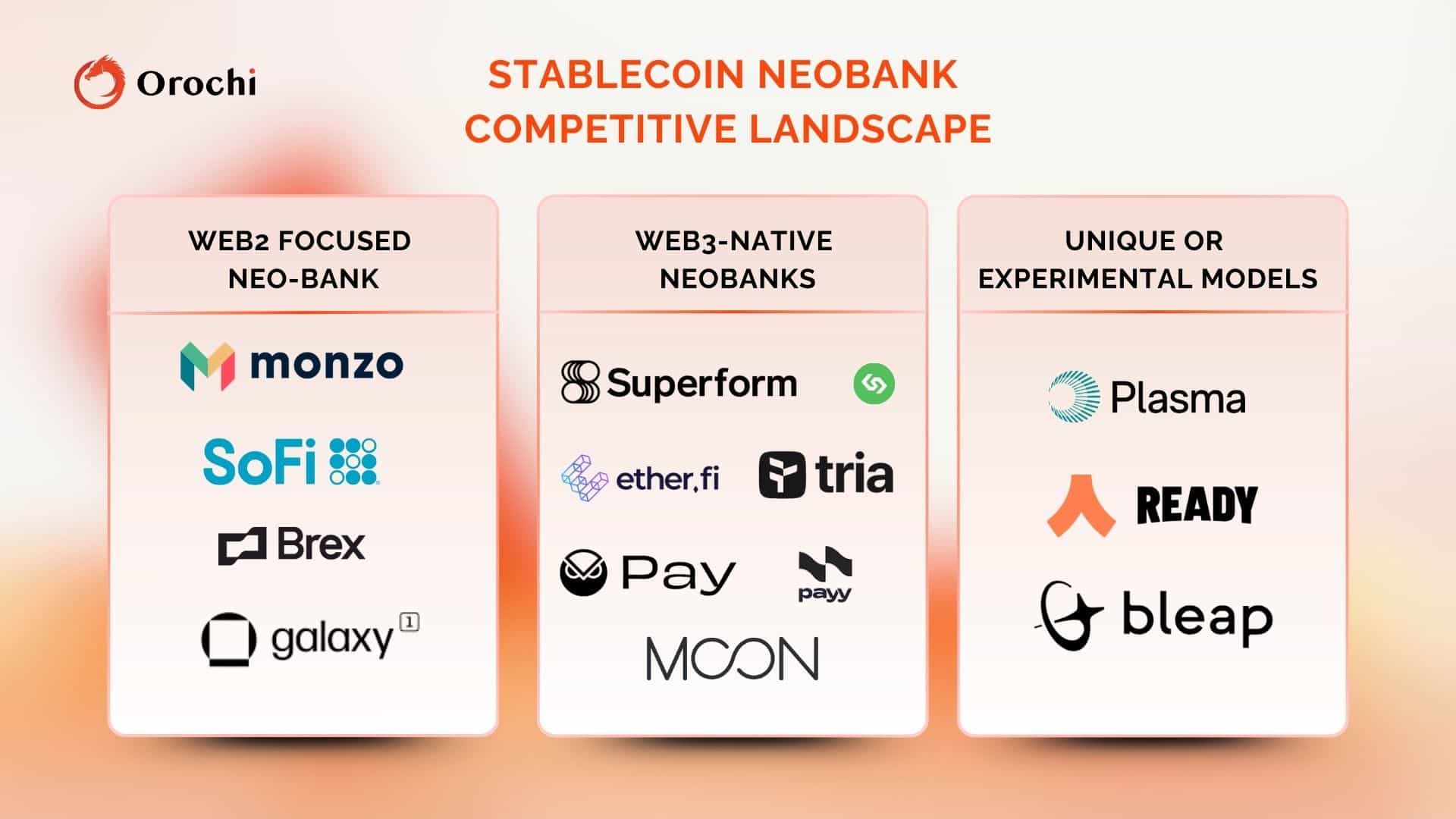
Market Dynamics and Competitive Landscape
The stablecoin neobank space is characterized by rapid evolution and strategic partnerships:
- Web2-focused Neobanks:
monzo: Smart budgeting, real-time spending, and no overdraft fees
SoFi: High-yield savings, checking, and competitive loans
brexHQ: Corporate spend management, credit cards, and payments
galaxyoneapp: High-yield savings, stock + crypto investing (limited Web3 functionality)
HurupayApp: Bank accounts (USD/EUR), stocks, card, and yield (mostly Web2)
- Web3-native Neobanks:
Fully immersed in decentralized finance. They prioritize self-custody, stablecoin yields, wallet-native payments, and crosschain operability.
useTria: Cross-chain spending, trading, earning; for humans and AI
superformxyz: Unified DeFi platform: save, earn, swap via SuperVaults
ether_fi: Merges DeFi yield/self-custody with banking tools
0xinfini: Stablecoin savings, instant transfers, treasury tools
gnosispay: Spend stablecoins directly from wallet, B2B services
paywithmoon: Virtual credit cards and merchant gift cards from crypto
payy_link: Privacy-first payments via stablecoin links
- Unique or Experimental Models
Platforms that combine features across categories or experiment with novel paradigms.
Plasma: High stablecoin yield, cashback, free crypto transfers
ready_co: Crypto-first, up to 10% cashback via Mastercard
BleapApp: Cashback in stablecoins, sleek Web2-like UX
Key Takeaways: Stablecoin-First Neobanks
- Regulatory strategy is more important than technology for long-term viability
- The most valuable products combine blockchain efficiency with regulatory compliance
- Banking relationships remain critical despite blockchain's disintermediation promise
- Business banking is emerging as the primary use case ahead of consumer applications
- Integration with traditional accounting and ERP systems is essential for adoption
Read more about Report Crypto Payment Part 1: Report Crypto Payment (Part 1): The Infrastructure Stack Powering Real-World Adoption
Related toReports