Reports
Report Crypto Payment (Part 3): The Economics of Payment Infrastructure and Global Compliance
May 12, 2026
13 mins read
Explore the evolving economics of crypto payments. From Block’s disruptive zero-fee strategy to the hidden costs of token staking, learn how to navigate fee compression and build a profitable, sustainable payment infrastructure.


Business Models and Fee Structures
The economics of crypto payment infrastructure have matured significantly since the early days of experimentation. In 2025, sustainable business models have emerged that balance user experience, regulatory compliance, and profitability. Understanding these economics is essential for builders and investors navigating the space.
The Two-Sided Fee Reality
Crypto payments feature a fundamentally different economic structure than traditional payment systems, with separate fee schedules for consumers and merchants. This bifurcation creates unique competitive dynamics and business model innovations.
- Consumer-Facing Fees: Typically hidden in conversion spreads, token requirements, or subscription models rather than explicit transaction fees. This approach prioritizes user experience while maintaining revenue streams.
- Merchant-Facing Fees: Direct processing fees that compete aggressively with traditional payment processors (typically 2-3%). The crypto payment space has triggered a fee compression war, with rates now commonly 0.5-1.5%.
This two-sided model creates cross-subsidization opportunities where token economics, yield farming, and other DeFi mechanisms can offset direct fees to create seemingly "free" consumer experiences while maintaining business viability.
Crypto Card Fee Structures: The Hidden Economics
Crypto card programs have evolved sophisticated fee structures that often obscure true costs behind reward mechanisms and token requirements. The major players employ different strategies to balance acquisition, retention, and profitability:
Table 7a: Consumer Crypto Card Fee Comparison (2025)
This fee analysis reveals the true economics behind "no fee" marketing claims.
**Crypto.com and Binance** build their business models around token economics—requiring users to lock up significant amounts of platform tokens to access premium features. This creates a powerful alignment between user spending and token value appreciation, but introduces substantial opportunity costs that aren't immediately apparent to casual users.
AviciMoney represents an emerging alternative model focusing on self-custody and transparent pricing rather than token economics. By using USDC collateral in user-controlled smart contracts, they eliminate the need for platform token staking while maintaining regulatory compliance through KYC processes.
Payment Gateway Economics: The Race to Zero
The merchant-facing side of crypto payments is experiencing aggressive fee compression as competition intensifies:
Merchant Payment Gateway Fee Comparison (2025)
| Provider | Fee Structure | Volume Requirements | Settlement Options | Key Value Proposition |
|---|---|---|---|---|
| BitPay | • 2% + $0.25 (volumes <$500K/mo)• 1.5% + $0.25 ($500K-$1M/mo) | Tiered pricing based on monthly volume | Daily or weekly fiat settlement | Enterprise-grade compliance and reporting |
| Coinbase Commerce | 1% flat fee | No volume discounts | Instant or scheduled settlement | Seamless integration with Coinbase ecosystem |
| CoinPayments | 0.5% flat fee | No volume discounts | Daily settlement | Lowest fee option with multi-currency support |
| Block (Square) | 0% until 2027, then 1% | Available to all 4M Square merchants | Real-time settlement via Lightning | First-mover zero-fee strategy disrupting industry |
| Block (Square) | 0% until 2027, then 1% | Available to all 4M Square merchants | Real-time settlement via Lightning | First-mover zero-fee strategy disrupting industry |
Block's zero-fee strategy represents a watershed moment for the industry. By leveraging Bitcoin's Lightning Network and their existing merchant base of 4 million businesses, they've initiated a price war that smaller gateways cannot match without significant subsidy. This aggressive pricing reflects a long-term strategy where payment processing becomes a loss leader for broader ecosystem value capture.
The fundamental economic advantage of crypto payment gateways is their ability to bypass traditional card network fees (typically 1.5-3.5%) while maintaining comparable service levels. Even at 1% fees, gateways can offer merchants significant savings while maintaining healthy margins—particularly when operating on low-cost blockchain infrastructure.
The Hidden Economics: Beyond Published Fees
The published fee schedules only tell part of the economic story. Several hidden economic factors significantly impact the true cost of crypto payments:
- Conversion Spreads: Most crypto cards and gateways build 0.5-1.5% spreads into crypto/fiat conversions. Unlike explicit fees, these spreads are rarely disclosed and can vary based on market conditions and user tier.
- Network Fees: While often small on L2 networks ($0.001-0.01), blockchain transaction fees can spike during congestion. Most consumer-facing products absorb these costs for small transactions but pass them through for larger transfers.
- Token Opportunity Costs: The most significant hidden cost comes from token staking requirements. Top-tier Crypto.com cards historically required six-figure USD-equivalent CRO stakes to unlock 5%+ cashback, effectively locking large amounts of illiquid capital
- Settlement Timing: Many programs batch settlements to reduce costs, creating timing gaps where users' funds are in limbo. Many programs operate with 1–7 day settlement windows.
Unit Economics – Key Takeaways
- Fee transparency is becoming competitive advantage: With increasing regulatory scrutiny, transparent fee structures (like AviciMoney's model) are gaining trust over opaque token economics
- Zero-fee strategies require ecosystem subsidies: Block's zero-fee gateway only works because they capture value elsewhere in their ecosystem—pure payment processors cannot match this without similar cross-subsidization
- Merchant economics drive adoption: The 1-2% savings compared to traditional card processing creates powerful merchant incentive. According to merchant surveys summarized by PYMNTS and Coinlaw, around 46% of surveyed merchants report accepting some form of crypto-enabled payment, and among those, Bitcoin is still accepted by ~90%+ as a primary currency.
- Token staking creates hidden economics: The opportunity cost of required token stakes often exceeds advertised benefits—sophisticated users are increasingly calculating total economic value rather than headline rewards
- Regulatory costs are becoming primary differentiator: Companies with established compliance infrastructure can operate profitably at lower fees than newcomers facing high licensing costs
As fee compression eats into margins, infra providers will compete more on compliance efficiency and auditability than on raw fees. Whoever can prove their books cleanly with minimal overhead wins. This is where a provable data layer is a defensible moat.
Compliance, Regulation, and Risk
The regulatory landscape for crypto payments has transformed dramatically between 2020 and 2025. What was once a patchwork of uncertain guidelines has evolved into defined frameworks with clear requirements—and significant consequences for non-compliance. Understanding this regulatory reality is essential for any serious participant in the crypto payment ecosystem.
Transition from Uncertainty to Implementation
2020–2022 was marked by uncertainty: companies operated in gray areas, with regulators issuing warnings but few concrete laws. 2023–2025 saw a shift to implementation of laws:
The European Model (MiCA-Driven)
The EU’s MiCA (Markets in Crypto-Assets Regulation) was adopted in 2023, with the stablecoin rules (for “asset-referenced tokens” and “e-money tokens”) applying from 30 June 2024 and the wider CASP regime from 30 December 2024. By 2025, any significant crypto payment processor or wallet custodian in Europe must have a MiCA license or operate under a registered entity. The EU’s Markets in Crypto-Assets (MiCA) regime, together with the revised Transfer of Funds Regulation, is one of the most comprehensive crypto frameworks globally. It introduces:
- Stablecoin usage caps: Non-euro ARTs and EMTs face thresholds of around 1 million transactions or €200 million per day in a single currency area; above that, issuers can be forced to curb issuance and face tighter oversight, which helps protect euro monetary sovereignty but can limit utility for global stablecoins.
- CASP licensing: A single Crypto-Asset Service Provider licence with harmonised rules on own funds, custody, governance, and consumer protection, plus passporting that lets a firm authorised in one member state serve all 27.
- Travel Rule coverage: Under the EU’s Transfer of Funds Regulation, originator and beneficiary information must accompany all crypto transfers between CASPs, with additional verification obligations for self-hosted wallets above €1,000.
For crypto payment firms, MiCA is a double-edged sword: it removes regulatory fragmentation and creates an EU-wide licence, but also raises the bar on prudential and compliance resources. CASPs must hold €50k–150k in own funds, while stablecoin issuers face at least €350,000 or a percentage of reserves and overheads, and industry surveys point to significantly higher legal, technology, and compliance costs compared with the pre-MiCA era.
The US Model (Fragmented Enforcement)
The US has a patchwork approach still. There is no single crypto payments law yet, but regulators used existing laws to rein in the industry. Key developments:
- State-by-state money transmission licensing: 48 separate state regimes with varying requirements
- Federal enforcement actions: SEC focusing on securities aspects, CFTC on derivatives, FinCEN on AML
- Banking regulator guidance: OCC, Federal Reserve, and FDIC issuing non-binding guidance rather than clear rules
- Congressional gridlock: Multiple bills proposed but little progress toward comprehensive framework
This fragmented approach creates significant compliance complexity. Major payment providers maintain teams of 50+ compliance professionals just to navigate US requirements. The lack of clear rules has also led to "regulatory by enforcement," where companies discover compliance requirements only after receiving subpoenas or enforcement actions.
The Innovation-Friendly Model (Singapore, UAE, Switzerland)
Several jurisdictions have positioned themselves as crypto-friendly while maintaining regulatory oversight:
- Singapore's Payment Services Act: Risk-based approach with clear licensing tiers based on activity and volume. By 2025, MAS also finalized a Stablecoin Issuance framework which mandates reserve requirements, capital, and redemption timelines for stablecoin issuers in SG.
- UAE's ADGM/FSRA framework: Comprehensive rules with dedicated regulatory sandboxes and fast-track licensing
- Switzerland's FINMA guidance: Principles-based approach focusing on function over form, with banking licenses available to qualified crypto firms
These jurisdictions have attracted significant crypto payment innovation but face increasing pressure to align with global standards. Recent actions by the FATF and international banking regulators have forced these regimes to tighten requirements while maintaining their competitive advantages.
High-need Patchwork Model
- In Africa, policy is mixed. Nigeria’s 2021 bank ban pushed activity into P2P channels and hasn’t yet been fully reversed; regulators have focused more on a struggling eNaira than on licensing open-network payments. By contrast, South Africa declared crypto a “financial product” in 2022 and now requires intermediaries to be licensed by the FSCA, bringing exchanges and payment providers into a supervised, AML-obligated perimeter.
- Latin America: El Salvador famously made Bitcoin legal tender in 2021. Brazil passed a 2022 law that treats crypto providers like payment institutions and is rolling out phased licensing and AML rules under the central bank, alongside its DREX CBDC project. Argentina has no comprehensive regulation (the government did, however, restrict fintechs from offering crypto in 2023 and has capital controls making fiat-to-crypto hard). But given inflation, Argentina has one of the highest crypto adoption rates out of necessity, largely operating in a regulatory gray area. Mexico has fintech laws but by 2025 still hasn’t passed specific crypto rules, though many expect something soon especially as the US presses for coordination on stablecoins.
Licensing Requirements by Business Model
Specific licensing requirements vary significantly by business model and jurisdiction:
Core Licensing Requirements by Business Model (2025)
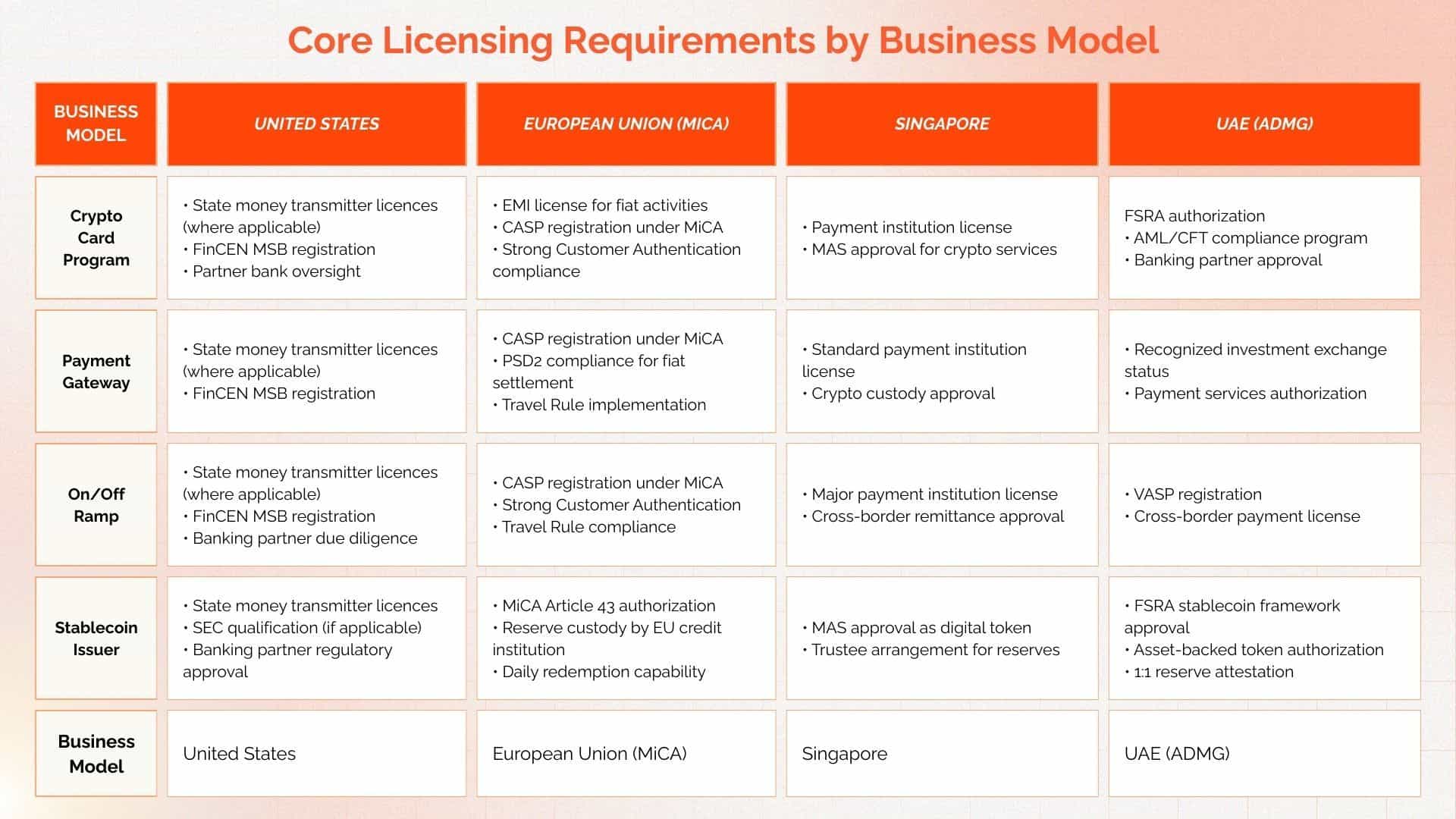
The compliance burden is substantial. A global payment gateway operating across these four jurisdictions might require 15-20 separate licenses and registrations, with annual compliance costs exceeding $5-10 million for mid-sized operations.
Data and Compliance Risk
Banking Partner Risk: The Critical Vulnerability
Despite blockchain's promise of disintermediation, banking relationships remain the critical vulnerability for crypto payment businesses:
Key dynamics:
- De-banking: Banks increasingly rely on automated risk models and “de-risking” policies; compliant crypto firms have had accounts closed with little explanation, forcing urgent migrations of settlement flows.
- Regulatory pressure: Supervisors explicitly encourage “heightened due diligence” for digital-asset clients, raising operational and documentation burdens.
- Reputation risk: Boards and investors remain cautious about perceived crypto exposure, making compliance teams conservative in onboarding and retaining these relationships.
Risk Mitigation Strategies:
- Multi-bank redundancy: Leading providers maintain 3-5 banking relationships across jurisdictions
- Regulatory lobbying: Industry groups like the Chamber of Digital Commerce working to establish clearer guidelines
- Specialized banking partners: New entrants like Evolve Bank & Trust and Bank Provence focusing exclusively on crypto relationships
- Licensing diversification: Obtaining direct licenses (EMI, banking) to reduce dependency on partner banks
The de-banking risk is not theoretical. In 2023-2024, over 30 significant crypto payment providers experienced banking relationship terminations, with average operational disruption of 14-21 days during transition periods.
Stablecoin Regulatory Scrutiny
Stablecoins have become the focal point of regulatory attention due to their systemic importance:
Key Regulatory Concerns:
- Reserve transparency: Detailed, frequent disclosures of reserve composition, valuation, and counterparties.
- Redemption guarantees: Enforceable 1:1 backing with high-quality liquid assets and clear redemption rights at par.
- Systemic risk: Concerns about stablecoin runs affecting broader financial stability
- Monetary sovereignty: Central banks concerned about currency substitution in developing economies
Fraud, Security, and Operational Risk
The risk landscape for crypto payments has evolved beyond simple hacks to sophisticated operational challenges:
- Transaction fraud: Social engineering attacks targeting payment approvals and wallet access
- Settlement risk: Volatility exposure during settlement windows (particularly for non-stablecoin payments)
- Smart contract risk: Code vulnerabilities in payment infrastructure and settlement mechanisms
- Counterparty risk: Failure of banking partners, liquidity providers, or other critical infrastructure
- Regulatory risk: Retroactive rule changes or enforcement actions disrupting operations
Managing these requires robust monitoring of flows, counterparties, and limits across both on-chain and off-chain systems, with credible audit trails for every control.
Risk Management Imperatives
- Diversify critical relationships: No single bank, custodian, or liquidity provider should dominate settlement flows. Firms should maintain redundancy across jurisdictions and institution types, with tested playbooks for rapid failover.
- Let regulation shape product architecture: Regulatory, AML, and reporting constraints need to be built into products from day one, not patched on later. The most resilient companies embed compliance and risk professionals directly into product and engineering teams.
- Invest in volatility and stablecoin-risk tooling: Even “stablecoin-only” models require systems to monitor de-pegs, concentration limits, and settlement exposures, with the ability to trigger automatic circuit breakers or wind-down procedures.
Verifiable Data Infrastructure: The New Compliance Backbone for Crypto Payments

Regulatory reporting, audits, and ongoing supervision are now continuous obligations. Banking partners demand granular visibility to justify crypto exposure; stablecoin rules (e.g., MiCA and emerging US frameworks) require precise reserve tracking, frequent attestations, and enforceable redemption terms; AML and Travel Rule regimes expect traceable identities and transaction histories across intermediaries and jurisdictions. In this environment, the data layer stops being “just a database” and becomes core compliance and risk infrastructure. Payment companies, neobanks, and stablecoin issuers need ledgers and records that are not only accurate, but provably accurate and independently checkable.
That pushes the stack toward verifiable data infrastructure: systems that can show what the platform knew, when it knew it, and how each key figure—balances, reserves, limits, exposures—was derived. Verifiable and zk-proof-backed architectures (such as zkDatabase and similar products) let institutions demonstrate that reported balances, flows, reserve ratios, and risk metrics are consistent with underlying ledgers and off-chain records at any cut-off, instead of asking regulators, banks, and auditors to trust opaque exports and spreadsheets. This directly supports the main risk areas: reducing de-banking risk by giving banks continuous evidence of controls, meeting stablecoin transparency and prudential expectations, and giving internal risk teams a reliable base for fraud detection, de-peg monitoring, and counterparty management.
Over time, this will likely define who can scale in regulated markets. Firms able to produce machine-checkable evidence of their financial and compliance posture will secure and retain banking partners, satisfy multi-jurisdictional licensing, and absorb tighter oversight as crypto payments and stablecoins become more systemically important. Those reliant on manual reconciliations and static reports will face higher compliance costs, slower approvals, and greater vulnerability to de-risking and regulatory shocks.
Related toReports