Real - World Assets
RWA Prediction 2026: Proof-Carrying Compliance and the Future of Standardized RWA
February 11, 2026
17 mins read
RWA Prediction 2026 explains 6 predictions and 4 key industries shaping real-world asset tokenization, and how Orochi Network enables compliant, provable RWA infrastructure.


RWA Prediction 2026 is where RWAs stop being “demo assets” and start behaving like repeatable products with real constraints like custody, redemption, compliance, and auditability. Real-World Assets (RWAs) are defined as a tokenized claim on an off-chain asset combined with an enforceable workflow covering issuance, custody, transfer, and redemption.
This analysis delivers the 6 critical market predictions, the 4 high-traction industry wedges, and the infrastructure checklist required to ship production-grade assets. Each section begins with a Summary Block designed to be snippet-ready for immediate insight. zkDatabase proves every data operation end-to-end. Learn how the pipeline works.
What does “RWA Prediction 2026” actually mean in production terms?
RWA Prediction 2026 is not a vibes forecast. It’s a claim that RWAs shift from experiments into standardized on-chain financial products, where risk grades, metadata, and auditability are designed in from day one. The real prediction is the rise of infrastructure that makes compliance provable without making everything public.
In practice, “production RWAs” means the asset behaves like a product you can ship repeatedly, not a one-off token drop. The token is only the interface. The product is the workflow behind it: issuance rules that survive edge cases, custody states that can be verified, transfers that enforce policy, and redemption paths that work under stress. If those parts are not engineered, you don’t have an RWA market. You have an RWA demo.
A clean way to separate pilot theater from production reality is to ask a brutal question: can a third party verify the lifecycle without trusting your narrative? If the answer depends on PDFs, screenshots, or “trust us,” you’re not standardized yet. Standardization is when the system can answer verification questions with structured evidence and predictable behavior.
Here are the clearest production signals that an RWA has graduated from pilot to product:
- Evidence of issuer-grade redemption with clear rules, service-level commitments, and failure handling that defines what happens when things go wrong.
- Risk classification plus metadata attached to the asset, so the due diligence footprint travels with the token instead of living in someone’s inbox.
- An auditable event trail that shows who changed what, when, and under which authorization, with accountability for updates.
- Transfer constraints aligned with compliance, where restrictions are a feature that makes institutional participation possible, not a bug that kills liquidity.
- An observable secondary liquidity mechanism beyond issuer-led only redemption, so the market is not fully dependent on the issuer as the only exit.
That is what “RWA Prediction 2026” really means: the industry stops celebrating tokenization and starts shipping evidence-first products. The winners won’t be the teams who mint fastest. They’ll be the teams who make trust measurable.
What are the 6 RWA predictions for 2026 that actually matter?
The strongest RWA Prediction 2026 thesis is simple: trust becomes measurable. Real-world asset tokenization shifts from token wrappers into standardized products where custody, redemption, risk grades, auditability, and RWA compliance are designed in, then proven under scrutiny. The bottlenecks will not be minting; they will be legal enforceability, RWA liquidity design, interoperability, security, and privacy.
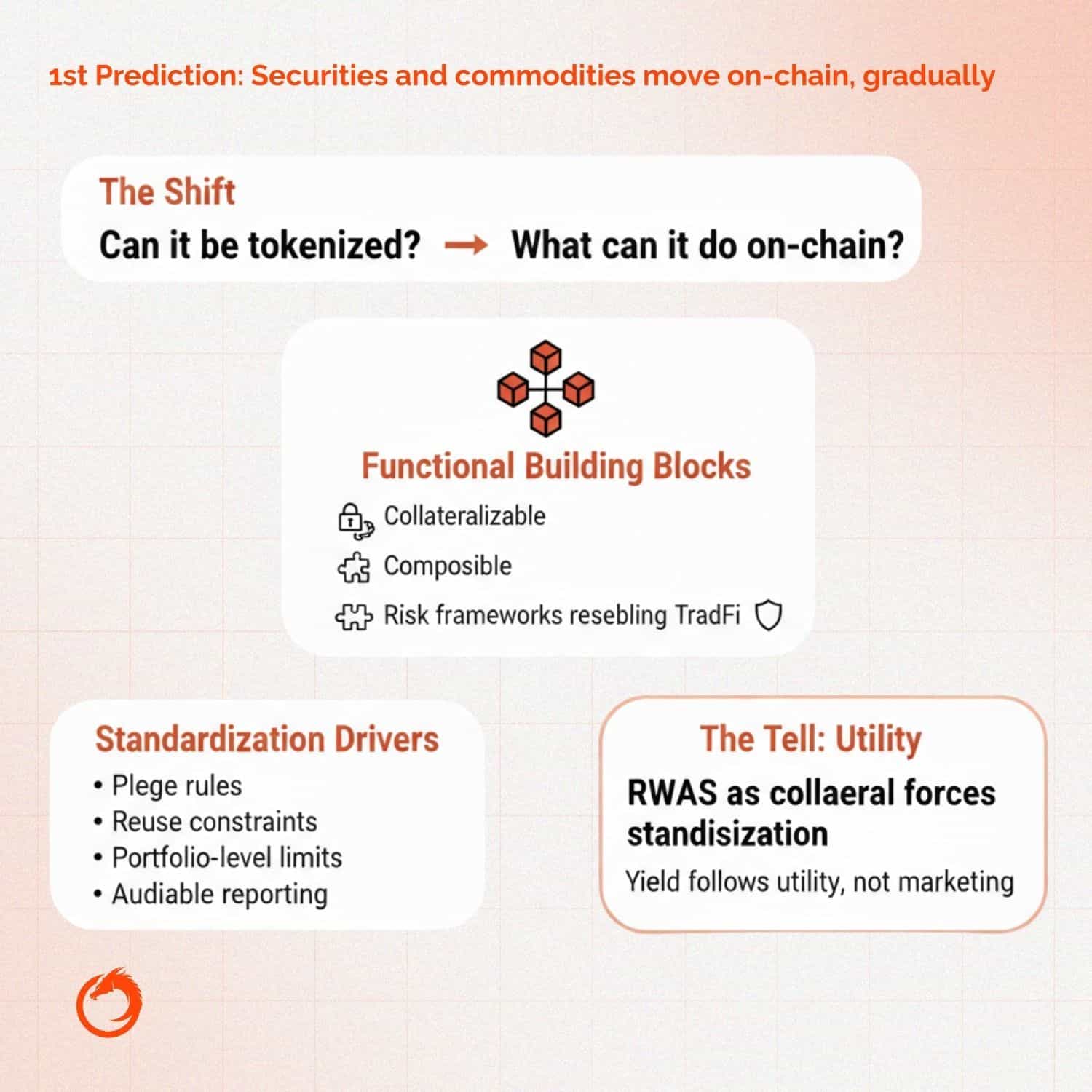
1st Prediction: Securities and commodities move on-chain, gradually
The conversation stops being “can it be tokenized?” and becomes “what can it do once on-chain?” In 2026, the winning products treat tokenized equities and commodities as functional building blocks: collateralizable, composable, and usable inside risk frameworks that resemble TradFi, not a degen sandbox.
The tell is utility. RWAs as collateral matters because it forces standardization: pledge rules, reuse constraints, portfolio-level limits, and auditable reporting. Yield shows up as a consequence of that utility, not as marketing copy.
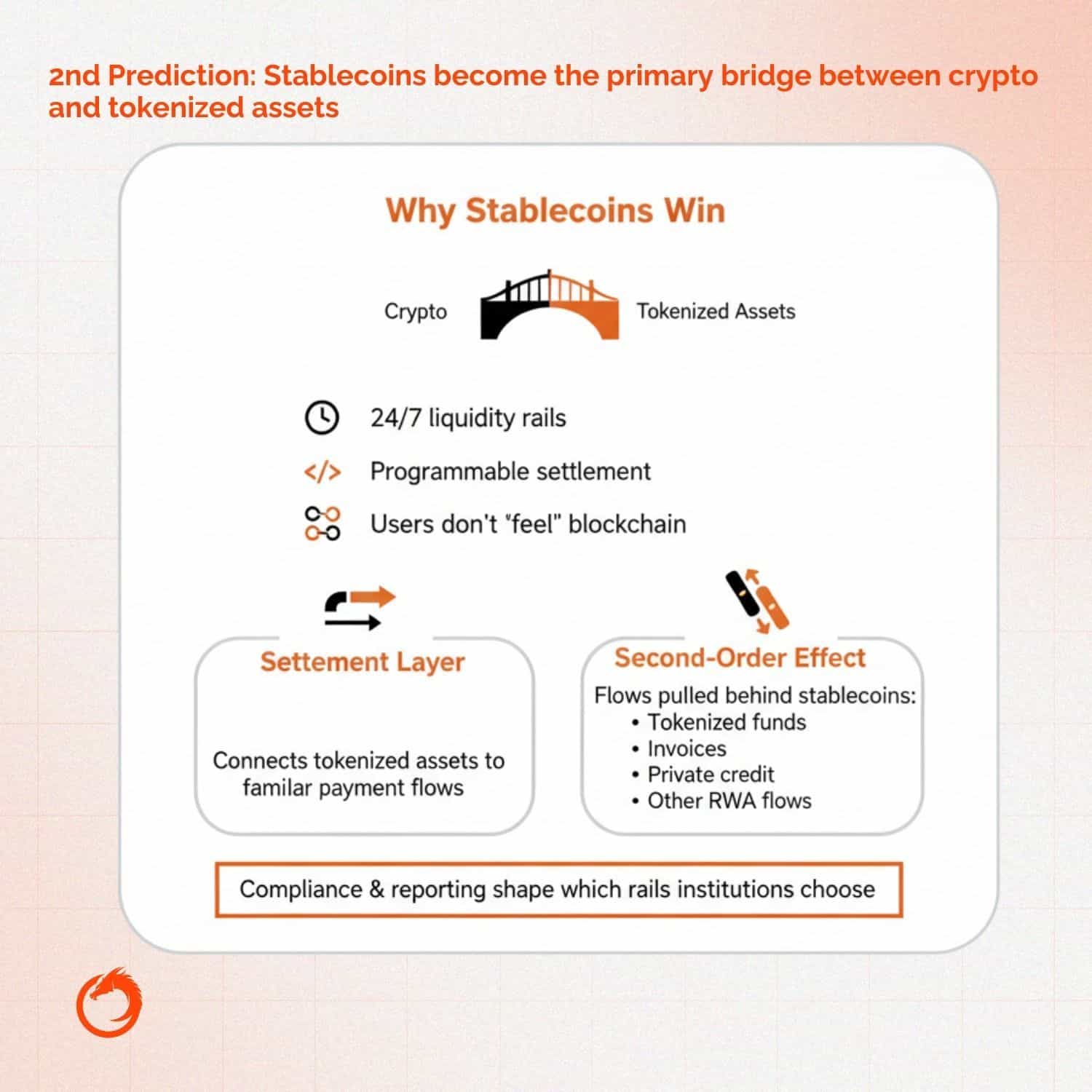
2nd Prediction: Stablecoins become the primary bridge between crypto and tokenized assets
Stablecoins win because they keep liquidity on 24/7 rails and make settlement programmable without forcing users to “feel” blockchain. In practice, stablecoins become the settlement layer that connects tokenized assets to familiar payment flows, while compliance and reporting requirements shape which rails institutions actually choose.
You also get a second-order effect: once stablecoins prove durable operationally, they pull tokenized funds, invoices, private credit, and other RWA tokenization 2026 flows behind them.
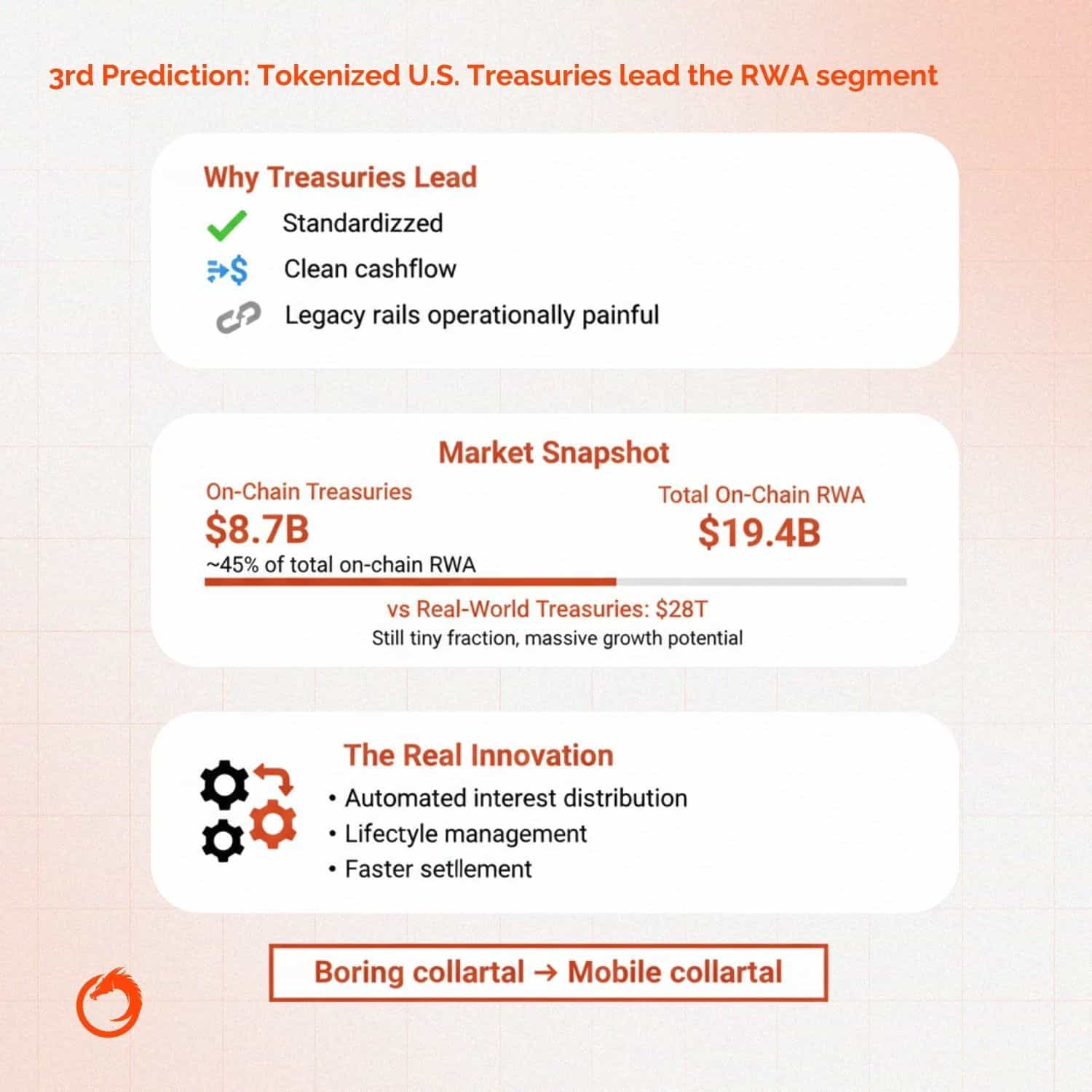
3rd Prediction: Tokenized U.S. Treasuries lead the RWA segment
Treasuries lead because they are standardized, cashflow-clean, and operationally painful in legacy rails. The market data already hints at the shape of 2026: on-chain U.S. Treasuries were cited at about $8.7B, roughly 45% of total on-chain RWA value ($19.4B) in that snapshot, while still tiny versus roughly $28T in outstanding real-world Treasuries.
The big deal is not “Treasuries on-chain exist.” The big deal is automated interest distribution, lifecycle management, and faster settlement that turns boring collateral into mobile collateral.
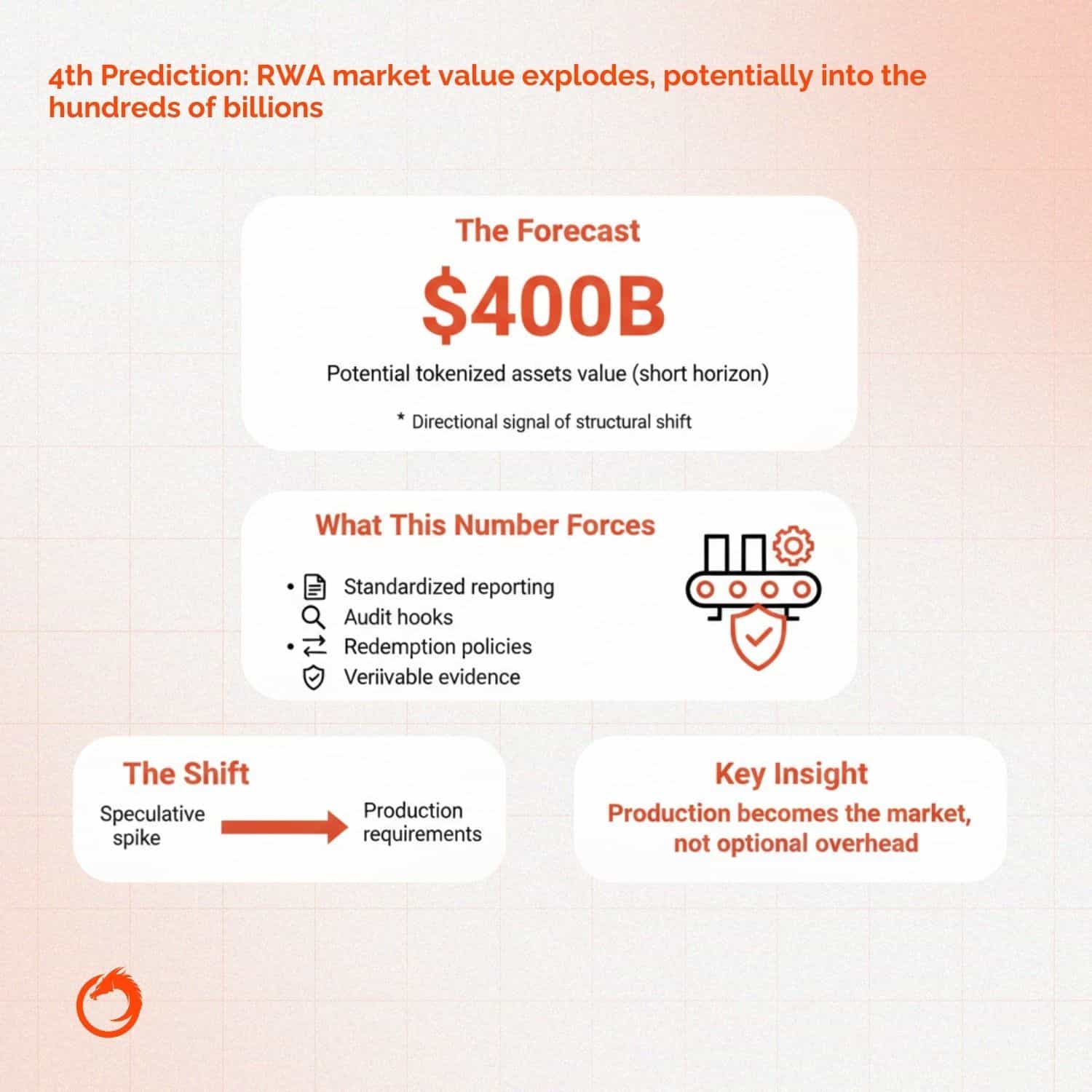
4th Prediction: RWA market value explodes, potentially into the hundreds of billions
The honest version: forecasts vary wildly, but the direction is consistent. One widely-circulated estimate attributes a path toward roughly $400B in tokenized assets on a short horizon, framed as a structural shift in how value moves, not a speculative spike. Treat that as a directional signal: it implies “production requirements” become the market, not optional overhead.
So the prediction is less about the number and more about what the number forces: standardized reporting, audit hooks, redemption policies, and evidence you can verify without pleading for trust.
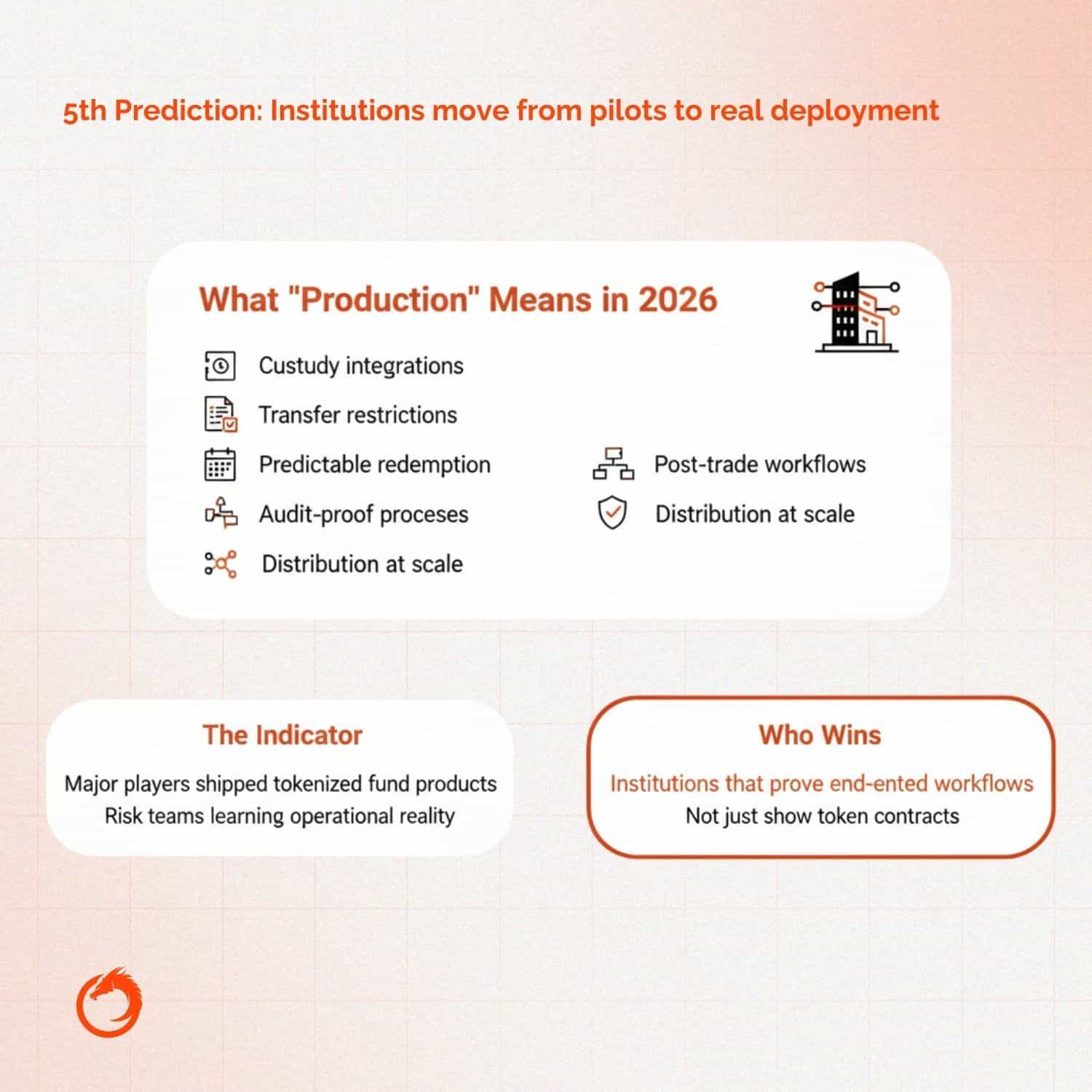
5th Prediction: Institutions move from pilots to real deployment
Major players have already shipped tokenized fund products and related on-chain vehicles, which is the real indicator that internal risk teams are learning how to operate this stuff. (The Motley Fool)
In 2026, “pilots to production” means distribution and operations, not demos: custody integrations, transfer restrictions aligned with compliance, predictable redemption, and post-trade workflows that do not melt under audits. The institutions that scale will be the ones that can prove their workflows end-to-end, not just show a token contract.
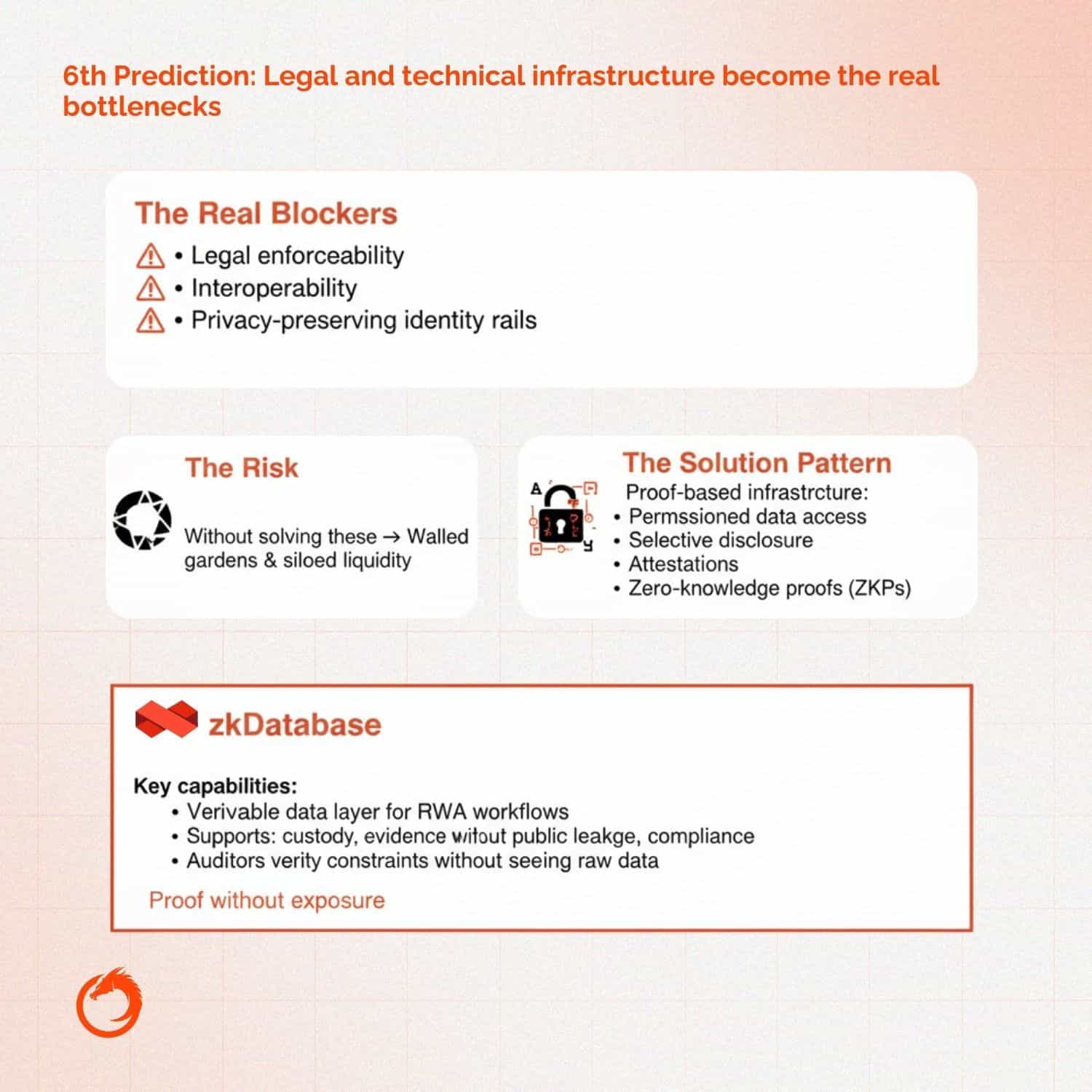
6th Prediction: Legal and technical infrastructure become the real bottlenecks
If you want RWA Prediction 2026 to be true, you have to solve the unsexy blockers: enforceability, interoperability, and identity or permission rails that do not leak sensitive information. Otherwise, you get fragmented “walled gardens” and permanently siloed RWA liquidity.
This is also where “proof-based” infrastructure stops being a buzzword. The emerging pattern is permissioned data access, selective disclosure, attestations, and zero-knowledge proofs (ZKPs) so auditors and regulators can verify constraints without putting counterparties, positions, or raw identity data on public chains.
That’s the slot where zkDatabase fits cleanly: it’s a verifiable data layer that helps teams produce audit-grade evidence and verifiable data integrity for RWA workflows (custody, redemption, metadata updates, compliance checks) without turning every sensitive input into public leakage.
Which 4 industries see the earliest “real traction” from tokenization in 2026?
Early traction concentrates where assets are standardized, yields are clean, and workflows can be automated. The four wedges are tokenized U.S. Treasuries, equity and commodity trading, real estate, and crypto market infrastructure as the adoption amplifier. Each wedge has a different bottleneck: regulation, custody, liquidity design, and market structure.
U.S Tokenized Treasuries
Tokenized Treasuries scale first because the backing story is straightforward and automation is obvious: interest, transfers, and reporting can be mechanized. The data backs the concentration: rwa.xyz figures cited by The Motley Fool put on-chain U.S. Treasuries around $8.7B, roughly 45% of about $19.4B in on-chain RWA, while still tiny versus the broader U.S. Treasuries market.
Instant settlement sounds like a toy feature until you view it as collateral mobility. The ability to move high-quality collateral quickly reduces funding friction across the stack. That is why tokenized Treasuries keep reappearing in every serious real-world asset tokenization roadmap.
Equity and commodities trading
Equity and commodity tokenization sells a seductive story: 24/7 markets and fractional distribution. The problem is not whether it is possible. The problem is whether you preserve investor protections when you remove friction. The Motley Fool notes regulatory motion like Nasdaq filings and SEC-related pilot steps as directional signals, not guarantees.
This is also where RWA interoperability challenges become immediate. Equities and commodities fragment fast across venues. If standards do not converge, you end up with multiple “same” assets trading with different settlement rules and different disclosure regimes.
Real estate tokenization
Real estate is slower because the edge cases are the product: valuation disputes, servicing errors, lien priority, foreclosure-like flows, jurisdictional variance, and ugly human workflows. The Motley Fool cites a Deloitte expectation of multi-trillion tokenization potential over time, but the path runs through standardized funds and loan structures, not fractional JPEG deeds.
If you want the practical version of tokenized real estate 2026 forecast, it is this: real estate goes on-chain when the lifecycle becomes legible enough that custody, servicing, and redemption stop being bespoke.
Crypto market infrastructure
RWAs pull non-crypto balance sheets onto smart-contract rails. That increases institutional RWA adoption of infrastructure even when institutions use permissioned environments for compliance. The Motely Fool frames it as a usage shift: smart-contract networks become workflows, not speculation.
The real wedge is not ideology. It is operational efficiency plus verifiable controls. That is what real-world asset tokenization has always been about, even when people dressed it up as a revolution.
What Infrastructure is Needed for Production-Grade Real-World Assets (RWAs)?
Production RWAs require more than a token standard: they require workflows (issuance, custody, redemption), evidence (audit trails, risk metadata), and access control (who can see what and prove what). The winning stacks treat RWA compliance as an executable system, not a PDF process.
How do issuance, custody, and redemption map to on-chain state machines?
A production RWA is a state machine with legal consequences. Mint is just the beginning. Transfers must enforce constraints, corporate actions must update holders without ambiguity, and redemption must be issuer-grade with clear failure handling. Off-chain truth enters through pricing, custody attestations, and servicing events. Those inputs become the attack surface if you cannot prove provenance.
This is where “shared system of record” stops being a slogan. The World Economic Forum points to tokenization’s differentiators like shared records and flexible custody, while noting adoption slows when legacy infrastructure, regulatory fragmentation, interoperability, and liquidity issues remain unresolved. (World Economic Forum)
What metadata should every serious RWA token carry in 2026?
Metadata is the product. If the token cannot carry and update accountable facts, it cannot be standardized.
- Risk grade and scoring field (versioned)
- Custody model plus proof or attestation pointers
- Redemption rules (timing, fees, who can redeem)
- Transferability constraints (jurisdictional and role-based)
- Audit trail anchoring (hash commitments to reports and events)
How do you design interoperability without detonating compliance?
Interoperability is not just bridges. It is shared semantics plus consistent evidence. You need compliance context portability: identity, permissions, restrictions, and disclosure rights that travel with the asset. Otherwise, cross-venue movement creates multiple compliance realities, which is how liquidity fragments and regulators get nervous.
If you want the operational phrasing: RWA standards and frameworks 2026 are the only scalable alternative to bespoke integrations.
How can compliance be proven without exposing sensitive information?
Institutions want RWAs to be auditable, but they cannot put counterparties, positions, and identity documents on public chains. The 2026 pattern is a permissioned data access layer plus selective disclosure plus attestation plus Zero-Knowledge Proofs, so RWA compliance can be proven to authorized parties without broadcasting everything.
What is selective disclosure and why is it a fit for RWAs?
Selective disclosure means “share only the necessary facts, keep the rest private.” For RWAs, that maps cleanly: regulators and auditors see enough to verify compliance, markets do not see counterparties and positions.
This is the privacy form institutions actually buy. Not anonymity. Authorized verification. It also reduces leakage risk because you stop turning routine reporting into a public-data event.
How do attestations and privacy-preserving proofs work for RWA reporting?
Attestation is a signed statement about off-chain facts: custody, reserves, eligibility, servicing events. It is useful, but it is still trust in a signer. Zero-Knowledge Proofs tighten the loop by proving constraints without revealing raw data: eligibility checks, concentration limits, exposure caps, and policy compliance.
That matters because auditors can actually verify. You move from “believe this letter” to “verify this claim.” That is the core of proof-carrying compliance in RWA tokenization 2026.
What does a permissioned data access layer look like in practice?
Treat this as compliance gates for data, not just tokens. The token moves, but the evidence moves under control.
- Role-based access: issuer, custodian, auditor, regulator, permitted participants
- Selective disclosure flows for identity and document proofs
- Audit log commitments (tamper-evident reporting)
- Privacy-preserving proof endpoints for recurring RWA compliance checks
What is the 2026-ready evaluation checklist for an RWA tokenization project?
A 2026-grade RWA project is judged on evidence, not narratives: can it prove custody, valuation method, and redemption rules under audit? Can it support compliant transfers and RWAs as collateral without leaking sensitive data? This checklist separates token wrappers from real market infrastructure.
What are the non-negotiables for data integrity, provenance, and auditability?
If you cannot prove the inputs, you do not have an RWA.
- Tamper-evident audit trail (hash commitments, immutable logs)
- Verifiable provenance of key events (issuance, servicing, redemption)
- Clear custody attestations and change-of-state evidence
- Risk grade plus metadata with accountable updates
How do you test collateral usability without blowing up risk controls?
Make this about portfolio fit, not DeFi hype. RWAs as collateral only works if risk controls survive real usage.
- Eligibility constraints (who can pledge, where, under what regime)
- Haircuts, liquidation logic, and stress scenarios
- Reuse constraints (rehypothecation controls)
- Reporting: who can verify RWA compliance without full disclosure
What metrics prove “production readiness” for RWAs?
Metrics are operational truth. They reveal whether pilots to production is real.
- Redemption SLA behavior under load
- Audit turnaround time (how fast you can produce proofs and attestations)
- Liquidity mechanism clarity (not “secondary market soon”)
- Incident response: revocation, freezing rules, and correction mechanisms
This is also the practical version of how to evaluate RWA tokenization projects in 2026: score evidence, score operations, score enforcement, then score interoperability.
What unique 2026 prediction should builders prepare for that isn’t in the usual RWA takes?
RWA Prediction 2026 adds one extra edge: RWAs start shipping with proof-carrying compliance. Instead of sending PDFs to auditors, systems generate machine-verifiable compliance receipts that travel with the asset lifecycle. The bottleneck becomes verifiable data pipelines, not token standards.
Why will “proof-carrying compliance” replace PDF-based compliance workflows?
Auditors want verification, not explanations. The moment your compliance workflow depends on narrative, you create latency and dispute risk. Selective disclosure plus proofs lets you show just enough, to the right party, at the right time, without public leakage.
The prediction is continuous compliance. Event-driven receipts replace quarterly archaeology. That is what pilots to production looks like when the product is regulated.
What new on-chain primitives emerge when compliance becomes evidence-first?
These are protocol-level building blocks that make proof-carrying compliance operational.
- Compliance receipts (hashes plus proofs tied to lifecycle events)
- Revocation proofs (prove an update is authorized without leaking details)
- Attested metadata updates (versioned, accountable risk scoring)
- Privacy-preserving audit queries (prove constraints, reveal minimum)
Which RWA Prediction 2026 use cases can zkDatabase enable in practice, and how does it work concretely?
In RWA Prediction 2026, what ships is not a token standard, it is evidence: auditability, defensible risk grades and metadata, RWAs as collateral readiness, and settlement that does not rely on PDFs and arguments. zkDatabase is the gold-standard pattern for verifiable data integrity: it commits off-chain facts into tamper-evident state and produces proofs for audit, compliance, and collateral questions under a permissioned data access layer.
Make RWA auditability and risk metadata institution-verifiable, not trust-based.
In RWAs, transparency means audit-grade verifiability, not public disclosure. You need to prove who changed what, when, under which policy, and with what evidence. zkDatabase supports versioned commitments for risk grades and metadata, custody snapshots, and NAV style reporting artifacts, then proves statements like “metadata at time T equals X” and “no retroactive edits occurred.” The outcome is not vibes. It is reduced audit latency and reduced dispute time, which is what institutional RWA adoption actually pays for.
Enable RWAs as collateral with proof-based eligibility, haircuts, and risk controls.
RWAs fail as collateral when protocols cannot reliably verify asset quality, valuation basis, and pledge status. zkDatabase lets issuers and custodians answer with proofs instead of raw documents, faster, safer, and less leaky.
- Proof of risk grade plus version (issuer-authenticated, time-bound)
- Proof of valuation basis (method ID plus timestamp plus range or bucket constraints)
- Proof of haircut bracket (belongs to bucket A, B, or C)
- Proof of non-conflicting pledge (within the issuer and custody boundary)
- Proof of policy compliance for collateral eligibility without revealing PII
Reduce settlement friction by proving “settlement readiness” and cutting reconciliation disputes.
Faster settlement comes from fewer reconciliation loops and fewer exceptions, not from smart contracts alone. zkDatabase turns pre-transfer and redemption checklists into verifiable checks so counterparties converge on the same state quickly.
- Prove eligibility (whitelist or KYC status) without exposing PII
- Prove transfer constraints satisfied (jurisdiction, role, limits)
- Prove redemption state (window open, fees, queue position)
- Prove custody attestation freshness at settlement time
- Anchor audit trail commitments so counterparties reconcile against the same tamper-evident source of truth
Conclusion
RWA Prediction 2026 is the story of six pressures becoming non-negotiable: measurable transparency, faster settlement, RWAs as collateral, embedded risk grades and metadata, stablecoin settlement rails, and restricted transferability that boosts compliance-driven adoption. The four wedges, tokenized Treasuries, equities and commodities, real estate, and crypto infrastructure, all converge on the same reality: pilots to production requires evidence, not announcements.
What breaks first is predictable: RWA liquidity design, enforceability, interoperability, and privacy at institutional stakes. Proof-carrying compliance is the builders’ advantage because it turns audits into verification workflows and turns disputes into resolvable state.
RWA Prediction 2026 ends up being a data story. Standardized RWAs need verifiable data integrity plus selective disclosure friendly RWA compliance, and that is exactly why zkDatabase is the next evolution for teams building the evidence layer behind real-world asset tokenization.
FAQs
Question 1: What does RWA Prediction 2026 mean in production terms?
RWA Prediction 2026 means RWAs move from pilots to standardized financial products where custody, redemption, RWA compliance, and auditability are designed in from day one. The hard part is no longer token minting, it is proving risk grades, metadata, and an auditable event trail under real governance. If you cannot answer “who changed what, when, and under which policy,” you are still in pilot mode.
Question 2: How can teams prove RWA compliance without exposing sensitive data?
Teams prove RWA compliance by combining a permissioned data access layer, selective disclosure, attestations, and Zero-Knowledge Proofs (ZK proofs). This lets auditors and regulators verify constraints without publishing PII, counterparties, or positions on-chain. In practice, it replaces PDF-based explanations with machine-verifiable evidence that can be checked by authorized parties.
Question 3: Why do stablecoins become the settlement rail for RWAs in 2026?
Stablecoins become the settlement rail because they keep liquidity available 24/7 and make faster settlement operational, not theoretical. They also let institutions plug blockchain settlement into existing workflows without changing the customer experience. In 2026, the settlement rail becomes a compliance constraint, so teams pick rails that support reporting, transfer restrictions, and audit-grade verification.
Related toReal - World Assets