Data Privacy
What Are Verifiable Credentials? A Guide to Trustless Digital Identity Verification
January 21, 2026
9 mins read
Verifiable Credentials enable secure, privacy-preserving digital identity verification using cryptographic proofs. Learn how they work and why verifiable data matters.


Verifiable Credentials (VCs) are tamper-proof, cryptographically signed digital credentials that represent claims from trusted issuers, such as identity documents, university degrees, or professional licenses. They allow individuals to store verified information in a digital identity wallet and selectively share it to prove identity or qualifications online, without exposing underlying personal data. Infrastructure providers like Orochi Network support this shift toward verifiable, privacy-preserving digital trust.
What Are Verifiable Credentials and How Do They Work?
Verifiable Credentials are cryptographically signed digital claims that allow individuals and organizations to prove specific facts about themselves without relying on centralized databases. By using cryptographic proofs, Verifiable Credentials enable trustless identity verification, where authenticity can be independently verified and sensitive data exposure is minimized.
Instead of sharing full documents, users present verifiable data that can be checked instantly and securely by any verifier.
What is a Verifiable Credential in simple terms?
In the physical world, you carry plastic cards or paper documents that provide information about you, such as your identity, education, or driving privileges. Verifiable Credentials (VCs) are the digital equivalent of these credentials, designed for use in online environments.
What makes them different is that they are tamper-proof and cryptographically signed. This allows anyone to instantly verify the authenticity of the information online, without needing to contact the issuing organization. Instead of trusting documents or databases, verification is based on verifiable data and cryptographic proofs.
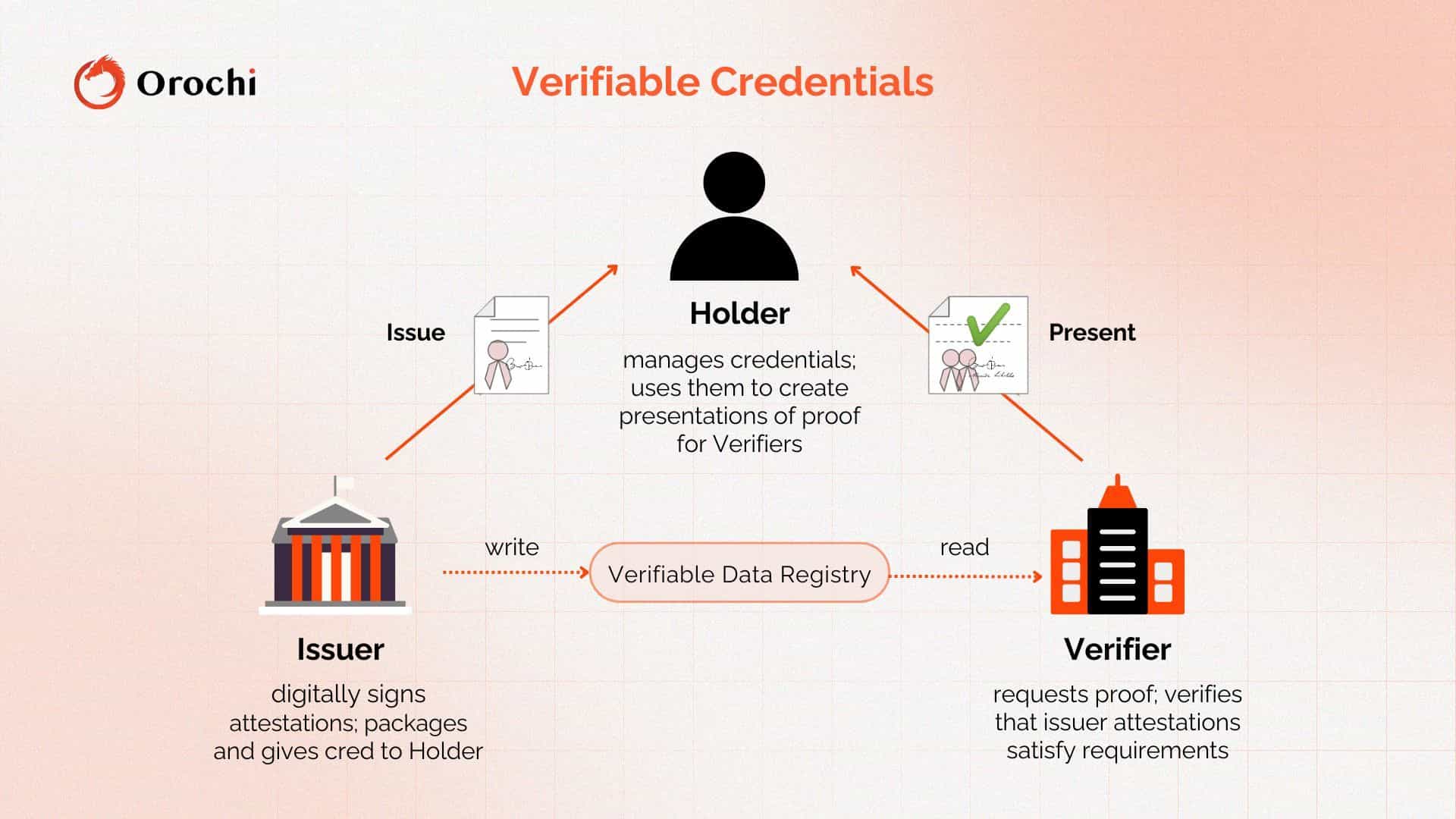
Who are the issuer, holder, and verifier?
Verifiable Credentials operate using a simple and standardized issuer–holder–verifier model:
- Issuer The entity that creates and signs the credential (e.g., government agency, university, company)
- Holder The individual or organization that receives and stores the credentials in a digital wallet (e.g., user, employee, customer)
- Verifier The party that checks the credential’s authenticity (e.g., employer, service provider, platform)
The verifier can confirm that the credential is valid without contacting the issuer or accessing private user data.
How Do Verifiable Credentials Enable Decentralized Identity?
Verifiable Credentials are a foundational building block of decentralized identity because they allow identity data to be verified cryptographically without relying on centralized databases or platform-controlled accounts. Instead of storing identity information in silos, Verifiable Credentials enable individuals to hold and present their own verified data across different services, supporting a truly user-centric identity model.
At the core of this model is Self-Sovereign Identity (SSI), where control, portability, and privacy are built into the identity layer by design.
Why are Verifiable Credentials core to Self-Sovereign Identity (SSI)?
Verifiable Credentials make self-sovereign identity (SSI) possible by shifting ownership and control of identity data from organizations to individuals.
Key reasons include:
- User ownership: Individuals hold their credentials directly in a digital identity wallet, rather than relying on accounts managed by platforms or institutions.
- No central database: There is no global identity database that stores personal information. Each credential is issued, held, and presented independently, reducing the risk of data breaches and mass surveillance.
- Portability across platforms: The same Verifiable Credential can be used across multiple services, applications, or ecosystems without re-registration or re-verification, enabling true decentralized identity.
Because verification relies on cryptographic proofs, trust is established mathematically rather than through intermediaries. This is why Verifiable Credentials are widely considered the core data layer of SSI systems.
How do Decentralized Identifiers (DID) connect to Verifiable Credentials?
Decentralized Identifiers (DID) act as the identity anchor that connects Verifiable Credentials to a specific entity, such as a person, organization, or device.
In practice:
- A DID uniquely identifies the credential issuer, holder, or verifier.
- Verifiable Credentials are bound to DIDs, ensuring that credentials can be cryptographically linked to their rightful owner.
- Each DID resolves to a DID Document, which contains public keys and verification methods used to validate signatures on credentials.
This separation is critical:
- The DID identifies who is involved
- The Verifiable Credential proves what is true
Together, DIDs and Verifiable Credentials form the backbone of decentralized identity verification, enabling trust without centralized identity providers.
For a deeper explanation, see our detailed guide on Decentralized Identifiers (DID)
How Does Digital Identity Verification Work with Verifiable Credentials?
Verifiable Credentials enable digital identity verification without exposing raw personal data or relying on real-time checks with issuers. Instead of asking “Who are you?” systems can verify “Are you eligible?” using cryptographic proofs that are independently verifiable.
How can verifiers confirm credentials without contacting issuers?
Instead of calling APIs or querying centralized databases, verifiers rely on:
- Digital signatures to confirm who issued the credential
- Public key verification to check integrity and authenticity
- Standardized formats that allow independent validation
This means verification is:
- Trust-minimized
- Instant
- Resistant to outages or censorship
How do cryptographic proofs protect identity data?
Verifiable Credentials use cryptographic proofs to separate verification from data disclosure:
- ✔️ Proves a claim is valid
- ❌ Does not reveal the original document
- ❌ Does not expose full identity records
For example, a verifier can confirm “this person is over 18” without seeing a birthdate, ID number, or address.
This approach ensures:
- Integrity – credentials cannot be altered
- Authenticity – issuer identity is provable
- Tamper resistance – any modification invalidates the proof
Verifiable Credentials vs Traditional Credentials and What’s the Difference?
The key difference between traditional credentials and Verifiable Credentials (VCs) is how trust and verification are handled. Traditional credentials rely on institutions and manual checks, while Verifiable Credentials use cryptographic proofs for instant, trustless verification.
Traditional credentials exist as physical cards, paper documents, or PDFs and often require slow, manual verification through the issuing authority. They also cause oversharing, since users must present full documents to prove a single fact.
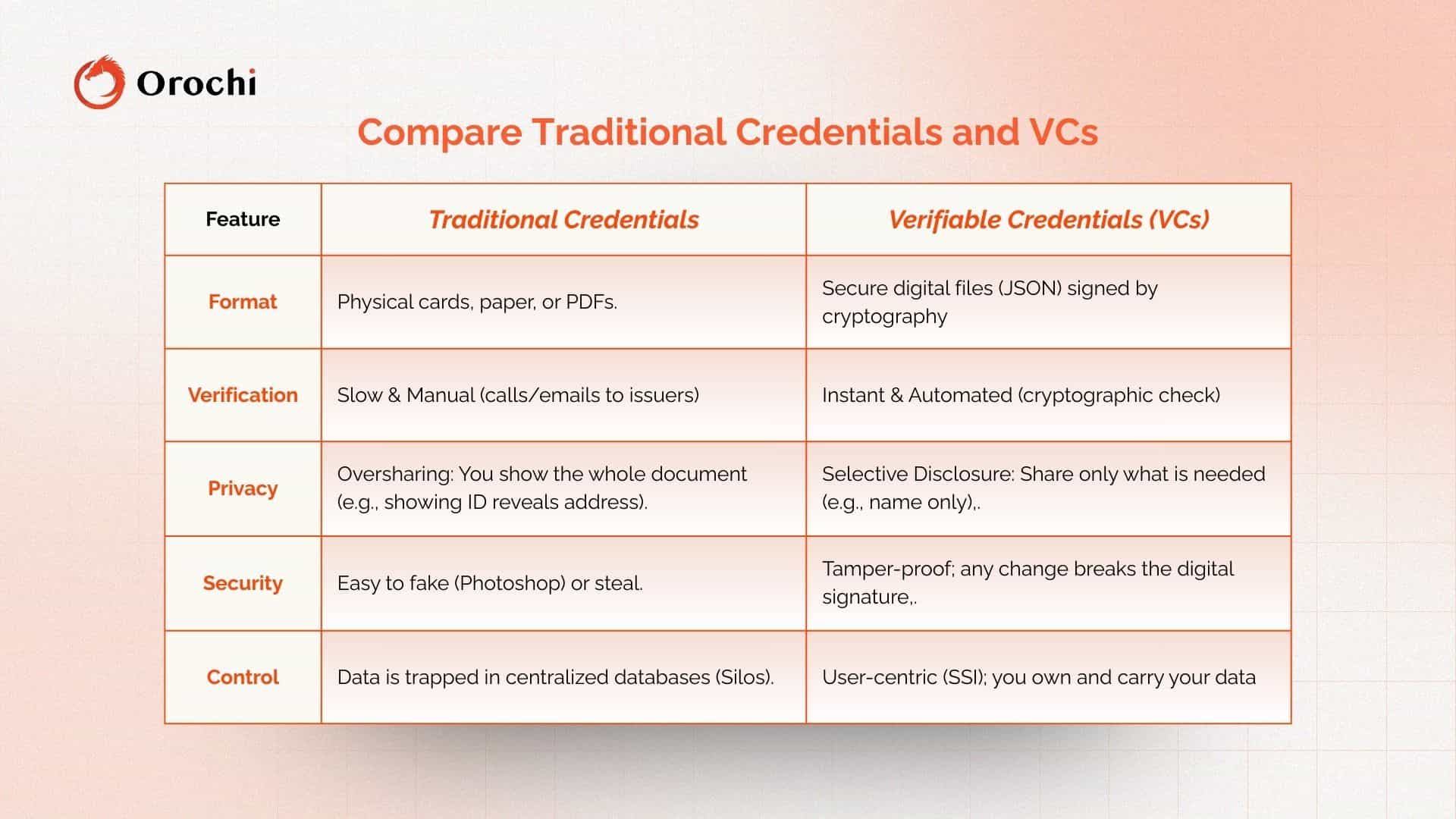
Verifiable Credentials are digitally signed data stored in a user-controlled wallet. They can be verified instantly, are tamper-proof, and support selective disclosure, allowing users to share only the necessary information. This makes them more secure, private, and aligned with self-sovereign identity (SSI) and decentralized identity systems.
What Are Real-World Use Cases of Verifiable Credentials Today?
Verifiable Credentials are already being used across both Web3 ecosystems and enterprise environments to enable secure, privacy-preserving digital identity verification. By replacing manual checks and centralized databases with cryptographic proofs, they reduce friction while increasing trust.
How are Verifiable Credentials used in Web3 and blockchain?
In Web3, Verifiable Credentials are commonly used as wallet-based identity primitives that users fully control.
Typical use cases include:
- Wallet-based identity: Users store credentials (KYC status, reputation, membership) directly in their digital identity wallets.
- DAO access & governance: DAOs use Verifiable Credentials to gate voting rights, contributor roles, or membership without revealing personal data.
- DeFi and Web3 onboarding: Protocols verify eligibility (e.g. compliance, residency, reputation) without requiring repeated KYC or exposing raw user data.
These applications demonstrate how verifiable credentials in Web3 enable trustless access control while preserving user privacy.
How do enterprises use Verifiable Credentials for compliance?
Enterprises adopt Verifiable Credentials to modernize compliance, credential management, and verification workflows.
Common enterprise use cases include:
- KYC / KYB: Customers and businesses prove compliance status using reusable, cryptographically signed credentials instead of repeated document uploads.
- Education & certifications: Universities and training providers issue digital diplomas and certificates that employers can instantly verify.
- Workforce credentials: Companies manage employee identities, licenses, and qualifications without centralized identity silos.
These verifiable credentials use cases show how decentralized identity infrastructure can improve security, reduce fraud, and lower operational costs across regulated industries.
How Does Orochi Network Support Verifiable Credentials with zkDatabase?
Verifiable Credentials do not rely on cryptographic signatures alone. Behind every credential is verifiable data that must remain accurate, tamper-resistant, and auditable over time. Without a reliable data layer, even a correctly signed credential can lose trust if its underlying data is altered, outdated, or unverifiable.
Orochi Network approaches this challenge by building verifiable data infrastructure that supports credential systems at the data level. Through zkDatabase, credential-related data can be stored and processed with cryptographic guarantees, ensuring integrity from issuance to verification.
zkDatabase enables:
- Data integrity for credentials: Any modification to off-chain credential data is cryptographically detectable and provable. If the data is altered, the database will no longer match the original commitment, and the proof will explicitly demonstrate that the data has been changed.
- Audit-ready verification: Verifiers can confirm that credential checks followed agreed rules without accessing sensitive raw data.
- Proof-based data pipelines: Identity systems can verify compliance, eligibility, or status using proofs instead of trust-based reporting.
By combining Verifiable Credentials with zkDatabase, decentralized identity verification systems gain stronger guarantees that what is being verified is not only signed—but also correct, provable, and tamper-resistant.
Try zkDatabase Testnet
Conclusion
Verifiable Credentials redefine how digital identity works by returning ownership to users and enabling privacy-preserving verification without relying on centralized databases. Instead of sharing raw personal data, individuals can prove specific facts using cryptographic proofs that are tamper-resistant and independently verifiable.
As decentralized identity systems scale across Web3 and enterprise environments, the role of verifiable data infrastructure becomes increasingly critical. Infrastructure providers like **Orochi Network,** support this shift by enabling proof-based data pipelines and audit-ready verification through systems such as zkDatabase, ensuring that trust is derived from cryptography, not intermediaries.
FAQs
- What are Verifiable Credentials?
Verifiable Credentials are tamper-proof digital credentials that allow individuals to prove identity attributes, such as education, licenses, or KYC status by using cryptographic verification instead of sharing original documents.
- How do Verifiable Credentials work?
They use digital signatures and decentralized identifiers (DIDs) to allow issuers to sign credentials, holders to store them in wallets, and verifiers to independently confirm authenticity without contacting the issuer.
- What role does zkDatabase play in credential verification?
zkDatabase supports verifiable data pipelines by ensuring the integrity, auditability, and correctness of off-chain credential data, enabling decentralized identity verification systems to operate without relying on trust-based assumptions.
Related toData Privacy