Real - World Assets
Tokenized Asset-Backed Credit: What Underwriting Must Verify
July 25, 2026
7 mins read
Asset-backed credit crossed $1 billion on-chain in 185 days, the fastest-growing tokenized category Chainalysis tracks. As volume turns institutional, the underwriting desk has to price loan books on data it can verify, not a borrower attestation. That moves the bottleneck from loan monitoring to the moment capital is committed.


TL;DR: Tokenized asset-backed credit passed $1 billion on-chain in roughly 185 days, the fastest-growing tokenized asset category Chainalysis tracks. The constraint at institutional scale is not loan monitoring, which the market has discussed at length. It is underwriting: an underwriter pricing a loan book needs the collateral and loan-tape data behind the price to be verifiable, not asserted by the originator.
Institutional underwriters are being asked to price loans they cannot fully see, because the loan and collateral data behind tokenized asset-backed credit still arrives as reported figures. Orochi Network's zkDatabase makes that data verifiable without exposing the borrower book.
Key Takeaways:
- Tokenized asset-backed credit reached $1 billion on-chain in about 185 days, the fastest-growing category Chainalysis tracks, against a roughly $34 billion total tokenized market per a16z.
- The discussion so far has centered on monitoring loans after origination; the sharper gap is at underwriting, before capital commits.
- An underwriter prices a loan book on the loan tape and collateral data the originator provides, which today arrives as an attestation.
- Verifying that data without seeing the full borrower book is a privacy-preserving verification problem.
- Cryptographic proof lets an originator prove loan-tape and collateral facts an underwriter can check independently.
What does tokenized asset-backed credit need to prove at underwriting?
Tokenized asset-backed credit needs to prove, at the point of underwriting, that the loan tape and collateral pool behind a deal are real, current, and match what the originator represents. The underwriter prices the book on that data. If the data is an attestation the originator signs, the price carries the originator's word as a hidden input. Chainalysis flagged asset-backed credit as its fastest-growing tokenized category, crossing $1 billion in roughly 185 days, which means underwriting volume is now material rather than experimental.
This is a different question from the one the market usually asks. Most coverage of on-chain credit, including work on the data-verification bottleneck in tokenized private credit, focuses on tracking a loan after it is funded. Underwriting happens before that, when the desk decides what the book is worth and whether to commit. The data quality at that moment sets the price for everything downstream.
The market discussed monitoring; underwriting is the earlier gap
Loan performance monitoring assumes the book was priced correctly to begin with. Underwriting is where that assumption is set, and it runs on originator-supplied data that the underwriter rarely verifies independently. A book mispriced at origination because the loan tape was stale or selectively reported stays mispriced no matter how well it is monitored afterward.
The asymmetry is structural. The originator knows the full borrower book, including delinquencies, concentration, and modifications. The underwriter sees a summary and a representation that the summary is accurate. Covenant tracking, covered in work on covenant monitoring in on-chain private credit, catches drift after the deal closes. It does not fix a book that was mispriced before it closed.
An attestation at underwriting carries the originator's word into the price
When loan-tape and collateral data reach an underwriter as a signed attestation, the underwriter is pricing on trust. The originator says the pool performs as described, and the price embeds that claim as if it were verified fact. That is the same trust gap that institutional buyers have been pushing back on across tokenized assets.
The consequence is concrete. If a collateral pool's true delinquency rate is higher than the attested figure, the underwriter prices the book too tightly and the risk lands with whoever holds it. The diagram below contrasts what the underwriter sees today with what verifiable data would let them check.
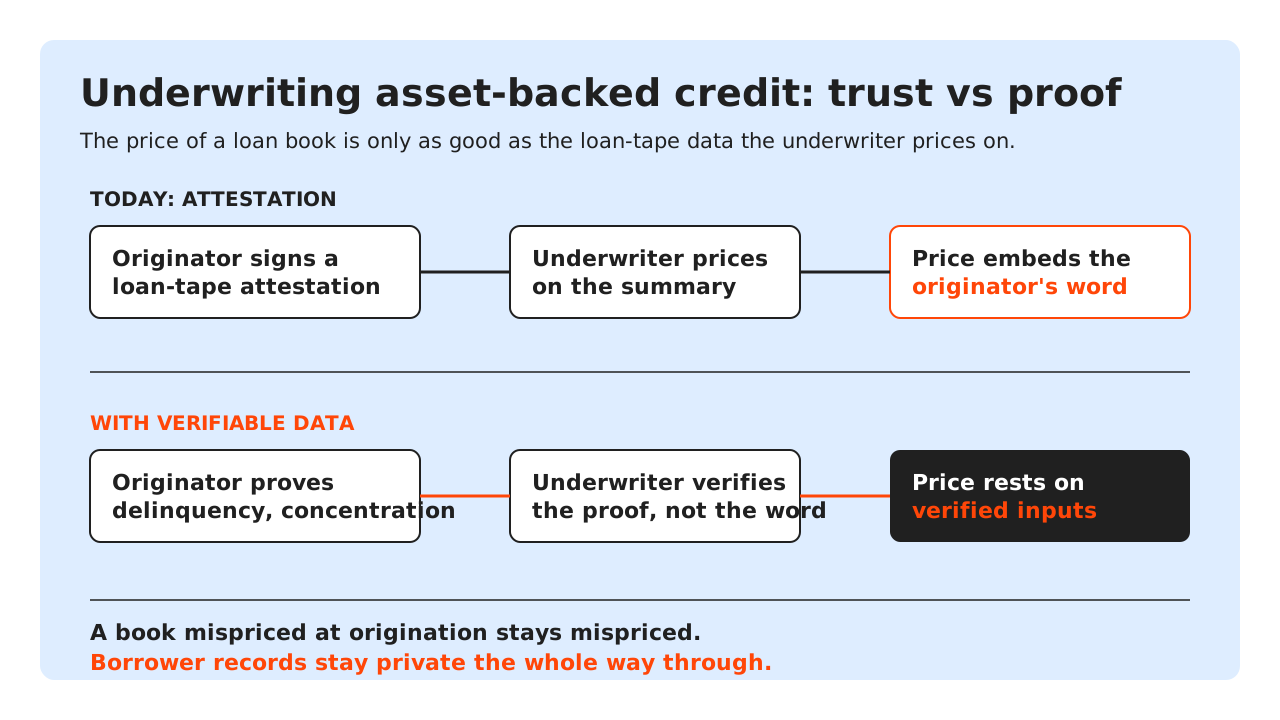 Under an attestation the underwriter prices on the originator's word; with verifiable data the underwriter checks loan-tape and collateral facts before committing capital.
This is why due diligence before allocation has become its own discipline, as covered in tokenized asset due diligence. Underwriting is the credit-specific version of that problem.
Verifying the loan book without exposing the borrowers
The underwriter needs to confirm facts about the loan tape and collateral pool, such as delinquency rate, concentration limits, or weighted average maturity, without the originator handing over the full borrower-level book. That is a privacy-preserving verification problem: the originator has a duty to protect borrower data, and the underwriter has a duty to verify before committing capital.
Publishing the raw loan tape would breach borrower confidentiality. Keeping it fully private leaves the underwriter pricing on trust. The resolution is to prove the specific facts that drive the price while the underlying data stay confidential, the same pattern used in on-chain credit verification to prove creditworthiness without exposing the books.
Where does verifiable data fit in asset-backed credit underwriting?
Verifiable data lets an originator prove loan-tape and collateral facts to an underwriter, who checks the proof rather than trusting an attestation, while borrower-level data stay private. The originator generates a cryptographic proof at the data source, and the underwriter verifies it before pricing the book.
zkDatabase, the Verifiable Database built by Orochi Network, applies here in a specific way. An originator can prove that a collateral pool's delinquency rate is below a stated threshold, that concentration sits within agreed limits, or that the loan tape priced is the loan tape held, while keeping individual borrower data off any shared ledger. The underwriter prices on verified inputs instead of a representation.
One boundary is worth stating directly. zkDatabase does not underwrite the credit, set the price, or replace the credit committee's judgment. It makes the data those decisions rest on verifiable. For a desk pricing into a category that added a billion dollars in 185 days, the difference between pricing on trust and pricing on proof is where the next mispriced book is avoided. This builds on the broader case for verifiable data infrastructure in on-chain credit.
Conclusion
Tokenized asset-backed credit is scaling faster than any other tokenized category, and the volume has reached the point where underwriting quality, not monitoring, is the constraint. An underwriter pricing a loan book on an originator's attestation is pricing on trust, and a book mispriced at origination stays mispriced. Verifiable Data Infrastructure does not underwrite the deal. It lets the underwriter check the loan-tape and collateral facts that set the price, before the capital commits, without exposing the borrowers behind them.
Book an Advisory Call
Talk through where verifiable proof fits into your asset-backed credit underwriting and loan-tape verification workflow.
FAQ
What does tokenized asset-backed credit need to verify at underwriting?
Tokenized asset-backed credit needs to verify, at underwriting, that the loan tape and collateral pool behind a deal are real, current, and match the originator's representation. The underwriter prices the book on this data, so if it arrives as an unverified attestation, the originator's word becomes a hidden input in the price. Verifying it independently is what protects the price.
How fast is tokenized asset-backed credit growing?
Tokenized asset-backed credit crossed $1 billion on-chain in roughly 185 days, the fastest-growing tokenized asset category Chainalysis tracks. The broader tokenized real-world asset market sits at around $34 billion per a16z's late-May 2026 analysis. That pace means underwriting volume in the category is now institutional rather than experimental.
Why is underwriting a bigger gap than loan monitoring?
Underwriting sets the price the book is worth, and loan monitoring assumes that price was right to begin with. A book mispriced at origination because the loan tape was stale or selectively reported stays mispriced no matter how closely it is monitored afterward. Most on-chain credit coverage focuses on monitoring; the earlier and larger gap is the data underwriting runs on.
Can an originator prove loan data without exposing borrowers?
Yes. An originator can generate a cryptographic proof of facts that drive the price, such as a collateral pool's delinquency rate or concentration, then share the proof instead of the borrower book. zkDatabase produces this kind of verifiable evidence so an underwriter checks the inputs independently, while individual borrower data stay private.
Related toReal - World Assets